
The 8 Most Watched Films Adapted from Rabindranath Tagore's Works.
Here is a artical about 8 most watch films adapted from Rabindranath Tagore's work....

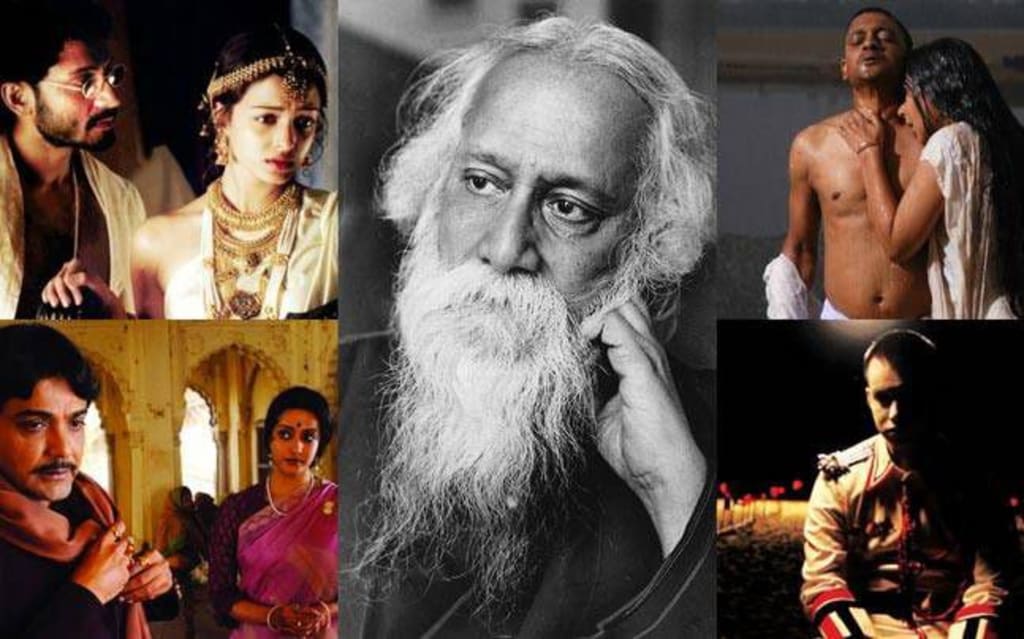
Introduction
Rabindranath Tagore, the Nobel laureate, poet, playwright, musician, and philosopher, is one of the towering figures of Indian and world literature. His multifaceted works have transcended the realm of literature and have been translated into various art forms, including cinema. Generations of filmmakers have been inspired by Tagore's profound comprehension of human emotions, social conflicts, love, and existential questions. His stories, rich in psychological depth and human drama, have been adapted into critically acclaimed and widely watched films in Indian cinema history.
This article explores the 8 most watched and influential films adapted from Tagore’s works, highlighting their cinematic significance, impact, and cultural resonance.
1. Charulata (1964) - Directed by Satyajit Ray
Document of Origin: Based on Tagore’s novella "Nashtanirh" (The Broken Nest).
Overview:
Charulata is often regarded as one of the best Indian films ever made. It is about a housewife in Bengal in the 19th century who meets the sensitive young writer cousin of her husband and experiences her emotional awakening. Why It’s Iconic:
Ray’s nuanced storytelling captures the intricate emotions of Charulata with poetic precision.
Madhabi Mukherjee’s performance is hailed as one of the best female performances in Indian cinema.
Won Silver Bear for Best Director at the Berlin International Film Festival.
Widely regarded as the definitive cinematic adaptation of Tagore’s exploration of loneliness, yearning, and intellectual desire.
Cultural Impact:
Charulata became a landmark film that brought Tagore’s inner worlds to global audiences and became an essential part of Bengali and world cinema.
2. Kabuliwala (1961) - Directed by Hemen Gupta
Source Material:
Adapted from Tagore’s short story "Kabuliwala".
Overview:
Set in Kolkata, the story revolves around the touching friendship between a young girl, Mini, and a fruit seller from Afghanistan, Kabuliwala, who is reminded of his daughter back home.
Why It’s Iconic:
Balraj Sahni’s empathetic portrayal of the Kabuliwala won hearts across India.
The film emphasized universal themes of fatherhood, separation, and human connection.
The song "Aye Mere Pyaare Watan" became an evergreen patriotic song.
Still frequently broadcasted on Indian television during festivals and special days.
Cultural Impact:
It brought to light Tagore’s humanistic approach and made the story a beloved part of Indian popular culture.
3. Ghare Baire (1984) - Directed by Satyajit Ray
Source Material:
based on "The Home and the World" by Tagore. Overview:
Set during the Swadeshi movement, the film depicts the personal and political tensions in a triangular relationship involving Nikhil, his wife Bimala, and the radical nationalist Sandip.
Why It’s Iconic:
The film explores feminist themes and the conflict between personal freedom and political duty.
Swatilekha Chatterjee’s portrayal of Bimala is critically acclaimed.
Nominated for the Palme d'Or at Cannes Film Festival.
Cultural Impact:
It remains a cornerstone film on Tagore’s critique of blind nationalism and continues to be relevant in discussions of freedom and identity.
4. Chokher Bali (2003) - Directed by Rituparno Ghosh
Source Material:
Adapted from Tagore’s novel "Chokher Bali" (A Grain of Sand).
Overview:
An erotic, emotional tale of Binodini, a widow, and her relationships with Mahendra and his wife, Ashalata, against the backdrop of social conventions in colonial Bengal.
Why It’s Iconic:
Aishwarya Rai’s powerful performance broke her glamorous image, earning critical praise.
Rich visual storytelling and period-accurate settings.
Won the National Film Award for Best Feature Film in Bengali.
Cultural Impact:
Revived interest in Tagore’s works among younger generations and showcased the complexities of female desires in Tagore’s writing.
5. Teen Kanya (1961) - Directed by Satyajit Ray
Source Material:
Based on "The Postmaster," "Monihara," and "Samapti," three short stories from Tagore's collection "Teen Kanya" (Three Daughters). Overview:
An anthology film that tells three distinct stories focusing on the lives and struggles of women from different walks of life.
Why It’s Iconic:
Each story reflects Tagore's deep empathy for women and his progressive thoughts on female agency.
Showcases Ray’s mastery of adaptation, blending subtlety with cinematic artistry.
Won National Film Award for Best Feature Film in Bengali.
Cultural Impact:
Teen Kanya remains an essential viewing for those interested in the intersection of cinema and feminist literature.
6. Uphaar (1971) - Directed by Sudhendu Roy
Source Material:
Based on Tagore’s short story "Samapti".
Overview:
A charming romantic drama about a free-spirited girl, Minoo, whose journey into womanhood is intertwined with love and societal expectations.
Why It’s Iconic:
Jaya Bhaduri (now Bachchan) delivered one of her most acclaimed early performances.
Nominated for Best Foreign Language Film at the 45th Academy Awards (though not shortlisted).
Captures the innocence and playfulness of Tagore's writing.
Cultural Impact:
Brought the delicate charm of Tagore’s rural Bengal to Hindi-speaking audiences.
7. Char Adhyay (1997) - Directed by Kumar Shahani
Source Material:
Based on Tagore’s last novel "Char Adhyay" (Four Chapters).
Overview:
Set in the backdrop of India's freedom struggle, the film delves into the emotional and ideological conflicts of its young protagonists, caught between love, duty, and radical politics.
Why It’s Iconic:
An experimental and philosophical film that challenges viewers with its narrative structure.
Shahani's interpretation emphasizes Tagore’s skepticism toward violent nationalism.
Cultural Impact:
Though art-house in nature, it became a cult classic among cinephiles and Tagore enthusiasts.
8. Bioscopewala (2018) - Directed by Deb Medhekar
Source Material:
Reimagined for the present era, "Kabuliwala" by Tagore serves as inspiration. Overview:
In this adaptation, the Kabuliwala is portrayed as a bioscopewala, showing films to children in Kolkata, while the core story of love, loss, and longing remains intact.
Why It’s Iconic:
Brought Tagore’s timeless narrative to the 21st century.
Danny Denzongpa’s touching performance added depth to the familiar tale.
demonstrated that Tagore's humanism still holds true today. Cultural Effects: Praised for its fresh take on a classic, Bioscopewala introduced Tagore’s story to a global audience.
Conclusion
Rabindranath Tagore's literary works have served as an enduring source of inspiration for filmmakers, offering rich, layered narratives that address universal themes of love, loss, freedom, identity, and social conflict. The adaptations discussed above are not only among the most watched but also the most critically acclaimed, reflecting the timelessness of Tagore's vision and the artistic brilliance of the filmmakers who brought his words to life on the silver screen.
These films continue to resonate with audiences worldwide, serving as cinematic gateways to the literary universe of one of India’s greatest minds.
About the Creator
Krypton
Be happy,Be calm,Be Better,Be honest,Be Strong,Be faithful,Be Loving,Life is journey&I am a traveler.
Ray Kroc: The Relentless Visionary Who Built a Global Empire One Hamburger at a Time
Today we look back at a man who proved that ambition has no age limit—someone who didn’t discover his life’s defining purpose until he was well into his fifties. His name was Ray Kroc, and his journey from a restless teenager to the architect of the world’s most successful fast‑food corporation is one of the most remarkable business stories of the 20th century.
By Haroon Pasha7 days ago in Chapters




Comments
There are no comments for this story
Be the first to respond and start the conversation.