
New Technique Makes It Possible to Read Writing on Mummified Remains
Advances in non-invasive imaging are helping researchers uncover hidden texts on embalmed bodies without damaging ancient human remains

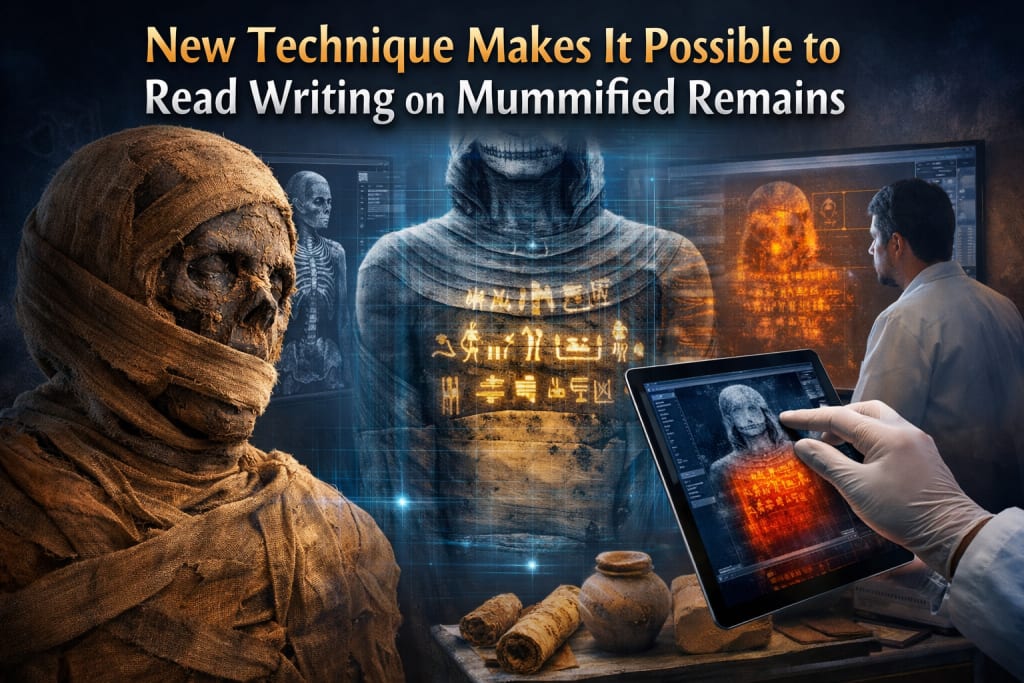
A new scientific technique is opening an extraordinary window into the ancient world: researchers are becoming increasingly able to read writing on mummified or embalmed human remains without unwrapping, scraping, or otherwise damaging them. This breakthrough is significant not only for archaeology, but also for the study of religion, medicine, burial customs, and the everyday lives of past civilizations.
For decades, scholars have known that many mummified remains, especially from ancient Egypt, may contain inscriptions on wrappings, amulets, coffins, cartonnage, and even on the body itself. In some cases, inked markings or texts were hidden beneath layers of resin, linen, or later restorations. Traditional methods of examining such remains often required physical intervention, which posed serious ethical and scientific concerns. Any attempt to remove coverings or clean surfaces risked destroying fragile evidence forever.
The new approach relies on advanced, non-destructive imaging technologies, including high-resolution CT scanning, multispectral imaging, infrared photography, and digital reconstruction software. Together, these tools allow researchers to detect faint traces of pigment, incised signs, and layered text that the naked eye cannot see. Instead of touching the mummy, scientists create a detailed digital model and then enhance subtle differences in texture, density, and reflectance. This can reveal letters, symbols, and patterns previously thought to be lost.
One of the most exciting aspects of the technique is its ability to work through layers of time. Mummified remains are rarely preserved in a simple or clean state. Over centuries, they may have been affected by humidity, handling, fungal growth, smoke, conservation chemicals, or rough excavation methods. In many museum collections, older restoration practices also obscured original details. With digital imaging, researchers can separate visual “noise” from the features that matter. A darkened patch that looks meaningless in ordinary light may, under infrared analysis, turn out to contain ritual markings or part of a funerary inscription.
This matters because writing associated with mummified remains can be deeply informative. In ancient Egypt, texts placed on or around the dead were not decorative extras. They were often believed to guide, protect, or transform the deceased in the afterlife. Names, titles, prayers, invocations to gods, and excerpts from funerary literature could all appear in burial contexts. Even a few deciphered words can help identify a person’s social status, family connection, profession, or religious role. In some instances, such writing may also clarify when a mummy was prepared and how burial practices evolved across different dynasties.
Beyond Egypt, the technique may also benefit the study of other preserved human remains around the world. Embalmed bodies from South America, Asia, and Europe sometimes bear wrappings, tattoos, labels, or ritual materials that are difficult to study safely. Non-invasive reading methods could help specialists investigate these remains with greater respect and fewer risks. This is especially important at a time when museums and universities are under growing pressure to treat human remains ethically, consult descendant communities, and avoid destructive analysis whenever possible.
The development also reflects a broader shift in archaeology: the move from excavation-centered discovery to data-centered discovery. In the past, major findings often depended on physically opening objects or burial chambers. Today, a sealed artifact can still yield a great deal of information through scanning and digital interpretation. This does not make traditional archaeology obsolete, but it does change the balance between preservation and access. A mummy that once seemed visually unreadable may now be studied repeatedly by teams across the world using shared digital files instead of repeated handling.
There are, of course, limitations. Imaging does not magically recover every lost word. Some inscriptions are too faded, too deeply covered, or too damaged to interpret with confidence. Digital enhancement can also introduce ambiguity, and scholars must be careful not to “see” patterns that are not truly there. The best results usually come when imaging specialists, conservators, linguists, and archaeologists work together to test interpretations and compare them with known scripts and burial conventions.
Even so, the potential is enormous. Museums hold thousands of mummified remains and associated burial materials that have never been fully studied. Many were catalogued generations ago under less rigorous standards, meaning that hidden texts may still wait unnoticed in storage rooms and archives. With improved imaging and artificial intelligence-assisted pattern analysis, researchers may soon be able to identify and read inscriptions at a scale that was impossible before.
In the end, the importance of this breakthrough lies in its sensitivity. It allows the dead to be studied without being harmed, and it recovers voices from the past without tearing apart the material that preserved them. Science, in this case, is not only revealing ancient writing. It is redefining how knowledge can be gained—carefully, respectfully, and with far greater precision than ever before.
About the Creator
Irshad Abbasi
Ali ibn Abi Talib (RA) said 📚
“Knowledge is better than wealth, because knowledge protects you, while you have to protect wealth.
Keep reading
More stories from Irshad Abbasi and writers in Chapters and other communities.
When Justice Is for Sale
In any democratic society, three pillars are expected to uphold justice and accountability: an independent judiciary, honest political leadership, and a free press. When these pillars function properly, they create a system of checks and balances that protects citizens from abuse of power. But when the courts become bribed, rulers turn corrupt, and pressure mounts against journalists, democracy itself begins to weaken. The relationship between these institutions can determine whether a nation moves toward justice or slides into authoritarianism.
By Irshad Abbasi a day ago in Chapters
The Cave Part 6
If you have ever heard a tale about yourself that you cannot remember and doubtless think is made up, you will know how I felt when Tharkin related all that the eagle had seen of me before my memories were scattered. Of far distances and traveling companions that I did not recall, camping out under the stars and making our way to the mountains with deliberate purpose. The great bird had lost contact with my party once we entered the forests, and the seven other members were not seen again by him or his brethren since.
By Jamye Sharp27 days ago in Chapters
Little apple of death
I arrive at the meeting and stand to attention in front of the holographic display module. The room is creamy white and brightly lit. There is a communion ball suspended from the ceiling. Once the door I entered closes, it instantly conceals within its structure. The walls appear soft and padded, but on closer inspection they are in fact spongy, constructed from a white fungal material.
By N J Delmas5 days ago in Chapters
Thief In The Night
To the thief in the night that took and replicated what once was mine: Honestly, I feel kind of bad for you. It’s funny, because we hardly know each other. I only know of you through the magazines you’ve written and the broadcasts you have televised in the past — as well as through the public mentions of you from your show business connections there.
By Snarky Lisa7 days ago in Humans



Comments
There are no comments for this story
Be the first to respond and start the conversation.