
Negotiations between Pakistan and Afghanistan and Russia's threat to Pakistan
Russia Denies Deepfake Video of Putin Threatening Pakistan Amid Afghanistan Negotiations

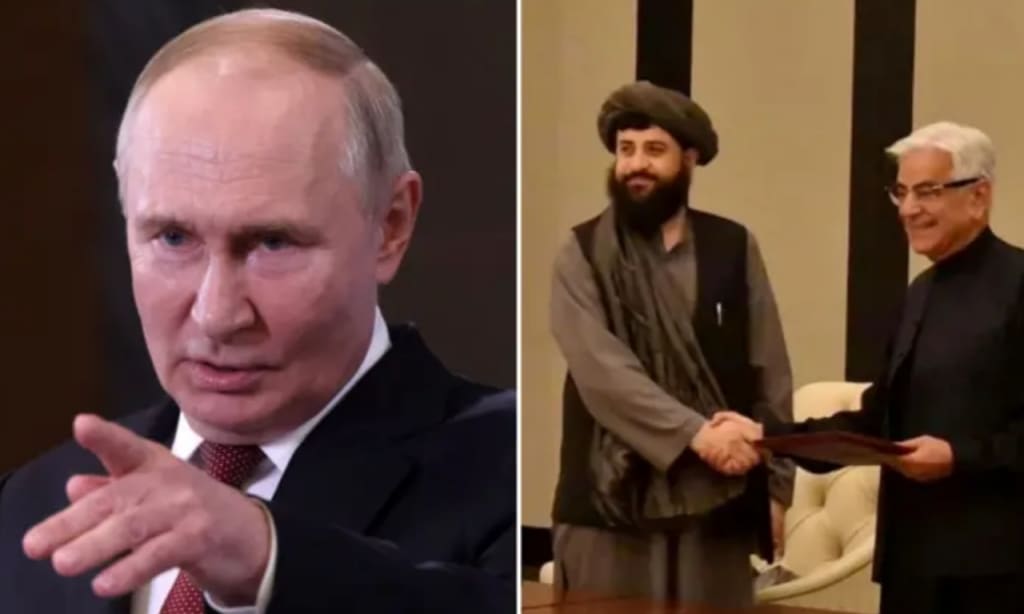
between Pakstan and Afghanistan and Russia's threat to Pakistan
The Russian embassy in Pakistan has declared a video attributed to Russian President Vladimir Putin—purportedly threatening Pakistan—to be fake, stating that the clip is actually part of the president’s remarks to the media in which Pakistan was not mentioned.
A video showing the Russian president allegedly threatening Pakistan in the context of Pakistan–Afghanistan tensions had been circulating on social media for several days.
The deepfake clip purportedly shows the Russian president saying, “Pakistan should refrain from any aggression against Afghanistan.”
In the fake video, the Russian president is shown warning that if Afghanistan is attacked, the response will not come only from Kabul.
The video also falsely portrays the Russian president offering full support to the Afghan Taliban and promising assistance to help them counter any external threat.
After the video went viral and was shared by several prominent accounts—causing concern—the Russian embassy in Islamabad has now declared it fake.
Russian Embassy’s Clarification
In a statement issued on Thursday, the Russian embassy said, “A video is currently circulating on social media claiming that Russia’s President Vladimir Putin threatened Pakistan in the context of tensions between Pakistan and Afghanistan. This video is entirely fake.”
The explanatory statement said that the clip is from President Vladimir Putin’s media remarks on October 23, 2025, following a meeting of the Board of Trustees of the Russian Geographical Society, where he answered various general questions. In the original remarks, he mentioned neither Pakistan nor Afghanistan.
The Russian embassy’s statement further clarified: “We want to make it clear that Russia supports a political and diplomatic resolution of differences between Pakistan and Afghanistan. Russia supports the continuation of constructive dialogue between the two countries and the strengthening of meaningful cooperation on counterterrorism and regional security issues.
Social Media Reaction
Social media users in Pakistan also expressed surprise over the fake video of the Russian president.
Recently, Pakistan–Russia relations have improved, and the leaders of the two countries have met warmly at various international forums.
But the fake video of President Putin generated diverse comments on social media.
Reacting to the Russian embassy’s statement, a user named Naveed Babar wrote that he had suspected the video was fake because Russia could never support a group like the Afghan Taliban.
A user named Hadiya posted that the fake video appeared to be circulated from accounts based in Afghanistan.
Faisal Ansari commented that the video was an attempt to widen distances between two states, which the Russian embassy has thwarted.
Akmal Bhatti wrote that given the region’s politics and geography, the Russian president could never have made such a statement.
What Has Russia’s Position Been in the Pakistan–Afghanistan Dispute?
Earlier this month, Russia expressed concern about the tensions and border clashes between Pakistan and Afghanistan and urged the parties to exercise restraint.
Russia welcomed the temporary ceasefire agreement reached between the parties after talks in Doha.
The Russian Foreign Ministry said it welcomed the ceasefire agreement mediated by Qatari and Turkish authorities.
Historically, Pakistan–Russia relations were cool because of Russia’s closeness to India, but in recent years the two countries have grown closer.
Pakistan has appreciated Russia’s balanced regional foreign policy, a view expressed by Pakistan’s Prime Minister Shehbaz Sharif during his meeting with President Putin at the Shanghai Cooperation Organization (SCO) summit last month.
At that meeting, Putin called Pakistan a traditional partner, spoke of increasing trade and cooperation at the United Nations Security Council, and invited Prime Minister Sharif to visit Moscow.
Prime Minister Sharif noted that last year bilateral trade increased due to oil imports from Russia.
He also pointed out that numerous delegation exchanges have taken place and that new agreements were made in sectors such as agriculture, steel, and transport—particularly on the Belarus–Pakistan corridor.
What Is a Deepfake?
In simple terms, deepfake technology allows one person’s face and voice to be superimposed onto another person’s face and voice.
Many people wonder whether this is the same as using Photoshop or other editing software. The answer is no.
With tools like Photoshop, we typically edit a single image ourselves. Deepfake technology, however, uses artificial intelligence.
When someone makes a deepfake of Michael Jackson, for example, the software trains on a large set of images and videos of Jackson. The deepfake program examines the facial movements and expressions from those materials.
The software does not only replace someone’s face with Jackson’s; it also makes the subject’s facial movements and expressions resemble those of Jackson.
About the Creator
Keep reading
More stories from Real content and writers in Chapters and other communities.
Pakistan-Afghanistan Ceasefire: Torkham Border Reopening Likely as Trade Losses Mount
Pakistan-Afghanistan Ceasefire: Torkham Border Reopening Likely as Trade Losses MountThe positive effects of the ceasefire following tensions between Pakistan and Afghanistan have begun to emerge. There is a strong possibility that the Torkham border, closed for ten days, will reopen soon. According to sources, Islamabad and Kabul have reached a principled agreement on reopening the border crossing, after which customs staff have been instructed to immediately return to the Torkham terminal.
By Real content4 months ago in Chapters
Valentine's Dates Over the Years
Colin grinned as Brooklyn slipped into the living room. “Is it all set?” he asked. The twenty-one year old grinned. She was in her last year of college and Colin knew that Lincoln was proud of her. Although she had been away at college, she’d eagerly helped Colin plan his surprise for Lincoln. “I’m so glad you’re finally doing this,” she said.
By Reb Kreyling16 days ago in Chapters



Comments
There are no comments for this story
Be the first to respond and start the conversation.