
Lots of Steel and Gold.
Excess

THE RINGS
They arrived on the Moon on a Tuesday, because Tuesdays were cheaper.
The brochure called it low season, though the concourse at Shackleton Arc felt crowded enough—honeymooners in pressed suits, retirees floating their luggage behind them like obedient pets, a school group staring too long at the ceiling where the Earth hung, blue and indecently alive.
Elena and Marcus were getting married on Friday.
That mattered, mostly to them.
The clerk at Customs smiled when she saw the license packet.
“Congratulations,” she said, stamping the document. “You’ll want Level Three for rings. Or Four, if you like heavier metals.”
“Heavier?” Marcus asked.
The clerk laughed. “You’ll see.”
The jewelry district occupied an entire crescent of the Arc. Shops without doors, just open bays, light spilling over velvet trays and glass rails. Gold everywhere. Not plated. Not thin. Actual gold chain piled in loose coils like rope. Platinum set in slabs, machined into shapes that would have been museum pieces back on Earth.
Elena stopped walking.
“They can’t be real,” she said.
The vendor nearest them—an old man with a respirator mask slung around his neck—raised an eyebrow.
“Of course they’re real,” he said. “You think we’d bother with fake up here?”
He gestured past them, toward the freight windows. Beyond the thick glass, a procession of cargo slugs drifted in slow arcs, their bellies dull and scratched.
“Amun shipments,” the vendor said casually. “Couple hundred tons a week. Sometimes more.”
Marcus picked up a ring.
It was heavy. Warm, somehow, even through the glove lining. The inside was stamped with a serial number so long it wrapped around twice.
“How much?” Marcus asked.
The vendor shrugged. “That one? Equivalent of four dinners back home. Maybe three, if you eat well.”
Elena put it down too quickly.
On Earth, her mother’s ring had been insured. Locked away. Taken out only for anniversaries and photographs. A thing discussed in hushed tones.
Here, it was just… inventory.
They bought three sets of bands.
One simple. One ornate. One they didn’t really like but couldn’t justify not buying, because it was beautiful and cost less than a taxi ride.
The receipt was printed on thick paper, the kind that didn’t tear easily.
“Plenty of choice,” the vendor said. “That’s the point, really.”
“The point of what?” Elena asked.
He smiled, but didn’t answer.
The dress came from Level Five.
Elena hadn’t planned to buy it on the Moon. That had been an impulse—walking past a window where fabric floated instead of hung, the threads catching the light in ways that made her stop breathing.
The tailor was precise and soft-spoken.
“Gold filament,” she said, indicating the weave. “Platinum too, for structure. It photographs better under vacuum lighting.”
Elena ran her fingers over the sleeve.
“It must be expensive,” she said.
The tailor tilted her head, considering. “Expensive where?”
They paid less than they’d budgeted for alterations back home.
That night, in their hotel room, Marcus lined the rings up on the table.
Three gold. Three platinum. Beautiful gold chains, just because.
“I don’t know how I feel about this,” he said.
Elena sat on the bed, the dress folded beside her like something asleep.
“About what?”
“About it not meaning as much,” he said. “If it’s everywhere.”
She picked up one of the bands, rolled it between her fingers.
“Does it mean less,” she asked, “or are we just not supposed to have this much of it?”
He didn’t answer.
Outside the window, another cargo slug latched onto the Arc, metal kissing metal with a sound you could feel through the floor.
They were married under the dome.
Earth hung overhead, impossibly far away. The officiant spoke the words carefully, as if each one had been weighed. Guests clapped. Someone cried.
When Marcus slid the ring onto Elena’s finger, it fit perfectly.
When Elena did the same, the band caught the light and threw it back, bright and unashamed.
Applause echoed. Cameras flashed.
Nothing went wrong.
On the way back to Earth, Elena watched the Moon recede.
“So,” Marcus said, “do you think it’s strange?”
“What?”
“That gold doesn’t matter anymore.”
Elena turned the ring on her finger.
“No,” she said. “I think it means something else now.”
“Like what?”
She looked at the shrinking gray disk, at the industrial scars just visible along its edge.
“I think,” she said slowly, “that precious was always a lie we told ourselves. And now we can’t tell it anymore.”
The shuttle engines burned.
Behind them, the Moon kept exporting forever.
SOUVENIRS
They had been married forty-two years when they went to the Moon.
Ruth said it was for the experience. Harold said it was because their grandchildren wouldn’t believe them otherwise.
They wore matching gravity shoes and moved carefully through Shackleton Arc, pausing often—not from the lower pull, but from habit. On Earth, things were already beginning to feel breakable.
The first shop sold chains.
Gold chains hung in loops thick as thumbs, thin as fishing line, some braided so intricately Ruth thought of lace. None were locked away. None were watched closely.
Ruth lifted one with a small cross.
“Real?” she asked, though she already knew.
The clerk nodded. “Cast yesterday.”
Harold picked up a Star of David from the neighboring tray. Then a crescent. Then something older—an eye, stylized and worn smooth by design.
“People buy faith up here,” the clerk said. “They like the weight of it.”
They bought three chains. Four symbols. One they didn’t recognize but felt rude not to include.
The charm bracelet came next.
It was heavy enough that Ruth laughed when she lifted it.
“Look at this,” she said. “I could hurt someone.”
Each charm was gold. Not plated. Not hollow.
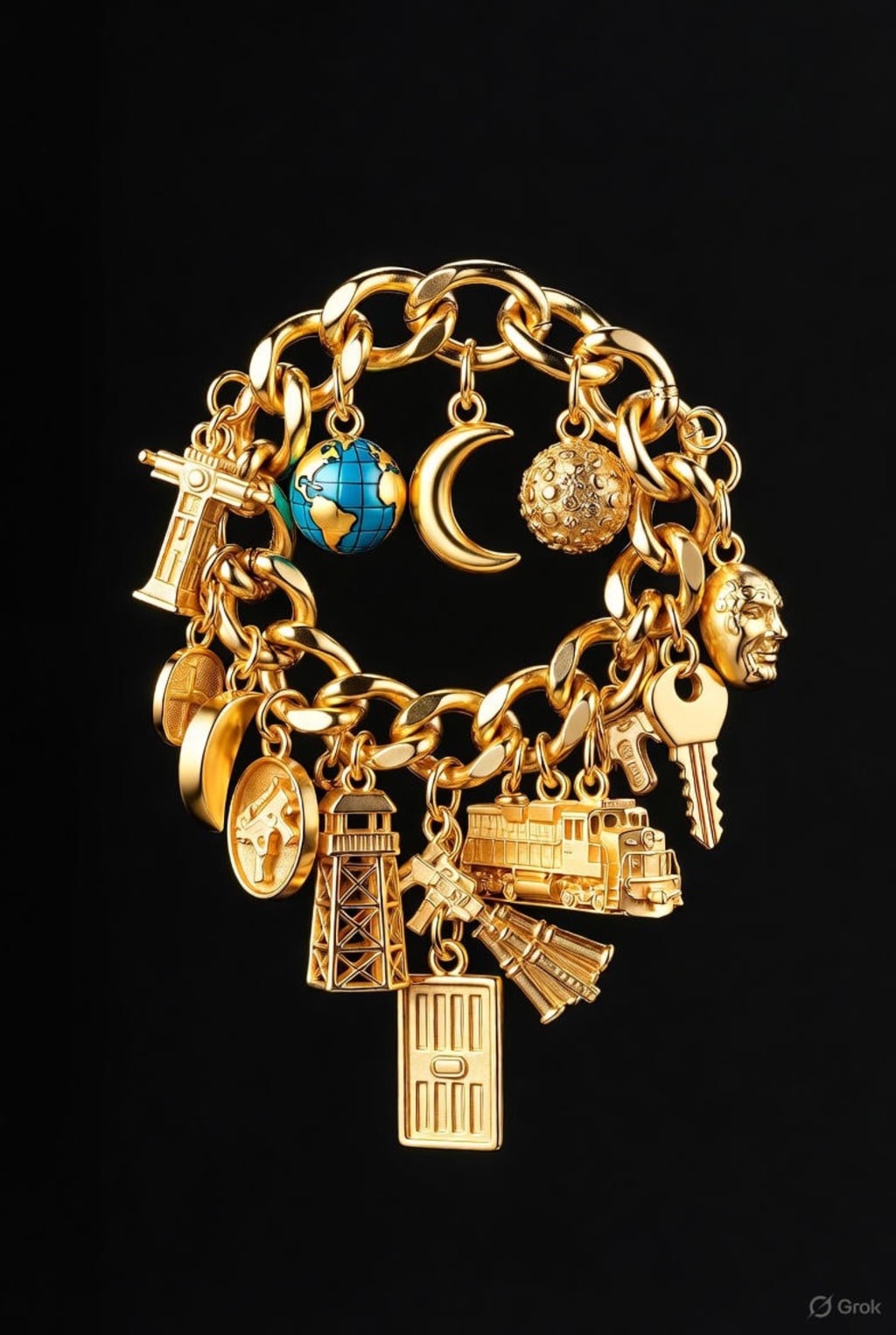
A tiny Earth. A crescent Moon. A freight slug. A dreadnought at sea. A border tower with its guns folded. A trade coin that vibrated faintly when you touched it. A book. A key. A door.
“You add as you go,” the clerk said. “Some people fill the whole arm.”
Ruth chose twelve charms. Harold insisted on paying for fifteen.
“For later,” he said.
They wandered into a quiet gallery that smelled faintly of alcohol and polish.
Crystal.
Heavy-cut wine glasses sat in rows, their stems thick and faceted. Whiskey tumblers looked like they could survive a fall onto concrete.
A decanter stood alone, round-bellied and proud.
The glass shimmered faintly red.
Ruth leaned closer. “Is that… color?”
“Gold-doped crystal,” the guide said. “Colloidal suspension. Old trick, really. Ruby glass. We just don’t ration the gold anymore.”
Harold whistled softly.
“So the gold is in it,” he said.
“Yes,” the guide replied. “It changes how the light behaves.”
They bought a full set. Wine. Whiskey. Water. The decanter. Extra stoppers.
“People like to drink from something that reminds them what’s inside matters,” the guide said.
The platinum hall was colder.
Brochures lay on a table, each page edged in a dull white sheen.
“Actual platinum foil,” Ruth said, surprised.
“For longevity,” the attendant replied. “Ink fades. Paper decays. This doesn’t.”
Harold flipped through one. Diagrams of the Arc. Of the Moon. Of the shipments from Amun. Of processes simplified almost to lies.
They took two.
Then necklaces. Platinum links, dense and understated. One with a smooth bar engraved with coordinates Harold didn’t recognize.
“Pilgrimage marker,” the attendant said. “Somewhere people can’t go anymore.”
They bought one anyway.
At the men’s outfitter, Harold lingered.
Gold cufflinks sat in shallow bowls.
Simple knots. Small discs. Ones shaped like old coins from countries that didn’t exist anymore. One pair bore the outline of Europe as it used to be.
“These are popular,” the clerk said. “Nostalgia pieces.”
Harold chose the map.
“They’ll look nice at funerals,” he said, not unkindly.
By the end of the day, they had bought:
• Gold chains and symbols
• A charm bracelet heavy with memory
• Platinum necklaces and brochures
• Gold cufflinks
• Cut crystal glassware infused with gold
• Gold-threaded napkins, because Ruth liked the way they caught the light
• A gold-edged mirror that didn’t tarnish
• A child’s rattle made of gold and soft polymer “for someday”
• A paperweight shaped like the Moon, solid gold, impractical and perfect
They shipped it all home in one crate.
The clerk sealed it without ceremony.
“Anything else?” she asked.
Ruth thought for a moment.
“What do people forget to buy?” she asked.
The clerk smiled, just a little.
“Time,” she said. “But we don’t sell that yet.”
That night, in their hotel room, Ruth removed her rings and laid them beside the charm bracelet.
“So much gold,” she said. “I grew up thinking this was what you saved for.”
Harold sat beside her.
“Maybe that was the problem,” he said. “We saved the wrong thing.”
Outside the window, the Moon kept shining—not precious, not rare, just there.
And somewhere deep beneath them, machines turned asteroid rubble into souvenirs.
THE FLAGGED ORDER
Marla’s station overlooked the northern concourse of Shackleton Arc. She sat behind a desk that could have held a freight slug and still had room for her tea. Piles of forms with: addresses, weights, coordinates, serial numbers. Steel. Gold. Platinum. Glass. Orders arrived faster than she could breathe.
Most were routine. Flatware by the crate. Cut crystal for every family member. Gold-threaded linens. Steel shelving units. Another wine set, another whiskey decanter. The Moon never slept, but Earth’s houses slowly drowned in delivery.
Then came this one.
The address looked normal: 14 Valhalla Street, Eastern Ridge, Settlement Twelve. The household: the Andersens. Retirees. Quiet people. One dog. But the order…
• Steel structural beams, 12 units, reinforced
• Bulkhead door, rated for vacuum containment
• Gold-edged mirrors, 8
• Crystal decanters, 16
• Platinum brochures, 12
• Charm bracelets, 24, with preloaded charms
• Cufflinks, 36 pairs
Ordinarily, quantity alone didn’t bother her. She’d seen villas built entirely from mail-order steel. She’d processed orders where crystal sets weighed more than a car. But something about this one…
Her red pen hovered over the flag box.
She checked the coordinates against the MI logs. No anomalies. No restricted zones. The Andersens had never caused a problem. No previous flags.
Her gut said pause.
She zoomed out on the building footprint. Every house in Eastern Ridge had expanded quietly over the decades. New wings, reinforced foundations, invisible staircases, attic storage for orders no one could possibly use. Steel beams doubled, tripled, quadrupled for no apparent reason. The town looked normal on paper. On the ground, it groaned under its own weight.
The Andersens’ house was… different. The footprint alone was modest, but the orders suggested something impossible: the interior would now rival a small commercial complex.
Marla flagged it. She had to attach a note.
“Excessive structural reinforcement. Household size incompatible with requested materials. Recommend review by MI audit.”
Her hand shook slightly as she submitted it.
A day latter it appeared on the checklist.
“Acknowledged. Audit scheduled. Keep observer discretion. No interference pending physical inspection.”
That meant someone would walk through the house, every door, every beam, every crystal glass, every gold edge. Someone would see… too much.
She leaned back in her chair. Around her, the concourse continued its monotone hum: orders processed, cargo slugs wheeling past, automated cranes stacking crates like miniature skyscrapers.
And here, in this sea of abundance, the Andersens’ home had already crossed a line she couldn’t name.
She sipped her tea. It tasted metallic.
Because steel and gold and platinum never left a human entirely unmarked.
Somewhere in that house, something heavier than material waited.
Something the MI hadn’t accounted for.
Something that even mail-order clerks could sense.
About the Creator
Mark Stigers
One year after my birth sputnik was launched, making me a space child. I did a hitch in the Navy as a electronics tech. I worked for Hughes Aircraft Company for quite a while. I currently live in the Saguaro forest in Tucson Arizona
Keep reading
More stories from Mark Stigers and writers in Chapters and other communities.
Top tipple tricks
Been thinking a lot about drinking, lately. Not least because of a recent episode of over-indulgence and the inevitable after effects. Some readers may recall the earlier articles I wrote about beating the booze. Here I set out an experiment in techniques for cutting down on my alcohol intake. The experiment was successful, the techniques worked, and I have armed myself with an arsenal of weapons in the war against the demon drink. I have yet to fire the first round however. It's all a question of timing (perhaps procrastination).
By Raymond G. Taylor4 days ago in Psyche




Comments
There are no comments for this story
Be the first to respond and start the conversation.