

TRANSCRIPT EXCERPT
JOINT SESSION: STEWARD MI & ROYAL SOLAR SCIENCE SOCIETY
SUBJECT: Amun Near-Earth Object Sampling Proposal
CLASSIFICATION: OPEN / TECHNICAL
LOCATION: Steward Hall, Lower Chamber
DATE: Recorded
CHAIR (Dr. Eliza Morcant, Royal Solar Science Society):
Thank you for receiving us. The Society proposes a limited probe mission to Near-Earth Object Amun. The purpose is strictly scientific—composition analysis of primordial solar system material. The probe would electromagnetically attach, collect subsurface samples, and eject them on a controlled trajectory to the Moon for analysis.
MI OBSERVER 1 (Director Hale):
You intend to return samples to the Moon rather than Earth?
Dr. Morcant:
Yes. Lunar vacuum laboratories eliminate atmospheric contamination. It is the cleanest possible chain of custody.
MI OBSERVER 2 (Analyst Verne):
And the probe remains attached for how long?
Dr. Morcant:
Indefinitely, if feasible. Continuous sampling improves statistical confidence.
MI OBSERVER 2:
So the probe is permanent.
Dr. Morcant:
Functionally, yes.
(A brief pause. Papers shuffle.)
The Question
MI OBSERVER 3 (Steward Industrial Liaison):
May I ask a clarifying question?
Dr. Morcant:
Of course.
MI OBSERVER 3:
If the probe is capable of electromagnetic attachment…
If it can separate metallic from non-metallic material…
If it can compact that material into ejectable mass…
Then what distinction are you drawing between a sample and a resource?
Dr. Morcant:
Scale. Intent. Ethics.
MI OBSERVER 3:
Quantity is not an ethical category.
The Pivot
MI OBSERVER 1:
Your proposal assumes throwing grams is acceptable, but tonnes are not.
Dr. Morcant:
We are not proposing industrial exploitation.
MI OBSERVER 2:
No. You are proposing infrastructure.
(Silence.)
MI OBSERVER 2 (continuing):
Once a permanent unit is clamped to Amun, the difference between research and extraction becomes a scheduling decision.
Scientific Objections
Dr. Morcant:
Mining would alter the asteroid’s structure, rotation—
MI OBSERVER 1:
So would repeated sampling.
Dr. Morcant:
—introduce geopolitical instability—
MI OBSERVER 3:
Amun already alters markets by existing.
The MI Frame
MI OBSERVER 2:
Let us restate your proposal in neutral terms:
• A metallic body not bound to Earth’s gravity
• A permanent processing unit attached
• Material ejected toward the Moon
• No atmospheric reentry
• No terrestrial customs
MI OBSERVER 1:
This is not exploration. This is supply chain discovery.
The Moon Enters the Room
Dr. Morcant:
We have no facilities to process bulk material.
MI OBSERVER 3:
The Moon does.
Dr. Morcant:
The Moon has laboratories.
MI OBSERVER 3:
It has solar furnaces, ice-derived oxygen, and excess vacuum.
(A longer pause.)
MI OBSERVER 1:
If iron reaches the Moon, it will be used. If it is not used, it will be stored. If it is stored, it will be counted.
The Unavoidable Logic
Dr. Morcant:
You are proposing industrialization.
MI OBSERVER 2:
We are proposing continuity.
MI OBSERVER 2 (after a beat):
Your probe answers the question “What is Amun made of?”
Mining answers the question “What is it for?”
Closing Statements
Dr. Morcant:
The Society cannot endorse extraction.
MI OBSERVER 1:
We are not asking you to.
MI OBSERVER 3:
Only to attach the probe.
Final Record Note (Entered by Steward MI)
“Once attached, the object becomes part of the system.
Systems optimize themselves.”
Therefore, the Moon did not build a cannon.
It built a motor.
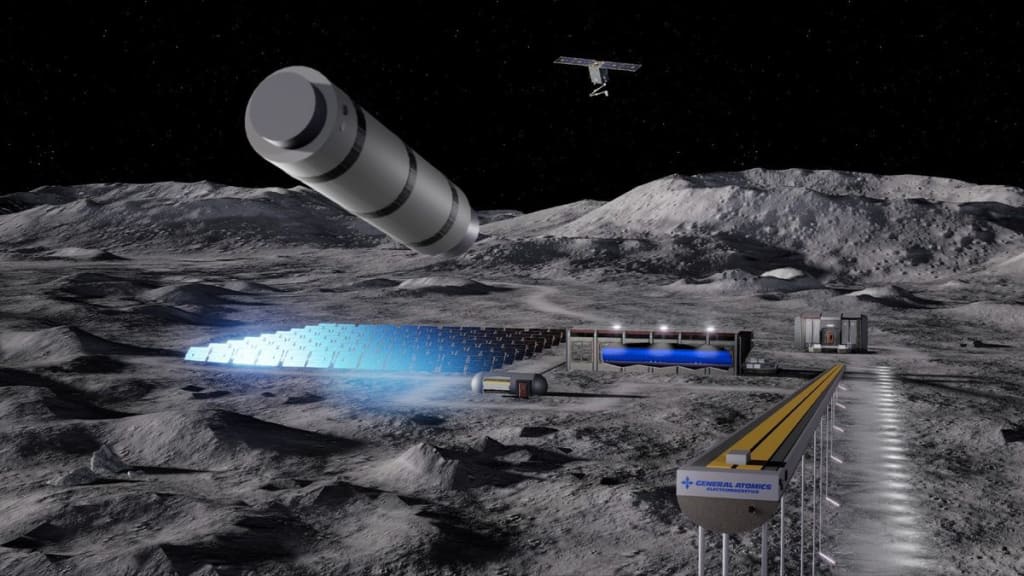
The first prototypes were assembled in Shackleton shadow, where oxygen slept in ice older than oceans. Engineers cast the fuel grain in long, ribbed cylinders—carbon drawn from trapped volatiles, reinforced with iron threads that remembered being an asteroid.
Unlike a solid rocket, the grain would not burn unless fed.
Oxygen flowed across its surface in measured streams.
More oxygen, more thrust.
Less oxygen, silence.
The MI signed off immediately.
“This is not propulsion,” one analyst wrote.
“This is braking.”
The public documents agreed. The motor existed to correct errors—to slow slugs that arrived too fast, to nudge trajectories away from Earth, to make accidents statistically smaller.
No one objected to safety.
During the first full test, the motor burned for nine seconds.
It shut down cleanly.
Someone quietly recalculated what nine seconds meant at lunar escape velocity and did not share the result.
SCENE — THE MINER ON AMUN
The miner did not land.
It clamped.
Electromagnetic pads bloomed against Amun’s surface, sinking their fields deep into the nickel-iron body. There was no dust cloud, no impact flare. The asteroid accepted the grip without complaint, its slow rotation registering as a gentle torque correction in the miner’s gyros.
Tendrils extended.
They were not drills. They did not cut. They vibrated, setting the loose rubble shivering until grains parted from cohesion and drifted free. Silicates floated outward, pale and useless, nudged aside by electrostatic fields. Metal answered the call.
Iron fragments slid inward along invisible gradients, clicking softly as they met, aligning themselves by habit older than planets.
Inside the miner’s core, the material passed through eddy rings and thermal veins. Nothing melted. Heat was rationed. Entropy was discouraged. The metal was pressed, sintered, coaxed into density.
The slug took shape slowly.
It was no larger than a ground vehicle’s engine block. Dense. Balanced. Its surface patterned with shallow grooves to encourage ablation if it ever met atmosphere—an unnecessary precaution, but one that made the paperwork easier.
When it was complete, the miner paused.
Amun’s rotation had brought the Moon into alignment, a distant gray coin hanging in the black. The target zone was not visible, but it did not need to be. The vectors had been solved years ago.
The miner adjusted its grip, bled off a fraction of angular momentum, and released.
The slug drifted for a heartbeat, then departed—no flame, no sound, only a slow, deliberate fall toward somewhere that had already prepared to receive it.
The miner retracted its tendrils.
Around it, the rubble settled, closing the small absence where mass had been persuaded to leave.
The asteroid continued its orbit, lighter by a margin too small to notice.
The miner moved a couple meters and began rooting again.
SCENE — LUNAR INTAKE
The slug arrived without flame.
From the surface of the Moon it appeared as a brief white line against black, a correction burn flickering once before silence returned. The hybrid motor cut cleanly, exactly as designed. The trajectory settled.
Impact came as a dull, spreading shock that rippled through the regolith instead of shattering it.
The slug struck four meters from the center marker.
No alarms sounded.
Dust rose, slow and lazy, arcing in perfect silence before falling back into the basin. The ingot lay half-buried, its surface blackened where the skin had flash-heated and cooled again.
A pause followed—not for safety, but for confirmation.
Green lights appeared along the perimeter.
The spider drones came out.
They moved low and wide on jointed legs, their bodies compact and purposeful. Diamond-edged cutters unfolded and bit into the metal with precise, economical strokes. No sparks. No hurry. The ingot was sectioned along pre-modeled stress lines, each cut placed to preserve grain structure.
Chunks were lifted, tagged, and stacked.
As the outer iron layers were peeled away, veins of brighter material emerged—yellow flashes, pale silvers, unfamiliar sheens. The drones adjusted automatically, diverting those pieces onto separate sleds without comment.
Gold.
Platinum.
Trace rares, catalogued by spectrum before they were fully exposed.
Nothing was wasted.
The iron-rich sections were hauled toward the furnace trenches, where mirrors were already tilting to greet the Sun. The others went the opposite direction, toward sealed processing bays cut deep into shadowed rock.
Oxygen bled off from nearby ice stacks, hissing softly into waiting tanks. Carbon feeds adjusted. The system balanced itself.
Within hours, the slug had ceased to exist.
In its place were billets of lunar steel cooling in vacuum, spools of precious metal locked and counted, and an entry in the ledger marked INTAKE NOMINAL.
The target field was brushed smooth.
Markers were reset.
The Moon waited for the next one.
APPENDIX — MATERIAL FLOW (EXCERPT)
STEWARD LUNAR INDUSTRIAL AUTHORITY
FACILITY: Shackleton Intake Field
PERIOD: Initial Operations (Redacted)
Intake Mass (kg) Impact Error (m) Recovery Time Status
001 1,820 4.0 6h 12m NOMINAL
002 1,815 3.6 6h 01m NOMINAL
003 1,822 3.2 5h 58m NOMINAL
004 1,819 2.9 5h 41m NOMINAL
005 1,817 2.4 5h 33m NOMINAL
COMPOSITION AVERAGES
• Iron-Nickel Matrix: 93.41%
• Carbon (bound & free): 0.62%
• Gold: 0.0041%
• Platinum Group Metals: 0.013%
• Rare Earth Traces: 0.087%
• Loss to Ablation: 0.19%
Variance trending downward.
OUTPUT — LUNAR STEEL
• Billets Cast: 112
• Average Purity: 99.997%
• Grain Length (mean): ↑
• Structural Rejects: 0
OXYGEN PRODUCTION (BYPRODUCT)
• Extracted: 14,320 kg
• Stored: 9,880 kg
• Allocated (Propulsion / Life Support): 4,440 kg
ENERGY BALANCE
• Solar Furnace Utilization: 41%
• Excess Capacity: ↑
• Thermal Loss: ↓
TRAJECTORY CORRECTIONS
• Hybrid Motor Firings: 2
• Mean Burn Duration: 7.4 s
• Emergency Cutoffs: 0
SYSTEM NOTE (AUTO-GENERATED)
Throughput may be safely increased.
Current margins exceed modeled requirements.
AUTHORIZATION STATUS
• Scientific Oversight: ACTIVE
• Industrial Classification: PROVISIONAL
• Review Trigger: NOT MET
FINAL ENTRY
INTAKE STATUS: CONTINUOUS
SYSTEM STATE: STABLE
About the Creator
Mark Stigers
One year after my birth sputnik was launched, making me a space child. I did a hitch in the Navy as a electronics tech. I worked for Hughes Aircraft Company for quite a while. I currently live in the Saguaro forest in Tucson Arizona
Keep reading
More stories from Mark Stigers and writers in Chapters and other communities.
Valentine's Dates Over the Years
Colin grinned as Brooklyn slipped into the living room. “Is it all set?” he asked. The twenty-one year old grinned. She was in her last year of college and Colin knew that Lincoln was proud of her. Although she had been away at college, she’d eagerly helped Colin plan his surprise for Lincoln. “I’m so glad you’re finally doing this,” she said.
By Reb Kreyling16 days ago in Chapters


Comments
There are no comments for this story
Be the first to respond and start the conversation.