
Land Beyond Borders
Indigenous Perspectives and the Struggle for Plurinational Nationhood in Indonesia

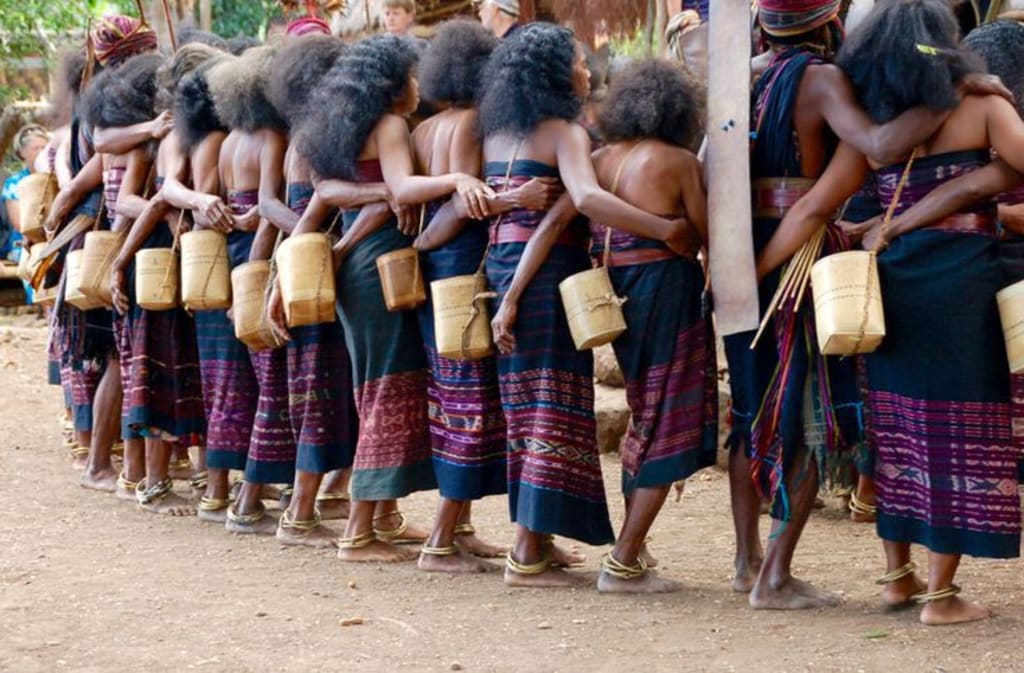
Land is a complex entity that transcends mere geographical definition or economic commodity. In the context of indigenous communities, land is a living space with profound spiritual, cultural, historical, and ecological dimensions. Comprehensive research by anthropologists and indigenous studies experts like Bonita Lawrence and Aslak Antti-Oksnanen opens a critical understanding of how land shapes identity, collective memory, and patriotism within a plurinational nationalist framework.
Bonita Lawrence, in her in-depth study "Real" Indians and Others: Mixed-Blood Urban Native Peoples and Indigenous Nationhood (2004), argues that land cannot be separated from indigenous identity. The concept of "land as life" that she elaborates goes beyond conventional views of land ownership. Land is a living entity with a dialogic relationship with the communities inhabiting it, not just an object to be traded or exploited.
Aslak Antti-Oksnanen, in his comparative research on indigenous communities in the Arctic region, further strengthens this argument. Through an ethnographic approach, he demonstrates how traditional knowledge systems form complex ecological relationships with their territories. The concept of "land memory" he develops explains how intergenerational knowledge is recorded in landscapes, cultural practices, and indigenous belief systems.
The plurinational nationalism they propose presents a transformative perspective in understanding nationhood. Unlike conventional centralistic and uniform nationalism, this approach emphasizes diversity as a fundamental strength. Plurinational nationalism does not merely demand tolerance but substantive recognition of diverse worldviews, knowledge systems, and territorial relationships.
In this context, land is no longer understood as an administrative territory that can be mechanically managed, but as a living space with complex spiritual, cultural, and ecological narratives. Catherine Walsh, a postcolonial studies expert, affirms that plurinationalism is an effort to deconstruct the homogeneous and linear nation-state model.
Indonesia, with its ethnic and geographical complexity, becomes an intriguing social laboratory to explore the dynamics between indigenous communities, land, and the state. Prolonged land conflicts, such as those occurring in Papua, Kalimantan, and Sumatra, reflect a systemic failure in understanding the cultural dimensions of land.
Based on data from the Agrarian Reform Consortium (KPA), there were at least 252 agrarian conflicts throughout 2021, with 70% involving indigenous communities. These figures are more than statistics; they represent concrete representations of structural tensions between the state's extractive development model and traditional knowledge systems.
The case in Papua, for instance, shows how economic expansion and development projects have alienated indigenous communities from their ancestral territories. Research by Pirous Panay (2019) demonstrates that land conflicts in this region are not merely about economic compensation but a crisis of identity recognition and traditional knowledge systems.
If Indonesia fails to adopt a plurinational framework in its development approach, the risk of social disintegration becomes increasingly apparent. Neglecting indigenous community rights could potentially trigger:
- Escalation of prolonged conflicts
- Emergence of separatist movements
- Ecological degradation
- Erosion of traditional knowledge systems
- Marginalization of indigenous communities
Fundamental transformation in development policies requires:
- Juridical recognition of traditional knowledge systems
- Active participation of indigenous communities in decision-making processes
- Reconstruction of land ownership and management concepts
- Multidisciplinary approaches in understanding community-territory relationships
Plurinational nationalism is not merely an academic concept but a political imperative for building a just Indonesian future. Only by respecting land narratives from indigenous perspectives can we create a truly national ecosystem that is inclusive, dynamic, and celebrates diversity.
References:
Lawrence, B. (2004). "Real" Indians and Others: Mixed-Blood Urban Native Peoples and Indigenous Nationhood. University of Nebraska Press.
Antti-Oksnanen, A. (2015). "Ecological Memory and Indigenous Territories". Journal of Indigenous Studies, 22(3), 45-67.
Walsh, C. (2010). "Interculturality and Coloniality: Perspectives from the Andes". Journal of Developing Societies, 26(4), 423-445.
Panay, P. (2019). "Land Conflicts and Indigenous Identity in Papua". Indonesian Journal of Anthropology, 37(2), 112-135.
Mignolo, W. (2011). The Darker Side of Western Modernity: Global Futures, Decolonial Options. Duke University Press.
Escobar, A. (2008). Territories of Difference: Place, Movements, Life, Redes. Duke University Press.
Konsorsium Pembaruan Agraria. (2021). Laporan Konflik Agraria Nasional. Jakarta.
About the Creator
Defrida
Writing is how I create my own universe of thought. Without it, I'd vanish into the swirling depths of a black hole.
I wanted to title this something different, but worried that my chosen title might cause problems entering the United States in the future so this is the new title. It's the greatest title. No one has ever written a title better than this. (All titles unrelated to content).
Let me be honest. I am finding this difficult. Now, I like a challenge, a stretch, a bit of an obstacle course. “Write about the decline of the British Empire in the form of a narrative poem in which your protagonist is an artichoke” I read, and flex my fingers. “Write a haiku to evoke the sensation of sibilance using only the first half of the alphabet.” “Well”, I think to myself, “this should be fun.” But “write about a system that isn’t working”? A system that isn’t working? Now? In 2026? ONE system? My favourite system that isn’t working? The sexiest system that isn’t working? The one giving me the most angst day to day? The one giving me the most existential dread? I am, as I say, finding this difficult. I will own that I have contemplated writing a thousand words on why the steady “all on” setting on my fairy lights is the EIGHTH of seven options which must be sequentially activated to get there, because that is a system that some fool came up with and it definitely doesn’t work, and now who is paying the price, eh? But how can I write about my fairy lights when…. When…. When….
By Hannah Moore6 days ago in Humans


Comments
There are no comments for this story
Be the first to respond and start the conversation.