
Journal of Mohandas K. Gandhi
Chapter 2 : The Declaration of the Other India

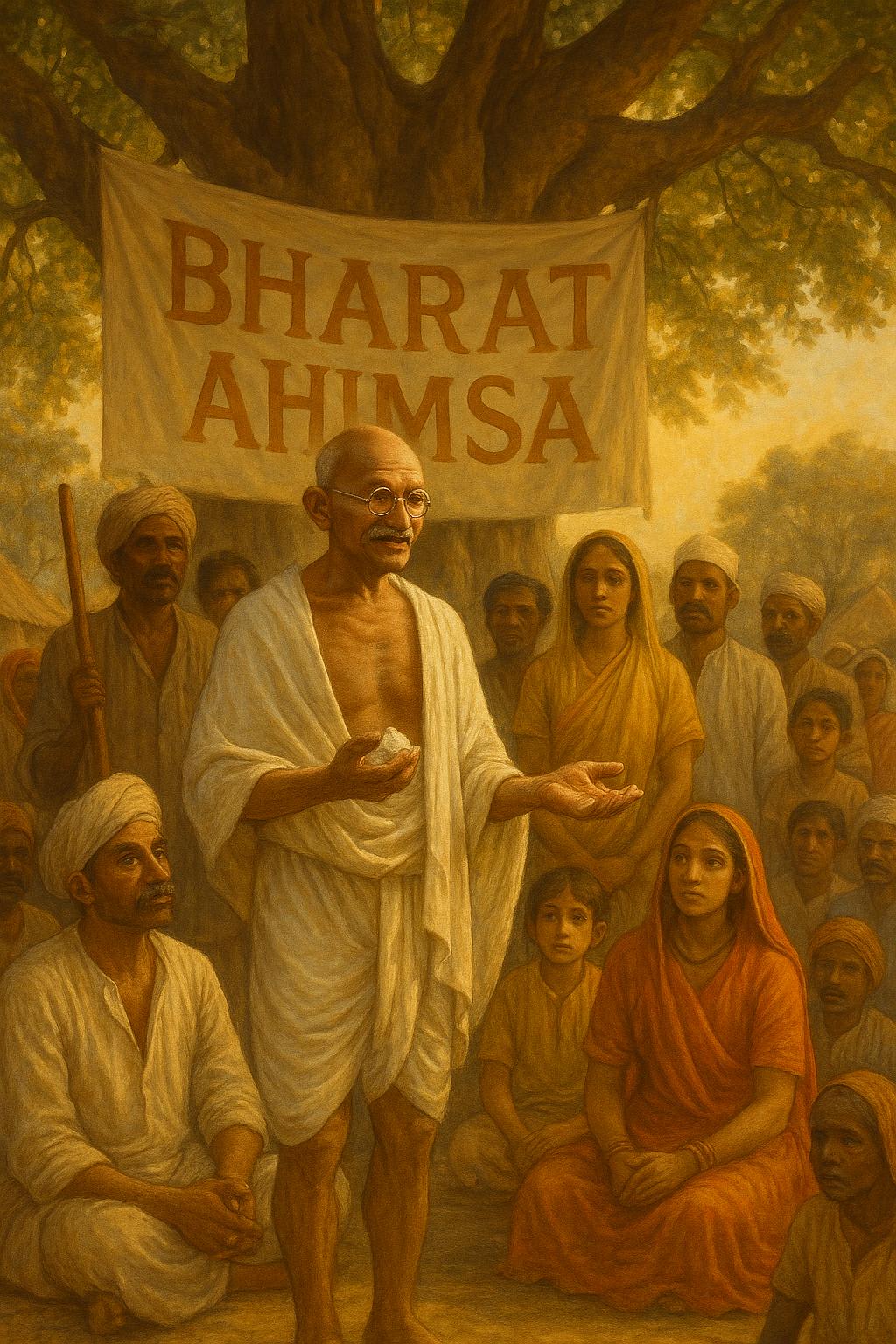
March 13, 1930 – Village of Nadiad
The Declaration of the Other India
This morning, we rose with the cries of peacocks and the scent of neem trees brushing the air. The earth was cool beneath our feet, and my legs, though worn, felt light. It is strange how the spirit, when burning with conviction, lends strength to even the frailest body. We marched early and covered great distance before the sun reached its zenith. As we entered the village of Nadiad, we were greeted not by fear but by reverence. The local elders had spread fresh cow dung on the road and laid marigolds in our path, not as decoration, but as welcome—as offering.
There, beneath a banyan tree thick with memory, I made the most solemn declaration of my life.
I did not merely call for the end of British rule. I announced the birth of Bharat Ahimsa, the India of non-violence. It is not a state in the ordinary sense. It has no parliament, no currency, no standing army. It cannot be occupied or razed. Its borders are spiritual, and its constitution is a vow. Those who enter do so not with passports, but with conscience. We are no longer subjects. We are stewards of a new moral order, one not built upon dominion but upon disciplined love.
I proclaimed the Ashram at Sabarmati as the provisional seat of this parallel India. Every village that rejects British tax and obeys the laws of ahimsa shall be part of our growing confederation. We shall spin our own cloth. We shall hold our own village councils. We shall settle disputes not with courts, but with community. We shall break salt, but never each other.
Some called it madness. Others, heresy. Yet as I looked into the eyes of those gathered—farmers, weavers, untouchables, even former sepoys—I saw no madness. I saw clarity, as if a veil had been lifted from their spirits. A young boy, no older than ten, approached me and asked, “Bapu, does this mean we are now rulers of ourselves?” I smiled and replied, “No, my child—we are servants of the truth. And in that, we are freer than kings.”
This declaration, I know, will ripple beyond our shores. The British will laugh. Perhaps they will imprison me again. But I no longer fear the jailer. I fear only silence. Silence is the mother of tyranny. Our voices must rise—not to shout, but to invite. I sent letters today to every princely state, to every district magistrate, and to friends abroad. Not manifestos, but invitations to join something that has not existed before in this world: a nation without a sword.
As I sat in quiet reflection tonight, a breeze lifted the pages of the Gita beside me. It opened to the teaching I have long carried in my breast: “Better one’s own dharma imperfectly lived, than the dharma of another lived well.” That is what we do now. Live our truth, however small, however frail.
Tomorrow, we march again. But we no longer march in protest. We march in creation.
Let the empire take note: India has already begun.
M.K. Gandhi
About the Creator
Alain SUPPINI
I’m Alain — a French critical care anesthesiologist who writes to keep memory alive. Between past and present, medicine and words, I search for what endures.
Keep reading
More stories from Alain SUPPINI and writers in Chapters and other communities.
Mastering French Without Losing Your Sanity: A Realistic Guide for Beginners
Learning French can feel like solving a Rubik’s Cube blindfolded. The tricky pronunciation, the never-ending grammar rules, and the surprising exceptions make it seem impossible. But don’t worry—equipping yourself with key expressions and effective strategies can turn frustration into fluency. Let’s simplify French and make learning enjoyable.
By Alain SUPPINIExclusive • 11 months ago
Fair Exchange, No Robberies
Dark Memoirs - Index There are at least two kinds of people in the world: those who write this half-arsed kind of intro to a story that looks to separate the rare and the norm, and those who realise it's an overused framing device and don't.
By Paul Stewart14 days ago in Chapters


Comments (1)
This description of the declaration in Nadiad is powerful. It makes you feel the significance of that moment. I wonder how the idea of a non - violent India spread among the people. And how did they manage to keep the spirit of ahimsa alive in the face of British opposition? It's amazing how a simple declaration under a banyan tree could inspire such a new way of life.