
Journal of Mohandas K. Gandhi
Chapter 1 : The First Step into the Other India

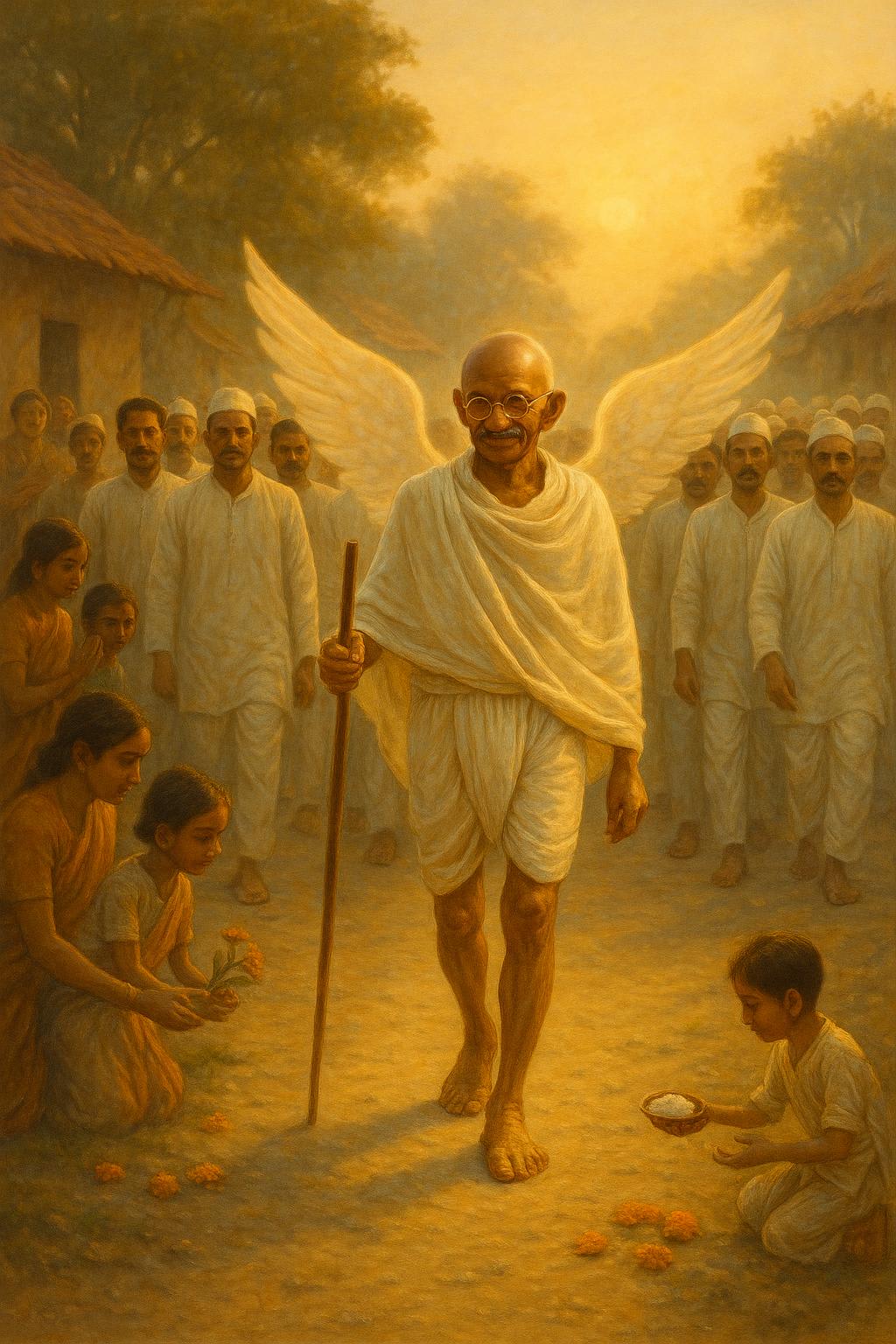
March 12, 1930 – Sabarmati Ashram
The First Step into the Other India
Today, as the morning sun peeled open the pale blue sky, I stood barefoot on the earth of Sabarmati, the river murmuring behind me like an old friend offering its blessing. My dhoti clung loosely to my frame, and my staff—plain, but sturdy—felt heavier than usual, not in weight but in responsibility. Around me, seventy-eight satyagrahis waited in silence, their eyes cast not downward in submission, but forward in serene defiance. Together, we took the first step of a journey not just toward the Arabian Sea, but toward a future I no longer ask for—I begin to enact.
The British rule has taken many things from us: our land, our salt, our dignity. But what we surrendered most disastrously was invisible: our belief in self-rule, in swaraj. We began to internalize the lie that we are unfit to govern ourselves, that we need a foreign hand to guide us, discipline us, civilize us. Today, with each footstep, I reject that lie.
I do not walk merely to defy a salt tax. No, I walk to announce the death of our obedience—not in hatred, not in fire, but in a silence deeper than their laws can reach. I walk with the firm belief that non-violence is not weakness, but the strongest force the world has yet to understand. And now, I am no longer content to resist the British Raj. I have resolved to replace it—not with a mirror image, not with power seized by force, but with a living alternative: one built on compassion, mutual aid, and inner discipline.
Along the dusty roads of Gujarat, villagers came forth to greet us. Some walked with us for an hour, others joined us indefinitely. One man brought only a pinch of salt and laid it in my palm without a word. A widow offered her last handful of grain. Children walked beside me, asking questions not about the British, but about justice, about truth. What is happening is not a protest. It is a gathering of the soul of India.
At dusk, we reached the village of Aslali. There, seated beneath a neem tree, I dictated a message to my faithful secretary, Mahadev Desai. In it, I declared our Ashram to be the spiritual capital of a new India, a parallel republic bound not by military or bureaucracy, but by the sacred vow of ahimsa—non-violence as law, as currency, as creed.
I know the Viceroy will laugh. Let him. Tomorrow, I shall send messengers to the princely states and to the district councils, not to beg for favors but to offer an invitation: Join us in a republic of conscience. Do not wait for freedom to be granted. Begin to act as if we are already free.
The hour is not ripe—it is overdue. The colonial mind must be dissolved, not with war, but with the fierce sunlight of truth. I shall no longer submit to illegitimate authority. Nor shall I ask my countrymen to merely endure. We shall construct a nation that does not yet exist—not in violence, but in vow.
Tonight, I do not feel weary. I feel awake, as if I had slumbered for decades under the illusion of patience. Now, the nation walks beside me, not just behind me. They sing, yes—but no longer songs of lament. They sing creation.
Tomorrow, we walk farther. Not toward the sea alone, but toward the soul of Bharat.
My heart is light. My vow is heavy. I go forward.
M.K. Gandhi
About the Creator
Alain SUPPINI
I’m Alain — a French critical care anesthesiologist who writes to keep memory alive. Between past and present, medicine and words, I search for what endures.
Keep reading
More stories from Alain SUPPINI and writers in Chapters and other communities.
Mastering French Without Losing Your Sanity: A Realistic Guide for Beginners
Learning French can feel like solving a Rubik’s Cube blindfolded. The tricky pronunciation, the never-ending grammar rules, and the surprising exceptions make it seem impossible. But don’t worry—equipping yourself with key expressions and effective strategies can turn frustration into fluency. Let’s simplify French and make learning enjoyable.
By Alain SUPPINIExclusive • 11 months ago
Fair Exchange, No Robberies
Dark Memoirs - Index There are at least two kinds of people in the world: those who write this half-arsed kind of intro to a story that looks to separate the rare and the norm, and those who realise it's an overused framing device and don't.
By Paul Stewart11 days ago in Chapters
Why is everyone's lifestyle different when it comes to living life
When we look at the lifestyles that people lead do we ever wonder why they are not all the same? Is the fact that lifestyles for people are all different because people are all different and that is what makes it unique? That is what I would say, because if we all had the same lifestyle the world would be a very boring place. So do different things then your neighbour when you do this you will feel so much better and so much more will come into your life that I am sure of. Lifestyles are what makes life worth living because we live our lives in the way that works for us, some of us work constantly, some of us know how to relax and take a break by doing the things we enjoy and we call those things hobbies. Everyone does different things in there lives because that is what makes us the people we are. Lifestyles are different because then life is different. When we live our lives, we do so because of what we want out of them don’t we? That is the way that I look at it, what about you? Everyone’s life is different because, if it was all the same then it wouldn’t be any fun, LIfe is meant to be fun and full of hobbies or else it isn’t anything at all, that is the way I look at it.
By Louise Barraco7 days ago in Chapters




Comments
There are no comments for this story
Be the first to respond and start the conversation.