

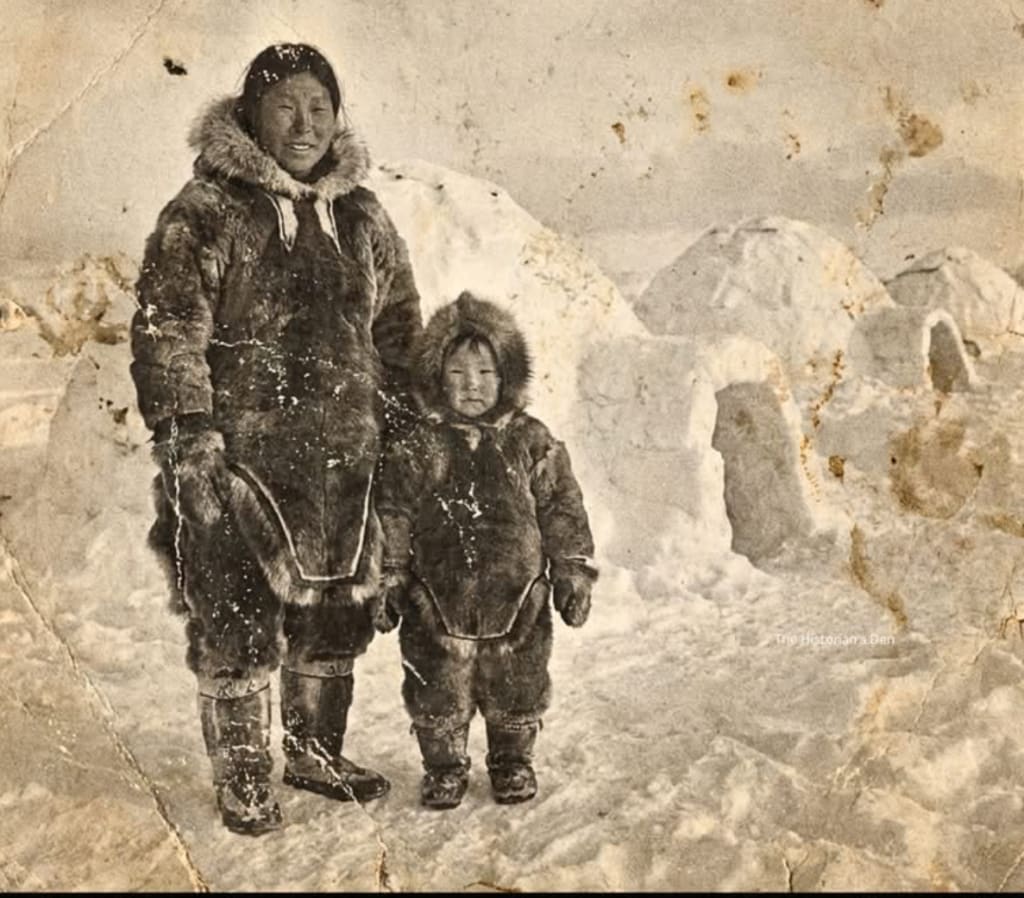
The human history of Greenland stretches far deeper than the Norse arrival, beginning with a succession of Paleo‑Eskimo cultures whose presence can be traced back nearly 4,500 years. Archaeological evidence from sites associated with the Independence I, Saqqaq, and later Dorset cultures reveals a long continuum of Arctic adaptation, marked by finely crafted microblades, bone tools, and skin‑covered watercraft suited to an environment defined by sea ice and migratory game.
These Paleo‑Eskimo communities were not a single people but a series of distinct cultural waves, each responding to climatic shifts such as the warmer phases of the Holocene and later cooling periods. Their settlements, often seasonal and small‑scale, demonstrate a sophisticated understanding of Arctic ecology long before any European contact.
Modern research, including radiocarbon dating, paleoenvironmental studies, and genetic analysis, has helped reconstruct this deep prehistory, showing that Greenland was never an “empty” frontier but a landscape shaped by millennia of Indigenous innovation.
Against this backdrop, the Norse arrival around 985 AD represents a comparatively recent chapter. Erik the Red’s voyage from Iceland occurred during the Medieval Warm Period, a climatic window that made the fjords of southern Greenland marginally more hospitable to European‑style pastoral farming. Medieval Icelandic sagas describe Erik’s exile for manslaughter, his westward exploration, and his deliberate choice of the name “Greenland” to attract settlers.
While these sagas blend history and literary tradition, archaeological excavations at sites such as Brattahlíð confirm the presence of substantial Norse farms, churches, and trade networks. Yet even at their peak, the Norse settlements coexisted with the later Thule Inuit, ancestors of today’s Greenlandic Inuit, who arrived from the Canadian Arctic around the 13th century with advanced technologies like dog sleds and large skin boats. In this broader context, Erik the Red did not “discover” Greenland so much as enter a landscape with a deep Indigenous past and a dynamic cultural future.
The next chapter of Greenland is being told right now and played out in the news. It is at the center of global geopolitics between the U.S. and Denmark, NATO, the rest of Europe, Russia and China. President Trump wants Greenland to be in the control of the U.S. for national security, and Russia looks like they are making a move on Greenland, with China as their ally getting involved. Denmark isn’t strong enough militarily or economically to hold Greenland or protect the western hemisphere or North America from hostile adversarie, so President Trump is negotiating with Denmark to buy Greenland. And make it the 51st state.
History in the making.
About the Creator
Guy lynn
born and raised in Southern Rhodesia, a British colony in Southern CentralAfrica.I lived in South Africa during the 1970’s, on the south coast,Natal .Emigrated to the U.S.A. In 1980, specifically The San Francisco Bay Area, California.
Fair Exchange, No Robberies
Dark Memoirs - Index There are at least two kinds of people in the world: those who write this half-arsed kind of intro to a story that looks to separate the rare and the norm, and those who realise it's an overused framing device and don't.
By Paul Stewart16 days ago in Chapters
The CEO of Everything
They say "jack of all trades, master of none," but they forgot to mention the part where the jack of all trades is also the camera woman, the makeup artist, and the person currently yelling at a tangled Wii microphone cable in a her own bathroom while recording herself singing and trying to make it look realistic and professional. (As professional as you can make it with nothing but a cell phone camera and a mic that doesn't work)
By Sara Wilson4 days ago in Humans


Comments (1)
Never going to happen. Imperialism doesn’t need to come back.