
Full story of Moses
The Birth of Moses and His Early Life

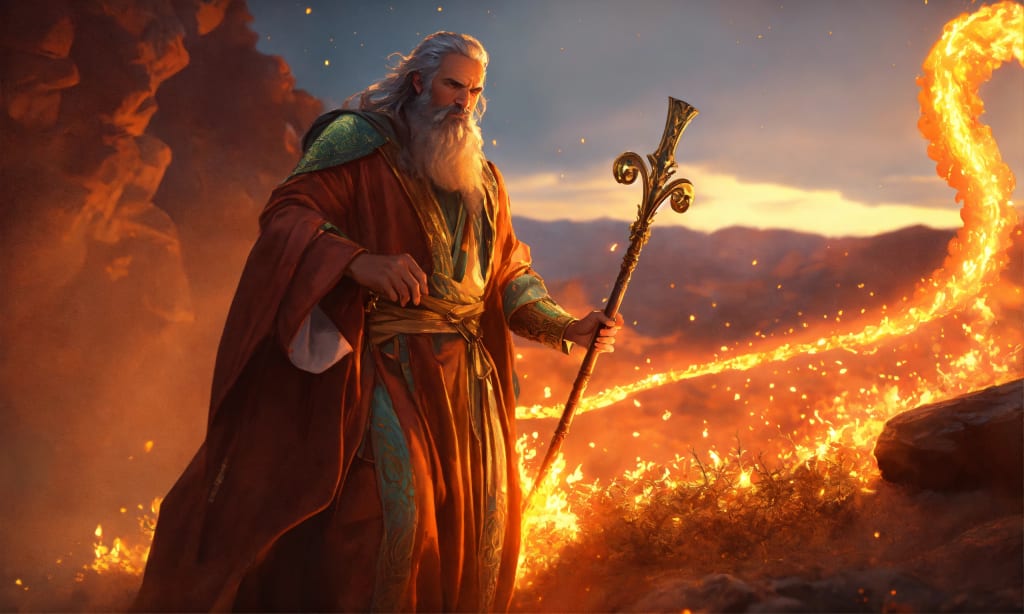
The story of Moses is one of the most significant and detailed narratives in the Bible, particularly in the Book of Exodus. It spans from his miraculous birth, his leadership in the liberation of the Israelites from Egyptian slavery, his encounter with God at Mount Sinai, to his final moments before the Israelites enter the Promised Land. Below is a comprehensive account of Moses' life:
1. The Birth of Moses and His Early Life
Moses was born during a time when the Israelites, who were living in Egypt, were growing in number, and the Egyptian Pharaoh began to fear their power. To control the population, Pharaoh issued a decree that all male Hebrew babies should be killed at birth by throwing them into the Nile River.
Moses' mother, Jochebed, refused to comply with this decree. She hid Moses for three months, and when she could no longer keep him hidden, she placed him in a basket made of reeds and set it afloat in the Nile. Moses' sister, Miriam, watched over him as he drifted down the river. Pharaoh's daughter discovered the baby while bathing in the river, and she took pity on him, adopting him as her own son. She named him Moses, meaning "drawn out of the water."
Moses grew up in Pharaoh’s palace, receiving an Egyptian education and privileges. However, he was aware of his Hebrew heritage, which would later play a crucial role in his life.
2. Moses Flees to Midian
As a young man, Moses witnessed the harsh treatment of the Hebrew slaves. One day, he saw an Egyptian taskmaster beating a Hebrew slave. Enraged, Moses killed the Egyptian and buried his body in the sand. When word of this reached Pharaoh, Moses feared for his life and fled Egypt, escaping to the land of Midian.
In Midian, Moses found refuge with a priest named Jethro (also called Reuel) and married his daughter Zipporah. Moses became a shepherd, living in Midian for many years. During this time, he had two sons and lived a quiet life, far removed from the turmoil in Egypt.
3. The Burning Bush and Moses' Call
While tending to his flock one day, Moses came across a burning bush on Mount Horeb (Mount Sinai) that was on fire but was not consumed by the flames. As he approached, God spoke to him from the bush, telling him to remove his sandals, for he was standing on holy ground.
God revealed His name as "I AM WHO I AM" (Yahweh) and instructed Moses to return to Egypt and lead the Israelites out of slavery. God promised Moses that He would be with him and that He would perform miracles to convince Pharaoh to let His people go. At first, Moses was hesitant, expressing doubt about his ability to speak effectively. God then appointed Moses' brother, Aaron, to speak on his behalf.
4. Moses Returns to Egypt and the Ten Plagues
Moses returned to Egypt with Aaron, and together they confronted Pharaoh, delivering God's message: "Let my people go." However, Pharaoh's heart was hardened, and he refused. This began a cycle in which Moses, through God's power, brought ten devastating plagues upon Egypt, each worse than the last:
Water to blood: The Nile and all the waters of Egypt turned to blood.
Frogs: A plague of frogs covered the land.
Gnats/Lice: Swarms of gnats or lice afflicted the people.
Flies: Egypt was overrun with flies.
Livestock Disease: A plague struck the Egyptian livestock.
Boils: Painful boils broke out on the Egyptians.
Hail: A deadly storm of hail devastated crops and livestock.
Locusts: Swarms of locusts devoured any crops that remained.
Darkness: A thick darkness covered the land for three days.
Death of the Firstborn: The final and most severe plague, where every firstborn in Egypt, including Pharaoh's son, died.
Before the final plague, God instructed the Israelites to sacrifice a lamb and mark their doorposts with its blood. This act would protect them from the angel of death, which "passed over" their homes during the final plague. This event became known as the Passover.
5. The Exodus and the Parting of the Red Sea
After the death of his firstborn son, Pharaoh finally relented and allowed the Israelites to leave Egypt. Moses led the Israelites out of Egypt, but soon Pharaoh changed his mind and pursued them with his army. The Israelites found themselves trapped between Pharaoh’s army and the Red Sea.
In one of the most dramatic miracles in the Bible, God instructed Moses to stretch out his staff over the sea, and the waters parted, allowing the Israelites to walk through on dry ground. When Pharaoh's army followed, the waters returned, drowning the Egyptian soldiers and ensuring the Israelites' escape.
6. The Journey to Mount Sinai
After crossing the Red Sea, the Israelites embarked on a journey through the desert toward the Promised Land. They faced numerous challenges, including hunger and thirst. God provided for them by sending manna (bread from heaven) and quail to eat, and water from a rock.
Three months after leaving Egypt, the Israelites arrived at Mount Sinai, where Moses ascended the mountain to meet with God. It was here that God gave Moses the Ten Commandments, which became the foundation of the covenant between God and the Israelites. These commandments outlined moral and religious laws that the Israelites were to follow.
Moses spent 40 days and nights on Mount Sinai, where God also gave him detailed instructions for building the Tabernacle, a portable sanctuary for worship.
7. The Golden Calf and Moses' Leadership
While Moses was on the mountain, the Israelites became restless and, in his absence, convinced Aaron to create a golden calf, which they began to worship as their god. When Moses descended the mountain and saw the idol worship, he was furious and broke the stone tablets of the Ten Commandments.
Moses pleaded with God to forgive the people, and eventually, God did, but not without consequences. The incident of the golden calf was a major test of Moses' leadership, as he worked to restore the covenant between God and the Israelites.
Moses returned to Mount Sinai, where God gave him a new set of stone tablets with the commandments.
8. The 40 Years in the Wilderness
Despite witnessing numerous miracles, the Israelites frequently complained and doubted God’s promises. At one point, they even expressed a desire to return to Egypt. Their lack of faith culminated when they refused to enter the Promised Land after hearing reports of its challenges from spies. As a result, God condemned the Israelites to wander in the desert for 40 years, until the entire generation that had doubted Him had passed away.
During these years, Moses continued to lead the Israelites, providing guidance, mediating between them and God, and reinforcing the laws they were to follow in the Promised Land.
9. Moses’ Final Days and Death
As the Israelites reached the borders of the Promised Land, God informed Moses that he would not enter it himself due to an earlier incident where he disobeyed God’s command. Instead, God allowed Moses to climb Mount Nebo, where he could see the land from a distance.
Moses delivered a series of farewell speeches to the Israelites, urging them to remain faithful to God and keep His commandments. He appointed Joshua as his successor to lead the people into the Promised Land.
Moses died on Mount Nebo at the age of 120, and the Bible says that God Himself buried Moses in an unknown location. His leadership and legacy as the deliverer and lawgiver of Israel remain central to the history of the Jewish people and the Bible.
Conclusion
Moses’ life is a powerful story of faith, leadership, and perseverance. From his miraculous birth and the rescue of his people from Egypt, to receiving the Ten Commandments and guiding the Israelites through 40 years of wandering, Moses stands as one of the greatest figures in religious history. His relationship with God and his role as a mediator between God and the Israelites made him an essential prophet in Judaism, Christianity, and Islam.
About the Creator
umn ministry Chennai
Passionate about guiding others in their spiritual journey, leads engaging story studies at UMN Ministry. With a focus on deepening faith and understanding, umn ministry fosters a welcoming environment for meaningful discussions and growth.
Keep reading
More stories from umn ministry Chennai and writers in Chapters and other communities.
Inductive Bible Study Lessons 4
Genesis 8-9: An Inductive Bible Study Introduction The narrative of Genesis 8-9 marks a profound transition in biblical history. After the cataclysmic flood that reshaped the Earth, Noah's journey from the confines of the ark to the reestablishment of humanity and creation is imbued with theological significance. This study embarks on an inductive examination of these chapters, exploring their implications and insights through a detailed, verse-by-verse exegesis. Our analysis will focus on two major themes: the restoration of Noah and the establishment of God's everlasting covenant.
By umn ministry Chennaiabout a year ago in Chapters
Why Pakistan Erupted in Protests After Ali Khamenei’s Death: Curfews, Casualties, and Diplomatic Tensions
In Pakistan-administered Gilgit-Baltistan, following violent protests over the reported killing of Iran’s Supreme Leader Ayatollah Ali Khamenei in an alleged U.S.-Israeli attack, authorities have imposed a three-day curfew in the districts of Gilgit and Skardu and called in the army.
By Real content4 days ago in Chapters


Comments (2)
What a great reminder of God's promises! This study has encouraged me to dig deeper into my Bible readings
Thank you for this detailed study! It really helped clarify some things for me, especially the connection between the Old and New Testaments.