
Chapter 7: The Treaty of Hudaybiyyah
When patience achieved what war could not


Chapter 7: The Treaty of Hudaybiyyah
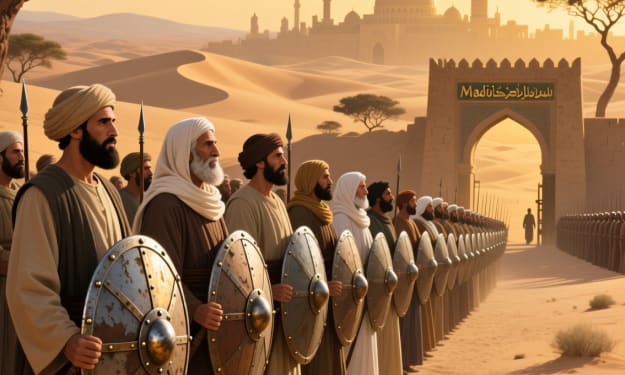
Several years after migrating to Madinah, the Prophet Muhammad ﷺ and his followers still longed for Makkah. It was their birthplace, the city of the Ka‘bah, and the center of their faith. Though they had been forced to leave, their love for Makkah never faded. In the sixth year after Hijrah, the Prophet ﷺ had a dream that Muslims would enter Makkah peacefully to perform Umrah, the lesser pilgrimage.
Believing this dream to be a sign from Allah, the Prophet ﷺ decided to travel toward Makkah with his companions. About fourteen hundred Muslims set out from Madinah. They carried no weapons of war, only travel swords, as was the custom. Their intention was clear: they were not coming to fight, but to worship.
When the Quraysh of Makkah heard about this journey, they became alarmed. Years of conflict had filled them with fear and suspicion. They assumed that the Muslims might attack the city. To stop them, the Quraysh sent armed men and blocked the main routes to Makkah.
The Prophet ﷺ did not want confrontation. He changed the route and stopped at a place called Hudaybiyyah, just outside Makkah. There, the Muslims set up camp. Tension filled the air, but the Prophet ﷺ remained calm and patient.
Messengers were sent back and forth between the two sides. The Prophet ﷺ sent Uthman ibn Affan to Makkah to explain their peaceful intentions. For a while, Uthman did not return, and a rumor spread that he had been killed. This deeply upset the Muslims. They gathered and pledged loyalty to the Prophet ﷺ, promising to stand firm if needed. This pledge became known as the Pledge of Ridwan.
Soon after, the rumor proved false. Uthman returned safely. The Quraysh then decided it was better to negotiate than to risk war. They sent a representative named Suhail ibn Amr to discuss terms with the Prophet ﷺ.
After long discussions, a treaty was written. This agreement became known as the Treaty of Hudaybiyyah.
The terms of the treaty surprised many Muslims. According to the agreement, Muslims would not enter Makkah that year but could return the next year to perform Umrah peacefully. There would be a truce between the two sides for ten years. Any tribe was free to join either side. However, one condition troubled the Muslims deeply: if someone from Makkah accepted Islam and went to Madinah, they would be returned, but if someone left Islam and went to Makkah, they would not be returned.
Many companions felt these terms were unfair. They were disappointed and confused. Some even questioned why they had to accept such conditions when they believed they were on the truth.
But the Prophet ﷺ accepted the treaty calmly. He understood something deeper. Peace, even with difficult terms, could open doors that war could not.
When the Muslims returned to Madinah without performing Umrah, their hearts were heavy. Yet soon, the wisdom of the treaty became clear.
For the first time in years, there was peace. People could travel safely. Muslims and non-Muslims met without fear. Conversations replaced battles. As a result, many people learned about Islam closely and accepted it. In just two years, more people accepted Islam than in all the previous years combined.
The Qur’an later described the Treaty of Hudaybiyyah as a “clear victory.” It was a victory not of swords, but of patience, wisdom, and trust in Allah.
The treaty also showed the world that Muslims honored agreements, even when the terms were difficult. This strengthened their moral position and earned respect from many tribes.
Eventually, the Quraysh themselves broke the treaty. When that happened, Muslims responded with dignity and strength, leading to the peaceful conquest of Makkah later on.
The Treaty of Hudaybiyyah teaches an important lesson. True success does not always come through force. Sometimes, restraint is greater than retaliation. Sometimes, stepping back leads to moving forward.
This chapter reminds us that leadership is not about pride, but about vision. The Prophet Muhammad ﷺ showed that peace, patience, and trust in Allah can change the course of history.
About the Creator
Wings of Time
I'm Wings of Time—a storyteller from Swat, Pakistan. I write immersive, researched tales of war, aviation, and history that bring the past roaring back to life
Keep reading
More stories from Wings of Time and writers in Chapters and other communities.
Chapter 6: The Early Battles and Self-Defense
The Early Battles and Self-Defense After migrating to Madinah, the Muslim community finally found safety—but peace did not come immediately. The Quraysh of Makkah were furious. They had lost control over the Prophet Muhammad ﷺ and his followers, and they feared that Islam would grow stronger outside their reach. Even though the Muslims had left their homes, property, and wealth behind, the hostility did not end.
By Wings of Time 2 months ago in Chapters
The Guardian Chapter V
Alexander left his Coming of Age ceremony with Cronos and the elders with as many new questions as he had answers for his old questions. Cronos had confirmed his suspicions were correct. Not only was there a link between the Beast Masters and the inhabitants of the Citadel, but it was the Citadel's fault that the Beast Masters existed in the first place. Instead of banishing the law breakers which allowed them to wreak havoc on the rest of humanity, the Citadel elders should have stripped them of their powers before they became too strong. Now Alexander would need to battle the Beast Masters and the Jikininki. It would be difficult for him to forgive the Citadel Elders because their poor decisions led to the deaths of his parents and more than half the planet's human population.
By Mark Gagnon14 days ago in Chapters
Stop the AI from taking over Earth!
Not long after, Gazzer and I arrived back at Void. It seemed… different not mentioning how much HAVE CHANGED! The buildings, many were removed, the houses looked the same, the population… INCREASED MAGNIFICIENTLY! Oh boy, how much trouble would it be… as in, I WOULD HAVE TO HELP GAZZER THROUGH BUSTLING STREETS JUST TO GET TO SCHOOL! It’s trouble alright! But then, I saw it… AI robots on MY PLANET! I had to stop them. I took my VoidA2000 which turned into a car and drove to the area where the AIs were at.
By *+*+*~Teja~*+*+*7 days ago in Chapters


Comments
There are no comments for this story
Be the first to respond and start the conversation.