
Analysis of Serial Device Server Brands In 2015
Application Guide
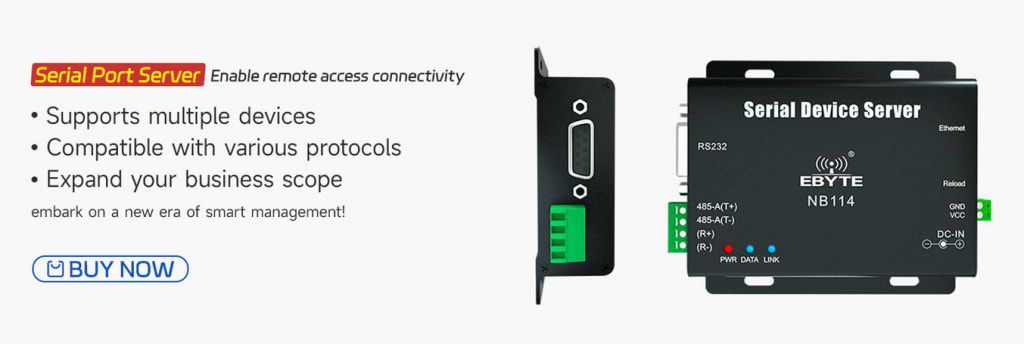
With industrial IoT (IIoT) penetration exceeding 42%, serial port servers—critical hubs bridging legacy devices and smart networks—are driving digital transformation across manufacturing, energy, transportation, and beyond. This article provides an in-depth analysis of serial port server technologies, leading brands, and industry-specific applications, empowering informed deployment decisions.
I. Core Functions and Technological Evolution of Serial Port Servers
1.1 Operational Principles and Value Proposition
Serial port servers convert RS-232/RS-485 serial signals into TCP/IP protocols for remote monitoring and centralized management. Key features include:
Protocol Translation: Supports 200+ industrial protocols (Modbus, OPC UA, etc.), breaking communication barriers.
Transparent Data Transmission: Real-time, unmodified data transfer from legacy devices.
Multi-Device Connectivity: Single server connects multiple serial devices, ideal for complex deployments.
1.2 Technology Milestones and Trends
(10 Mbps): Basic protocol conversion with Windows virtual COM port support.
(100 Mbps + Opto-isolation): Enhanced speed and noise immunity for industrial environments.
(5G + Edge AI): Integrated 5G and lightweight AI models for low-latency decision-making.
According to Gartner, edge-enabled serial port servers will rise from 23% (2024) to 58% by 2026, accelerating device intelligence.
II. Global Leading Brands and Technology Matrix
2.1 International Brands: Technical Leadership and Ecosystem Advantages
Advantech
Core Tech: UNO series with Intel Atom processors, edge computing support (<20 ms inference latency).
Case Study: Tesla Gigafactory robot control network achieves collaborative precision optimization.
Market Share: 18.7% (IoT Analytics, 2024).
Moxa
Key Innovation: NPort 5600 series (UL 508-certified, -40°C to 85°C operation, IP40 rating).
Application: CNPC pipeline monitoring system (500+ nodes, 1,000+ hours zero-failure operation, TÜV-certified).
Siemens
Ecosystem: SCALANCE X204RNA achieves 99.2% compatibility with Siemens PLCs, aligning with Industry 4.0.
Use Case: Medical device interoperability (EMC-certified for healthcare).
2.2 Domestic Brands (China): Innovation and Vertical Expertise
EBYTE
Technological Breakthroughs:
Full Protocol Compatibility: Supports 50+ protocols (Modbus RTU/TCP, Profinet, EtherNet/IP), improving conversion efficiency by 30%.
Industrial-Grade Design: IP67 rating, -40°C to 85°C operation, IEC 61000-4-5 surge protection (±4 kV), and 10G vibration resistance.
Edge Intelligence: ARM Cortex-A53 processor with TensorFlow Lite integration for local AI inference (<15 ms latency).
Flagship Products:
E810 Series: Dual-mode 5G + Wi-Fi 6 server (10 Gbps bandwidth) for high-speed data acquisition (e.g., semiconductor production lines).
E520 Series: LoRaWAN gateway + serial protocol converter for remote areas (oil fields, wind farms).
Gizwits
Cloud Platform: GW200 series manages 120,000+ terminals with remote OTA updates.
Case: 7-11 store chain implements nationwide temperature/humidity monitoring
III. Selection Guide: Scenario-Driven Parameters
3.1 Industry-Specific Requirements
Industrial Automation: Prioritize IEC 61000-4-6 EMI certification (≥10 V/m), e.g., Advantech UNO.
Outdoor Deployments: IP67 + wide-temperature (-40°C to 85°C) models like EBYTE E810 (5G redundancy).
SMB Projects: Opt for cloud-integrated solutions (e.g., EBYTE E520 with Alibaba Cloud/Huawei Cloud compatibility).
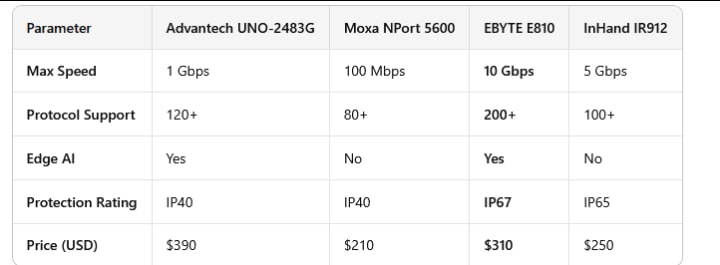
3.2 Key Parameter Comparison
3.3 Cost vs. ROI
Entry-Level: $85–170 (3-year warranty), prioritize MTBF ≥80,000 hours.
5G+AI Models: $210–420, ROI within 12–18 months (bandwidth-dependent).
EBYTE Cost Advantage: E810 series offers 10-year warranty, <0.5% annual failure rate, and 35% lower TCO.
IV. Industry Applications
4.1 Smart Factories
Solution: EBYTE E810 + Siemens PLCs for Modbus/Profinet conversion.
Impact: Automotive plant reduces fault response time by 60%, boosts equipment utilization by 18%.
4.2 Smart Cities
Requirements: Outdoor durability, wide coverage.
Deployment: EBYTE E520 (5G + LoRaWAN) optimizes traffic light control, cutting peak-hour congestion by 25%.
4.3 Smart Healthcare
Solution: Siemens SCALANCE X204RNA (EMC-certified) paired with EBYTE E810 for real-time patient monitoring.
Result: Hospital reduces critical-value response time from 5 minutes to 30 seconds.
V. Future Trends and Challenges
5.1 Opportunities
AIoT Integration: EBYTE’s edge modules enable predictive maintenance (e.g., bearing wear alerts) via PyTorch models.
Low-Power 5G: RedCap tech slashes 5G device power use by 60%, scaling EBYTE E520 deployments in grid monitoring.
Security: AES-256 adoption exceeds 75%; EBYTE supports SM2/SM4 for domestic substitution mandates.
5.2 Challenges
Protocol Fragmentation: Requires OPC UA over TSN standardization.
User Experience: Non-technical users rely on EBYTE Cloud for zero-code configuration.
By 2025, the serial port server market will feature dual-track competition: global high-end brands vs. localized innovators like EBYTE. With strengths in full protocol compatibility, industrial ruggedness, and edge intelligence, EBYTE is rapidly displacing imported solutions. Whether for precision manufacturing, smart energy, or urban IoT, EBYTE’s solutions reduce deployment costs and enhance operational efficiency. As 5G-Advanced and AI penetrate deeper, EBYTE’s ecosystem will drive the democratization of industrial IoT.
About the Creator
rubinlee
Enjoy sharing product reviews and evaluations, providing insights and personal experiences with various products.
Fair Exchange, No Robberies
Dark Memoirs - Index There are at least two kinds of people in the world: those who write this half-arsed kind of intro to a story that looks to separate the rare and the norm, and those who realise it's an overused framing device and don't.
By Paul Stewart15 days ago in Chapters
Not an Exception
Dark Memoirs - Index "For writers who knowingly lie, for those who substitute unbelievable human behavior for the way people really act, I have nothing but contempt. Bad writing is more than a matter of shit syntax and faulty observation; bad writing usually arises from a stubborn refusal to tell stories about what people actually do—to face the fact, let us say, that murderers sometimes help old ladies cross the street.
By Paul Stewart6 days ago in Chapters
Smart phones, Humans and Aliens.
WARNING. I will be tapping into one of your favorite creative tensions: The absurdity of humans worshipping their glowing rectangles as if they were tiny oracles. There’s something deliciously poetic about that contradiction, and it lends itself beautifully to an instructive proviso.
By Novel Allen4 days ago in Poets


Comments
There are no comments for this story
Be the first to respond and start the conversation.