
A New Continent Found Between Greenland and Canada 🤫
When asked how many continents exist on Earth, most of us would confidently say seven. However, recent scientific discoveries suggest that a new continent may be forming, changing our understanding of Earth's geography. This newly identified landmass, referred to as the Davis Strait Proto-Microcontinent, lies between Greenland and Canada.


The Emerging Continent Between Greenland and Canada:
Nestled between Greenland and Canada, the Davis Strait serves as a critical link between the Labrador Sea and Baffin Bay. This region, known for its complex geological features, has long intrigued scientists. Recently, a remarkable discovery has brought fresh attention to this area. Researchers have identified a microcontinent formed through intricate tectonic processes.
A Fascinating Geological Formation
For adventurers and geology enthusiasts, the Davis Strait offers a unique opportunity to explore Earth's tectonic mysteries. Despite its remote location, the area's striking beauty and scientific significance make it a must-visit destination for environmental tourism and educational trips. Imagine embarking on a journey to witness the astounding landscapes shaped by ancient geological forces—it's truly awe-inspiring.
A Major Geological Discovery
Dr. Jordan Bithian from Derby University, a member of the research team, emphasized the importance of this discovery. "The well-defined changes in plate movement in the Labrador Sea and Baffin Bay, combined with their relatively limited external complexities, make this region an ideal natural laboratory for studying microcontinent formation," he explained.
Could More Continents Be Emerging?
The research team believes that this microcontinent was formed around 58 million years ago, highlighting the role of the newly identified tectonic feature known as the Pre-Ungava Transform Margin in facilitating this separation. These findings have broad implications, providing insights into the formation of other microcontinents around the world, such as the Jan Mayen Microcontinent northeast of Iceland, the East Tasman Rise southeast of Tasmania, and the Gulden Draak Knoll in Australia. This suggests that similar microcontinents may exist in various parts of the Earth.
Despite these discoveries, all identified formations are classified as microcontinents. Therefore, for now and for many centuries to come, the number of recognized continents on Earth remains seven.
About the Creator
Ms.Odyssey
Hey there, adventurers! I’m Ms. Odyssey, Follow me and let's dwelve deeper into psychology , mystery and some fascinating facts. Sometimes I write creepy and horror stories too!
Keep reading
More stories from Ms.Odyssey and writers in Chapters and other communities.
The Earth Does Not Orbit the Sun! NASA’s New Discovery ☠️
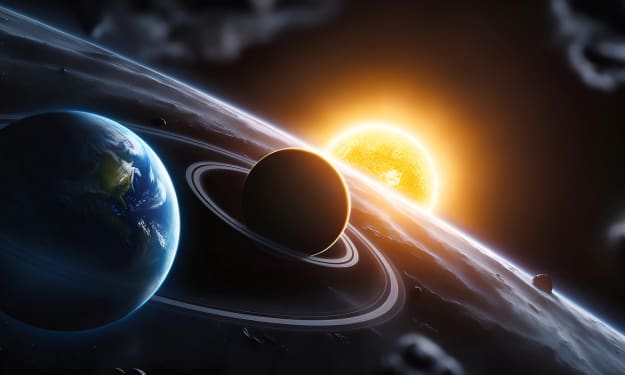
The reason for this change is the center of mass. If we take the entire structure of the solar system, we should visualize it like a sports arena. In this arena, the Sun and Earth are both rotating at the same level. Based on this, scientists believe that the center of the solar system is not centered on the Sun.
By Ms.Odyssey2 years ago in Chapters
The Cave Part 6
If you have ever heard a tale about yourself that you cannot remember and doubtless think is made up, you will know how I felt when Tharkin related all that the eagle had seen of me before my memories were scattered. Of far distances and traveling companions that I did not recall, camping out under the stars and making our way to the mountains with deliberate purpose. The great bird had lost contact with my party once we entered the forests, and the seven other members were not seen again by him or his brethren since.
By Jamye Sharp15 days ago in Chapters
After Khamenei: How the Middle East Crisis Could Redraw Global Politics
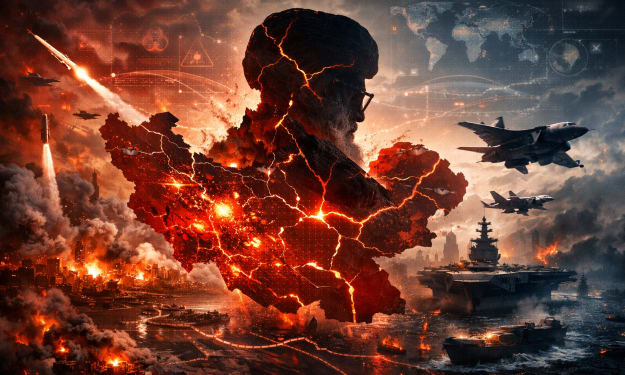
After Khamenei: How the Middle East Crisis Could Redraw Global Politics The confirmed death of Ayatollah Ali Khamenei after joint strikes by the United States and Israel has sharply intensified the ongoing conflict in the Middle East—turning what was a dangerous regional crisis into a moment with global implications. Khamenei, who led Iran for nearly four decades and wielded extraordinary political and military influence, was killed when missiles and airstrikes hit Tehran in the opening phase of a major military operation targeting Iranian leadership and strategic infrastructure. The impact of his death is already reverberating across the region and the world in ways that may last for years.
By Wings of Time about 23 hours ago in Chapters


Comments
There are no comments for this story
Be the first to respond and start the conversation.