
A Knight Against the Sky
An engaging and grounded reimagining of the original tale:

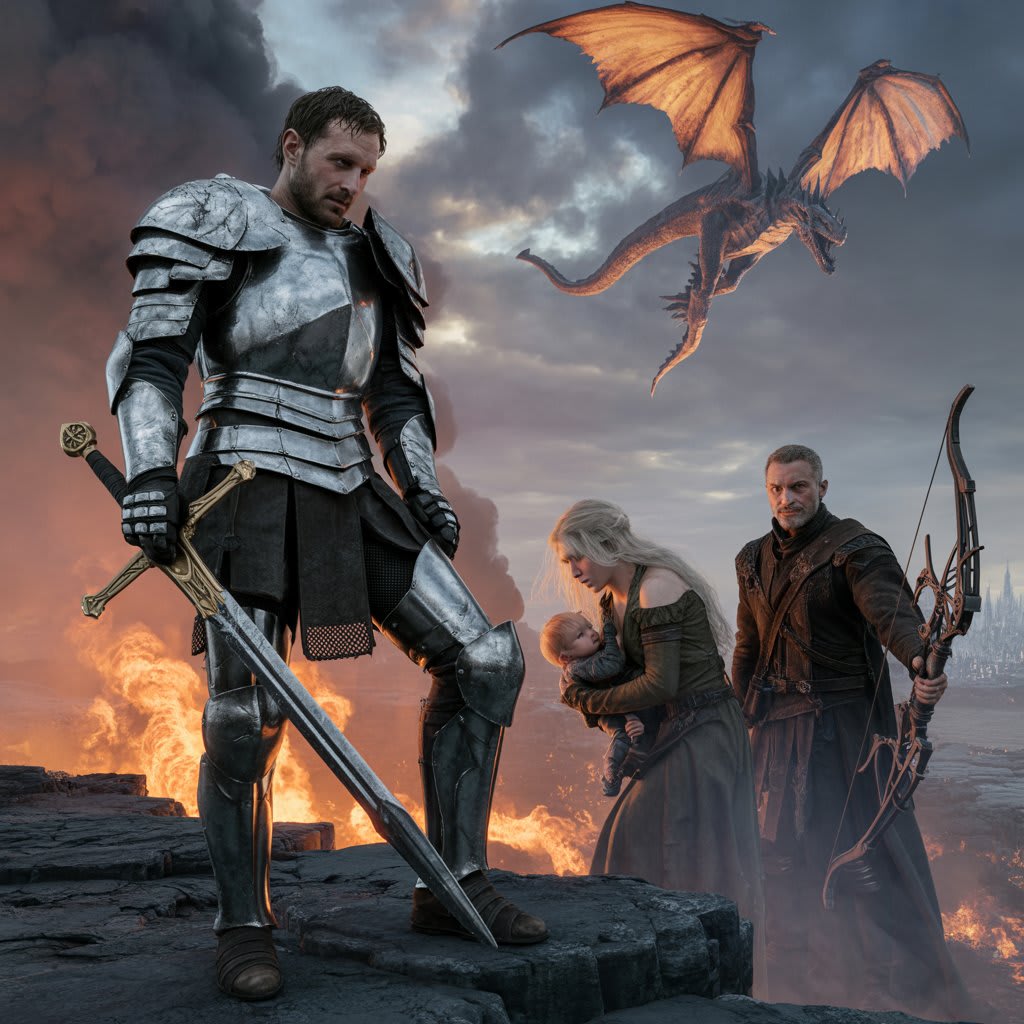
The river ran backward the day the Queen vanished.
Few noticed. Fewer still understood. The old signs were no longer read—those with eyes trained in prophecy were dead, exiled, or forgotten. Men had burned their sacred groves, buried their stories, and scoffed at their elders. The silver trees no longer grew. And the dragons, once holy companions, had become harbingers of fire.
They descended from the high places—those glittering titans of wing and flame—and lit the skies above the cities of men. What was once sacred had turned savage. What was once sung in reverence now roared in ruin.
But one man had done the unthinkable.
He had killed a dragon.
He was no prince, no lord. Once, he had been a knight—a highborn son from the Eastern Reaches. But for love, he gave it all up. Land. Title. Glory. He had chosen exile among the Elven people of Eletheme, tending their strange herds of long-necked dragonkin. He played the flute beneath the silver trees. Learned their tongue. Drank their fruit. Loved their daughter.
His name was Ser Grimold, though few called him that anymore.
When the dragons turned, one of them—Mêmraahq, the Glimmerwing—descended in fury upon his elven kin. Without warning. Without cause. He burned the great trees. He tore through the fields. He incinerated the children.
And Grimold did not run.
He fought.
The battle left him half-burned and barely alive. But the dragon lay dead in the ashes of his wrath. And with that death came more than grief.
The Elves, horrified, cast him out. Slaying a dragon—even in defense—was unthinkable. He had "broken the order of the skies." Their gods had become monsters, but they were gods nonetheless.
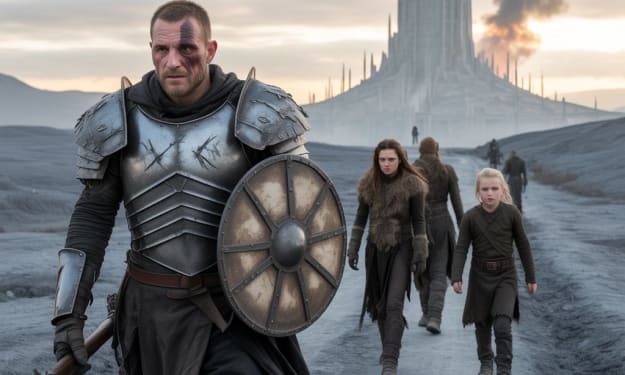
Stripped of hope, scorned by his adopted people, Ser Grimold walked into the lands of men with his wife, Ellowyn, and their children. He bore scars of flame and guilt in equal measure. And yet, he walked—not to escape—but to warn.
The dragons were not sick.
They were not maddened.
They were angry.
And they had begun a quiet war against mankind.
In the mountain halls of Frothinger, the dwarf-smith Uurnik the Wizard listened to Grimold’s tale. He had never seen dragonbone. He wept when he touched it.
“Not in all the ages of stone have we seen such sorrow,” Uurnik whispered. “You slew the sky—and yet you look not proud, but broken.”
“I did what I had to,” Grimold replied, voice low. “And I’ll do it again.”Uurnik gave the knight a gift—a bow of dwarven design for his young son—and whispered, “Go to the Queen. The King is lost on his own foolish errand. The city of Ithilion will burn unless someone stands beneath its sky.”
The road ahead bent toward ruin. Cities had already fallen—Blackstone, Eddenbur, Thimbledon. Burned to the bone.
But Ithilion still stood.
And though Ser Grimold’s body failed, though his honor was lost, and though the sky itself now seethed with fire—he walked still.
A knight.
No longer for crown or cause.
But for the lives that still remained.
End of Part One,
Would you keep reading?
About the Creator
Keep reading
More stories from Hazrat Bilal and writers in Chapters and other communities.
A Knight Against the Sky part(II).
The wind on the Ash-Road carried no birdsong. Only soot, silence, and the distant whisper of wings. Grimold stood at its edge with Ellowyn beside him. Her once-luminous cloak of star-silk hung in tatters, streaked with ash. In her arms, their youngest son, Calen, slept uneasily, whispering Elvish words in his dreams—words that spoke of fire and fleeing and the silver trees that no longer stood.
By Hazrat Bilal7 months ago in Chapters
Giving all you got from living that you do mean what?
When you look at your life and how you live it what is the first thing that comes to mind? Do you think about what you can offer your life or what your life can offer you? If you think of both of these things, do you give your life all that you got while you live it the way that you want to live it? Most people’s answer to this question is yes they do, or they wouldn’t be living the way that they are. When you give your life all you got, what is it that you are doing. Well you are living by making money, and doing hobbies of course, if you didn’t do hobbies in your life then you wouldn’t be living and what type of life is that? It isn’t a life, or at least that isn’t what I think that a life is if you don’t actually have hobbies in it and love the hobbies that you do. When you do the hobbies you enjoy, in life while living the life you want, you are getting so much more out of it. For example, if you like to garden or be outside as a hobby the summer is a great time to do that. You can go outside, do your gardening, and hang out in your backyard oasis if you have one. If you don’t have a backyard oasis you can make one as one of your summer hobbies for the rest of the summer that the world still has in your area right now. If it is summer how cool is that?
By Louise Barraco6 days ago in Chapters


Comments
There are no comments for this story
Be the first to respond and start the conversation.