
William Shakespeare's Henry the Sixth, Part One
By Doc Sherwood

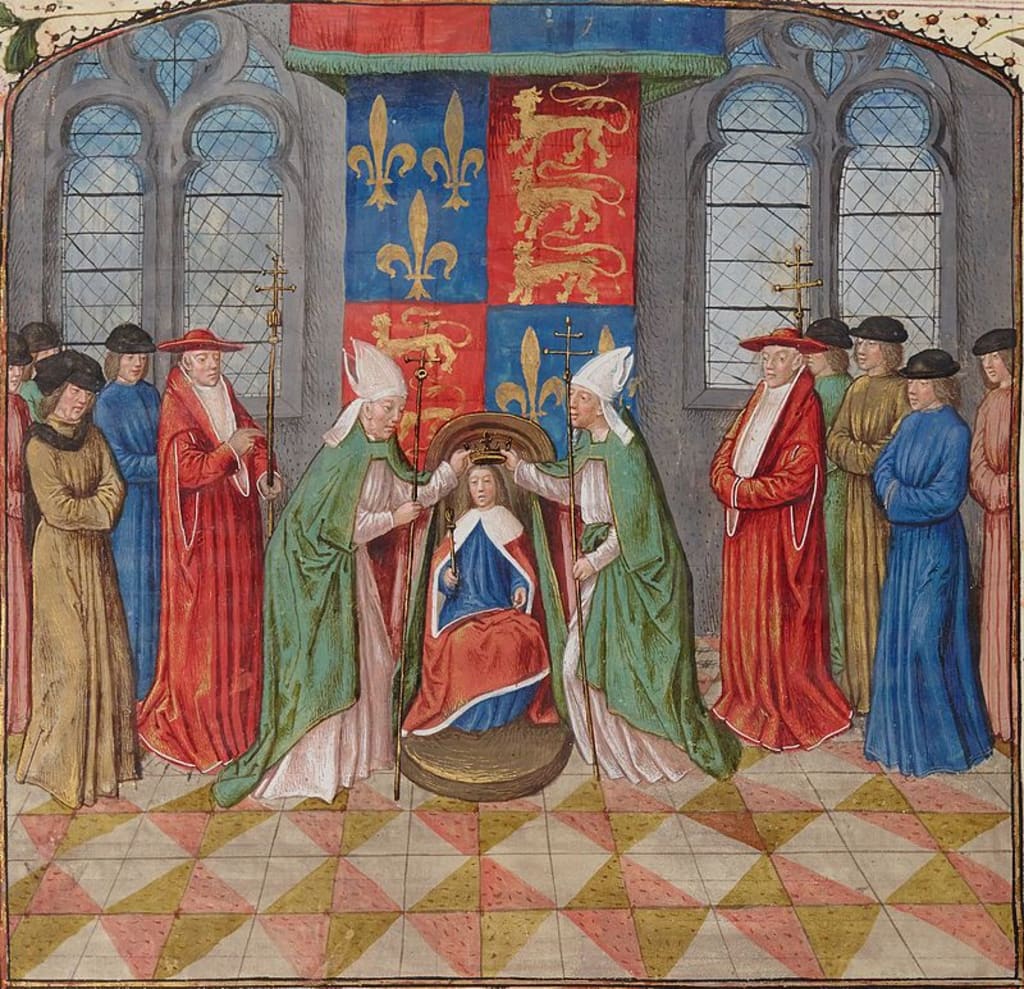
Written around 1592, The First Part of Henry the Sixth was one of Shakespeare’s earliest plays, but probably not his very first. Despite the title, it’s widely believed that the plays now known as Henry the Sixth, Part Two and Part Three were written before it. These, under different titles, had been published in Shakespeare’s lifetime as a two-part sequence, and Part One was probably intended as a prequel, dealing with earlier historical events, to cash in on the popularity of the previous pair. The First Part did not appear in print until the folio edition of 1623, which collected all the history plays in chronological sequence rather than the order in which they were written.
The three parts of Henry the Sixth are Shakespeare’s first history plays, and were also the very first plays about English history to win popularity on the Elizabethan stage. All were highly successful in Shakespeare’s time and helped greatly in establishing the then-young playwright’s reputation, although like many of the early group they were probably only co-written by Shakespeare, with other contemporary authors including Robert Greene and Thomas Nashe supplying some of the material.
Henry the Sixth’s fame faded as the centuries went by, and Part One in particular is now among the least performed or studied of Shakespeare’s works. In this essay we’ll be looking at some of the possible reasons why.
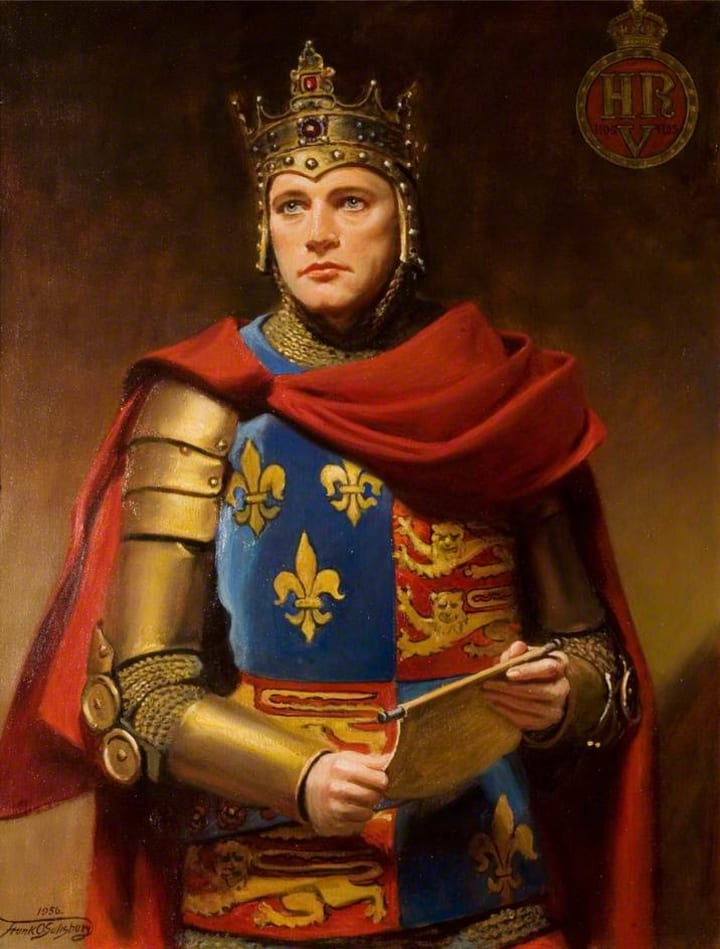
The First Part of Henry the Sixth opens with the funeral of that king’s father, Henry the Fifth, about whom Shakespeare would write another history play later in his career. Henry the Sixth was in fact less than a year old when he succeeded to the English throne, but the plot also requires later scenes such as Henry’s coronation as King of France when he was ten. Shakespeare here reworks certain facts for the sake of his narrative – something else we would see again from him throughout his cycle of history plays. King Henry the Sixth as he appears in Part One seems from his dialogue to be a young boy, and was presumably played by a child-actor on Shakespeare’s stage.
Comparisons with Henry the Fifth, now one of Shakespeare’s best-known and most beloved history plays, are inevitable. The two run consecutively in the histories’ chronological sequence, which means many of the same characters appear in both. Shakespeare would return to his earlier depictions of these English historical figures when he set down to write Henry the Fifth. Likewise, although the dead king obviously does not appear in Henry the Sixth Part One, its funeral scene’s descriptions of him as a warlike conquering hero informed Shakespeare’s later characterization of the “star of England.” Finally, the most common criticism of Henry the Fifth also applies to the play set in its aftermath. Both are extremely jingoistic, and even arguably xenophobic.
On the one hand, this is to be understood within the context of Shakespeare’s own time. Patriotic fervour ran high in the reign of Queen Elizabeth the First, especially after the defeat of the Spanish Armada in 1588. France remained a potential threat to England, though Spain by now posed a greater one, and plays about the French wars of a century or so before were very much in keeping with popular public sentiment. This resulted in a presentation of the French characters from both Henry the Sixth Part One and Henry the Fifth which today often appears unflattering, one-sided, and even offensive.
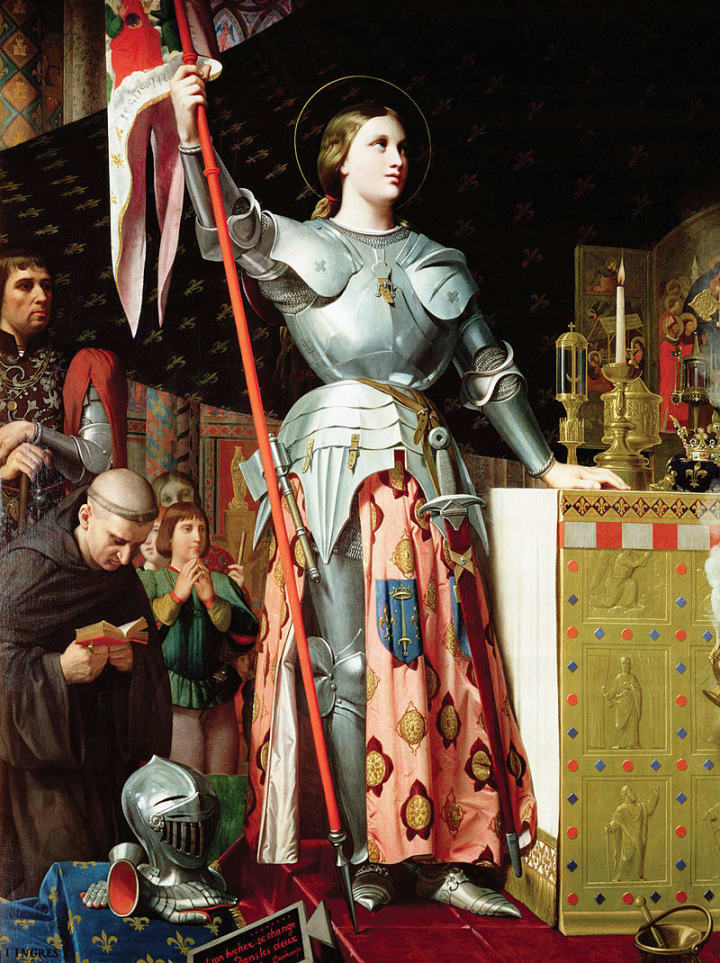
The French historical figure who surely receives the roughest treatment from Shakespeare is Joan of Arc, who the playwright includes as a character in Henry the Sixth Part One. Joan’s life has become the stuff of legend, a peasant girl who rose from humble beginnings to lead her nation in the final defeat of the English, at the end of what is now called the Hundred Years’ War. Her enormous skill as a warrior and tactician were self-evident, and she was also widely believed to possess magical powers such as the ability to see the future. All these, Joan claimed, were gifts she had received from God when He set her on a crusade to expel the invader from her homeland.
Joan of Arc did not live to see the French victory for which she had fought. She was captured by the English in 1430 and burned at the stake as a witch the following year. However, both her direct military involvement and the spiritual significance she took on for the French people at large were very real factors in her country’s ultimate triumph. Today Joan is considered a folk heroine, and has been canonized as a Catholic saint.
When we approach William Shakespeare’s presentation of her in Henry the Sixth Part One, however, we find something altogether different. From her very first scene onward, Shakespeare reveals that his Joan of Arc is a vainglorious fraud who uses her feminine wiles to control a weak and foolish Prince. Key events from the traditions surrounding Joan are included, from her correctly identifying the Prince when he attempts to hide his identity, all the way to her final violent end (of which more later) but all this is turned by Shakespeare to the purposes of anti-French propaganda.
The history plays have typically left a lasting impression on our perceptions of the figures they portray – Richard the Third is arguably the best example. Henry the Sixth Part One’s treatment of Joan of Arc, however, is a rare example of an instance when the playwright did not achieve this.
Joan’s English English enemies, meanwhile, are all presented as noble chivalrous knights fighting to a code of honour. It will have been to Shakespeare’s advantage that the men on whom these characters were based had already come to be regarded by his contemporary audience as heroes from the glorious era of Henry the Fifth’s victories in France. In Henry the Sixth Part One, Shakespeare dramatizes the downturn of this conflict, as one by one these great figures from the past meet battlefield deaths or fall to French treachery. On each separate instance they are poignantly mourned by their brothers-in-arms, usually moments before Joan and her army deliver a callous gloat.
For Lord Talbot, the play’s hero and most celebrated of all the historical Henry the Fifth’s veterans, Shakespeare preserves an extant tradition that he and his son died in each other’s arms, the latter having heroically chosen to meet his end by the side of his valiant father. Moments later, Joan of Arc makes a sneering joke about Talbot’s dead body lying “stinking and fly-blown” at her feet. It’s fair to say that the mature Shakespeare of Hamlet didn’t write in quite such a heavy-handedly manipulative way when steering his audiences into choosing a side!
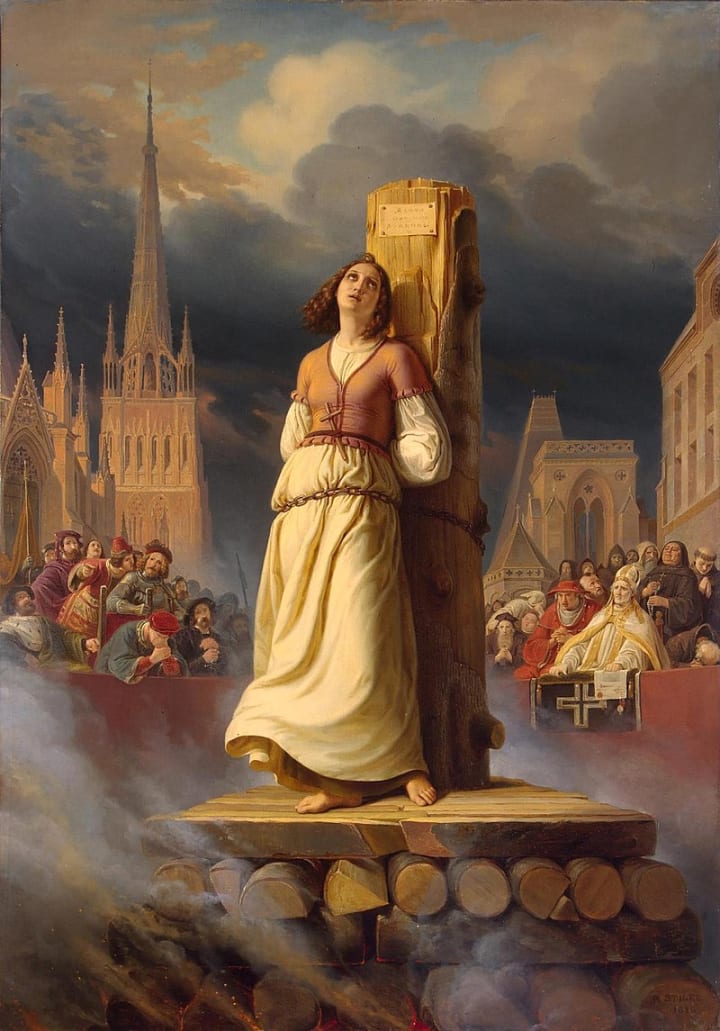
Shakespeare’s version of the trial of Joan of Arc is disturbing, and not simply because it portrays the brutal suppression and state-endorsed murder of a young woman through ruthless male authority. That is part of history, and part of the legend whereby Joan has been remembered as a martyr and become a saint. We are accustomed to tragic versions of this story, wherein the reader’s sympathies are aligned squarely with Joan.
What makes Shakespeare’s pro-English retelling harder to stomach is that here we are required to take the side of her executioners instead. Laughing along with the Duke of York and Earl of Warwick as they force Joan to confess her lies one by one, before condemning her to be burnt alive, is a task which usually proves to be beyond modern audiences – and rightly so. This might remind us of The Taming of the Shrew, another of Shakespeare’s early plays, in which comedy is generated through the harsh mistreatment of a woman. Likewise his first tragedy, Titus Andronicus, contains much violence including violence against women, and a strong vein of black humour is prevalent throughout.
BBC Television’s 1978-1985 series of Shakespeare adaptations cast as Titus Andronicus the same actor who played Talbot in Henry the Sixth Part One, perhaps indicating some acknowledgment of this troubling common ground between two of Shakespeare’s early plays. Such problems, of course, are not limited only to his very first works – The Merchant of Venice, with its stereotypical Jewish villain, has fallen considerably from favour in the decades since the Holocaust and World War Two. Nevertheless, Titus Andronicus was ignored by scholars for centuries because its bloodthirsty content failed to live up to expectations of its author, and something of the same may be responsible for the continuing neglect of Henry the Sixth, Part One. Clearly we still struggle to accept those moments when Shakespeare appears anything less than agreeable to the tastes of the present day.
About the Creator
Keep reading
More stories from Doc Sherwood and writers in BookClub and other communities.
Malvolio, in William Shakespeare's Twelfth Night
Twelfth Night; or, What You Will does not appear to have seen print until the first collected edition of Shakespeare’s works in 1623. We know however it was written around 1601, and performed in February 1602. This would make Twelfth Night the last in the group of plays we consider Shakespeare’s great comedies. By 1602 Shakespeare had already begun work on what are sometimes called the four great tragedies, and his more ambiguous and troubling comedies which are now known as the problem plays.
By Doc Sherwood3 years ago in BookClub
Rachel Reviews: Lakefront Wolves by Joseph Deegan
Meet Finn. He's an 18 year old kid who has potential. He's bright with great school scores and he's also an athlete, a footballer of some prowess. He has it all going for him, it would seem, and yet, he's determined to send what could be a well-planned, stable existence firmly off the rails. He drinks, he smokes, he takes drugs, he has violent tendencies and he's in danger of losing not only his mind but all that he holds dear.
By Rachel Deeming11 days ago in BookClub
7 Historical Romance Books You Must Read in 2026
Historical romance captivates readers by transporting them to eras filled with passion, intrigue, and societal constraints. These stories blend the allure of history with the timeless appeal of love, offering more than just escapism—they provide a window into past cultures, values, and human emotions.
By Diana Meresc5 days ago in BookClub


Comments
There are no comments for this story
Be the first to respond and start the conversation.