
Where the Crawdads Sing by Delia Owens
A Haunting Melody of Solitude, Survival, and the Untamed Heart


As I closed the final page of Delia Owens' "Where the Crawdads Sing," I found myself sitting in silence, letting the emotions wash over me like the tides of the North Carolina marsh that had become so familiar over the course of this remarkable novel. There's something profoundly moving about a story that makes you feel as though you've walked in another's footsteps, breathed their air, and carried their burdens – and Owens achieves this with a mastery that's all the more impressive considering this is her fiction debut.
The novel introduces us to Kya Clark, known to the nearby townsfolk as the "Marsh Girl," a child abandoned by her family one by one until, at just ten years old, she must learn to survive alone in the wild coastal wetlands of North Carolina. What follows is an extraordinary tale that weaves together a coming-of-age story, a murder mystery, a celebration of nature, and a poignant exploration of what it means to be truly isolated from human connection.
The Poetry of Isolation
From the opening pages, Owens' background as a wildlife scientist shines through in her breathtaking descriptions of the marsh. The setting isn't merely a backdrop; it's a living, breathing character in its own right. The marsh becomes Kya's parent, teacher, and only true friend:
"Marsh is not swamp. Marsh is a space of light, where grass grows in water, and water flows into the sky. Slow-moving creeks wander, carrying the orb of the sun with them to the sea, and long-legged birds lift with unexpected grace—as though not built to fly—against the roar of a thousand snow geese."
These lyrical passages aren't just beautiful writing—they're essential to understanding Kya's development. The natural world shapes her in ways that human society cannot, teaching her about life, death, mating, survival, and beauty. As readers, we're invited to see the world through her heightened senses, to feel the mud between our toes and the salt spray on our faces. It's a sensory experience that makes the marsh so vivid you can almost smell the brackish water and hear the rustle of cordgrass in the wind.
The Untamed Heart
Kya's emotional journey is where Owens truly excels. The raw vulnerability of a child abandoned by her mother, then her siblings, and finally her abusive father is portrayed with heartbreaking authenticity. What could have been a character defined solely by her trauma instead becomes a nuanced study in resilience and adaptation. Kya's loneliness is palpable—a physical ache that accompanies her through the years—yet she finds ways to survive and even thrive in her isolation.
Her tentative steps toward human connection are handled with delicate precision. When she meets Tate Walker, a kind local boy who teaches her to read, we witness the blossoming of first love alongside her intellectual awakening. Their relationship unfolds naturally against the rhythm of the tides, making their eventual separation all the more painful. Later, when Chase Andrews enters her life with his charming smile and empty promises, we understand Kya's vulnerability to his attention, even as we sense the danger lurking beneath.
The Mystery That Binds It All
The murder mystery element—beginning with Chase Andrews' body discovered in the marsh—provides the novel with its structuring device. Owens cleverly alternates between Kya's chronological story beginning in 1952 and the investigation of Chase's death in 1969, creating a tension that pulls readers through the narrative. This dual timeline allows us to see how the isolated "Marsh Girl" became a woman capable of both deep love and fierce independence, while simultaneously wondering: could she also be capable of murder?
The courtroom drama that unfolds in the latter part of the book offers a searing commentary on prejudice and the justice system. The townspeople's willingness to believe the worst of Kya based on rumors and her outsider status reveals much about human nature and our tendency to fear what we don't understand. Tom Milton, her defense attorney, delivers one of the novel's most powerful lines when he tells the jury: "We'd heard the testimony that Kya collected shells. I ask you, is that not what we all do? We collect shells as we walk along the beach of life...hoping to find the rare, perfect specimens. But they're just shells, dead things that once protected something living."
The Naturalist's Eye
What makes "Where the Crawdads Sing" truly distinctive is Owens' integration of natural science with human emotion. Kya's careful observations of fireflies, gulls, and other creatures become metaphors for human behavior. Her scientific drawings and collections aren't just hobbies—they're her way of making sense of a world that has rejected her. When she eventually publishes her observations as field guides, it's both a triumph of self-education and a poetic justice: the outcast becomes the authority.
The mating rituals of animals provide a particularly poignant parallel to human relationships. As Kya observes the intricate dances of fireflies, the loyalty of geese, and the deceptions of male birds who abandon their mates, she gains insights that both protect and wound her. "Female fireflies draw in strange males with dishonest signals and eat them alive," she notes, foreshadowing darker themes to come.
The Language of Poetry
Owens' prose shifts effortlessly between lyrical nature writing and straightforward narrative, with occasional bursts of colloquial dialogue that ground the story in its time and place. Kya's limited but precise vocabulary reflects her isolation and self-education, making her occasional poetic thoughts all the more striking. The poetry she reads—and eventually writes—becomes another language through which she tries to understand human connection, particularly after encountering the works of Amanda Hamilton (whose identity becomes a touching revelation later in the book).
The novel's title comes from a memory Tate shares with Kya, when his father had told him that they needed to go "where the crawdads sing" to find the real, wild places of the world. It's a metaphor that resonates throughout—the idea that there's a primal truth to be found beyond the reach of civilization, in places where nature still speaks its ancient language.
The Verdict
As the trial reaches its conclusion and truths are revealed, Owens delivers twists that feel both surprising and inevitable. The resolution to the mystery is satisfying, but it's the emotional journey that lingers. By the novel's end, we understand that this has always been a story about the human need for connection, the consequences of rejection, and the possibility of finding belonging in unexpected places.
The novel's epilogue, spanning decades in just a few pages, provides a bittersweet conclusion that had me reaching for tissues. Without spoiling its revelations, I'll simply say that Owens delivers a final twist that casts everything we've read in a new light while reinforcing the book's central themes of loneliness, love, and survival.
The Lasting Echo
"Where the Crawdads Sing" deserves its bestseller status not just for its gripping plot but for its emotional authenticity. It's a rare book that can make you feel simultaneously heartbroken and hopeful, that can transport you so completely to another place and time that you emerge from its pages feeling as though you've lived another life.
Owens has gifted us a protagonist in Kya who takes her place among the most memorable characters in contemporary literature—fierce yet vulnerable, wild yet yearning for connection. Her story is ultimately about resilience, about finding beauty in the broken places, and about the human capacity to survive against all odds.
In a world increasingly disconnected from nature, this novel reminds us of what we lose when we forget our place in the natural order. But it also celebrates our adaptability, our capacity for wonder, and our never-ending search for connection—even in the most isolated circumstances.
Like the marsh that shapes its protagonist, "Where the Crawdads Sing" is deceptively quiet on the surface but teeming with life underneath. Long after you've finished reading, you'll find yourself listening for the distant song of crawdads, calling you back to the wild, untamed places of the heart
About the Creator
THE EMBER AND THE ECHOES
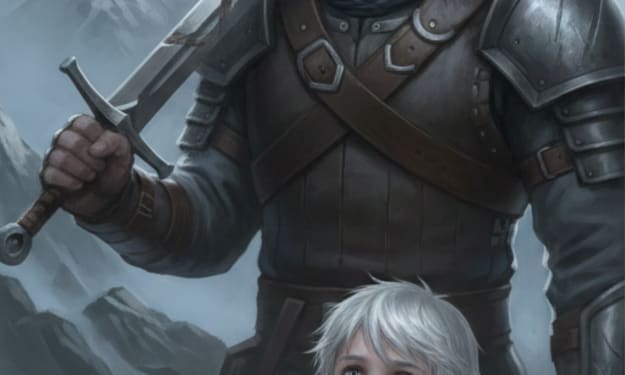
EPISODE 1: THE DEBT UNPAID The rain on the night of the Severing did not fall; it was a solid, weeping veil that drowned the world. It soaked through the midnight-blue velvet blanket, threatening to silence the weak cries of the infant wrapped within. The man who placed the bundle on the granite steps of the Iron Ridge Orphanage did not linger. He was a silhouette against the storm, tall and straight as a blade, his face a mask of terrible, empty purpose. He drove a dagger through the blanket, pinning it to the wood, the tip stopping a hair’s breadth from the infant’s side. It was not an attempt to kill; it was a punctuation mark. Attached to the hilt was a sodden scroll.
By Akua Anitaabout 4 hours ago in BookClub
Center Stage with Paul Stewart
*** I'm keen to republish the interviews I did for my series with Vocal creators. It's been a few years and I thought it might be nice to revisit these wonderful conversations. I'll be releasing them one at a time for a few weeks/months.
By Heather Hubler3 days ago in Interview



Comments
There are no comments for this story
Be the first to respond and start the conversation.