
What I Learned from The Social Contract by Jean-Jacques Rousseau
What I Learned from The Social Contract by Jean-Jacques Rousseau

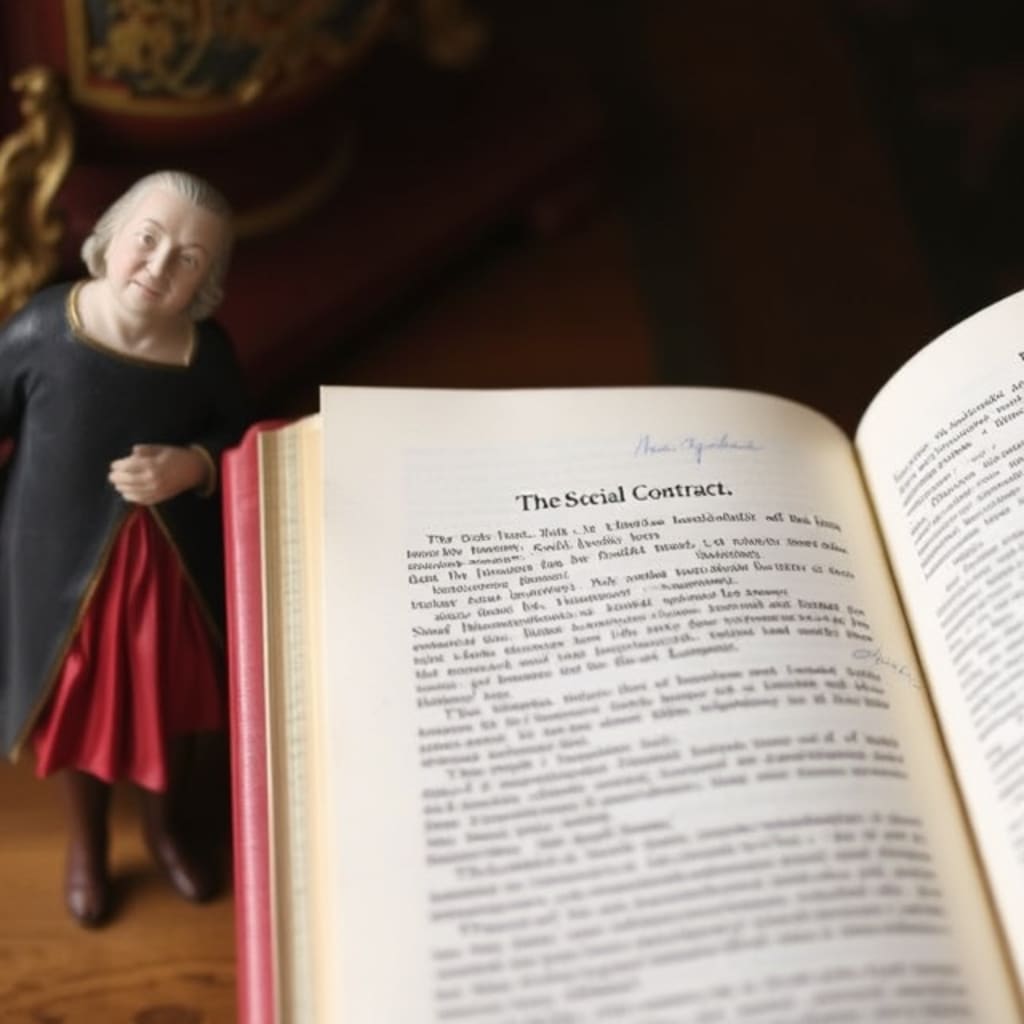
Few books have left as profound an impression on my understanding of human society as The Social Contract by Jean-Jacques Rousseau. Published in 1762, it remains one of the most significant works of political philosophy, influencing revolutions, shaping democracies, and sparking debates that continue to this day. Rousseau’s central idea—that legitimate political authority arises not from divine right or brute force but from a social contract among citizens—has fundamentally reshaped how we think about governance and human relationships.
Here are the key lessons I took away from this remarkable book and how they resonate in the modern world.
The Idea of the General Will
One of Rousseau’s most intriguing and controversial concepts is the "general will." He argues that a legitimate government is one that acts according to the collective will of its citizens, prioritizing the common good over individual interests. This idea made me rethink the relationship between personal freedom and societal obligations.
In a society governed by the general will, individuals surrender some personal freedoms to achieve a greater shared freedom. It’s not about majority rule or suppressing dissent but about collectively agreeing on principles that benefit everyone. This concept challenged me to consider how often modern politics prioritizes individual or special interests at the expense of the collective good. What does it mean, for instance, for a policy to reflect the general will in a society as diverse and polarized as ours? The question remains as vital today as it was in Rousseau’s time.
Freedom Through Cooperation
Rousseau’s paradoxical assertion that people must be “forced to be free” initially baffled me. However, as I delved deeper, I realized that he wasn’t advocating for tyranny but rather highlighting how true freedom emerges from adherence to laws that we, as citizens, have collectively established. To live according to the general will is to be free from domination—whether by a king, an oligarchy, or even unchecked individual desires.
This lesson made me reconsider the idea of freedom itself. In a hyper-individualistic world, freedom is often equated with the absence of restraint. Rousseau, however, suggests that true freedom lies in self-governance and mutual cooperation. By aligning our individual actions with the collective good, we achieve a higher form of liberty. This perspective feels particularly relevant in addressing contemporary issues such as climate change, where individual sacrifices for the collective benefit are essential.
Inequality and Corruption of Society
Rousseau’s sharp critique of inequality struck a deep chord with me. In The Social Contract, he doesn’t just focus on political structures but also questions how economic and social inequalities undermine the very foundations of freedom and democracy. According to Rousseau, the social contract is only legitimate when it ensures equality among citizens. Extreme disparities in wealth and power corrupt the general will, as the wealthy few manipulate laws and institutions to serve their interests.
This analysis resonates powerfully today, as rising inequality fuels political instability and weakens public trust in democratic systems. Rousseau’s work pushed me to reflect on how modern societies can balance economic systems with principles of fairness and equality. If inequality continues to grow unchecked, can we truly claim to live in free societies?
The Role of Civic Virtue
One of Rousseau’s enduring insights is the importance of civic virtue—the idea that citizens must actively participate in and care about the common good for a social contract to function. Reading this prompted me to examine my own engagement with my community and political system. Am I doing enough to contribute to the general will? Or am I merely a passive beneficiary of the freedoms and rights secured by others?
In a world increasingly dominated by apathy, consumerism, and disengagement, Rousseau’s emphasis on civic responsibility feels like a wake-up call. Democracies cannot thrive unless their citizens are informed, engaged, and willing to prioritize the public interest over narrow self-interest. This lesson has inspired me to take a more active role in my community, whether through volunteering, voting, or simply staying informed about the issues that matter.
The Fragility of Freedom
Finally, Rousseau’s work taught me that freedom is not a given; it is fragile and must be continually nurtured. The social contract is not a one-time agreement but an ongoing process that requires vigilance and renewal. When citizens become complacent, when leaders grow corrupt, or when inequality spirals out of control, the social contract erodes, and freedom is lost.
This insight is particularly relevant in an era of political polarization and democratic backsliding. Rousseau’s warnings remind us that freedom demands constant effort and that we must remain vigilant against forces that seek to undermine it, whether through authoritarianism, economic exploitation, or social division.
Relevance in Today’s World
Reading The Social Contract felt like a profound conversation across centuries. Rousseau’s ideas are neither easy nor uncontroversial, but their relevance is undeniable. From debates about wealth inequality to the challenges of climate change and the fragility of democratic institutions, his insights offer a lens through which to view our modern struggles.
One of my key takeaways is the importance of balance: between individual freedom and collective responsibility, between equality and liberty, and between personal interests and the common good. These tensions define the human experience and will continue to shape our political and social evolution.
As I closed the book, I found myself filled with both urgency and hope. Rousseau’s vision of a just society is not utopian but aspirational. It reminds us that while the perfect social contract may never be fully realized, striving for it is what makes us truly human.
About the Creator
Fred Bradford
Philosophy, for me, is not just an intellectual pursuit but a way to continuously grow, question, and connect with others on a deeper level. By reflecting on ideas we challenge how we see the world and our place in it.
Keep reading
More stories from Fred Bradford and writers in BookClub and other communities.
What I Learned from Atomic Habits by James Clear
James Clear’s Atomic Habits is more than just a guide to forming good habits and breaking bad ones—it’s a blueprint for personal transformation. The book’s brilliance lies in its simplicity and practicality, offering readers actionable steps grounded in behavioral science to improve their lives incrementally. Here are the key lessons I took away from this transformative read:
By Fred Bradford12 months ago in BookClub
My New Book is Finally Here
My poetry collection Beautiful and Brutal Things is done. It's actually done and finally published over 270 pages. Over a year of my life went into this book. More than a year, really. Long days at my computer, sometimes seven days a week because I couldn't stop even when I probably should have. Then two months of editing that felt harder than the writing itself. But it's finished, and I'm still standing, and the book is real.
By Tim Carmichaela day ago in BookClub
7 Books That Will Make You More Positive About Human Beings
In a world often dominated by negative headlines, political unrest, and social division, it’s easy to feel pessimistic about humanity. Yet, if we pause and look closer, countless stories reveal the remarkable capacity for kindness, cooperation, and resilience in people. Books have a unique power to illuminate these qualities—offering perspective, hope, and inspiration. Below is a list of 7 books that will make you more positive about human beings. Through these works, we can reconnect with the belief that, despite our flaws, people are fundamentally capable of good.
By Diana Meresc7 days ago in BookClub



Comments
There are no comments for this story
Be the first to respond and start the conversation.