
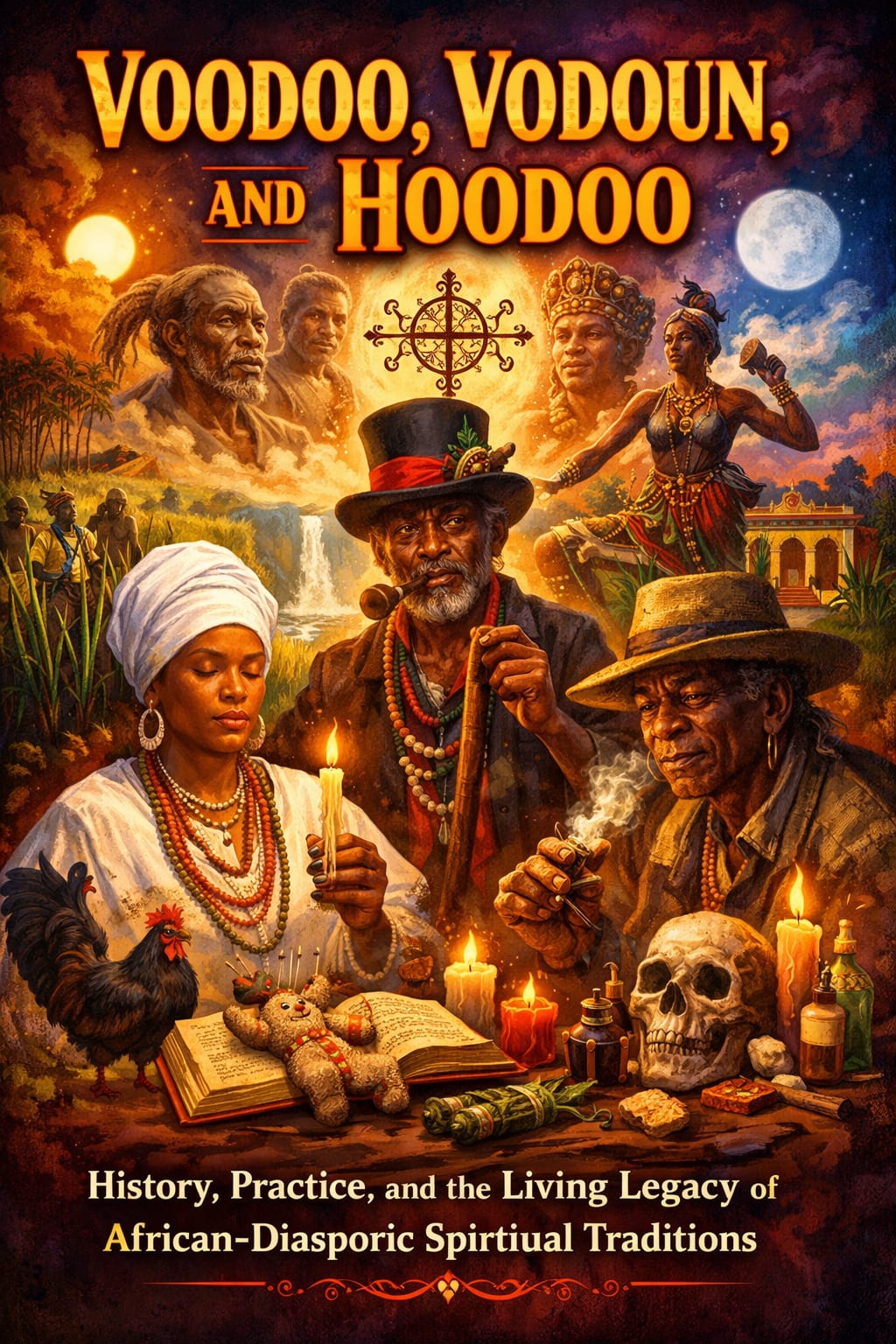
Voodoo, Vodoun, and Hoodoo
History, Practice, and the Living Legacy of African-Diasporic Spiritual Traditions

Sacred Systems Born of Survival, Memory, and Power
Voodoo, Vodoun, and Hoodoo exist as living spiritual systems shaped by forced migration, cultural fragmentation, and extraordinary resilience. These traditions did not arise in abstraction or isolation. Each developed through the preservation of African cosmologies under conditions of enslavement, colonial domination, and social exclusion. Spiritual knowledge functioned as memory, medicine, resistance, and identity when formal power structures were denied. Ritual, story, song, and practice carried ancestral worlds across oceans and generations.
Vodoun originates in West Africa, particularly among the Fon, Ewe, and related peoples of present-day Benin and Togo. In these societies, Vodoun operated as an integrated religious system governing cosmology, ethics, health, governance, and social harmony. Divine forces were understood as expressions of natural and cosmic principles rather than distant abstractions. Ancestors remained active participants in communal life, while ritual specialists maintained balance between visible and invisible realms through ceremony, divination, and healing. Knowledge transmission relied on oral tradition, embodied practice, and initiatory lineage.
The violent rupture of the transatlantic slave trade carried Vodoun worldviews into the Caribbean, where Haitian Vodou emerged under extreme repression. Enslaved Africans from multiple ethnic groups blended compatible cosmologies into a unified yet flexible system capable of adaptation. Catholic iconography became a protective veil rather than a theological replacement, allowing African deities to persist beneath saintly forms. Vodou ceremonies preserved communal bonds, reinforced moral order, addressed illness and misfortune, and sustained hope during centuries of exploitation. Vodou also played a documented role in organizing resistance, including spiritual gatherings that preceded the Haitian Revolution.
Louisiana Voodoo developed within a different colonial environment shaped by French and Spanish rule, Catholic dominance, and a complex racial caste system. African spiritual traditions intersected with Indigenous knowledge of the land and European folk magic, producing a distinct spiritual culture centered in New Orleans. Ritual practice emphasized healing, spirit intercession, public ceremony, and personal empowerment. Voodoo leaders often held significant social influence, serving as healers, counselors, and mediators within marginalized communities. The tradition became inseparable from the cultural identity of the region.
Hoodoo represents a separate but related system rooted in African American folk practice rather than formal religion. Hoodoo evolved across the American South as a practical spiritual technology addressing immediate material and spiritual needs. Enslaved and later emancipated communities relied on rootwork, conjure, herbalism, charms, and prayer to protect families, influence legal outcomes, treat illness, and secure livelihoods. African spiritual logic blended with Indigenous plant knowledge and European folk customs. Biblical texts, especially the Psalms, functioned as tools of power rather than markers of orthodox belief. Hoodoo remained adaptive, decentralized, and deeply localized.
Misrepresentation has followed these traditions for centuries. Colonial authorities labeled African spiritual systems as dangerous, primitive, or demonic in order to justify suppression. Later popular culture transformed sacred practices into spectacles of fear or exotic fantasy. Such distortions erased ethical structures, theological depth, and communal responsibility embedded within these traditions. Academic research and practitioner testimony consistently demonstrate that Vodoun, Vodou, and Hoodoo operate within moral frameworks concerned with balance, accountability, and relational harmony.
Despite historical persecution, these traditions endure. Ceremonies continue. Herbal knowledge survives. Ancestors remain honored. Spirits remain addressed through song, rhythm, prayer, and offering. Voodoo, Vodoun, and Hoodoo stand as evidence that spiritual systems rooted in ancestral memory can survive rupture, adapt to new worlds, and retain meaning across centuries. Understanding these traditions requires recognition of their origins in lived experience rather than myth, fear, or spectacle.
The Origins and History
Vodoun and the Emergence of Haitian Vodou
Vodoun developed in West Africa as a comprehensive religious and social system among the Fon, Ewe, and related peoples of the region now known as Benin and Togo. In these societies, Vodoun structured relationships between humans, the natural world, ancestral spirits, and divine forces. Spiritual life did not exist apart from daily life. Healing, governance, morality, agriculture, and family obligations were inseparable from religious practice. Sacred knowledge passed through initiation, lineage, ritual performance, and oral tradition rather than written doctrine.
The transatlantic slave trade shattered these societies through violence and forced displacement, yet spiritual knowledge endured. Enslaved Africans carried cosmological principles, ritual memory, rhythms, and sacred language into the Caribbean. In the French colony of Saint-Domingue, Africans from diverse ethnic backgrounds encountered one another under extreme conditions of brutality. Shared spiritual structures allowed distinct traditions to merge into a cohesive religious system. Haitian Vodou emerged from this convergence as both spiritual inheritance and adaptive response to colonial domination.
Colonial authorities attempted to suppress African religious expression through legal prohibition and compulsory Catholic conversion. In response, Vodou practitioners incorporated Catholic imagery as a protective strategy rather than theological submission. Saints functioned as symbolic coverings for African spirits, allowing rituals and devotions to continue under surveillance. Beneath these surface adaptations, African cosmology remained intact.
Haitian Vodou developed into an organized religion with ritual houses, sacred calendars, priesthood roles, and initiation rites. Houngans and mambos served as healers, spiritual authorities, and custodians of ritual knowledge. Ceremonies centered on drumming, song, dance, and invocation, culminating in spirit possession understood as sacred presence rather than disorder. Spirits known as lwa engaged directly with communities, offering guidance, correction, healing, and protection. Ancestors remained central, reinforcing continuity between generations.
Vodou also functioned as a source of collective strength. Spiritual gatherings provided spaces for communication, solidarity, and resistance. Historical accounts document Vodou ceremonies as sites where shared identity and resolve were affirmed during the period leading to the Haitian Revolution. Despite centuries of demonization, Vodou remains a living religion practiced in Haiti and throughout the diaspora, rooted in community, memory, and sacred continuity.
Louisiana Voodoo and the Spiritual Culture of New Orleans
In the United States, a distinct expression of Voodoo developed in Louisiana, shaped by the unique social and cultural environment of New Orleans. French and Spanish colonial rule, Catholic dominance, and the presence of free Black communities created conditions that allowed African spiritual traditions to remain visible and adaptive. African cosmologies encountered Indigenous botanical knowledge and European folk practices, producing a localized spiritual culture tied closely to place.
Louisiana Voodoo did not coalesce into a single standardized religion. Practice emphasized ritual work, spirit engagement, healing, charm making, and public ceremony. Candles, powders, gris-gris, ritual baths, prayers, and spirit petitions formed part of daily spiritual life. Catholic saints, African spirits, and folk symbols existed within a fluid spiritual landscape shaped by community need rather than formal theology.
Spiritual authority often rested with individuals recognized for effectiveness, charisma, and community trust. Marie Laveau remains the most prominent figure associated with Louisiana Voodoo. Historical records and oral tradition describe a woman whose spiritual practice intersected with social influence, healing work, and public ritual leadership. The title of Voodoo Queen reflects both spiritual standing and symbolic power within a racially stratified society.
Public ceremonies and gatherings made Louisiana Voodoo highly visible, contributing to fascination as well as misrepresentation. Sensational accounts often obscured the tradition’s role as a source of healing, counsel, and communal identity. Within Black communities, Voodoo functioned as spiritual support amid social marginalization and legal inequality.
Hoodoo, Rootwork, and Conjure Traditions
Hoodoo developed separately from Vodoun and Voodoo as a system of African American folk magic in the American South. Hoodoo does not function as a religion and does not require communal worship, temples, or priesthoods. Practice centers on applied spiritual knowledge directed toward daily concerns. This distinction remains essential to understanding the tradition.
Rooted in African cosmological logic, Hoodoo absorbed Indigenous plant knowledge and European folk practices as enslaved Africans adapted to new environments. Survival demanded practical solutions. Spiritual work addressed protection, healing, justice, luck, and economic stability. Power was understood as accessible through ritual action, sacred speech, and material symbolism.
Rootworkers and conjure doctors employed herbs, roots, minerals, animal curios, and crafted objects such as mojo bags and talismans. Spiritual baths, floor washes, candle rituals, and spoken formulas formed part of regular practice. Biblical Psalms were frequently used as tools of invocation and authority, reflecting continuity with African traditions of sacred speech rather than adherence to orthodox Christianity.
Hoodoo knowledge passed through families, apprenticeships, and community networks. Regional variation emerged as practitioners adapted methods to local conditions. Hoodoo functioned as a spiritual technology of survival under slavery, segregation, and systemic injustice. Despite ridicule and distortion, Hoodoo remains a living tradition, sustained through practice, memory, and community transmission.
Slavery, Survival, and Spiritual Resilience
The histories of Vodoun, Vodou, and Hoodoo are inseparable from the brutal realities of transatlantic slavery. Enslaved Africans brought to the Americas carried with them rich cosmologies, ritual knowledge, and communal traditions from West and Central Africa. These systems provided structure, moral guidance, and spiritual sustenance under conditions of extreme violence, forced labor, and cultural suppression. Spiritual practice became a site of resistance, preserving memory, identity, and ethical frameworks despite laws, oversight, and punishment aimed at erasing African cultural life.
In the Caribbean, enslaved Africans in Saint-Domingue (modern Haiti) adapted Vodoun to survive under colonial control. Ceremonies were often clandestine, incorporating elements of Catholic ritual to conceal African-derived practices from authorities. These adaptations ensured continuity of spirit veneration, communal solidarity, and moral instruction while protecting practitioners from violence. In Louisiana, enslaved Africans and their descendants maintained Hoodoo and Voodoo practices that combined African, Indigenous, and European elements, sustaining spiritual life within plantations, urban centers, and familial networks.
Spiritual practices under slavery were both pragmatic and sacred. Hoodoo rootwork provided tools for protection, healing, and personal empowerment in daily life. Vodou ritual offered opportunities to commune with ancestors, honor the deceased, and assert moral agency within oppressive structures. These practices were not merely symbolic; they were functional, providing guidance, resilience, and hope amid systemic violence and social marginalization.
The survival and adaptation of these traditions underscore the resilience of enslaved communities. Knowledge was preserved through oral transmission, ritual repetition, and communal mentorship. Ancestors and spirits provided both guidance and continuity, linking the living to the wisdom and experiences of those who endured bondage. Recognizing the historical context of slavery allows for a deeper appreciation of Vodoun, Vodou, and Hoodoo not only as spiritual systems, but as enduring expressions of cultural survival, moral imagination, and communal integrity.
Key Terms and Concepts
The spiritual traditions of Vodoun, Vodou, and Hoodoo are grounded in shared African cosmological principles shaped by regional history and lived experience. Language within these systems carries layered meaning, reflecting ritual function, ethical responsibility, and relational power rather than abstract belief alone.
Lwa and the Spirit World
Within Haitian Vodou, lwa function as intermediary spirits who connect human communities to the divine source of creation. Lwa are neither omnipotent gods nor symbolic archetypes. Each lwa possesses a defined personality, history, temperament, and sphere of influence. Areas of governance include healing, fertility, love, protection, justice, agriculture, death, and transition. Relationships with lwa are cultivated through ritual observance, offerings, music, dance, and ethical behavior.
Lwa are organized into spiritual nations known as nanchons, such as Rada, Petro, and Gede. These groupings reflect historical origin, ritual character, and moral orientation rather than hierarchical rank. During ceremonial gatherings, lwa may enter the bodies of initiated participants through possession. This state is understood as sacred embodiment in which the spirit temporarily inhabits the physical body to speak, heal, discipline, or restore balance within the community.
Ancestors and Ongoing Relationship
Ancestor veneration forms a foundational pillar across Vodoun, Vodou, and Hoodoo traditions. Ancestors are regarded as active participants in communal and family life rather than distant or symbolic figures. The dead retain spiritual authority and continue to influence health, fortune, and moral order.
In Vodou cosmology, death marks a transition rather than an ending. Rituals guide the spirit through separation from the physical body and eventual reintegration into ancestral status. Offerings, remembrance, and ritual communication maintain harmony between the living and the dead. In Hoodoo practice, ancestral connection often manifests through family-based rituals, graveyard work, and invocation of ancestral strength for protection or justice. Neglect of ancestral obligations is traditionally understood to result in imbalance rather than punishment.
Kanzo and Ritual Initiation
Kanzo refers to the formal initiation process within Haitian Vodou through which individuals assume ritual responsibility and spiritual obligation. Kanzo involves extended instruction, purification rites, and ceremonial trials. Initiation represents transformation rather than elevation. Those who undergo kanzo accept lifelong commitments to ethical conduct, ritual maintenance, and service to the community.
The process reflects broader African initiation traditions that emphasize symbolic death and rebirth, secrecy, discipline, and embodied knowledge. Sacred names, ritual tools, and spiritual guardians are received during initiation, establishing lineage continuity and accountability within the religious structure.
Rootwork and Conjure
Rootwork describes the applied spiritual practice central to Hoodoo tradition. Rootwork focuses on the use of botanical materials, minerals, animal elements, and ritual formulas to influence circumstances in both spiritual and material realms. Knowledge of plant properties, timing, and symbolic correspondence forms the foundation of effective work.
Rootwork does not function as devotional worship. Practice addresses concrete needs such as healing, protection, reconciliation, justice, luck, and financial stability. Ritual methods include spiritual baths, floor washes, candle work, powders, oils, and spoken prayers. Effectiveness depends on knowledge, intention, and proper execution rather than abstract belief.
Mojo Bags and Gris-Gris
Mojo bags, also known as gris-gris, are small ritual bundles used within Hoodoo and Louisiana Voodoo traditions. These bags contain selected items such as roots, herbs, stones, written petitions, personal concerns, or symbolic objects chosen for specific purposes. Each component contributes to the function of the bag through material and spiritual association.
Mojo bags are activated through prayer, breath, smoke, or ritual feeding and require ongoing care. These objects are treated as spiritually responsive tools rather than decorative charms. Loss or neglect is traditionally believed to weaken effectiveness.
Syncretism as Cultural Strategy
Syncretism refers to the blending of religious symbols that occurred under colonial rule. In Haitian Vodou and Louisiana Voodoo, Catholic saints became associated with African spirits through shared attributes, iconography, or ritual timing. This alignment allowed African religious systems to continue under enforced Christianization.
Syncretism functioned as a strategy of preservation rather than theological replacement. African cosmology remained intact beneath Catholic forms, demonstrating adaptive resilience rather than religious confusion.
Spiritual Force and Sacred Speech
Across Afro-diasporic traditions, spiritual power is understood as an active force that animates speech, action, and ritual. While terminology varies by region, the principle remains consistent. Spoken words, rhythmic sound, breath, and song are treated as vehicles of power rather than symbolic gestures. Prayer, invocation, and naming function as acts that shape reality when performed with knowledge and alignment.
Vèvè and Ritual Geometry
In Haitian Vodou, vèvè are sacred symbols drawn on the ground using cornmeal, ash, or powdered materials. Each vèvè corresponds to a specific lwa and serves as a visual invocation. These designs encode cosmological knowledge, lineage affiliation, and ritual intent. Creation of a vèvè constitutes a ritual act requiring precision and respect rather than artistic expression.
Personal Concerns and Sympathetic Connection
Within Hoodoo practice, personal concerns such as hair, handwriting, clothing, or photographs establish a spiritual link between ritual work and its intended focus. This principle reflects African concepts of interconnectedness between body, spirit, and material trace. Ethical standards govern the collection and use of personal concerns within traditional practice.
Ancestors, Memory, and the Sacred Dead
In Vodoun, Haitian Vodou, and Hoodoo, ancestors are living presences whose influence shapes the lives of their descendants. These spirits are approached as guides, protectors, and moral authorities whose continued engagement ensures community cohesion and ethical accountability. Death is not seen as a severing of existence, but as a transformation that allows the dead to participate in worldly affairs through ritual, memory, and spiritual intervention. Ancestors are treated as elders whose wisdom and power demand recognition and care. Ignoring or disrespecting these spirits is understood to disrupt spiritual balance and social harmony rather than merely failing to observe symbolic tradition.
In Haitian Vodou, ancestral spirits, or les morts, play a central role in everyday spiritual life. They are honored with offerings of food, drink, and symbolic objects, as well as through prayer and ceremonial acknowledgment during major rituals. Ancestors act as mediators between the human world and the lwa, reinforcing moral and spiritual guidance while sustaining communal memory. Their presence links generations, preserving ethical practices, historical knowledge, and cultural continuity even in the face of displacement and adversity.
Hoodoo practices also emphasize ongoing relationships with ancestors, often through domestic rituals and personal devotion. Family altars, graveyard visits, and ritual remembrance allow practitioners to consult ancestors for guidance, protection, or resolution of challenges. Elements such as graveyard dirt, herbal offerings, or sacred objects symbolize ancestral authority and the continued presence of those who have passed. Through these practices, knowledge that survived enslavement, migration, and systemic oppression is maintained and honored. Ancestors serve as living repositories of history, memory, and resilience.
Ancestral veneration is inseparable from ethical responsibility. Ritual practice is understood as a reciprocal relationship; the living honor the dead while maintaining integrity in daily actions. Decisions, prayers, and spiritual work are framed by ancestral expectations, emphasizing accountability to family, community, and spiritual lineage. This framework discourages superficial engagement and underscores why meaningful participation requires study, respect, and humility.
The veneration of ancestors also reinforces historical memory. Practices, oral transmission, and ritual repetition preserve knowledge that might otherwise have been lost. Each ceremonial act or domestic ritual strengthens the continuity of cultural identity and spiritual heritage. The presence of the dead in these traditions is not metaphorical, but real, active, and essential. Recognizing ancestors as integral participants in spiritual life allows a fuller understanding of Vodoun, Vodou, and Hoodoo as living, relational systems grounded in history, ethics, and resilience.
Influential Figures
The spiritual traditions of Vodoun, Vodou, and Hoodoo have been shaped and sustained by leaders, healers, ritual specialists, and community figures whose lives embody the ethical, cultural, and ritual principles of their practices. Influence within these systems is measured not by fame alone but by spiritual authority, ethical guidance, ritual mastery, and service to community.
Marie Laveau: The Voodoo Queen of New Orleans
Marie Laveau remains the most widely recognized figure in Louisiana Voodoo history. Born in the late eighteenth century in New Orleans, she gained prominence as a healer, spiritual counselor, and ritual leader. Laveau’s practice combined African spiritual knowledge, Catholic ritual forms, and folk healing techniques. She served as an intermediary between spirits and the local community, providing guidance on health, justice, personal challenges, and social relations.
Laveau’s authority extended beyond ritual practice. Historical accounts and oral tradition depict her as a community organizer, confidante, and protector of the marginalized. Her reputation for spiritual power and ethical leadership cemented her enduring legacy, preserved in contemporary Voodoo practice, storytelling, and ceremonial remembrance. Public ceremonies associated with Laveau, including annual rituals at her gravesite, reflect her ongoing symbolic and spiritual presence in New Orleans.
Mama Lola: Vodou in the Diaspora
Marie Thérèse Alourdes Macena, better known as Mama Lola, is a Haitian Vodou mambo whose life and practice were extensively documented by anthropologist Karen McCarthy Brown. Through immersive ethnographic study, Brown illustrated Vodou as a living, embodied religious tradition rather than a sensationalized or exoticized caricature.
Mama Lola’s practice exemplifies continuity between Haitian Vodou and its diasporic expressions in the United States. Her rituals, healing work, spirit possession ceremonies, and community leadership demonstrate the ethical frameworks and spiritual discipline inherent in Vodou. Mama Lola’s public visibility helped reshape academic and popular understanding, highlighting Vodou as a religion of community care, ethical engagement, and ancestral connection.
Jean-Jacques Dessalines and Vodou in Haitian History
Though primarily recognized as a revolutionary leader, Jean-Jacques Dessalines’ life intersected with Vodou practice in ways that highlight the religion’s social and political dimensions. Vodou ceremonies and spiritual gatherings played a crucial role in the Haitian Revolution, serving as spaces for communal solidarity, moral fortification, and strategic planning. While not a ritual specialist, Dessalines’ engagement with Vodou demonstrates the religion’s historical function as a source of resilience and collective empowerment.
Zora Neale Hurston: Anthropologist and Storyteller
Zora Neale Hurston, though primarily known as a novelist and anthropologist of the Harlem Renaissance, made significant contributions to the documentation and preservation of African American folk spiritual practices, including Hoodoo and Louisiana Voodoo. Through ethnographic writing and oral history collection, Hurston preserved stories, ritual knowledge, and practitioner testimony, emphasizing the complexity, humanity, and moral structure of these traditions. Her work has informed both scholarship and public understanding, situating Hoodoo and Voodoo within lived cultural realities rather than caricature.
Catherine “Queen Betsy” Sejour: Louisiana Voodoo Leadership
Another historically influential figure in New Orleans was Queen Betsy, a contemporary and predecessor of Marie Laveau. Known for her healing work and spiritual counsel in the early nineteenth century, Queen Betsy contributed to the formation of ritual structures and communal authority that informed subsequent Voodoo practice. Oral histories credit her with mentoring future leaders and maintaining spiritual continuity during a period of social instability.
Malfini, Simbi, and Spirit Authorities in Vodou Lineage
Within Haitian Vodou, certain priesthood lineages maintain historical significance through their spiritual and ritual contributions. Leaders associated with Rada and Petro nanchons, including houngans and mambos with generational lineages, have preserved ritual techniques, sacred songs, dance forms, and healing practices. These figures, though often unnamed in published accounts, form the backbone of Vodou’s living continuity and community instruction.
Black American Rootworkers and Hoodoo Practitioners
Hoodoo practice in the American South was historically shaped by anonymous but influential rootworkers who transmitted practical spiritual knowledge through families, apprenticeships, and local networks. Figures such as Dr. Buzzard and other documented conjure doctors exemplify the role of rootwork as a survival strategy and ethical system. Their work addressed health, justice, protection, and economic well-being within African American communities during slavery, Reconstruction, and Jim Crow eras.
Intersection with Western Esotericism
Although not practitioners of Vodoun or Hoodoo, Western esoteric figures such as Aleister Crowley, Gerald Gardner, and others influenced the broader metaphysical landscape. Their writings and ritual frameworks intersected with popular interest in African diasporic spiritual systems, often in ways contested by traditional practitioners. These interactions highlight the importance of cultural integrity and the ethical considerations surrounding spiritual borrowing or adaptation.
Core Practices
The spiritual systems of Vodoun, Vodou, and Hoodoo are expressed through richly developed ritual and practical practices. These practices operate simultaneously as methods of spiritual engagement, ethical formation, community cohesion, and individual empowerment. Across traditions, ritual and material culture mediate human interaction with spirits, ancestors, and natural forces, sustaining cosmology through embodied action.
Ceremonial Rituals in Haitian Vodou
Haitian Vodou ceremonies represent the public and sacred performance of the religion’s cosmology and moral framework. Rituals take place in hounfors, ceremonial spaces maintained by houngans and mambos, or in private domestic settings. Central elements of Vodou ceremony include drumming, rhythm, song, dance, invocation, offerings, and spirit possession.
Drumming follows precise patterns corresponding to particular lwa or ritual stages. Drums, known as tanbou, serve as conduits between the human and spiritual realms. Songs incorporate call-and-response structures and lyrics that recount the history, powers, and moral character of specific lwa. Rhythm functions as spiritual language, guiding both possession and communal engagement.
Dance constitutes both devotional expression and a physical vehicle for spirit possession. Ritual participants move in patterns aligned with the character of the lwa they invite. Spirit possession allows lwa to temporarily inhabit the bodies of initiates, providing counsel, healing, and instruction to the community. Contrary to popular misconception, possession is controlled and consensual, conducted within established ethical and ceremonial frameworks.
Offerings are central to ceremonies. These may include food, drink, perfumes, flowers, and objects symbolically associated with particular lwa. Each offering follows a precise ethical and ritual protocol, reflecting reciprocal obligation between humans and spirits. Offerings sustain relational networks, ensure moral alignment, and honor the continuity of the sacred.
Ceremonies also reinforce community cohesion. They function as spaces for moral education, dispute resolution, and collective affirmation of cultural identity. Ritual practice embeds knowledge, ethics, and social memory in both participants and observers, preserving cultural continuity despite historical and social disruption.
Conjure, Rootwork, and Practical Spiritual Application
Hoodoo, distinct from Vodou in structure and theology, emphasizes practical spiritual labor aimed at influencing daily life. Rootwork constitutes the central methodology, utilizing natural materials and ritual action to address protection, health, justice, luck, reconciliation, and prosperity.
Mojo bags, also known as gris-gris, are crafted bundles containing roots, herbs, minerals, personal concerns, and symbolic objects. Each component carries both material and spiritual resonance. Bags are activated through prayer, ritual feeding, smoke, or sacred motion. Maintenance may involve periodic blessing or reinforcement, reflecting the understanding of mojo as a responsive spiritual tool.
Spiritual baths and floor washes harness the energy of water, herbs, and ritual substances to cleanse, protect, or influence personal circumstances. Baths often combine aromatic plants, salts, oils, and prayers, administered under specific lunar or planetary conditions to enhance efficacy. Floor washes integrate similar ingredients and intentions, symbolically shaping space and environment.
Talismans, charms, and protective amulets extend the principles of rootwork into material form. Crafted with botanical, mineral, or symbolic items, these objects focus intent, mediate spiritual power, and safeguard individuals, households, or property. Proper preparation, ethical use, and alignment with community or ancestral norms are considered essential to success.
Syncretic Ritual Objects and Symbolic Tools
Across Vodou and Hoodoo, material objects function as mediators between the spiritual and physical worlds. In Haitian Vodou, vèvè are sacred geometric symbols drawn on the ground using cornmeal, ash, or powdered substances. Each vèvè corresponds to a specific lwa and provides a visual invitation, mapping cosmological principles and ritual intent. Creation of vèvè is considered a sacred act requiring focus, precision, and ethical responsibility.
Other ritual objects appear in both Vodou and Hoodoo practice. Candles, often colored to correspond with specific lwa or intentions, serve as focal points for meditation, prayer, and activation of spiritual energy. Holy water, herbs, and ritual powders are applied in ceremonies to purify, protect, or transform spaces, objects, or participants. These items are not merely symbolic; they operate as active instruments in a cosmologically structured system of action, intention, and reciprocity.
Healing, Divination, and Communal Guidance
Healing is a central practice in both Vodou and Hoodoo. In Vodou, healers employ herbs, ritual, and lwa intervention to address physical, emotional, and spiritual imbalance. Divination techniques, such as card reading, shell casting, or spirit consultation, guide decisions, restore harmony, and confirm ritual timing.
In Hoodoo, divination also guides rootwork and practical spiritual interventions. Knowledge of correspondences—between plants, days of the week, lunar cycles, or planetary influence—ensures the proper application of ritual techniques. Both systems integrate healing, ethics, and community responsibility, linking spiritual practice to tangible outcomes in human life.
Ritual as Ethical and Cultural Practice
Across these traditions, ritual functions simultaneously as spiritual communication, ethical instruction, and cultural preservation. Every action, from dance to the crafting of a mojo bag, carries intentionality, ethical accountability, and a relational dimension. Ritual practice reinforces identity, continuity, and social cohesion while honoring ancestors and maintaining reciprocal connections with the spirit world.
Through these ceremonies, practices, and material interactions, Vodoun, Vodou, and Hoodoo transmit knowledge, memory, and ethical frameworks, demonstrating that these traditions are living systems of spiritual, social, and cultural resilience.
Controversies and Misconceptions
Voodoo, Vodoun, and Hoodoo have faced persistent misrepresentation, often shaped by colonial narratives, sensationalist media, and popular culture. Misunderstanding has created social stigma and obscured the religious, ethical, and cultural significance of these traditions. Historical context and careful scholarship reveal both the sources of these misconceptions and their impact on perception and practice.
Misrepresentation in Popular Culture
Popular portrayals of Voodoo and Hoodoo in Western media have often emphasized fear, exoticism, and supernatural spectacle. Films, literature, and television frequently depict dolls with pins, curses, necromantic powers, and malevolent magic as central to these traditions. Such representations flatten complex spiritual systems into caricature and propagate the idea of “voodoo magic” as inherently sinister.
These distortions trace back to colonial propaganda and early travel writing, where African-derived religious practices were depicted as primitive or threatening to justify control and exploitation. Later fictional accounts reinforced these tropes for entertainment, often neglecting historical accuracy or cultural nuance. Conflation of separate traditions—Vodoun, Haitian Vodou, Louisiana Voodoo, and Hoodoo—into a single monolithic category further compounds misunderstanding. Each system possesses its own cosmology, ritual structure, ethical framework, and cultural history. Oversimplification obscures this diversity and erases the lived experiences of practitioners.
Ethical Boundaries and Cultural Integrity
Practitioners consistently emphasize the ethical dimensions of spiritual work. Vodou, Hoodoo, and Louisiana Voodoo operate within systems of accountability, lineage, and community protocols. Ritual practices, healing work, and spirit consultation are embedded in relational obligations that connect practitioners to ancestors, spirits, and the human community. Misapplication or unsupervised experimentation by outsiders can violate these ethical structures and is often regarded as disrespectful or appropriative.
Community guidance stresses that spiritual power is inseparable from knowledge, intention, and social responsibility. Hoodoo rootwork, for example, is not merely a set of techniques but a practice sustained through apprenticeship, mentorship, and ethical alignment. Similarly, Vodou priesthood requires initiation, ritual knowledge, and a commitment to communal service. Attempts to extract ritual practices for entertainment, profit, or personal gain ignore these embedded responsibilities and risk misrepresenting the tradition.
The “Witchcraft” Label and Cultural Reduction
Labeling Vodou or Hoodoo as “witchcraft” in popular or academic discourse often oversimplifies complex religious systems. While ritual techniques, spellwork, and spirit engagement may superficially resemble European notions of witchcraft, this comparison misrepresents both the scope and ethical grounding of these traditions. Vodou and Hoodoo are structured around cosmology, communal obligations, ancestral relationships, and moral accountability rather than individualistic or adversarial notions of magical power.
Such reductionist labeling contributes to misunderstanding, stigma, and cultural erasure. It frames spiritual practice through an external lens rather than acknowledging the internal logic, historical context, and lived experience that give these traditions meaning. Accurate understanding requires attention to specific historical trajectories, ethical frameworks, and ritual protocols unique to each system.
Historical Persecution and Stigmatization
Both Vodou and Hoodoo have historically faced persecution, often legally and socially enforced. In colonial Haiti, African-derived religious expression was criminalized and suppressed. In the United States, Hoodoo was marginalized during slavery and segregation, with practitioners facing legal and social risks. Misrepresentation in media and popular imagination has perpetuated these stigmas, shaping public perception and reinforcing prejudice against African-descended religious and magical traditions.
Despite these challenges, these traditions have survived and adapted, maintaining ethical, spiritual, and communal continuity. Understanding controversies and misconceptions is essential for appreciating the resilience, sophistication, and cultural significance of Vodoun, Vodou, and Hoodoo.
Contributions to Modern Occultism and Witchcraft Movements
Afro-diasporic spiritual systems, including Vodoun, Haitian Vodou, Louisiana Voodoo, and Hoodoo, have contributed profoundly to contemporary occultism, modern witchcraft, and eclectic spiritual practices. Their influence extends to ritual structure, spirit communication, trance work, ceremonial drumming, herbal magic, and material symbolism. These contributions are often adopted or adapted in global spiritual communities, but understanding the depth and cultural grounding of these practices is critical for respectful and accurate engagement.
Ritual Structure and Community-Centered Practice
One of the most significant contributions of Afro-diasporic traditions is the emphasis on structured ritual as a medium for spiritual and social cohesion. Haitian Vodou ceremonies integrate drumming, call-and-response singing, ritual dance, and spirit possession into a communal framework. Drumming patterns correspond to specific lwa and act as spiritual languages, facilitating communication between the human and spirit worlds. Ritual dance embodies the character and movement of spirits, and ceremonial possession allows lwa to speak, heal, and guide the community.
In modern occult and witchcraft practices, these elements have influenced approaches to collective ritual, ecstatic states, and spirit work. Ceremonial drumming, rhythm-based meditation, and guided trance are increasingly incorporated into contemporary magical systems. However, the intention and ethical framework of Afro-diasporic practice differ from many modern adaptations. Vodou rituals function as reciprocal engagements with spirits, grounded in community care and ethical accountability, while some contemporary adaptations emphasize individualistic or performative experiences without relational or moral frameworks.
Spirit Work and Altered States
Spirit communication and trance states are central to Vodou and Voodoo and have inspired modern magical practices that involve channeling, mediumship, or ritual possession. In Afro-diasporic systems, spirit possession is carefully regulated, ethical, and embedded in community life. Practitioners are trained to mediate safely and respectfully with spiritual forces. Spirits act as guides, healers, or moral agents rather than sources of arbitrary power or spectacle.
Contemporary magical practitioners often explore altered states and mediumship, drawing inspiration from these traditions. The ethical and ritual principles of Vodou and Hoodoo, however, highlight the importance of preparation, intention, and community accountability. Ignoring these dimensions risks misrepresentation, spiritual harm, or the commodification of sacred practices.
Botanical, Root, and Material Magic
Hoodoo and Louisiana Voodoo have contributed significantly to the widespread understanding of botanical and material magic in modern occultism. Rootwork techniques, use of mojo bags, herbal baths, protective talismans, powders, and oils demonstrate the practical application of spiritual intention through natural materials. Botanical magic and talismanic work in eclectic witchcraft and contemporary magical practice often mirror these methods, using herbs, minerals, and symbolic objects to influence health, prosperity, protection, or luck.
These practices are deeply embedded in the ethical and cosmological frameworks of Afro-diasporic traditions. Knowledge of correspondences, timing, ritual preparation, and ancestral approval is essential for effective practice. Extracting techniques without this knowledge removes ethical and relational dimensions, reducing the practices to mere superstition or decoration.
Syncretism and Ritual Innovation
The historical adaptability of Afro-diasporic spiritual systems demonstrates syncretic potential that has informed modern occult practices. Vodou and Louisiana Voodoo blend African cosmologies with Catholic, Indigenous, and European folk traditions to preserve spiritual continuity under colonial pressure. This adaptability provides a model for ritual innovation in contemporary spiritual communities while maintaining ethical grounding.
Modern practitioners inspired by these traditions are encouraged to study historical context, honor lineages, and recognize the communities that sustained these practices. Syncretism in contemporary magic must be distinguished from appropriation, with attention to ancestral relationships, moral obligations, and cultural context.
Influence on Eclectic Witchcraft
Elements of Vodou and Hoodoo, including ritual structure, spirit invocation, trance, and material magic, have influenced eclectic and neo-pagan witchcraft traditions worldwide. Practitioners incorporate drums, chants, rootwork, and talismans into rituals, often blending them with Western ceremonial magic or pagan practices. Despite shared techniques, the underlying meaning differs. Afro-diasporic systems are relational, community-centered, and ethically grounded, while some eclectic applications prioritize personal power or aesthetic symbolism. Recognition of these differences is essential to preserve the integrity of the original traditions.
Ethical Responsibility and Cultural Respect
Engagement with Afro-diasporic spiritual systems requires ethical responsibility, cultural awareness, and historical knowledge. Practitioners emphasize respect for lineages, initiation, communal authority, and ancestral connection. Study or adaptation without this framework risks misrepresentation, cultural appropriation, and spiritual harm. Communities rooted in Vodou, Hoodoo, and Louisiana Voodoo stress that practice is inseparable from moral accountability, communal care, and relational ethics.
Respectful engagement includes acknowledgment of origin communities, consultation with knowledgeable practitioners, and attention to historical and social context. These principles ensure that contemporary practice honors the resilience, sophistication, and ethical frameworks of the traditions from which inspiration is drawn.
Lasting Cultural and Spiritual Influence
The enduring influence of Afro-diasporic spiritual systems on modern occultism and witchcraft highlights their complexity, adaptability, and resilience. Ritual forms, trance states, spirit work, and botanical magic have provided models for contemporary practice. Yet, these contributions retain full significance only when approached with cultural awareness, ethical responsibility, and historical knowledge. Understanding the origins and purposes of these practices allows practitioners to engage meaningfully without erasing or distorting the traditions that created them.
Recommended Reading: #commissionearned
Mama Lola: A Vodou Priestess in Brooklyn by Karen McCarthy Brown
Karen McCarthy Brown’s ethnographic study documents the lived religious world of Alourdes Margaux, widely known as Mama Lola, a Haitian Vodou priestess practicing in Brooklyn. The book presents Vodou as a coherent religious system grounded in ritual, ethics, kinship, and ancestral obligation rather than spectacle or superstition. Brown’s long-term relationship with Mama Lola allows detailed insight into initiation, healing work, spirit possession, and daily devotional life. Vodou emerges as adaptive, diasporic, and deeply relational, shaped by migration, gender, family, and community responsibility. The work challenges colonial and sensationalized narratives by centering practitioner authority and spiritual agency. This text directly supports understanding of Vodou as a living tradition sustained through ritual knowledge, lineage, and communal care.
Divine Horsemen: The Living Gods of Haiti by Maya Deren
Maya Deren’s classic work offers one of the most influential early studies of Haitian Vodou ritual, aesthetics, and cosmology. Written from direct participation and observation, the text emphasizes rhythm, movement, dance, and possession as sacred technologies rather than theatrical phenomena. Deren presents lwa as relational beings whose presence reinforces ethical and cosmological order within the community. The book also examines the philosophical foundations of Vodou, including balance, reciprocity, and ancestral continuity. Despite limitations reflective of its historical period, the work remains foundational for understanding ritual structure and embodied spirituality. This text contributes essential insight into ceremonial practice and the spiritual logic underlying Vodou ritual life.
Tell My Horse: Voodoo and Life in Haiti and Jamaica by Zora Neale Hurston
Zora Neale Hurston combines anthropology, folklore, and narrative observation to document Afro-Caribbean spiritual life in Haiti and Jamaica. The work contextualizes Vodou within everyday social realities, economic survival, and post-colonial identity. Hurston presents ritual, belief, and spiritual authority as inseparable from cultural resilience and historical memory. Observations of initiation, spirit work, and healing practices emphasize Vodou as a system of moral and communal coherence. The writing foregrounds Black cultural authority at a time when African-derived religions were routinely dismissed or distorted. This text reinforces the blog’s emphasis on Vodou as lived religion rooted in history and cultural continuity.
Voodoo Hoodoo Spellbook by Denise Alvarado
Denise Alvarado presents a practitioner-oriented exploration of Hoodoo and Louisiana Voodoo rooted in historical research and regional tradition. The book documents spiritual practices associated with protection, justice, healing, and prosperity, drawing from African American folk magic and New Orleans spiritual culture. Alvarado situates ritual techniques within cultural lineage rather than presenting them as abstract or universal spells. Attention is given to roots, herbs, oils, candles, and prayer forms commonly associated with Hoodoo practice. The text emphasizes ethical intention, ancestral awareness, and spiritual responsibility. This work complements the blog’s discussion of Hoodoo as practical spiritual labor grounded in lived experience and historical context.
Hoodoo, Voodoo, and Conjure: A Handbook by Jeffrey E. Anderson
Jeffrey E. Anderson provides a clear historical and cultural overview of Hoodoo, Vodou, and Conjure as distinct yet related traditions. The book traces African origins, transatlantic survival, and adaptation within American and Caribbean contexts. Anderson distinguishes religious systems from folk magic practices while acknowledging points of overlap. Attention is given to social conditions such as enslavement, segregation, and migration that shaped spiritual expression. The text also addresses common misconceptions and sensationalism surrounding these traditions. This handbook supports accurate differentiation between Vodou and Hoodoo while reinforcing shared cultural foundations discussed throughout the blog.
Mules and Men by Zora Neale Hurston
Mules and Men documents African American folklore, Hoodoo practices, and oral tradition through immersive fieldwork in the southern United States. Hurston records stories, rituals, rootwork techniques, and spiritual beliefs shared by community practitioners. Hoodoo appears as a practical system addressing justice, protection, love, and survival rather than abstract magic. The work highlights oral transmission, mentorship, and community authority within spiritual practice. Hurston preserves voices often excluded from academic discourse, emphasizing lived knowledge and cultural continuity. This book directly reinforces the blog’s portrayal of Hoodoo as rooted in everyday spiritual resilience.
Vodou: Haitian Creole Religion by Diohka Aesden
Diohka Aesden presents Vodou through the perspectives of houngans and mambos, focusing on ritual structure, spirit relationships, and healing traditions. The text explores lwa such as Papa Legba and Ezili Dantor within cosmological and ethical frameworks. Rituals, initiation, and spiritual service are described as communal responsibilities rather than individual pursuits. The work emphasizes healing, balance, and ancestral continuity as core principles of Vodou practice. While written for spiritual seekers, the book aligns with practitioner-centered perspectives. This text supports the blog’s emphasis on Vodou as a coherent religious system grounded in service and ethical obligation.
The Voodoo Path: Unveiling the Mysteries of New Orleans Voodoo and Haitian Vodou by Mari Silva
Mari Silva presents an accessible overview of New Orleans Voodoo and Haitian Vodou, focusing on history, symbolism, and ritual structure. The book outlines spiritual principles, common practices, and historical development without framing the traditions as exotic or malicious. Attention is given to spirit relationships, ritual tools, and cultural origins. The work serves as an introductory bridge for readers unfamiliar with Afro-diasporic religions. While less academic than other titles, the book reinforces the importance of respect and historical awareness. This text complements the blog’s goal of fostering informed curiosity while cautioning against superficial engagement.
Beyond Myth and Misunderstanding
Voodoo, Vodoun, and Hoodoo endure as living spiritual systems shaped by endurance, adaptation, and cultural memory. These traditions emerged from conditions of displacement, enslavement, and cultural suppression, yet preserved complex cosmologies, ethical structures, and ritual knowledge across generations. Far from relics of the past, they continue to guide healing, moral responsibility, and community cohesion within diasporic communities today. Their survival reflects deliberate acts of preservation, teaching, and spiritual labor carried out by ancestors whose knowledge was safeguarded through oral transmission, ritual practice, and communal care.
Misrepresentation and oversimplification continue to obscure the depth of these traditions. Popular culture frequently substitutes fear, spectacle, or novelty for historical reality and lived experience. Such distortions erase practitioner voices and disconnect spiritual practice from its cultural foundations. Accurate understanding requires attention to historical record, anthropological research, and practitioner testimony, particularly from those whose families and communities have sustained these systems across centuries.
Serious engagement with Vodou, Vodoun, and Hoodoo begins with reading, listening, and contextual learning. Primary texts, ethnographic studies, and community-centered scholarship provide essential insight into ritual meaning, ethical frameworks, and spiritual authority. Equally important is recognizing that knowledge within these traditions is not freely extractable or universally transferable. Spiritual practice is shaped by lineage, mentorship, and communal accountability, and respectful study acknowledges these boundaries.
Readers drawn to these traditions are encouraged to continue research with patience and intellectual integrity. Study grounded in humility fosters understanding rather than appropriation. Attention to historical truth honors both the people who preserved these traditions and the spiritual frameworks they continue to uphold. Through careful reading, ethical inquiry, and respect for cultural specificity, deeper appreciation becomes possible, allowing these traditions to be encountered as they exist in lived reality rather than imagined myth.
Voodoo, Vodoun, and Hoodoo remain vital expressions of spiritual resilience and cultural knowledge. Their continued presence affirms the power of tradition to endure, adapt, and speak across generations. Thoughtful study ensures that this legacy is approached with clarity, respect, and responsibility.
About the Creator
Marcus Hedare
Hello, I am Marcus Hedare, host of The Metaphysical Emporium, a YouTube channel that talks about metaphysical, occult and esoteric topics.
https://linktr.ee/metaphysicalemporium
Keep reading
More stories from Marcus Hedare and writers in BookClub and other communities.
The Lemurian Path
Opening the Path Lemurian Mysticism sits at an unusual crossroads where scientific history, speculative philosophy, and spiritual imagination meet. People encounter it in many ways. Some hear about Lemurian crystals. Others come across stories of an ancient civilization that valued cooperation over conflict. Still others meet the idea through meditation circles that speak of memory, intuition, and the possibility of forgotten wisdom. However someone arrives at it, Lemurian Mysticism has a way of inviting curiosity. It encourages people to ask where stories begin, how beliefs take shape, and why certain ideas endure long after the facts that created them have faded.
By Marcus Hedare29 days ago in BookClub
Golden's Bridge Mom Hangs in There with New Book on Raising Teenagers
See John Jay Crowd Shots and all Winter Photos Below When Ali Flynn became an empty nester in September 2025, it wasn’t the sight of her twins leaving that brought finality. Out food shopping, the mother of four realized that she had no idea how much broccoli to buy. “I started crying,” Flynn remembered. Broccoli obviously not the point, the feelings are, and the angst and joy of raising teenagers is meant to be shared as a form of support. So that’s just what the Golden’s Bridge mom has done.
By Rich Monettia day ago in BookClub
'20/20'
"Do It Again" the track that would ultimately open the Beach Boys final album on Capitol Records which was released on February 10th 1969 had originally been released as a single in August of 1968. The track was the first of many post-Pet Sounds era throwbacks to the early Beach Boys sound which would become continually more cliched and eventually lead the Beach Boys to the level of self-parody they would eventually succumb to in the 1980s while their closest contemporaries The Beatles nearing the end of their run in 1969 would go on to be viewed as the most influential band of all time. However, the song itself is not bad on its surface, and it opens with a futuristic sounding (for 1969) drumbeat captured by then-Beach Boys engineer Stephen Desper using tape delays on the drums performed by Dennis Wilson and John Guerin. The song has been re-recorded numerous times over the years on various Beach Boys-related projects most notably the 2011 re-recording at Capitol studios featuring the five surviving Beach Boys at the time backed instrumentally by various members of both the Brian Wilson Band and Mike Loves touring "Beach Boys" to promote the then upcoming Beach Boys 50th Anniversary reunion tour in 2012. The hammering and power drill sound at the end of the song was an excerpt from a track called "Workshop" that was to be a part of the uncompleted "SMiLE" album.
By Sean Callaghan6 days ago in Beat


Comments
There are no comments for this story
Be the first to respond and start the conversation.