
The Lemurian Path
A Clear Look at the Legends, Teachings, and Mystery

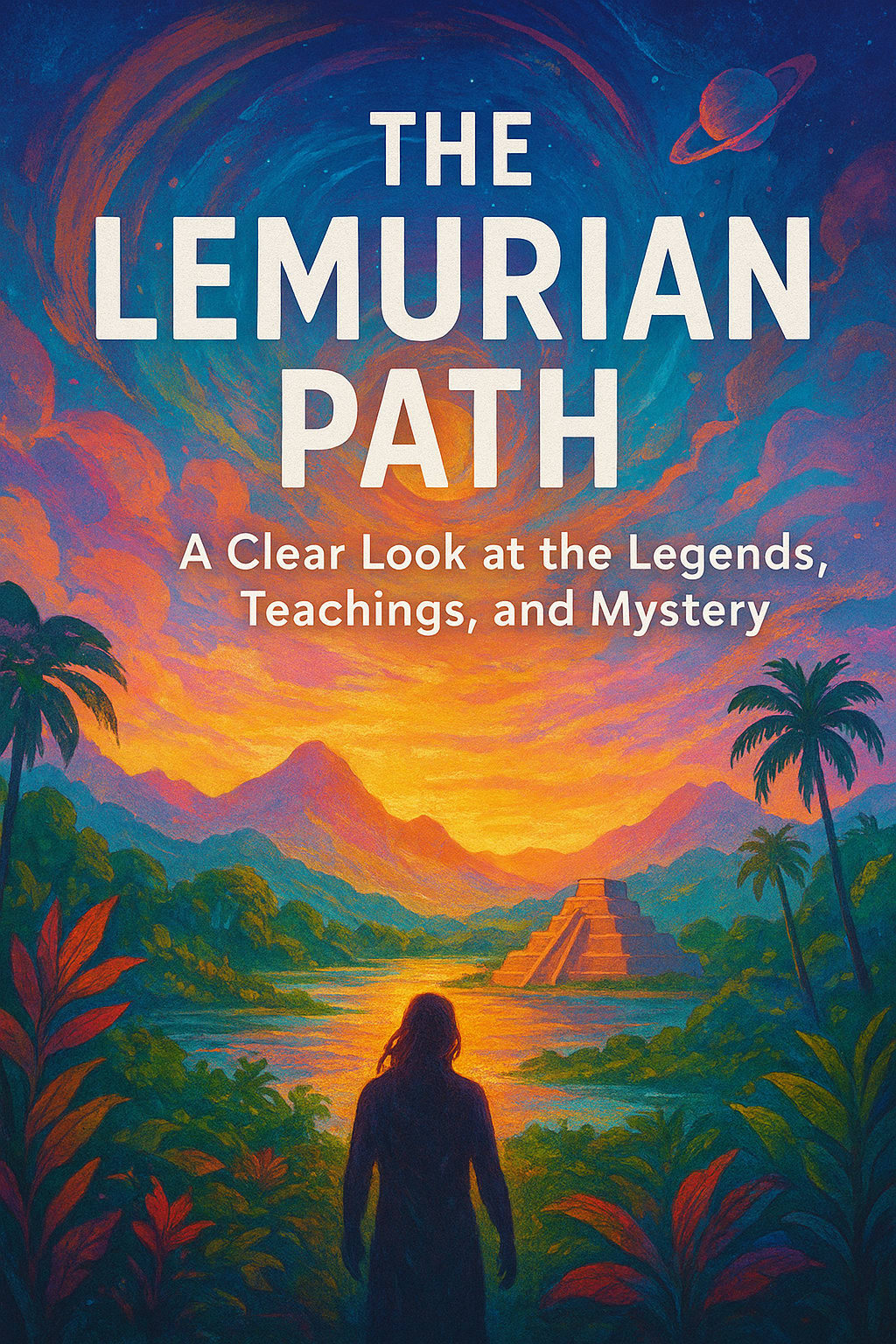
Opening the Path
Lemurian Mysticism sits at an unusual crossroads where scientific history, speculative philosophy, and spiritual imagination meet. People encounter it in many ways. Some hear about Lemurian crystals. Others come across stories of an ancient civilization that valued cooperation over conflict. Still others meet the idea through meditation circles that speak of memory, intuition, and the possibility of forgotten wisdom. However someone arrives at it, Lemurian Mysticism has a way of inviting curiosity. It encourages people to ask where stories begin, how beliefs take shape, and why certain ideas endure long after the facts that created them have faded.
The earliest roots of the Lemurian story come from a scientific problem that puzzled nineteenth century naturalists. In 1864, British zoologist Philip Sclater attempted to solve a distribution puzzle involving lemurs. Fossil evidence showed links between animals in Madagascar, India, and parts of Africa. Since plate tectonics had not yet been accepted, Sclater suggested that a now lost landmass once connected those regions. He used the name Lemuria as a simple geographic label. His goal was not to describe an ancient culture but to address a zoological question with the tools available at the time. As geology matured and the idea of shifting continental plates became foundational science, Sclater’s proposed landmass was no longer needed. Lemuria should have disappeared as a scientific concept, but instead it entered an entirely different world.
In the late nineteenth century, Helena Blavatsky and thinkers in the Theosophical Society began weaving Lemuria into a spiritual prehistory that described cycles of humanity and the rise and fall of great civilizations. Their writings did not claim scientific authority. They combined Eastern philosophies, Western esotericism, mythic narrative, and symbolic interpretation. Lemuria became one of several ancient epochs described in theosophical cosmology. Its inhabitants were portrayed as an early stage of humanity, something mythic rather than historical. These stories were imaginative and complex, and they took on a life of their own as they circulated among early occult and metaphysical communities.
Through the twentieth century, the idea of Lemuria continued to evolve. Writers such as James Churchward added new interpretations, blending speculation, allegory, and spiritual aspiration. Lemuria was no longer just a theoretical place but a symbol of lost harmony, deep intuition, and the possibility that humanity once lived in a state of greater balance. Although Churchward’s claims had no basis in archaeology or geology, the emotional power of his vision attracted readers who were less interested in proving the existence of a vanished continent and more interested in what the idea represented.
As metaphysical movements grew in the mid and late twentieth century, Lemuria shifted again. What began as a scientific hypothesis and then moved into theosophical cosmology became the foundation for various spiritual practices. Meditation groups developed techniques inspired by the idea of ancestral memory and intuitive lineage. Some healing practitioners adopted the concept of Lemurian crystals, treating them as symbolic tools for clarity, reflection, or energy work. These practices did not rely on historical evidence. They emerged from personal interpretation, community tradition, and the belief that symbols can hold meaning even without material proof.
For many people today, Lemurian Mysticism functions as a lens for exploring inner life. It offers a mythic landscape that encourages reflection on themes like compassion, cooperation, and the search for origins. Even when individuals do not believe in a literal lost continent, they find value in the imagery and the stories. Lemuria becomes a metaphor for a world that could have been or for a way of being that still feels possible. It offers a contrast to modern life, which often feels fragmented or hurried. In that sense, Lemurian teachings speak to a longing for unity, intuition, and connection.
Understanding Lemurian Mysticism requires holding two things at once. On one side are the verifiable historical facts: Sclater’s zoological theories, the development of geology, and the documented evolution of theosophical literature. On the other side are the spiritual claims that inspire contemporary practitioners. These claims cannot be confirmed through scientific study, but they reveal a great deal about how people use myth and symbolism to explore meaning. Treating each category with respect allows for a clear view of how the tradition formed and why it continues to thrive.
Approaching Lemurian Mysticism in this way keeps the boundaries honest. The historical record is clear about where the name came from and how it changed. The spiritual dimensions belong to the lived experiences of those who work with them, shaped through meditation, storytelling, and personal insight. When taken together, they show how a simple nineteenth century hypothesis transformed into a rich symbolic tradition that continues to resonate with people across cultures and generations.
A World That Never Was and a Story That Would Not Die
Lemuria occupies an unusual place in the landscape of modern mythmaking. It is not anchored in an ancient manuscript or a ruin buried beneath centuries of soil. It did not emerge from the oral storytelling traditions of any known culture. Yet it survives with remarkable force. People who have never read a single work of esoteric history still recognize the name. It appears in meditation courses, crystal lore, speculative fiction, and the countless online spaces where spiritual seekers gather. It stands shoulder to shoulder with Atlantis and other imagined civilizations, as if it had always belonged to a deep mythic past.
What makes this endurance so striking is the simplicity of its origin. Lemuria began as a scientific idea crafted to solve a specific nineteenth century puzzle. The naturalists of that era worked with the tools available to them. Without a modern understanding of tectonic plates, they relied on creative geographic hypotheses to explain how similar species could appear across vast distances. When zoologists compared the fauna of Madagascar, India, and parts of Africa, they found resemblances that did not fit the accepted models. Land bridges and lost continents were common explanations, and many versions were proposed by different scientists throughout the century.
The name Lemuria entered the record in 1864 through the work of Philip Lutley Sclater, a British zoologist known for his careful studies of animal distribution. Sclater observed that the family of animals we now associate with lemurs appeared in regions that did not seem connected. To solve the problem, he suggested that these lands were once joined as part of a larger landmass. He named this proposed continent Lemuria in recognition of the species that had inspired the idea. His hypothesis was not considered fantastical at the time. It was one of many attempts to map out Earth’s earlier geography with incomplete information.
As geology advanced, particularly during the twentieth century, the theory of continental drift provided a far more accurate explanation. Continents move, collide, and reshape themselves over immense spans of time. With the adoption of plate tectonics as a foundational scientific theory, the need for Lemuria vanished. No geological evidence supported the idea of a recently submerged continent in the Indian Ocean, and the hypothesis was retired from scientific discussion.
Yet the story did not end there. As Lemuria left the scientific stage, it entered an entirely different realm. The late nineteenth and early twentieth centuries were periods of intense interest in esoteric philosophy, comparative religion, and alternative histories. Thinkers in the Theosophical Society were especially drawn to speculative accounts of humanity’s distant origins. Helena Blavatsky and other theosophical writers reimagined Lemuria not as a land bridge but as the home of an early stage of humanity. In their cosmologies, Lemurians became a symbolic population within a vast narrative of spiritual evolution.
Once this imaginative door opened, Lemuria began to gather meanings that had nothing to do with zoology. It became a stage on which authors projected ideas about intuition, spiritual nobility, and ancient harmony. Later metaphysical writers elaborated on these themes, presenting Lemuria as a civilization guided by compassion and higher awareness. Many of these works relied on channeling, visionary experience, or symbolic interpretation rather than historical research. Although unsupported by archaeology, these stories resonated deeply with readers who felt drawn to the idea of a lost age defined by cooperation and balance.
This is one of the key differences between Lemuria and Atlantis. Atlantis traces its roots to a philosophical tale in Plato’s dialogues, where it served as an allegorical warning about the consequences of hubris. Lemuria does not come from antiquity. It is a modern creation, shaped at first by scientific speculation and later by the imagination of occult and metaphysical thinkers. Its lack of ancient pedigree has not weakened its impact. In some ways, it has strengthened it, because the myth is not tied to a single historic interpretation. Lemuria has remained flexible, adaptable, and open to reinterpretation.
Today, many who feel connected to Lemurian Mysticism approach it not as a literal history but as a symbolic inheritance. They describe it as a memory that resides somewhere deeper than the intellect, a sense of belonging to a peaceful, intuitive lineage. Others work with Lemurian imagery as a way to explore themes of healing and spiritual identity. Whether one views it as metaphor, archetype, or spiritual reality, the idea carries emotional weight.
Lemuria’s persistence shows how powerful a story can become once it taps into a collective longing. It did not need ancient temples or archaeological ruins to survive. It needed only imagination, curiosity, and the human desire to envision a world shaped by insight rather than conflict. Understanding the path from a forgotten zoological hypothesis to a thriving spiritual construct reveals how myths are built, why they matter, and how they continue to evolve long after their original purpose fades.
The Scientific Beginning
The story of Lemuria begins not in myth, meditation, or spiritual vision, but in the careful work of nineteenth century science. This origin is important because it demonstrates how ideas, even when rooted in empirical observation, can evolve into powerful cultural myths. It also shows how human imagination seizes on the unknown and transforms it into meaning.
In 1864, the British zoologist Philip Lutley Sclater published a paper in The Quarterly Journal of Science that attempted to classify the animal world into distinct geographical regions. While undertaking this work, he encountered a puzzle that troubled many naturalists of his time. Madagascar, an island off the southeastern coast of Africa, was home to numerous lemur species, small primates that had no counterparts in most other parts of the world. At the same time, India revealed fossil evidence of animals that appeared related to lemurs, and certain regions of Africa also bore traces of early primates. Yet continental Asia showed no similar pattern.
For scientists who believed continents were fixed, this distribution made little sense. How could species appear in such far-flung locations without a clear connection? The tools of nineteenth century geology were limited. Plate tectonics had not yet been conceived. Naturalists could observe and catalog, but they could not explain how continents had moved, drifted, or collided over millions of years.
To address the puzzle, Sclater proposed a bold solution. He suggested that Madagascar, India, and portions of Africa had once formed a single landmass, now partially submerged beneath the oceans. He named this hypothesized continent Lemuria, after the lemurs that had inspired his inquiry. For Sclater, this was a pragmatic scientific explanation, a bridge to account for the mysterious paths of animal life across the globe. There was no suggestion of human inhabitants, no speculation about lost civilizations, and no spiritual significance attached to the land. It was, at its heart, a biological solution—a practical tool for understanding the natural world.
The idea resonated with the scientific community of the time because it fit a pattern of reasoning that had been applied elsewhere. Before the discovery of plate tectonics, many scientists relied on imagined land bridges and vanished continents to account for anomalies in plant and animal distribution. Lemuria was one of several such proposed regions, alongside others like Atlantis in literary imagination or the theoretical continents imagined to explain Pacific flora and fauna.
Yet Sclater’s hypothesis contained something more enduring than its immediate scientific purpose. The name Lemuria itself possessed an almost lyrical quality, evoking mystery and antiquity. It was exotic but credible. Even when the theory lost its explanatory necessity, the word retained a sense of wonder. It suggested a hidden past, a forgotten world, a place that might once have existed beneath the waves, just out of reach of human memory.
As the twentieth century unfolded, the understanding of the Earth changed dramatically. Alfred Wegener’s proposal of continental drift in 1912 offered a new lens for interpreting the distribution of landmasses and species. Decades later, in the 1960s, the theory of plate tectonics became widely accepted, providing robust evidence that continents are not fixed but move over geological time. These discoveries rendered Lemuria obsolete as a scientific explanation. Madagascar, India, and Africa had indeed been connected, but as parts of the ancient supercontinent Gondwana, which separated hundreds of millions of years before humans appeared. By the time Homo sapiens emerged, the land bridge Sclater had envisioned had vanished millions of years prior, leaving no trace of human habitation.
Despite this scientific obsolescence, the idea of Lemuria did not vanish. On the contrary, it began a new life outside the laboratory and academic journals. Its exotic resonance made it a perfect vessel for imagination. Writers and thinkers found in Lemuria the sense of the ancient, the mysterious, and the lost. Its origins as a scientific hypothesis lent it a subtle authority, a bridge between the real and the imagined.
It was in this fertile context that Helena Petrovna Blavatsky encountered the term. Blavatsky, the co-founder of the Theosophical Society, had immersed herself in a wide range of texts: Eastern philosophies, Western esotericism, folklore, and contemporary scientific literature. The word Lemuria, with its origins in zoological inquiry, offered her a starting point. It was concrete enough to feel real, yet empty enough to fill with spiritual and metaphysical meaning. She repurposed it, transforming a vanished landmass into a continent of consciousness, a symbolic birthplace of humanity, and a home for one of the “root races” in her cosmology.
This transition from biology to mysticism is not accidental. It reveals the human tendency to search for deeper meaning in ideas that resonate emotionally, aesthetically, or symbolically. Sclater’s Lemuria solved a scientific problem, but in the hands of Blavatsky and later spiritual thinkers, it became a canvas for exploring what humanity might have been, what it could aspire to be, and how memory, intuition, and spiritual knowledge might survive through imagined landscapes.
The story of Lemuria, therefore, begins in the measured world of nineteenth century science and evolves into a living tradition of symbol, story, and spiritual exploration. It shows how a single idea can shift from observation to metaphor, from biology to mysticism, and from a footnote in a scientific journal to a cornerstone of modern esoteric thought. Understanding this scientific beginning is crucial, not to validate the myths that followed, but to appreciate the depth of human imagination and the enduring appeal of a world that once never was.
Theosophy and the Birth of Lemurian Myth
Helena Petrovna Blavatsky occupies a unique place in the history of modern spirituality. Born in 1831, she emerged as one of the most influential occult thinkers of the nineteenth century. Her life was a mixture of travel, study, and personal exploration, as she delved into Eastern philosophy, Western esotericism, folklore, and the emerging sciences of her time. In 1875, she co-founded the Theosophical Society, an organization dedicated to exploring the hidden dimensions of human consciousness, the nature of the universe, and the spiritual evolution of humanity.
Blavatsky’s vision was ambitious. She sought to create a unified spiritual cosmology, one that could explain not only the physical origins of humanity but also its moral, psychological, and metaphysical development. Her work combined rigorous scholarship with imaginative speculation. She drew from Hindu, Buddhist, and other Eastern teachings, but interpreted them through the lens of Western mystical traditions and her own visionary experiences. The resulting cosmology was as much symbolic as it was intellectual, blending empirical observations, esoteric wisdom, and spiritual insight into a coherent, if highly complex, framework.
In her seminal work, The Secret Doctrine, published in 1888, Blavatsky introduced Lemuria into this framework. No longer a scientific hypothesis about animal distribution, Lemuria became a central element of her cosmology. It was recast as a vast prehistoric continent inhabited by one of humanity’s early “root races.” According to theosophical teaching, human history was not linear but cyclical, with successive root races appearing at different stages of spiritual and physical development. Each root race corresponded to a different epoch, a distinct civilization, and a specific continent. Lemuria represented one of the earliest stages of this spiritual evolution, long before the rise of civilizations we now recognize.
Blavatsky’s description of the Lemurians is striking and vivid. She portrayed them as gigantic in stature, beings of immense physical presence. They were spiritually powerful, capable of extraordinary psychic abilities, yet intellectually less developed than later races. They existed millions of years ago, on a continent that has since vanished beneath the Indian or Pacific Oceans. These traits were not claims of archaeology or history; they were symbolic illustrations. Lemuria served as a canvas to explore the evolution of consciousness, moral awareness, and the interplay between physical form and spiritual capacity.
Despite its imaginative nature, The Secret Doctrine quickly became a foundational text within occult and esoteric circles. Blavatsky’s skill lay in her ability to combine scientific language, mythic imagery, and metaphysical theory into a compelling vision. By presenting Lemuria with references to geology, biology, and ancient wisdom, she gave the continent a sense of credibility and intrigue. Readers found themselves captivated by a world that seemed both distant and attainable, scientific yet spiritual.
Over the next decades, other occult writers expanded on Blavatsky’s vision. Lemuria was no longer just a symbolic stage of human evolution; it became populated with detailed societies, advanced spiritual beings, and dramatic narratives of rise and fall. Authors elaborated on its cities, social structures, and moral codes, transforming the continent into a rich imaginative landscape. Each reinterpretation added layers of meaning, reinforcing Lemuria as a central motif in Western esotericism.
Blavatsky did not treat Lemuria in isolation. She connected it with Atlantis, Hyperborea, and other mythic lands, weaving them together into a comprehensive story of human and spiritual development. Each continent and root race represented a step in the unfolding of consciousness. The lessons of Lemuria, she suggested, were about harmony, intuition, and the cultivation of inner potential—qualities that could guide contemporary seekers if remembered and applied.
Through these writings, Lemuria became more than an idea. It became a living narrative, a source of inspiration for generations of theosophists, ceremonial magicians, and later New Age practitioners. Its story spread beyond the pages of Blavatsky’s books into workshops, lecture circuits, and metaphysical communities. By the early twentieth century, the Lemurian myth had transcended its Victorian origins, shaping how people imagined humanity’s past, its spiritual heritage, and the potential futures available to the human spirit.
In this way, Blavatsky transformed Lemuria from a lost continent of zoological theory into a cornerstone of modern mystical thought—a symbol of human possibility, a mirror of spiritual growth, and a stage upon which the imagination could explore the deepest questions of origin, evolution, and destiny.
James Churchward and the Rise of Mu
While Helena Blavatsky had transformed Lemuria into an esoteric homeland of spiritual symbolism, the early twentieth century saw the emergence of another writer who expanded the idea of ancient lost civilizations on an even grander, more dramatic scale. James Churchward, a British-born soldier turned occult writer, brought Lemuria and its counterparts into the popular imagination in ways that combined adventure, mysticism, and a deep fascination with the unknown.
Churchward’s most famous work, The Lost Continent of Mu, was published in 1926. In it, he described a vast, technologically advanced civilization called Mu, which supposedly existed somewhere in the Pacific Ocean before being destroyed by a catastrophic event that sank the entire continent beneath the waves. According to Churchward, the civilization of Mu had flourished long before the earliest recorded human societies, possessing knowledge, wisdom, and technology that surpassed even the most modern achievements. He claimed access to ancient tablets and inscriptions that revealed the history of Mu, which he said he had deciphered through a special method of reading lost symbols.
Yet the claims Churchward made were not supported by archaeology or historical evidence. The tablets he described have never been found, and his method of deciphering them was never verified independently. Scholars and critics quickly dismissed the work as imaginative speculation, a fantastical narrative rather than a record of the distant past. Nonetheless, Churchward’s writing captivated readers. He offered richly detailed accounts of grand cities, monumental architecture, elaborate social systems, and a civilization governed by wisdom and harmony. His descriptions were vivid, often cinematic, and they fed a growing cultural appetite for the exotic, the mysterious, and the esoteric.
Over time, the ideas of Mu and Lemuria became intertwined in popular imagination. The two names—originally describing different notions of lost lands—merged in metaphysical circles. In many New Age and occult communities, they came to signify the same sunken continent, a symbolic homeland of ancient wisdom. Whether a practitioner spoke of Lemuria or Mu, the essence of the story remained the same: a distant, vanished world where humanity had lived in balance, possessed extraordinary abilities, and understood the deeper truths of existence.
Both Churchward and Blavatsky shared a common vision: they depicted ancient humanity not as primitive or brutish, but as spiritually advanced, morally centered, and in some cases technologically sophisticated. Their writings offered a contrast to the industrialized, fragmented, and often morally ambivalent world of the early twentieth century. For readers who were disillusioned with modernity, with the dislocations of industrial labor, colonial conflicts, and the rapid pace of urban life, these visions of a harmonious past were profoundly appealing. They suggested that humanity had once reached a golden age, that knowledge and virtue were attainable, and that this lost wisdom might, in some symbolic or spiritual way, be recovered.
The enduring appeal of Churchward’s work, much like Blavatsky’s, lies not in historical accuracy but in what might be called emotional truth. The story of Mu resonates because it speaks to universal human longings: a desire for harmony, for moral clarity, for connection to something vast and enduring beyond the everyday. The sunken continent, whether called Lemuria or Mu, became a vessel for hopes, ideals, and spiritual imagination.
Churchward’s writings also reinforced a pattern that would define much of modern metaphysical thought: the transformation of a scientific or historical hypothesis into a living myth, one that functions as both a story of origin and a mirror for contemporary aspirations. Mu, like Lemuria, was never about proving a literal past. It was about offering a vision, an emotional landscape, and a symbolically rich setting in which human potential could be imagined, explored, and celebrated.
Even today, references to Mu continue to appear in esoteric literature, meditation practices, and spiritual workshops. Its legacy is inseparable from Lemuria, illustrating how a single idea—originating as a scientific theory, reimagined through theosophy, and elaborated by Churchward, can evolve into a myth that endures across decades, cultures, and modes of spiritual practice.
The Rebirth of Lemuria in Modern Spirituality
In the decades following the mid-twentieth century, Lemuria experienced a remarkable resurgence within the landscape of New Age and alternative spirituality. As Western society saw an explosion of interest in meditation, channeling, holistic healing, and esoteric teachings, the idea of Lemuria found fertile ground. Its origins as a scientific hypothesis or a theosophical concept were largely forgotten, replaced by a vision of a lost civilization rich with wisdom, harmony, and spiritual insight.
Lemuria’s resurgence manifested in many forms. Practitioners reported receiving channelled messages from supposed Lemurian masters, spiritual beings who had survived the cataclysm that sank their continent and whose consciousness remained accessible through meditation or inner journeying. Meditation techniques developed with the aim of accessing past-life memories from Lemuria, enabling practitioners to connect with ancestral wisdom and intuition. Crystals, particularly quartz, became associated with Lemurian energy, serving as tools for meditation, alignment, and personal reflection. Books, workshops, and seminars proliferated, promising to awaken what some called the “return of Lemurian consciousness.” Healing modalities inspired by Lemurian principles also emerged, emphasizing intuitive approaches, heart-centered awareness, and energetic balance.
Across these practices, Lemuria was no longer treated as a physical location to be discovered. Instead, it became a symbol of spiritual ideals: unity, compassion, empathy, and the pursuit of higher consciousness. Practitioners imagined Lemurian society as one in which heart-centered wisdom guided daily life, cooperation prevailed over conflict, and harmony with nature was central. These values resonated deeply with the holistic and countercultural movements of the 1960s, 1970s, and beyond. In a world that often felt industrial, alienated, and fragmented, Lemuria represented an aspirational vision of balance, belonging, and ecological awareness.
The Rise of Lemurian Seed Crystals
One of the most widely recognized contemporary expressions of Lemurian Mysticism is the concept of Lemurian seed crystals. These quartz crystals, distinguished by faint horizontal striations along their sides, are often sold and used in spiritual communities for meditation and intuitive work. Teachers and sellers claim that the striations contain encoded messages left by Lemurian elders, intended to be discovered when humanity reached a level of readiness for their wisdom.
From a geological perspective, Lemurian seed crystals are ordinary quartz. The striations are natural growth patterns formed as the crystals developed. There is no empirical evidence linking them to any lost civilization. Yet the spiritual significance of these crystals does not depend on scientific verification. For many practitioners, the crystals act as conduits for meditation, focal points for reflection, and tools to access intuition and inner guidance. Their value is symbolic and experiential rather than material.
Modern Lemurian Practices
Contemporary Lemurian Mysticism encompasses a wide and diverse range of practices. Heart-centered meditation encourages practitioners to cultivate empathy, compassion, and inner peace. Intuitive healing and energy alignment techniques focus on balancing personal energy and connecting with subtle forces. Crystal work, often involving Lemurian seed crystals or other symbolic stones, supports reflection, meditation, and intention-setting. Channelled teachings, past-life regression, and consciousness journeying invite practitioners to explore the past, both mythic and personal, as a way to unlock wisdom in the present. Rituals and ceremonies sometimes emphasize ecological consciousness and Earth healing, reflecting an understanding of Lemuria as a model of harmony with nature.
Through these practices, Lemuria functions less as a historical claim and more as a living mythic archetype. Anthropologists and scholars of religion have long observed that such myths provide structure, meaning, and symbolic guidance for personal and collective spiritual narratives. Lemuria offers a vision of a world where humans lived in balance—with each other, with the natural world, and with the deeper currents of consciousness. For many, engaging with Lemurian teachings is not about proving a literal lost continent but about cultivating the qualities its story embodies: empathy, spiritual attunement, and ecological responsibility.
In this way, Lemuria continues to evolve. It adapts to the needs of contemporary spiritual seekers while retaining the symbolic resonance established by Blavatsky, Churchward, and later New Age teachers. It is a myth that has grown with the times, offering both inspiration and practice, a space in which imagination, ritual, and reflection intersect.
What Lemurian Mysticism Represents to Practitioners
Lemurian Mysticism is many things at once. For some, it is a spiritual identity, a way of seeing oneself in relation to a larger cosmic story. For others, it is a meditative tradition, a framework for exploring consciousness, intuition, and inner life. It can serve as a tool for self-reflection, offering symbolic narratives that guide personal growth. And for many, it is an aspirational model—a vision of what humanity might achieve if it embraced qualities such as empathy, harmony, and spiritual awareness.
A Return to Heart Wisdom
At the heart of Lemurian practice is the cultivation of heart-centered awareness. Many teachings depict Lemuria as a civilization where empathy, intuition, and compassion were not occasional virtues but the foundations of everyday life. Practitioners seek to embody these qualities through meditation, reflection, and spiritual exercises. By focusing on the heart as a center of perception and guidance, individuals aim to reconnect with a part of human consciousness often obscured by the demands and distractions of modern life. Lemurian symbolism encourages attention to feelings, inner guidance, and relational awareness, reminding practitioners that spiritual insight is not only a matter of intellect but of lived, felt experience.
A Symbol of Lost Harmony
Lemuria is also imagined as a society in which human beings lived in balance with nature. Forests, oceans, and mountains were not merely resources to be exploited but partners in a reciprocal relationship. This vision resonates strongly with contemporary ecological concerns. Practitioners often see Lemuria as a reminder of the possibilities for sustainable living, interconnectedness, and respect for the Earth. By engaging with Lemurian stories and imagery, they cultivate awareness of environmental stewardship as both a spiritual and ethical responsibility.
A Narrative of Spiritual Evolution
Many who work with Lemurian Mysticism view human history not as a linear progression of technological achievement but as a journey of consciousness. In this framework, humanity has lost contact with parts of its spiritual heritage, and Lemuria functions as a symbolic memory of that lost knowledge. Meditation, crystal work, and intuitive practices are seen as methods to recover fragments of this wisdom. The Lemurian narrative emphasizes that spiritual evolution is ongoing; it is both a reflection of what humans once were and an invitation to explore what they might become. In this sense, Lemuria serves as a bridge between past, present, and future, offering a framework for personal and collective transformation.
A Framework for Healing
Healing is central to many expressions of Lemurian practice. Meditation with Lemurian crystals, energy alignment techniques, and intuitive healing exercises are designed to support the restoration of balance within the individual. Practitioners use these tools to release emotional blockages, attune to inner guidance, and cultivate states of calm, clarity, and connection. The act of engaging with Lemurian symbolism itself can be restorative, offering a narrative in which personal and spiritual challenges are placed within a larger, meaningful context.
A Mythic Identity
For some, Lemuria becomes a deeply personal reference point, a mythic identity woven into dreams, meditations, and intuitive experiences. Practitioners describe visions of Lemurian cities, impressions of wise guides, or a sense of lineage that extends back to the continent itself. These experiences function symbolically, helping individuals situate themselves within a narrative of growth, learning, and spiritual development. Whether approached as literal memory or imaginative exploration, Lemurian imagery offers a structure for self-understanding and transformation.
A Companion to Other Traditions
One of the remarkable qualities of Lemurian Mysticism is its adaptability. It integrates smoothly with other spiritual and healing traditions, complementing practices such as Reiki, crystal healing, shamanic journeying, Theosophical study, lightworker practices, and past-life regression. It does not demand exclusivity; it evolves with the individual, allowing practitioners to adapt its teachings to their own spiritual path. This flexibility ensures that Lemurian practices remain vibrant, relevant, and deeply personal, even as they draw on shared archetypes and communal narratives.
In essence, Lemurian Mysticism functions less as a fixed doctrine and more as a living symbolic framework. It provides meaning, structure, and inspiration for those seeking to cultivate heart-centered wisdom, reconnect with lost aspects of consciousness, and engage with the world through empathy, harmony, and spiritual imagination. Through its stories, symbols, and practices, Lemuria continues to inspire practitioners to explore not only the mysteries of a mythical past but the possibilities of a more conscious and compassionate present.
Archaeology, Geology, and the Limits of Literal Interpretation
When examined through the lens of modern science, Lemuria does not survive as a historical reality. Geological surveys, ocean floor mapping, and studies of plate tectonics show no evidence of a continent-sized landmass in the Indian or Pacific Oceans that could have supported human populations in the recent geological past. Human civilization, as we understand it, arose during the Holocene epoch roughly eleven thousand years ago. By this time, the ancient supercontinent Gondwana had already broken apart hundreds of millions of years earlier. The timelines suggested by Lemurian myths are therefore incompatible with the archaeological record. From a strictly empirical perspective, there is no indication that the civilizations described in theosophical accounts or modern spiritual practices ever existed as physical societies.
Yet the absence of scientific evidence does not diminish the significance of Lemuria. Its value lies in its symbolic, psychological, and cultural resonance. Myths of lost lands and vanished civilizations are found in nearly every culture, and scholars have long observed their role in shaping human thought. These stories offer frameworks for exploring human origins, identity, and potential. They function as mirrors of cultural values and societal aspirations. They also provide metaphors for moral, spiritual, and ethical lessons, allowing communities and individuals to navigate questions about how to live well and harmoniously.
Lemuria, in this context, becomes a symbolic landscape of meaning. Its imagined cities, advanced inhabitants, and harmonious ways of life represent ideals of compassion, balance, and spiritual development. The continent itself is a tool for reflection, prompting consideration of human potential, ethical choices, and the possibility of harmony between people and the natural world. Such myths operate independently of scientific verification and provide insight into the ways humans imagine, dream, and seek understanding.
This distinction between literal history and symbolic myth is particularly important for practitioners of Lemurian Mysticism. The lack of geological or archaeological proof does not invalidate their experiences, meditative practices, or spiritual insights. Instead, it allows Lemuria to exist as a metaphorical and psychological reality. Practitioners can engage with its teachings and imagery while understanding that the continent functions as a symbolic representation of inner and collective human growth rather than as a place to be discovered.
Ultimately, Lemuria demonstrates that myths derive their power not from historical accuracy but from their ability to convey meaning and inspire reflection. The story of a lost civilization continues to captivate because it encourages consideration of who we are, what values we hold, and the kind of world we aspire to create. In this way, Lemuria remains both timeless and relevant, offering lessons that transcend literal interpretation and speak directly to the human imagination.
Cultural Influence and Modern Adaptations
Lemuria’s journey from a nineteenth-century zoological hypothesis to a vibrant element of modern spiritual culture demonstrates its remarkable adaptability. Over time, the idea has influenced a wide array of practices, creative expressions, and communities, becoming a multilayered symbol of harmony, spiritual evolution, and imaginative possibility.
In the realm of spiritual and healing practices, Lemuria has left a tangible mark. Crystal healing, meditation, and intuitive energy work often reference Lemurian principles, particularly the emphasis on heart-centered wisdom, compassion, and balance. Meditation techniques inspired by Lemuria invite practitioners to visualize ancient landscapes, connect with symbolic guides, or access inner states of calm and clarity. Workshops, retreats, and metaphysical courses frequently incorporate these teachings, offering structured approaches to exploring Lemurian consciousness.
The influence of Lemuria extends beyond personal spiritual practice into artistic and literary realms. In New Age visual art, depictions of Lemurian cities, landscapes, and beings often convey themes of harmony, balance, and interconnection. Artists draw on its imagery to explore human potential, spiritual evolution, and environmental awareness. In literature and media, Lemuria often appears as an alternative to Atlantis. Where Atlantis is typically portrayed as technologically advanced but sometimes hubristic, Lemuria is imagined as a civilization guided by intuition, empathy, and moral wisdom. This contrast reflects deeper cultural metaphors: head versus heart, intellect versus intuition, technology versus nature. Through these representations, Lemuria serves as a narrative tool for exploring human values, ethical dilemmas, and spiritual ideals.
Lemuria’s presence is equally visible in contemporary popular culture. It appears in graphic novels, fantasy literature, science fiction, video games, and television series. Musicians and performance artists occasionally reference Lemurian themes in their work, evoking ideas of lost wisdom, cosmic harmony, or spiritual awakening. Online communities dedicated to starseeds, lightworkers, and other New Age practices frequently discuss Lemuria, creating spaces for shared reflection, education, and experiential engagement. These forums allow the myth to evolve organically, shaped by the collective imagination and the lived experiences of practitioners.
Earth-centered and eco-spiritual movements also draw on Lemurian symbolism. The idea of a society living in harmony with nature resonates strongly with contemporary environmental awareness. Practitioners use the image of Lemuria to explore sustainable living, ecological responsibility, and the interconnectedness of humans and the natural world. In this context, Lemuria functions as both a mirror and a guide, illustrating values and practices that remain deeply relevant today.
Taken together, these influences reveal how far Lemuria has traveled from its scientific origins. What began as a proposed land bridge to explain animal distribution has become a rich, symbolic framework embedded in modern spiritual practice, art, literature, and popular culture. Its story has been adapted, reinterpreted, and expanded to meet the needs of diverse communities, offering lessons about compassion, balance, and human potential.
Lemuria’s endurance and adaptability demonstrate the power of myth to evolve alongside culture. Once a minor footnote in a scientific journal, it has grown into a multilayered cultural symbol, inspiring imagination, ethical reflection, and spiritual exploration. Its presence across so many domains reflects not only the creativity of human storytelling but also a deep, enduring desire to envision worlds in which humanity can live with wisdom, empathy, and harmony.
The Role of Lemurian Mysticism in Personal Growth
Lemurian Mysticism resonates deeply with many individuals because it speaks to emotional, psychological, and spiritual longings that are often unmet in modern life. People are drawn to it for a variety of reasons, each reflecting a desire to connect with something larger than themselves. Some feel a sense of homesickness for a world that seems gentler and more harmonious than the modern human experience. Others seek spiritual belonging, a community of meaning and values that aligns with their inner sense of purpose. The idea of ancient wisdom, preserved across lost civilizations, fascinates many, offering a sense of continuity and depth that transcends ordinary life.
For some practitioners, Lemurian Mysticism provides a framework for healing. Symbolic past-life work, meditative journeys, and intuitive exercises offer opportunities to explore unresolved emotions, confront trauma, and access insights from imagined ancestral lineages. The work of connecting with Lemurian consciousness can function as a mirror for self-reflection, allowing practitioners to discover inner strengths, cultivate resilience, and nurture qualities such as empathy and patience.
The practice of working with Lemurian crystals also draws people into the tradition. These quartz crystals, often marked with horizontal striations, serve as tangible points of focus for meditation and energy work. The ritual of holding, gazing, or intuitively connecting with a crystal can help individuals center their attention, calm the mind, and strengthen a sense of inner clarity. Even for those who approach the practice symbolically rather than literally, the crystals provide a bridge between imagination and lived experience, a way to externalize intentions and explore inner landscapes.
The emotional and psychological appeal of Lemurian Mysticism is profound. The stories of Lemuria depict a world in which empathy, connection, and harmony were not abstract ideals but lived realities. For individuals who feel sensitive, misunderstood, or alienated in contemporary society, this narrative offers validation. It suggests that there is a place, real or symbolic, where one’s values, gifts, and awareness are not only acknowledged but celebrated. It reassures practitioners that their longing for connection, wisdom, and gentle ways of being is legitimate and shared.
In many ways, Lemurian Mysticism functions as a mythic identity. It allows people to imagine themselves as part of a larger story that stretches across time and consciousness. It provides symbols, rituals, and imagery that serve as tools for inner exploration and personal development. Meditation, energy work, and creative engagement with Lemurian narratives become exercises in self-understanding and spiritual growth. The tradition offers vocabulary and structure for experiences that might otherwise feel ineffable, transforming feelings, insights, and intuitive perceptions into a coherent framework for personal evolution.
Ultimately, the role of Lemurian Mysticism in personal growth lies in its capacity to inspire hope, cultivate empathy, and guide the inner journey. It invites practitioners to explore who they are, what they value, and how they might live in alignment with higher principles of compassion and harmony. In this sense, Lemuria is not just a story of a lost continent—it is a living map for the cultivation of the heart, the imagination, and the spirit.
Responsible Research and Ethical Engagement
Engaging with Lemurian Mysticism can be deeply enriching, but it benefits from a balance of openness, curiosity, and critical thinking. The tradition invites exploration of myth, meditation, and symbolism, yet it also intersects with historical interpretation, cultural sensitivity, and personal experience. Approaching it responsibly ensures that study is both meaningful and respectful.
Distinguish Between Historical Fact and Symbolic Narrative
One of the first principles of responsible study is recognizing the difference between empirical history and symbolic or spiritual narrative. Lemuria, as a geological continent, has no support from modern archaeology or geology. Ocean floor mapping and plate tectonics confirm that no landmass existed in the Indian or Pacific Oceans in recent human history capable of supporting civilizations described in theosophical or New Age accounts. At the same time, Lemuria as myth, metaphor, or spiritual symbol remains profoundly meaningful. Understanding this distinction allows practitioners and researchers to appreciate the richness of the tradition without conflating imagination with evidence.
Trace Claims to Original Sources
Lemuria appears in many forms across history. Helena Blavatsky introduced it as a spiritual and cosmological concept within theosophy. James Churchward expanded it into the narrative of Mu, a technologically and spiritually advanced civilization. Twentieth and twenty-first century New Age authors added further layers, connecting the idea to crystals, meditation, and intuitive practices. By tracing claims back to their sources, students of Lemurian Mysticism can understand how the narrative evolved, what motivations and contexts influenced each version, and how the story has adapted over time.
Avoid Cultural Appropriation
Lemurian Mysticism draws on ideas from diverse traditions, and it is essential to respect the boundaries between symbolic myth and the histories of real cultures. Practitioners should avoid attributing the achievements of indigenous societies to imaginary lost continents. Doing so risks erasing real human history and diminishing the contributions of living cultures. Ethical engagement means honoring the sources of inspiration while recognizing that Lemuria functions primarily as a symbolic or spiritual construct.
Treat Personal Experiences as Personal, Not Universal
Meditative visions, intuitive impressions, channelled messages, and encounters with Lemurian energy can be profound and transformative. Yet these experiences are subjective. They provide insight into the individual’s inner life and spiritual growth but do not constitute historical or scientific evidence. Recognizing the personal nature of such experiences allows practitioners to explore them safely and meaningfully while maintaining perspective on their broader cultural and symbolic context.
Develop Critical Thinking Without Cynicism
It is possible to engage deeply with mythic traditions while maintaining analytical awareness. Critical thinking does not require dismissing symbolic or spiritual practices. Instead, it encourages discernment, curiosity, and reflection. By considering sources, contexts, and interpretations, researchers and practitioners can explore Lemurian Mysticism thoughtfully, appreciating its lessons without treating it as a literal history of the human past.
Explore Interdisciplinary Frameworks
Lemurian Mysticism benefits from study across multiple fields. Anthropology, religious studies, depth psychology, and folklore all offer tools for understanding how myths function in human life. These perspectives illuminate why stories like Lemuria endure, how symbolic frameworks influence personal and collective identity, and what emotional, psychological, or cultural needs they fulfill. By combining historical, scientific, and symbolic inquiry, learners gain a comprehensive understanding of the tradition’s significance.
Recommended Readings: #commissionearned
The Lost Land of Lemuria: Fabulous Geographies, Catastrophic Histories by Sumathi Ramaswamy
This book is the most academically rigorous study of Lemuria available and serves as a cornerstone for understanding Lemurian Mysticism in its historical context. Ramaswamy documents how Lemuria originated as a nineteenth century scientific hypothesis and later transformed into a cultural, spiritual, and political symbol. The book carefully traces how Lemuria moved from zoology into Theosophy, colonial imagination, and modern metaphysical thought. Rather than debating literal existence, the work explains how Lemuria gained emotional and symbolic power across different societies. This approach aligns directly with a blog focused on Lemurian Mysticism as a living myth rather than a lost continent. The book provides essential grounding for readers who want to understand why Lemuria continues to function as a meaningful spiritual idea despite the absence of geological evidence.
Lemuria and Atlantis: Studying the Past to Survive the Future by Shirley Andrews
This book examines Lemuria and Atlantis as moral and spiritual narratives rather than archaeological claims. Andrews draws from metaphysical traditions, including Edgar Cayce’s readings, to explore how stories of lost civilizations reflect concerns about ethical decline, misuse of power, and spiritual imbalance. Lemuria is presented as a symbolic civilization representing harmony, spiritual awareness, and ecological balance. This framing closely mirrors how Lemurian Mysticism is practiced today, where the focus lies on values rather than historical reconstruction. The book supports a blog approach that treats Lemuria as a teaching myth rather than literal history. It helps readers understand how lost continent stories function as mirrors for contemporary spiritual and cultural challenges.
Cosmic Memory: Atlantis and Lemuria by Rudolf Steiner
This book presents Lemuria through the lens of anthroposophy, a spiritual philosophy that interprets human history as an evolution of consciousness. Steiner describes Lemuria as a primordial stage of human development characterized by instinctive spirituality and emerging moral awareness. The narrative is explicitly metaphysical and symbolic, not scientific, which makes its relevance to Lemurian Mysticism clear. The book demonstrates how Lemuria became embedded in Western esoteric systems as a spiritual homeland rather than a physical place. This perspective directly informs modern Lemurian Mysticism, which often emphasizes memory, intuition, and inner knowing. The work is valuable for understanding how spiritual lineages incorporated Lemuria into broader cosmologies of human development.
This book analyzes Edgar Cayce’s psychic material alongside archaeological research, geology, and comparative mythology. Joseph presents Cayce’s descriptions of Lemuria as spiritual and intuitive narratives, then examines where those claims align or conflict with modern scientific understanding. Lemuria is treated as a conceptual civilization whose influence lies in symbolism, spiritual identity, and metaphysical teaching rather than physical evidence. This balanced approach mirrors the tone of a responsible exploration of Lemurian Mysticism. The book is particularly useful for readers interested in how psychic traditions shaped modern New Age interpretations of Lemuria. It reinforces the idea that Lemurian Mysticism operates within symbolic and spiritual frameworks rather than empirical history.
The Women of Lemuria: Ancient Wisdom for Modern Times by Monika Muranyi and Amber Wolf
This book represents a contemporary expression of Lemurian Mysticism as it is practiced today. The text draws from channeled material associated with Kryon to describe Lemuria as a heart centered society emphasizing cooperation, intuition, and spiritual leadership. The portrayal is explicitly symbolic and spiritual, not historical. This approach reflects how Lemuria functions in modern meditation, healing, and identity based spiritual communities. The book helps readers understand how Lemurian Mysticism has evolved into a living tradition focused on personal growth and collective healing. It provides insight into why Lemuria resonates so strongly within modern metaphysical culture.
The Lost Lands: A Magickal History of Lemuria, Atlantis, and Avalon by Lucy Cavendish
This book situates Lemuria within a broader symbolic landscape of sacred and lost places. Cavendish treats Lemuria as an archetypal realm associated with earth wisdom, spiritual memory, and inner transformation. The emphasis remains on mythic meaning rather than literal geography. This perspective aligns closely with Lemurian Mysticism as an aspirational model for harmony with nature and spiritual balance. The book illustrates how Lemuria functions as a symbolic reference point within modern spiritual practice. It supports a blog narrative that explores Lemuria as a mythic template rather than a vanished civilization.
Valuing the Tradition on Its Own Terms
Lemurian Mysticism holds significance not because it documents a vanished prehistoric civilization, but because it reveals how human cultures create meaning, continuity, and spiritual aspiration. The tradition emerged at the intersection of science, esotericism, mythology, and modern spiritual practice. Its endurance reflects a deep and recurring human impulse to imagine origins rooted in harmony, wisdom, and balance with the natural world.
Approaching Lemurian Mysticism on its own terms allows the tradition to be understood without forcing it into scientific or historical frameworks that it was never meant to satisfy. In scholarly terms, Lemuria functions as a mythic construct rather than an archaeological claim. Myths of this kind offer symbolic maps rather than literal timelines. They provide language for experiences that are emotional, ethical, and spiritual rather than empirical.
When studied carefully, Lemurian Mysticism reveals patterns common to many myth traditions. These include the idea of a lost golden age, the belief in spiritual decline followed by renewal, and the hope that ancient wisdom can inform present challenges. Such themes appear across cultures and eras, from Plato’s Atlantis to Indigenous origin stories and modern ecological spirituality. Lemuria belongs to this wider human tradition of symbolic storytelling.
Respectful engagement requires discernment. Scientific geology does not support the existence of a sunken Lemurian continent inhabited by advanced human societies. Ocean floor mapping, plate tectonics, and archaeological timelines clearly define the limits of literal interpretation. Recognizing these boundaries strengthens rather than weakens ethical study. It allows Lemurian Mysticism to be appreciated for its symbolic depth without misrepresenting science or history.
Within spiritual communities, Lemuria often functions as an aspirational model. Teachings associated with Lemurian consciousness emphasize compassion, empathy, cooperation, and ecological awareness. These values resonate strongly in a world shaped by environmental crisis, social fragmentation, and technological acceleration. The tradition offers an imaginative space where alternative ways of living can be contemplated and explored.
Seen through this lens, Lemurian Mysticism becomes a framework for reflection rather than belief enforcement. Meditation practices, crystal symbolism, intuitive healing, and mythic narratives serve as tools for inner exploration. The effectiveness of these tools lies in personal meaning and cultural context, not in historical verification. Anthropology, religious studies, and depth psychology all recognize the role of myth in shaping identity and ethical orientation.
A Living Myth in a Changing World
Lemurian Mysticism stands as a living myth that continues to adapt alongside cultural change. The concept began as a nineteenth century scientific hypothesis, was reshaped through Theosophy and esoteric philosophy, merged with other lost continent narratives, and eventually took root in modern spiritual movements. Each stage reflects the concerns and hopes of the era in which it developed.
Lemuria may be understood in many ways. Some view it as a literal ancient civilization. Others see a spiritual homeland, a metaphor for human potential, a symbolic landscape for healing, or a cultural artifact shaped by colonial history and metaphysical thought. For many, Lemuria functions as a personal narrative that gives form to intuition, memory, and longing.
This flexibility explains the tradition’s persistence. Lemurian Mysticism does not demand uniform belief. Instead, it offers imagery, values, and practices that individuals interpret through personal experience and study. Such adaptability allows the myth to remain relevant across generations and spiritual frameworks.
Continued exploration benefits from thoughtful research. Reading original theosophical texts, examining scholarly analyses of myth, reviewing geological science, and engaging contemporary spiritual interpretations all contribute to a more complete understanding. Comparing sources reveals how stories evolve and why certain ideas endure. Critical thinking and openness can coexist without contradiction.
Readers are encouraged to pursue independent study and reflection. Investigate historical origins. Examine scientific evidence. Explore modern spiritual practices with curiosity and responsibility. Consider how myth shapes perception of humanity’s past and informs visions of a possible future.
About the Creator
Marcus Hedare
Hello, I am Marcus Hedare, host of The Metaphysical Emporium, a YouTube channel that talks about metaphysical, occult and esoteric topics.
https://linktr.ee/metaphysicalemporium
Keep reading
More stories from Marcus Hedare and writers in BookClub and other communities.
The Enchanted Court
The Enchanted Sovereigns of the Hidden Court Oberon and Titania stand among the most enduring figures connected to the fairy realm, shaped by centuries of shifting belief, folklore, and literary imagination. Each name carries a long and intricate lineage that reaches into medieval legend, classical mythology, and the developing ritual practices of later occult movements.
By Marcus Hedareabout a month ago in BookClub
7 Books On Confidence You Must Read In 2026
Confidence is not a personality trait reserved for the lucky few—it is a learnable skill, a muscle we can train with the right tools, mindset, and guidance. In a world where imposter syndrome, comparison culture, and constant pressure erode self-belief, confidence has become a survival skill. Whether we are leading teams, building relationships, speaking up, or simply trying to trust ourselves, confidence shapes how we show up in every area of life.
By Diana Meresc17 minutes ago in BookClub



Comments
There are no comments for this story
Be the first to respond and start the conversation.