
Unmasking Deception
- A Review of "The Confidence Game" by Maria Konnikova


"The Confidence Game" by Maria Konnikova takes readers on a fascinating journey into the world of cons, scams, and the psychology of deception. Through a blend of captivating storytelling and insightful analysis, Konnikova dissects the art of the con, revealing the intricate workings of confidence games and the psychology behind them. In this review, we'll explore the book's key themes, strengths, and its contribution to our understanding of deception and human behavior.
At the heart of "The Confidence Game" lies the exploration of the human propensity to be deceived and the artful strategies employed by con artists to exploit this vulnerability. Konnikova draws on a rich tapestry of real-life stories and historical anecdotes to illustrate her points. From notorious con artists like Bernie Madoff to infamous hoaxes like the Ponzi scheme, the book uncovers the anatomy of these scams, dissecting the tactics used to manipulate victims' trust and emotions.
One of the book's strengths is its ability to balance engaging narratives with in-depth analysis. Konnikova's writing style keeps the reader thoroughly engaged, turning each chapter into a gripping tale of deception. As she delves into the stories of both con artists and their victims, she skillfully connects them to the psychological principles that underpin the confidence game. Readers gain insight into the emotional triggers and cognitive biases that make us susceptible to manipulation, making the book not only an entertaining read but also an educational one.
Konnikova also shines a spotlight on the concept of "consensual deception," emphasizing that, in many confidence games, victims willingly participate in their own deception. She explores the complex interplay between the con artist's persuasive abilities and the victim's desires and vulnerabilities. By examining why people choose to believe in the deception, the book goes beyond a simple condemnation of con artists and forces readers to confront their own susceptibility to manipulation.
One of the most intriguing aspects of "The Confidence Game" is the exploration of the psychological techniques used by con artists to build trust and rapport. The author introduces readers to concepts like "mirror and matching," wherein con artists mimic their victims' behavior and preferences to establish a sense of connection. Additionally, the book discusses the use of "reciprocity" and "social proof" to create a false sense of security, demonstrating how these techniques can be applied in various aspects of life, not just in the realm of cons.
Konnikova's background in psychology shines through as she meticulously dissects the cognitive biases that contribute to our susceptibility to deception. She explores phenomena like the "illusory truth effect" and "confirmation bias," explaining how these mental shortcuts lead us to accept false information as true and disregard contradictory evidence. By offering practical examples and real-life case studies, she helps readers recognize these biases in their own decision-making processes.
The book also delves into the psychology of trust, explaining why humans are naturally inclined to trust others and how con artists exploit this innate trait. Konnikova's discussion of the "trust game" sheds light on the delicate balance between skepticism and trust that individuals must navigate in a world filled with potential deceivers.
While "The Confidence Game" offers a comprehensive and insightful exploration of its subject matter, it does have a few minor drawbacks. Some readers may find the pacing uneven, as some sections delve deeply into the psychological intricacies of deception, while others focus more on narrative storytelling. Additionally, although the book does a fantastic job of dissecting the psychology behind cons, it offers fewer practical insights into how readers can protect themselves from falling victim to scams.
In conclusion, "The Confidence Game" by Maria Konnikova is a captivating exploration of deception, trust, and the intricate dance between con artists and their victims. Through vivid storytelling and psychological analysis, Konnikova sheds light on the inner workings of the confidence game, helping readers understand why we fall for deception and how to guard against it. It is a must-read for anyone interested in psychology, human behavior, and the fascinating world of cons and scams. With its engaging narratives and thought-provoking insights, this book leaves readers with a newfound awareness of the psychological forces at play in their daily lives.
About the Creator
Preethi Siva
Writing is not my hobby.........
It comes when my heart is connected to my soul and says to write!!!
Keep reading
More stories from Preethi Siva and writers in BookClub and other communities.
The Happiness Hypothesis
In "The Happiness Hypothesis," renowned psychologist Jonathan Haidt embarks on a captivating exploration of human happiness, drawing from ancient wisdom and contemporary science to unravel the complexities of our emotional well-being. Published in 2006, this book has continued to be a source of insight and inspiration for those seeking a deeper understanding of what makes us happy. With wit, wisdom, and a keen sense of storytelling, Haidt provides readers with a thought-provoking journey into the realms of psychology, philosophy, and human nature.
By Preethi Siva2 years ago in BookClub
Rachel Reviews: Lakefront Wolves by Joseph Deegan
Meet Finn. He's an 18 year old kid who has potential. He's bright with great school scores and he's also an athlete, a footballer of some prowess. He has it all going for him, it would seem, and yet, he's determined to send what could be a well-planned, stable existence firmly off the rails. He drinks, he smokes, he takes drugs, he has violent tendencies and he's in danger of losing not only his mind but all that he holds dear.
By Rachel Deeming11 days ago in BookClub
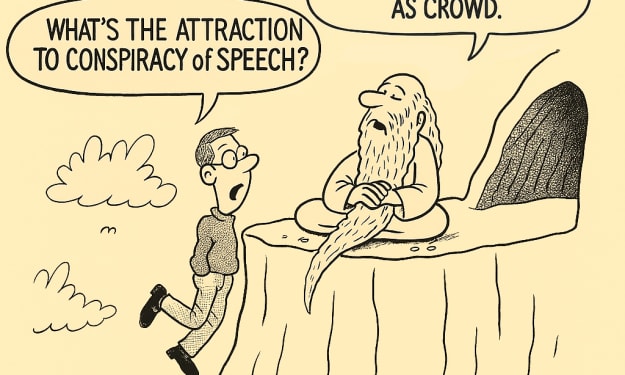
The Conspiracy of Speech
Breathing Together in an Age of Noise: A Review of The Conspiracy of Speech The Conspiracy of Speech, the second part of Volume I with the same name in THE MISCOMMUNICATION TRILOGY, is an ambitious and penetrating study of how speech itself becomes the engine of distortion in contemporary society. If the earlier theoretical groundwork of the volume diagnosed the structural decay of language, this book moves from structure to performance. It asks not merely how language deteriorates, but how speech actively produces the conditions for misunderstanding, ideological capture, and social fragmentation.
By Peter Ayolov6 days ago in BookClub
A More Human Vocal
When we launched Vocal nearly a decade ago, the world was a very different place. LLMs did not exist, and stories were created one at a time by people sitting down to write, revise, and share something personal. Many of our assumptions about publishing, trust, and participation were built for a world where effort and output were inseparable.
By Justin @ Vocal7 days ago in Resources



Comments (1)
Fantastic!!! Very well written!