
Unlocking Solomon’s Secrets
The Mysteries of the Greater and Lesser Keys Revealed

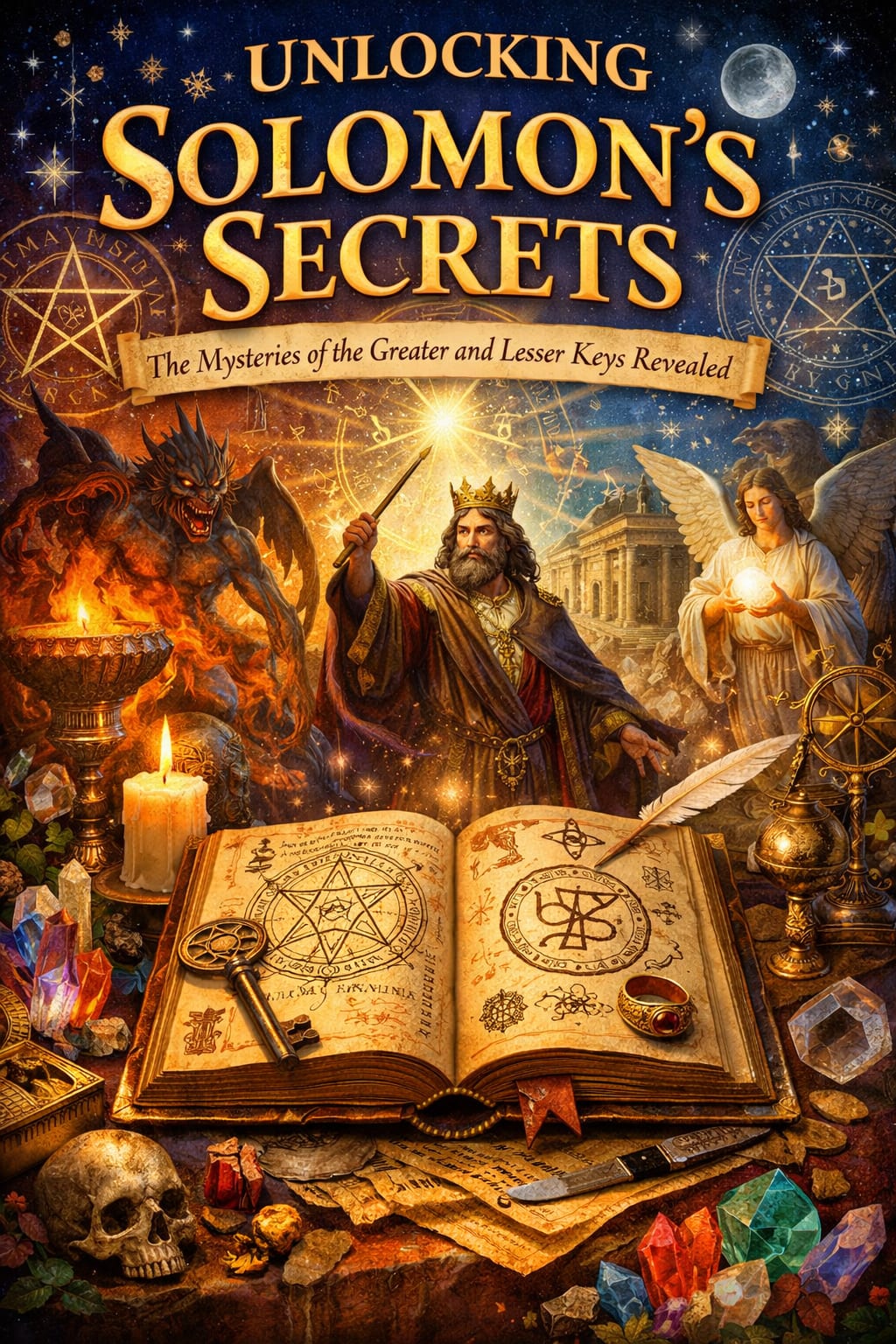
The Gateway to Hidden Knowledge
Human curiosity has consistently sought ways to access realms beyond ordinary perception. Civilizations across the world have constructed elaborate systems of ritual, symbol, and storytelling to explain the invisible forces believed to shape daily life. In this quest, magic, mysticism, and esoteric practice have functioned as bridges between material reality and imagined or spiritual worlds. Among the many texts produced to codify these efforts, The Greater Key of Solomon and The Lesser Key of Solomon occupy a unique place. These grimoires, attributed to the biblical King Solomon, have achieved enduring influence because they articulate a complex, structured approach to unseen forces, blending ritual, cosmology, and hierarchies of spiritual entities.
The Greater Key of Solomon, often referred to as Clavicula Salomonis, emphasizes ritual precision. It provides extensive instruction on the preparation of sacred tools, the consecration of altars and implements, and the alignment of ritual acts with celestial forces. These texts reflect a worldview in which cosmic order permeates every aspect of human action, and the performance of ritual in harmony with that order was believed to grant power over the spiritual realm. The meticulous attention to detail in ceremonial procedures suggests that ritual mastery was as important as any mystical outcome.
The Lesser Key of Solomon, or Lemegeton, focuses largely on the classification, hierarchy, and invocation of spiritual entities. Its most well-known section, the Ars Goetia, catalogs seventy-two spirits, complete with individual seals, titles, and attributes. Each entry outlines specific powers, responsibilities, and appropriate modes of engagement. Beyond the Ars Goetia, the Lesser Key also includes sections that explore angelic hierarchies, astrological correspondences, and visionary techniques intended to enhance intellectual and spiritual insight. The text embodies the Renaissance and early modern fascination with ordering the cosmos and categorizing the unseen.
The origins of these works are complex and multilayered. Neither text was written by the historical King Solomon. Manuscript evidence indicates that the Greater Key emerged in medieval Europe, with Latin and Greek versions circulating in the 14th and 15th centuries. It incorporates influences from Jewish mystical traditions, Byzantine ritual practice, Hellenistic magical papyri, and Arabic occult treatises. The Lesser Key was compiled later, in the seventeenth century, drawing on earlier sources such as the Pseudomonarchia Daemonum, Ars Notoria, and other medieval ritual manuals. Translation and editorial decisions over centuries have shaped the modern editions, blending practical ritual instructions with cosmological frameworks, theological symbolism, and esoteric philosophy.
These texts did not merely serve practical purposes for ritualists. They became cultural artifacts, generating folklore, debate, and speculation. Religious authorities often condemned these works as heretical, associating them with forbidden sorcery and moral transgression. Scholars have examined them critically, tracing influences, cataloging variations, and situating them within broader trends of European esoteric thought. Their enduring presence demonstrates that fascination with the hidden and the mysterious extends far beyond the desire for practical magical outcomes.
The significance of The Greater and Lesser Keys of Solomon lies not only in their ritual and mystical content but also in their capacity to illuminate human attempts to conceptualize the unseen. The texts reflect a deep intellectual engagement with questions of power, hierarchy, cosmology, and symbolic representation. Their structure, complexity, and enduring relevance reveal the extent to which humans have sought systematic ways to navigate the unknown. These grimoires serve as windows into centuries of cultural imagination, representing both a rigorous ceremonial tradition and a broader effort to impose order upon the mysteries of existence.
A Journey Through Time and Text
The grimoires known as The Greater Key of Solomon and The Lesser Key of Solomon carry the name of the biblical King Solomon, whose wisdom is celebrated across Judaism, Christianity, and Islam. In the Hebrew Bible, Solomon is portrayed as a ruler of unparalleled intellect and discernment, the builder of the First Temple in Jerusalem, and a figure whose judgments exemplify fairness and insight. Ancient texts describe Solomon as a scholar of nature and human behavior, yet there is no biblical evidence that he practiced magic or commanded spirits. The association of Solomon with magical power emerges from later legend and mystical interpretation rather than historical record.
By the early medieval period, Solomon had become a central figure in mystical and magical folklore. Jewish texts, such as the Testament of Solomon, attributed magical practices to the king, describing a ring that allowed him to command spirits. This ring, often called the Seal of Solomon in later lore, became an enduring symbol of authority over the supernatural. Christian mystical writers of the Middle Ages also adopted these legends, interpreting Solomon’s wisdom as a model for engaging with divine and angelic powers. Islamic tradition contributes parallel narratives, depicting Solomon, or Sulayman, as a prophet endowed with the ability to communicate with animals, control the wind, and exercise dominion over jinn. Over centuries, these cross-cultural traditions coalesced into a shared mythic figure: Solomon as both wise king and master of unseen forces.
Neither the Greater Key nor the Lesser Key was authored by Solomon. Both texts are pseudepigraphical, written under his name to confer legitimacy and authority. The Greater Key of Solomon, also known as Clavicula Salomonis, appears in manuscripts dating to the 14th and 15th centuries, primarily in Latin and occasionally in Greek. These manuscripts contain detailed instructions on ritual preparation, consecration of tools, purification processes, and the invocation of spiritual forces. The Lesser Key of Solomon, or Lemegeton, was compiled later, in the 17th century, drawing on earlier sources such as the Pseudomonarchia Daemonum, Ars Notoria, and other medieval magical treatises. Many of these sources themselves incorporated material from even older Arabic, Jewish, and Hellenistic magical traditions, reflecting centuries of synthesis and adaptation.
The historical context of these grimoires places them firmly in the intellectual and spiritual currents of medieval and Renaissance Europe. During this period, Christian mysticism, Jewish Kabbalistic study, and Mediterranean ritual magic intersected in rich and complex ways. Greek magical papyri, dating as early as the 3rd century, preserved practical and theoretical knowledge of astrology, divination, and spirit invocation, while Arabic texts translated into Latin in the 12th and 13th centuries introduced sophisticated techniques for celestial calculation, talismanic design, and ritual architecture. Jewish mystical writings, including early Kabbalistic texts such as the Sefer Yetzirah, emphasized the power of letters, divine names, and numerical correspondences. The Greater and Lesser Keys emerge as cultural artifacts at the intersection of these traditions, synthesizing practical ritual instruction with cosmological theory and symbolic hierarchies.
Manuscript evidence supports this synthesis. Surviving copies of the Clavicula Salomonis display extensive marginalia, diagrams, and symbolic seals, suggesting that the texts were actively studied, copied, and adapted by ritual practitioners. The Lemegeton appears in several 17th-century manuscripts, often alongside other esoteric compilations, indicating that it circulated as part of a broader European magical canon. Many of the rituals and incantations described in these works demonstrate precise attention to timing, material preparation, and symbolic correspondences, reflecting a worldview in which the natural and supernatural were deeply interconnected.
Despite their legendary association with Solomon, these grimoires are not revelations of ancient Near Eastern magic. Archaeological evidence from the Levant, including inscriptions, temple records, and artifacts from the Iron Age, provides no support for the existence of ritual manuals of this kind in Solomonic Jerusalem. Instead, these texts are best understood as products of late medieval and early modern imagination, crafted to systematize, codify, and transmit a body of esoteric knowledge that had evolved over centuries. They are intellectual and cultural artifacts that reveal the human desire to order the unseen, exercise control over spiritual forces, and articulate complex symbolic systems.
The enduring influence of these texts stems from both their practical detail and their mythic resonance. By attributing ritual expertise to Solomon, medieval and Renaissance writers conferred legitimacy and authority on practices that would otherwise have been regarded as marginal or heretical. At the same time, these grimoires encode a rich symbolic universe in which cosmic forces, angelic hierarchies, and spiritual entities interact in ways that mirror human structures of governance, hierarchy, and law. This combination of historical grounding, ritual precision, and imaginative breadth has ensured that the Greater and Lesser Keys remain central to the study of Western esotericism, ceremonial magic, and the intellectual history of mysticism.
The Greater Key of Solomon
The Greater Key of Solomon, also known as Clavicula Salomonis, stands as one of the most detailed and methodical ritual texts in Western esoteric tradition. Unlike texts that emphasize invocation alone, this grimoire provides comprehensive instructions for preparing the practitioner, the environment, and the tools necessary for ceremonial work. The text presents ritual magic not as an impulsive or superstitious act but as a disciplined craft requiring precision, timing, and symbolic understanding.
A central aspect of the Greater Key is ritual purification. Detailed procedures describe the use of fasting, bathing, prayer, and meditation to prepare the body and mind. Practitioners are instructed to fast for specific durations, often timed with lunar cycles or planetary hours, to cultivate clarity and spiritual receptivity. Ritual attire is described with exacting detail: robes must be consecrated with specific prayers, embroidered symbols, and anointed with sacred oils. These garments function not merely as decoration but as instruments aligning the practitioner with spiritual forces.
Sacred tools receive extensive attention in the text. Blades, rods, wands, pentacles, and vessels are consecrated using combinations of prayers, astrological timing, and symbolic inscriptions. Pentacles are engraved with names of angels, divine words, and symbolic figures corresponding to planets, days of the week, or celestial hierarchies. Each object is situated within a precise system of correspondences that reflects the Renaissance worldview of interconnectedness between heaven, earth, and human action. For example, a pentacle engraved with the name of a planetary angel may be employed at a specific hour dictated by planetary motion to amplify the ritual’s efficacy.
Incense and fragrances hold both symbolic and practical importance. Specific combinations of aromatic resins, herbs, and oils are prescribed to attract spiritual entities, sanctify spaces, and maintain focus. Timing, sequence, and repetition of incantations are critical. The text emphasizes that deviations from prescribed procedures can weaken or invalidate the ritual. This insistence on discipline reflects a worldview in which ritual work is both ethical and cosmically harmonized.
The Greater Key also introduces complex diagrams, geometric designs, and the use of circles and squares inscribed with divine names. Circles function as protective boundaries, while squares, triangles, and other geometric forms serve as conduits for spiritual forces. These visual elements are more than artistic flourishes; they encode symbolic information about hierarchies, cosmic order, and the channels through which divine energy flows. Surviving Latin and Greek manuscripts from the 14th and 15th centuries demonstrate meticulous attention to the orientation, proportions, and inscriptions of these symbols, underscoring the text’s role as both a practical manual and a cosmological map.
Planetary correspondences are woven throughout the Greater Key. Days of the week, hours of the day, phases of the moon, and positions of celestial bodies are aligned with specific rituals, prayers, and tools. The system reflects the Hermetic axiom as above so below, in which human actions mirror and interact with the motions of the heavens. The practitioner is not merely invoking spirits; they are situating themselves within a structured cosmic framework designed to ensure order, protection, and efficacy.
Unlike sensationalized depictions of magical grimoires in literature and popular media, the Greater Key of Solomon is not a guide for spontaneous spellcasting or reckless manipulation of spiritual forces. The text demands rigorous study, reflection, and precise execution. This structure has made it a subject of interest not only to ceremonial magicians but also to historians, anthropologists, and scholars of religion. The grimoire offers insights into how early modern Europeans conceptualized ritual authority, moral responsibility, and the relationships between humans, the cosmos, and spiritual hierarchies.
Manuscript evidence reveals that the Greater Key was actively copied and transmitted across Europe. Marginalia in surviving Latin codices indicate that practitioners annotated instructions, clarified correspondences, and sometimes modified incantations to suit local cultural or linguistic contexts. Some 15th-century manuscripts include diagrams of pentacles, circles, and squares rendered with extraordinary precision, demonstrating that these works were not merely textual but also visual manuals of ceremonial architecture.
The enduring relevance of the Greater Key lies in its systematic approach. It reflects an attempt to harmonize ethics, ritual practice, and cosmology into a coherent framework. Every preparation, tool, symbol, and timing element is carefully codified, illustrating a profound understanding of ritual as a disciplined art. It offers a unique perspective on how European thinkers of the late medieval and Renaissance periods sought to negotiate the unseen world through structured practice, intellectual rigor, and symbolic sophistication.
The Lesser Key of Solomon
The Lesser Key of Solomon, also known by its Latin name Lemegeton, occupies a unique position in Western esotericism. Unlike the Greater Key, which emphasizes ritual preparation and the crafting of sacred implements, the Lesser Key focuses on the cataloging, hierarchy, and invocation of spiritual entities. Its most famous component, the Ars Goetia, enumerates seventy-two spirits, detailing each with specific names, titles, ranks, attributes, and associated domains of influence. Each spirit is represented by a unique seal or sigil, a symbolic design intended to act as a focal point during ritual engagement. These seals function not merely as identifiers but as instruments believed to connect the practitioner with the essential power or characteristic of the entity.
The Lesser Key is a composite work, comprising multiple books, each with its own focus, methodology, and symbolic framework. The Ars Goetia deals primarily with the evocation of spirits often considered demonic or intermediary beings. Each entry provides guidance on the hierarchy of spirits, their roles in the spiritual cosmos, and the proper protocols for summoning or dismissing them. Historical copies demonstrate that practitioners adhered strictly to procedural and protective measures, such as inscribing protective circles, invoking divine names, and observing precise timing according to planetary correspondences.
The Ars Theurgia-Goetia complements the Ars Goetia by introducing additional spirits, often associated with angelic or semi-divine hierarchies. It expands upon the concept of spiritual order, connecting specific entities with cardinal points, astrological influences, and planetary forces. This section underscores the Renaissance preoccupation with celestial correspondences, reflecting the belief that cosmic alignment enhanced the efficacy and safety of ritual practice.
The Ars Paulina, another component of the Lemegeton, focuses on angelic hierarchies and the influence of planets over hours of the day and night. It categorizes angels by direction, hour, and celestial association, offering a system in which cosmic order dictates the timing and structure of ritual engagement. Manuscript evidence indicates that medieval practitioners often cross-referenced this system with the Ars Goetia, integrating knowledge of both benevolent and intermediate spirits into a comprehensive cosmological framework.
The Ars Almadel presents an entirely different approach. It instructs the practitioner in constructing a wax altar, known as the Almadel, for receiving visions from spirits associated with the four cardinal directions. The text specifies the materials, design, and ritual context required to communicate with these spirits. Unlike the Ars Goetia, which emphasizes command and control, the Ars Almadel prioritizes receptivity, communication, and the refinement of spiritual perception. It reflects a contemplative and visionary dimension within the Lesser Key, demonstrating the diversity of methods for interacting with spiritual entities.
The Ars Notoria differs significantly from the other sections. Instead of cataloging spirits or providing evocation formulas, it offers prayers, meditations, and visual exercises designed to cultivate intellectual mastery and spiritual illumination. Originating in medieval Latin traditions of contemplative practice, the Ars Notoria emphasizes the acquisition of knowledge, memory enhancement, and eloquence through the disciplined use of sacred letters, names of God, and symbolic diagrams. Its inclusion in modern editions of the Lesser Key highlights the breadth of the grimoire, which combines operative magic, angelology, and contemplative mysticism in a single manuscript tradition.
Manuscript evidence demonstrates that the Lesser Key circulated widely in seventeenth-century Europe, particularly in France and England. Surviving codices reveal annotations, emendations, and cross-references to other ritual texts, indicating that practitioners treated the work as a practical guide as well as a theoretical compendium. Illustrations of sigils and diagrams show extraordinary attention to geometric precision, often accompanied by astrological markers and symbolic inscriptions. These visual elements are integral to the text, encoding cosmological principles and hierarchical relationships among spiritual beings.
The Lesser Key presents a structured universe in which spiritual, celestial, and material realms are interconnected. Each spirit or angel occupies a specific place within a broader hierarchy, with defined attributes and responsibilities. Ritual engagement with these entities requires strict adherence to procedural rules, protective measures, and symbolic correspondences. The text is as much a philosophical and cosmological treatise as it is a practical guide, revealing how early modern European practitioners sought to codify the invisible world.
The enduring significance of the Lesser Key of Solomon lies in its capacity to combine cataloged knowledge, ritual structure, and visionary insight. Its sections together form a diverse corpus that resists oversimplification. The work reflects centuries of accumulated esoteric knowledge, drawing on Jewish, Christian, Arabic, and Hellenistic traditions. Its influence extends beyond ceremonial magic into literature, art, and modern occultism, shaping the Western imagination of spirits, hierarchies, and ritual practice.
Controversies and Cultural Reactions
The Greater and Lesser Keys of Solomon have generated significant debate and controversy over centuries, occupying a complex intersection of religious, scholarly, and cultural discourse. Their blend of ritual instruction, cosmology, and spiritual cataloging has provoked suspicion, fascination, and critical inquiry from diverse audiences.
Religious opposition to these texts has been both consistent and severe. In medieval and early modern Christian Europe, ritual magic was frequently equated with heresy, witchcraft, and allegiance to demonic forces. Clerical authorities warned that engagement with grimoires could endanger the soul, violate divine law, and destabilize social order. Biblical injunctions, particularly in Deuteronomy and Exodus, explicitly condemn practices such as sorcery, divination, and necromancy. Texts that claimed to provide secret knowledge of spirits or mystical forces were therefore categorized as subversive or blasphemous. Religious condemnation extended beyond formal pronouncements; grimoires often circulated in secrecy, copied privately by scholars, ritualists, or occult enthusiasts who risked censure or persecution. In some regions, possession of magical manuscripts could result in legal penalties, reflecting a broader tension between institutional authority and esoteric practice.
Scholarly controversy surrounding these works centers primarily on questions of origin, authenticity, and historical claims. Claims of direct authorship by King Solomon or continuity from the First Temple period have been consistently rejected by historians and archaeologists. Archaeological surveys of the Levant, including extensive excavation at Jerusalem and surrounding Iron Age sites, have produced numerous inscriptions, tablets, and material artifacts documenting religious and administrative life. Nowhere among these findings is there evidence of ritual manuals attributed to Solomon or any direct analogue to the structured magical systems described in the Keys. Even the legendary Seal of Solomon, often depicted in medieval manuscripts as a hexagram or pentagram, has no corroborating archaeological provenance from the first millennium BCE. Scholarly consensus treats assertions of Solomonic authorship as myth-making designed to confer authority and legitimacy on ritual texts that actually emerged in late medieval and Renaissance Europe.
Historical manuscripts of the Greater and Lesser Keys provide additional context for these debates. Surviving copies date to the 14th century for the Greater Key and the 17th century for the Lesser Key, written primarily in Latin and occasionally in Greek or vernacular translations. Variations in content, diagrams, and ritual procedures between manuscripts suggest local adaptation, editorial interpretation, and the incorporation of multiple magical and mystical traditions, including Jewish Kabbalistic thought, Arabic talismanic practices, and Greco-Roman esoteric systems. This evidence further undermines claims of a singular ancient origin, emphasizing instead the cumulative and syncretic nature of European esoteric writing.
Interpretive controversy continues into modern practice. Some contemporary occultists treat the Greater and Lesser Keys as operative manuals for ceremonial magic, rigorously following procedural instructions, consecrating tools, and invoking spirits according to the texts. Within these circles, debates arise over proper methodology, ethical limits of invocation, and the symbolic versus literal efficacy of rituals. In contrast, psychological or symbolic interpretations view the texts as frameworks for understanding archetypal forces, internal processes, or meditative exercises. These interpretations align ritual imagery and angelic or demonic entities with human psychological patterns, offering insight into consciousness, motivation, and symbolic thought rather than external spiritual influence.
Scholarly study of the Keys emphasizes cultural, historical, and literary analysis over practical ritual use. Researchers examine these grimoires to understand the evolution of magical practice, the transmission of esoteric knowledge, and the interaction of religion, philosophy, and cosmology in medieval and early modern Europe. Anthropologists and historians highlight the texts as mirrors of societal attitudes toward knowledge, authority, and the boundary between sacred and profane. Linguistic analysis, codicology, and comparative manuscript studies reveal how the Keys integrated multiple cultural streams, including Latin ritual manuals, Byzantine ceremonial texts, and Arabic astrological works, reflecting the cosmopolitan intellectual environment of the Renaissance.
The controversies surrounding the Greater and Lesser Keys of Solomon are therefore multifaceted. Religious objections have framed the texts as morally and spiritually dangerous, while archaeological evidence and manuscript study clarify their historical development and debunk claims of ancient Solomonic origin. Interpretive debates persist among practitioners, with perspectives ranging from literal ritual efficacy to psychological or symbolic frameworks. These layers of contention underscore the complex place of the Keys within Western esoteric tradition, illustrating how ritual texts can simultaneously inspire devotion, scholarship, caution, and fascination.
The enduring debate highlights a broader cultural and intellectual dynamic: the tension between institutional authority and esoteric knowledge, the desire to systematize the unseen, and the human impulse to investigate the mysteries of existence through both imaginative and empirical lenses. The Keys remain central to understanding how historical communities negotiated knowledge of the spiritual and supernatural while navigating social, religious, and intellectual boundaries.
Manuscript Evidence and Archaeology
The Greater Key of Solomon and the Lesser Key of Solomon survive today primarily through manuscript traditions that trace their circulation across medieval and early modern Europe. The Greater Key, or Clavicula Salomonis, appears in multiple Latin and Greek manuscripts dating from the 15th to the 18th centuries. These copies exhibit remarkable consistency in structure while showing variations in diagrams, inscriptions, and ritual formulas, reflecting local adaptations by scribes and practitioners. Linguistic and paleographic analysis confirms a Renaissance origin, with features such as Latinized magical formulas, translations from Greek sources, and Christian liturgical elements embedded within the rituals. These elements indicate that the text was crafted in a cultural context centuries removed from the historical period of Solomon.
Manuscripts of the Greater Key often include elaborate diagrams, such as pentacles, seals, and protective circles. Marginal annotations demonstrate active engagement by readers, with corrections, clarifications, and occasionally alternate versions of prayers or symbols. Some codices contain lists of planetary hours and astrological tables, suggesting that ritual practice was closely intertwined with contemporary knowledge of astronomy and astrology. The presence of Greek, Latin, and occasionally vernacular glosses indicates cross-cultural transmission of knowledge across the Mediterranean and Northern Europe. These codices are evidence of a manuscript culture in which ritual manuals were valued both for practical guidance and for their intellectual content.
The Lesser Key of Solomon, or Lemegeton, survives in several notable manuscripts, with significant examples preserved in the British Library. Mid- to late-17th-century copies document the compilation of the text around 1641, though they draw heavily on earlier sources. Among these sources are the Liber Iuratus Honorii, a 13th-century Latin grimoire emphasizing angelic and protective magic; the Pseudomonarchia Daemonum, an early printed catalogue of spirits from the 16th century; and portions of the Ars Notoria, a medieval treatise on prayers, meditative practices, and intellectual cultivation. This layering illustrates the composite nature of the Lesser Key, showing how European ritual traditions were not static but evolved through adaptation, revision, and synthesis.
Codicological examination reveals careful attention to structure and symbolic clarity. Sigils of spirits are meticulously drawn, often occupying full pages and accompanied by inscriptions of divine names, astrological symbols, or ritual instructions. Layout, proportion, and placement are critical; deviations were believed to compromise efficacy. Some manuscripts include instructions for the construction of wax altars, the timing of rituals according to planetary hours, and the exact wording of invocations. These features demonstrate a level of scholarly rigor and ritual discipline that contrasts with later popular depictions of spontaneous or haphazard magic.
From an archaeological perspective, the grimoires themselves are artifacts of European manuscript culture rather than remnants of ancient Near Eastern ritual practice. Excavations in Jerusalem, Megiddo, and other Iron Age sites have yielded inscriptions, temple records, and domestic objects, but no evidence exists linking the historical King Solomon to ritual manuals resembling the Greater or Lesser Keys. No ancient seals, rings, or codices corroborate the texts’ legendary claims of Solomonic authorship. Instead, the surviving grimoires reflect intellectual and cultural developments in medieval and Renaissance Europe. They provide insight into the codification of ritual, the symbolic representation of the cosmos, and the human desire to systematize interaction with unseen forces.
The materiality of the manuscripts themselves offers additional insight. Ink composition, parchment preparation, handwriting styles, and marginal annotations provide evidence of local production, transmission, and use. Manuscripts were often copied in monastic scriptoria, private workshops, or by itinerant scribes familiar with esoteric and mystical traditions. Some pages exhibit corrections, added glosses, or adaptations to local linguistic norms, indicating that these texts were living documents, adapted to the needs and understanding of successive generations of practitioners.
The archaeological and manuscript record together illustrates that the Greater and Lesser Keys functioned as tools for codifying ritual knowledge, mapping cosmological hierarchies, and structuring engagement with the spiritual realm. They are not relics of ancient Israelite magic but witnesses to the intellectual creativity of medieval and early modern European occultism. Their survival provides modern scholars and practitioners with a tangible connection to centuries of ritual theory, symbolic representation, and cultural imagination, revealing how humans sought to understand and negotiate unseen forces in structured, systematic ways.
Misunderstandings and Myths
Modern perceptions of the Greater Key of Solomon and the Lesser Key of Solomon are shaped heavily by popular culture, sensational literature, and cinematic imagery. Grimoires are frequently portrayed as shortcuts to absolute power, instant wealth, or effortless domination over supernatural forces. Such portrayals bear little resemblance to the historical reality preserved in manuscript traditions. The grimoires are complex ritual systems rooted in discipline, theological structure, and symbolic logic. Magical practice within these texts demands extensive preparation, ethical framing, ritual purity, and mastery of liturgical language. No manuscript presents ritual work as casual, impulsive, or consequence free.
A persistent myth frames the grimoires as manuals for demon worship. This interpretation collapses under textual examination. Ritual structures within both Keys emphasize divine authority, sacred names, angelic mediation, and protective boundaries. Spirits are addressed through hierarchical command rather than devotion. The cosmology reflected in the texts mirrors medieval Christian and Jewish angelology rather than adversarial theology. Ritual operators are instructed to invoke divine authority repeatedly, often through psalms, sacred names, and invocations aligned with orthodox religious language of the period. Such framing reflects a worldview in which spiritual authority flows downward from a divine source, not upward from infernal allegiance.
Another widespread misunderstanding involves authorship. Folklore and modern occult marketing frequently attribute direct authorship to King Solomon. Historical and archaeological scholarship rejects this claim. The attribution functions as a literary strategy rather than a historical assertion. In medieval Europe, pseudepigraphy served to legitimize texts by associating content with revered figures. Solomon represented idealized wisdom, judicial authority, and divine favor within Jewish, Christian, and Islamic traditions. The name functioned as symbolic capital rather than a claim of historical authorship. Confusion arises when symbolic attribution is treated as biographical fact.
Nineteenth and twentieth century occult revival movements further complicated public understanding. Figures such as S. L. MacGregor Mathers and Aleister Crowley produced influential editions and translations that shaped modern access to the grimoires. Mathers approached the Greater Key and Lesser Key through a ceremonial magic framework influenced by Hermeticism, Rosicrucian symbolism, and Victorian esotericism. Crowley’s editorial work often reflected personal philosophical commitments, including Thelemic cosmology and psychological interpretations of ritual symbolism. While both figures contributed to preservation and dissemination, editorial interventions sometimes altered emphasis, terminology, and interpretive framing. Modern readers frequently encounter these editions without awareness of the historical layers separating Renaissance manuscripts from modern print culture.
Another enduring myth involves the assumption of uniformity. Popular summaries often describe the Greater Key or Lesser Key as singular, fixed books. Manuscript evidence contradicts this notion. Variations across copies include differences in seals, ritual instructions, divine names, and structural organization. Some manuscripts omit entire sections, while others expand ritual commentary. This variability reflects living traditions rather than static scripture. Treating any single printed edition as definitive obscures the dynamic transmission history of ritual knowledge.
Conflation with other esoteric works also contributes to misunderstanding. Texts such as the Testament of Solomon, the Picatrix, and the Liber Iuratus Honorii are often grouped indiscriminately with the Solomonic Keys. While thematic overlaps exist, each text emerged from distinct linguistic, cultural, and philosophical environments. The Testament of Solomon reflects late antique Jewish and Christian folklore. The Picatrix derives from Arabic astrological and philosophical traditions transmitted through medieval Spain. The Liber Iuratus emphasizes visionary prayer and angelic protection within a Latin Christian framework. Treating all grimoires as interchangeable erases meaningful differences in purpose, structure, and worldview.
Skeptical critiques introduce another layer of mythmaking by reducing the grimoires to superstition or delusion. Such dismissals overlook historical significance. Regardless of metaphysical interpretation, the texts document how medieval and early modern societies conceptualized authority, cosmology, language, and ritual action. Grimoires function as intellectual artifacts rather than proof of supernatural efficacy. Analysis grounded in history, philology, and cultural context allows appreciation without requiring belief in literal spirit summoning.
The most enduring myth surrounding the Solomonic Keys is the belief that engagement requires blind belief or rejection. Historical reality offers a third position. Careful reading reveals structured symbolic systems reflecting human attempts to impose order on an unpredictable universe. The grimoires preserve evidence of disciplined imagination, theological synthesis, and symbolic reasoning. Understanding emerges not from sensationalism or dismissal but from sustained, critical engagement with the texts as products of human culture, shaped by fear, hope, devotion, and intellectual ambition.
Why These Texts Matter Today
The Greater Key of Solomon and the Lesser Key of Solomon occupy a position that extends far beyond occult practice. These grimoires serve as valuable resources for multiple academic disciplines, offering insight into how societies have historically organized knowledge about the invisible, the sacred, and the unknown. Within literary studies, the texts illuminate narrative strategies, symbolic language, and the transmission of mythic authority. In comparative religion, the grimoires provide examples of how theological concepts migrate across cultural boundaries and adapt to new doctrinal frameworks. Anthropology and the history of ideas draw upon these works to examine ritual as a social technology, one that structures belief, behavior, and identity.
In literary history, Solomonic traditions have exerted a lasting influence. Medieval romances, Renaissance drama, and early modern poetry incorporated motifs drawn from legendary accounts of Solomon’s wisdom and command over spirits. Johann Wolfgang von Goethe engaged with demonic hierarchies and symbolic magic in Faust, reflecting intellectual currents that had absorbed elements of grimoire literature. Later authors of speculative fiction and fantasy continued this lineage, drawing on the structured cosmologies, sigils, and hierarchies found in the Solomonic tradition. These elements provided narrative tools for exploring moral conflict, forbidden knowledge, and the boundaries of human aspiration. The persistence of these motifs demonstrates how esoteric texts shape imaginative literature even when stripped of ritual context.
Visual culture also bears the imprint of Solomonic imagery. Magical seals, planetary symbols, and geometric diagrams associated with the grimoires appear in manuscripts, engravings, modern art, and graphic design. These images carry layered meanings that combine theological symbolism, mathematical proportion, and cosmological mapping. Artists and designers have repurposed these forms to evoke mystery, authority, or transcendence. The visual language of the grimoires has become part of a broader symbolic vocabulary within Western esotericism, influencing everything from book illustration to contemporary digital art.
From a historical perspective, the grimoires reveal how knowledge was preserved and transmitted outside formal institutions. Manuscript culture allowed ritual texts to circulate among scholars, clerics, physicians, and educated laypeople. The texts reflect an era in which science, religion, and magic were not clearly separated domains. Astrology coexisted with theology. Natural philosophy overlapped with ritual practice. Study of the grimoires challenges modern assumptions about rigid boundaries between rational inquiry and symbolic thought. The texts illustrate how earlier cultures approached the natural and supernatural as interconnected aspects of a single cosmos.
The use of pseudepigraphy within the Solomonic tradition offers a lens into the construction of authority. Attribution to Solomon functioned as a claim to divine wisdom rather than historical authorship. This strategy appears across religious and philosophical literature, revealing how communities legitimize knowledge through association with revered figures. Examination of this practice deepens understanding of how texts acquire influence and how tradition is shaped by narrative authority rather than empirical verification.
At a deeper level, these grimoires matter because they preserve evidence of enduring human questions. Curiosity about unseen forces, desire for order within chaos, and longing for communion with higher knowledge recur across cultures and eras. Ritual systems found in the Greater and Lesser Keys represent attempts to structure those impulses through language, symbolism, and disciplined action. Whether approached as historical documents, literary artifacts, or philosophical systems, the texts offer insight into how humans negotiate uncertainty and meaning.
Engagement with these works fosters critical reflection on the nature of belief itself. Study reveals how symbolic systems gain power through repetition, authority, and shared imagination. The grimoires demonstrate that meaning is not solely discovered but constructed through ritual, narrative, and cultural inheritance. In an age marked by rapid technological change and renewed interest in mythic frameworks, these texts remain relevant as mirrors reflecting the persistent human effort to understand worlds both seen and unseen.
Recommended Reading: #commissionearned
The Three Books of Solomon the King: The Key of Solomon the King by S.L. MacGregor Mathers
Ancient ceremonial practices emerge vividly in this exploration of Solomonic magic, offering detailed instructions for invoking spirits, crafting talismans, and preparing ritual spaces. Magical operations are carefully linked to celestial timing and planetary influences, showing how cosmic forces guide spiritual work. Diagrams and sigils illustrate practical applications, demonstrating the balance between theory and hands-on ritual skill. Historical context bridges legendary accounts of King Solomon with practical ceremonial techniques, revealing a coherent system of spiritual authority. Ethical considerations accompany ritual instructions, emphasizing the responsibility inherent in commanding supernatural forces. Connections to the Greater Key appear in the description of angelic hierarchies and divine invocations, expanding the scope beyond demonic entities. Knowledge from this work underpins both scholarly study and practical experimentation in Solomonic traditions.
The Lesser Key of Solomon by L.W. de Laurence
Evocative instructions for summoning and controlling spirits dominate this grimoire, which catalogs seventy-two demons along with their sigils, powers, and hierarchies. Detailed preparations for magical circles, incantations, and protective rituals reveal the meticulous nature of Solomonic practice. The text blends medieval mystical philosophy with practical methodology, showing the careful structure behind controlling spiritual forces. Comparisons with the Greater Key highlight contrasts between commanding lower spirits and invoking higher angelic powers. Ritual tools, consecration methods, and symbolic correspondences demonstrate the intimate link between physical objects and spiritual influence. Ethical restraint and precise procedure reinforce the serious responsibility of magic. The compilation offers a vivid portrait of spiritual command grounded in historical and symbolic tradition.
The Testament of Solomon by F.C. Conybeare
A legendary account of King Solomon’s wisdom unfolds through encounters with demons who reveal their abilities and vulnerabilities. Narrative storytelling merges with practical instruction, showing how myth and ritual intersect in the Solomonic tradition. Rings, seals, and divine authority are emphasized as essential instruments of spiritual governance. Higher-level operations reflect principles seen in the Greater Key, connecting angelic and celestial forces to ritual practice. Exorcisms, incantations, and talismanic magic illustrate a deep understanding of spiritual hierarchies. The text also conveys moral guidance, emphasizing the ethical dimension of supernatural control. By weaving legend with practical knowledge, this work illuminates the historical evolution of Solomonic ceremonial magic.
Illuminated pages reveal detailed instructions for creating talismans, drawing pentacles, and performing rituals aligned with celestial forces. Practical guidance demonstrates how purification, preparation, and timing work together to strengthen magical results. Annotations provide historical insight, showing the transmission of Solomonic knowledge across centuries. Connections to the Greater Key emerge through angelic hierarchies and the invocation of divine names. Symbolic correspondence between tools, planets, and rituals clarifies abstract concepts for practitioners. Ethical and spiritual considerations are consistently emphasized as part of effective magical operation. Visual diagrams and explanatory notes make complex practices accessible to both students and experienced adepts.
The Lesser Key of Solomon by Joseph H. Peterson
Careful translation and commentary illuminate the Goetic material, revealing the structured framework for commanding spirits. Seals, sigils, and ceremonial techniques demonstrate the precision required in Solomonic practice. The interplay between ethical restraint and ritual effectiveness highlights the responsibility of spiritual authority. Historical notes trace the grimoire’s lineage and show connections to earlier Jewish and Mediterranean magical traditions. Comparisons with the Greater Key underscore the contrast between summoning lower spirits and invoking angelic forces. Instructions for preparation, invocation, and talismanic creation provide practical insight into ritual structure. The text offers both a scholarly perspective and a hands-on guide for serious practitioners.
The Greater Key of Solomon: The Complete Books I-III by Anonymous, Victor Shaw
Advanced ritual practice dominates the three volumes, presenting intricate ceremonies for invoking angels, consecrating tools, and engaging with cosmic hierarchies. Instructional sequences emphasize purification, timing, and alignment with celestial influences. Planetary correspondences and symbolic logic show the interconnection of physical ritual and spiritual effect. Practical exercises are combined with philosophical reflections, bridging technical skill and mystical understanding. Comparisons with the Lesser Key clarify differences between commanding spirits and invoking higher divine powers. Charts, diagrams, and ritual layouts aid comprehension of complex operations. Mastery of these techniques requires discipline, knowledge, and respect for ethical boundaries inherent in Solomonic magic.
Full-color talismans bring symbolic and ritual principles to life, demonstrating how visual design influences magical operation. Instructions describe the creation of seals, inscriptions, and ceremonial tools with precision, reflecting the structure shared with the Lesser and Greater Keys. Connections between spiritual authority, ritual accuracy, and ethical practice are emphasized. Historical context links contemporary understanding to ancient Solomonic traditions. Angelic hierarchies and divine names are explored as higher-level operations complementing demonic control. Ritual diagrams provide clarity and accessibility to complex magical concepts. Practical application merges with historical scholarship to illuminate centuries of Solomonic practice.
Seventy-two Goetic spirits are brought to life through illustration and description, creating an educational resource for ritual practice. Ceremonial instructions detail protective measures, invocations, and sigil use, revealing the structured discipline of Solomonic magic. Planetary correspondences and symbolic logic show the interconnectedness of spiritual, cosmic, and material realms. Historical commentary situates Goetic practice within broader mystical traditions. The balance between lower spirit command and higher angelic invocation demonstrates a nuanced understanding of Solomonic authority. Protective circles, consecrated tools, and ethical considerations reinforce safety and responsibility. Visual and textual clarity makes complex magical principles accessible to students and practitioners alike.
The Key to Solomon's Key: Is This the Lost Symbol of Masonry? by Lon Milo DuQuette
Solomonic symbolism is examined alongside Masonic traditions, revealing how ritual, geometry, and ethics converge in mystical practice. Talismans, tools, and symbolic geometry demonstrate principles shared with both the Lesser and Greater Keys. Moral guidance underscores the responsible use of knowledge and spiritual authority. Connections between ancient Solomonic methods and modern esoteric systems highlight continuity in magical philosophy. Illustrations and diagrams clarify ritual operations and symbolic correspondences. Celestial hierarchies and divine names link these practices to advanced Solomonic ceremonies. The book provides a bridge between historical magic and contemporary mystical understanding, offering practical insight for scholars and adepts.
Cultural Impact and Legacies
The Greater Key of Solomon and the Lesser Key of Solomon have exerted a long and complex influence on cultural expression, intellectual history, and spiritual imagination. Their impact extends far beyond the narrow category of occult manuals. Over centuries, motifs drawn from Solomonic grimoires have shaped literature, art, spiritual movements, and popular conceptions of magic. These texts function as cultural lenses through which societies have explored authority, forbidden knowledge, and the limits of human agency.
Literary influence represents one of the most visible legacies. Medieval legends surrounding Solomon’s wisdom and command over spirits informed romances, sermons, and moral allegories long before the grimoires circulated in manuscript form. Early modern writers absorbed these themes into dramas and poems that explored temptation, ambition, and moral consequence. Later Gothic and Romantic literature drew heavily on hierarchies of spirits, ritual circles, and forbidden books of knowledge. Modern fantasy and horror genres continue this inheritance, often adapting names, sigils, and conceptual frameworks drawn directly from Solomonic sources. Such adaptations rarely preserve ritual detail but retain symbolic resonance associated with mastery over hidden forces.
Visual culture provides another channel through which Solomonic material persists. Seals, pentacles, and geometric figures originating in manuscript diagrams have entered Western esoteric iconography. These images appear in engravings, album art, graphic novels, tattoos, and digital design. The appeal lies not only in aesthetic complexity but in the suggestion of encoded meaning. Symmetry, sacred geometry, and symbolic language invite contemplation even when stripped of ritual context. Artistic reuse transforms functional diagrams into visual metaphors for mystery, order, and transcendence.
Spiritual movements of the nineteenth and twentieth centuries further amplified the reach of these grimoires. Ceremonial magic orders incorporated Solomonic symbolism into structured initiation systems. New Age communities adapted elements of ritual language, planetary correspondences, and protective symbolism while often discarding theological frameworks present in the original texts. This selective appropriation produced new hybrid systems that blended historical material with modern spiritual psychology. Such transformations demonstrate how ritual texts evolve when transplanted into different cultural climates.
Academic engagement forms a quieter but equally significant legacy. Scholars in history, religious studies, and anthropology examine the Solomonic Keys as evidence of how knowledge systems were constructed in premodern Europe. The grimoires illuminate intersections between religion, science, and magic during periods when such categories were fluid. Study of these texts challenges modern assumptions about rationality and belief by revealing sophisticated symbolic reasoning embedded in ritual practice. Rather than representing intellectual marginalia, the grimoires document serious attempts to understand cosmic order and moral authority.
The endurance of these works also reflects persistent human fascination with hidden knowledge. Across cultures, narratives of secret books and lost wisdom recur as expressions of curiosity and longing for mastery over uncertainty. The Solomonic Keys occupy a prominent place within this tradition because they promise structure rather than chaos. Ritual sequences, hierarchies, and rules impose order on imagined spiritual landscapes. Such order appeals to the human desire for coherence in a world perceived as unpredictable.
Responsible engagement with these texts requires historical awareness and critical distance. Recognition of symbolic intent and cultural context prevents reduction to superstition or sensationalism. The grimoires function most powerfully as records of human imagination disciplined by ritual form. Their legacy lies not in literal supernatural claims but in the enduring effort to articulate meaning, authority, and connection within an unseen dimension of experience.
Opening the Last Seal
The Greater Key of Solomon and the Lesser Key of Solomon stand as intricate monuments of ritual literature shaped by centuries of intellectual exchange, manuscript transmission, and symbolic invention. These works emerged from medieval and early modern Europe, drawing upon Christian liturgy, Jewish mystical traditions, Greco Roman philosophy, and Islamic astrological knowledge. No credible historical or archaeological evidence connects the grimoires directly to the biblical King Solomon or the First Temple period. Their significance lies not in legendary authorship but in what the texts reveal about the cultures that produced, preserved, and adapted them.
Careful reading shows that these grimoires are not chaotic collections of spells but structured systems built around order, hierarchy, and discipline. Ritual purity, moral authority, celestial timing, and symbolic precision form the backbone of their instructions. Such features reflect a worldview in which the cosmos operated according to intelligible patterns accessible through study, prayer, and ritual action. Recognition of this intellectual framework transforms the grimoires from objects of fear or fascination into valuable historical documents that record how earlier societies understood knowledge and power.
Serious engagement with Solomonic texts benefits from direct exposure to reliable editions and thoughtful comparison between versions. Public libraries offer access to scholarly studies, critical editions, and historical surveys without financial barriers. Many university libraries also provide digital access to manuscripts and academic commentary through publicly available portals. These resources allow readers to trace textual variations, examine historical annotations, and develop informed perspectives grounded in evidence rather than speculation.
Caution remains essential when consulting free online materials. While the internet hosts valuable scans and translations, it also contains altered texts, modern interpolations, and unsourced claims presented as historical fact. Responsible research favors editions that clearly identify manuscript origins, translation methods, and editorial choices. Cross checking information across multiple sources strengthens understanding and guards against mythologized interpretations detached from historical reality.
Independent study encourages appreciation of these grimoires as cultural artifacts rather than instruments of literal supernatural control. Examination of their language, symbolism, and ritual logic illuminates broader human efforts to impose meaning upon uncertainty. The Greater and Lesser Keys endure because they articulate enduring questions about authority, knowledge, and the unseen through disciplined symbolic systems.
Continued reading, comparison, and reflection allow each reader to develop a nuanced understanding shaped by evidence and context. Public libraries, reputable academic works, and careful manuscript studies provide pathways into deeper exploration. Through patient research and critical engagement, the Solomonic tradition reveals itself not as a relic of superstition but as a record of human imagination striving toward order, insight, and connection across generations.
About the Creator
Marcus Hedare
Hello, I am Marcus Hedare, host of The Metaphysical Emporium, a YouTube channel that talks about metaphysical, occult and esoteric topics.
https://linktr.ee/metaphysicalemporium
Keep reading
More stories from Marcus Hedare and writers in BookClub and other communities.
How Ancient Goddess Worship Shaped Modern Witchcraft
When the Sacred Had a Body Human spirituality began long before temples, scriptures, or organized priesthoods. The earliest expressions of the sacred emerged from direct encounters with survival and mystery. Breath leaving a dying body. Blood appearing with the moon. Seeds buried and returning as food. Storms arriving without warning. These experiences shaped meaning long before abstract theology existed.
By Marcus Hedareabout 11 hours ago in BookClub
7 Books That Take Less Than a Week to Finish
In a world overflowing with information, notifications, and endless to-do lists, finding time to read can feel like a luxury. Yet reading remains one of the most powerful ways to sharpen our thinking, deepen our empathy, and expand our perspective—often in just a few hours a day. The good news? You don’t need months to finish a life-changing book.
By Diana Meresc7 days ago in BookClub




Comments
There are no comments for this story
Be the first to respond and start the conversation.