
How Ancient Goddess Worship Shaped Modern Witchcraft
From Prehistoric Reverence to Contemporary Practice

When the Sacred Had a Body
Human spirituality began long before temples, scriptures, or organized priesthoods. The earliest expressions of the sacred emerged from direct encounters with survival and mystery. Breath leaving a dying body. Blood appearing with the moon. Seeds buried and returning as food. Storms arriving without warning. These experiences shaped meaning long before abstract theology existed.
Early human communities measured time through natural repetition rather than written record. Pregnancy marked months more reliably than calendars. The moon offered a visible rhythm that governed tides, fertility, animal behavior, and night travel. Migration patterns of animals signaled seasons of abundance or scarcity. These cycles embedded awareness of continuity, loss, and renewal into daily life.
From this environment arose symbolic systems that emphasized creation, sustenance, and regeneration. Female figures appeared repeatedly in early religious imagery, not as sentimental icons but as embodiments of processes essential to survival. Birth, nourishment, sexual reproduction, death, and rebirth were not philosophical concepts but lived realities. The female body became a visible mirror of forces shaping the land itself.
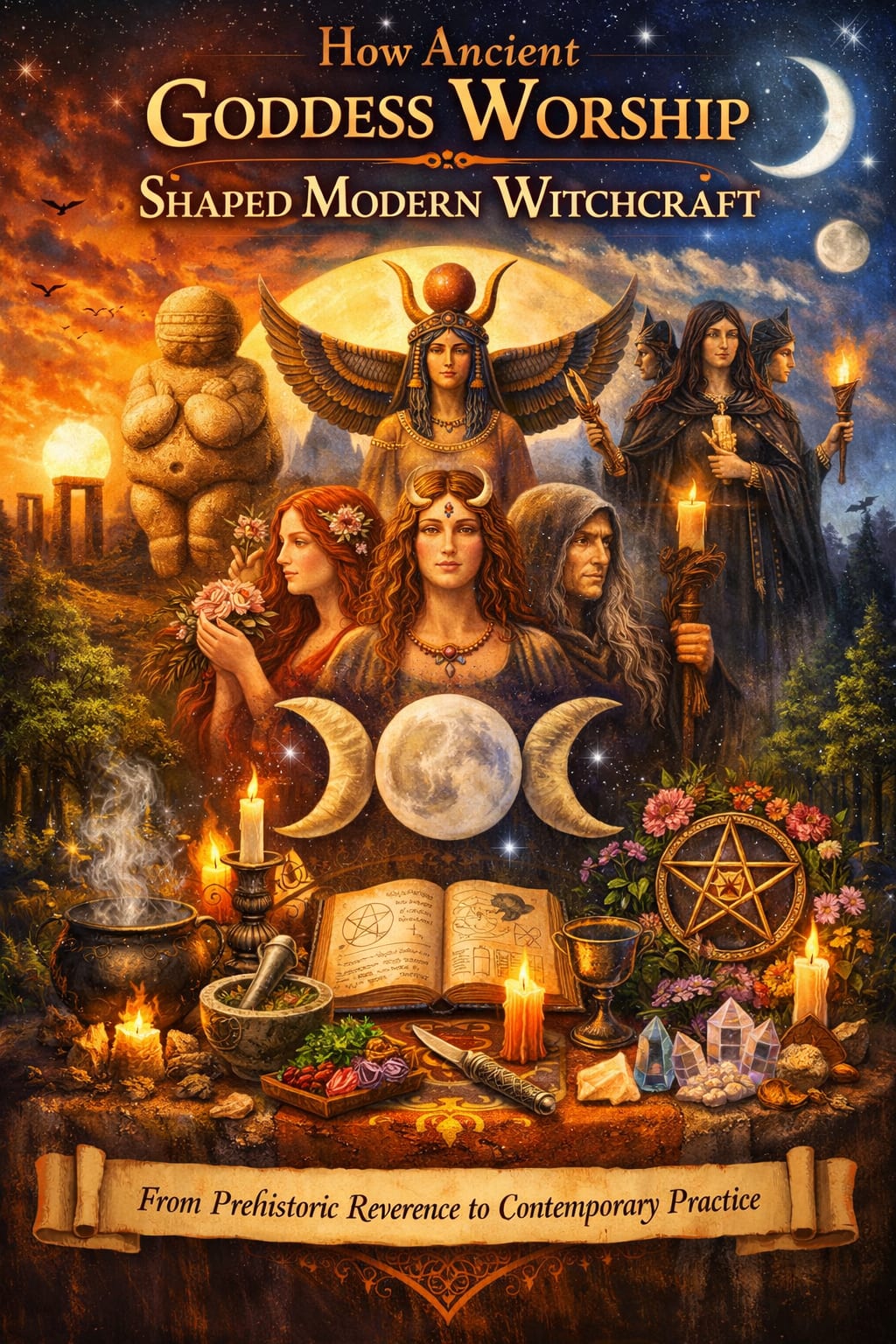
Archaeological discoveries from Paleolithic and Neolithic contexts reveal figurines emphasizing hips, breasts, and abdomens. While modern interpretations once hastily labeled these objects as fertility goddesses, current scholarship approaches such artifacts with caution. Certainty about purpose remains impossible. What remains clear is the cultural importance placed on reproduction, continuity, and embodied power.
As agriculture developed, religious expression expanded in complexity. Agrarian societies depended on predictable cycles of planting and harvest, reinforcing reverence for forces governing growth and decay. Divine feminine figures emerged with defined names, myths, and ritual functions. In Mesopotamia, Inanna embodied sexuality, political authority, and warfare alongside fertility. In Egypt, Isis represented magical speech, healing knowledge, and royal legitimacy. Across the Mediterranean, goddesses governed grain, wild animals, thresholds, and the underworld. These figures were not passive caretakers. Many commanded armies, enforced justice, or controlled fate.
The modern phrase goddess worship flattens this diversity. Ancient cultures did not share a single goddess tradition. Each society developed religious systems shaped by geography, economy, and social structure. Some honored multiple goddesses with specialized roles. Others centered power within a dominant female deity. Still others integrated divine feminine figures within broader pantheons. The common thread was not uniform belief but recognition of creative and destructive forces expressed through feminine symbolism.
Modern witchcraft emerged within a very different historical context, yet retained a profound attraction to these ancient symbols. Folklore preserved fragments of earlier beliefs. Anthropology provided comparative frameworks. Literature revived mythic language. Feminist movements challenged religious hierarchies that erased female sacred authority. Religious reconstruction offered tools for rebuilding ritual where continuity had been broken.
The goddess within modern witchcraft functions neither as archaeological reconstruction nor nostalgic fantasy. The figure operates as a symbol of immanent divinity, locating sacred presence within nature, body, and lived experience. Ancient goddess traditions survive not as untouched relics but as remembered patterns reshaped by changing cultural needs. This process reflects how religious meaning endures across time, adapting without remaining static.
The Earliest Expressions of the Sacred Feminine
Some of the oldest surviving objects shaped by human hands are small figurines emphasizing breasts, hips, thighs, and abdomens. Archaeological finds across Ice Age Europe and parts of western and central Asia date many of these objects to more than twenty thousand years before present. Carved from stone, ivory, or bone, these figures were portable, durable, and clearly intentional in form. Earlier scholarship grouped such artifacts under the name Venus figurines, a label now considered misleading because the term projects later Greco Roman ideas onto societies without written language.
Current archaeological interpretation resists definitive conclusions about function. No single explanation fits all examples. No evidence proves use as goddesses, charms, teaching tools, or portraits. What remains consistent across regions and time periods is emphasis on reproductive anatomy. Pregnancy, birth, nourishment, and bodily continuity dominated survival in Paleolithic communities. Female embodiment represented continuity of the group itself. These figurines reflect attention to forces shaping existence rather than decorative impulse.
As climatic stability increased and agriculture developed, spiritual expression became more formalized. Permanent settlements required coordination, surplus management, and seasonal planning. Religious systems grew alongside social complexity. Within many early agrarian cultures, female deities expanded beyond fertility alone. Divine femininity absorbed authority over land ownership, political legitimacy, sexuality, warfare, and law.
In southern Mesopotamia, Inanna emerged as one of the earliest named deities recorded in writing. Temple hymns and myths portray a figure of immense contradiction and power. Inanna ruled sexual desire and reproduction while commanding armies and enforcing justice. Political authority flowed through temples dedicated to Inanna, linking sacred femininity with governance. Mythic narratives describe conquest, deception, erotic union, and violent retribution. One surviving myth recounts descent into the underworld, stripping of symbols of power, death, and eventual return. This story established an early literary framework for cycles of loss and restoration.
Along the Nile, religious imagination produced Isis, a goddess associated with motherhood, healing, funerary rites, and magical knowledge. Unlike deities limited to domestic roles, Isis wielded spoken spells capable of altering fate. Royal legitimacy depended on Isis as protector of kingship. Devotion extended across social classes, reaching farmers, priests, and rulers alike. Over centuries, devotion to Isis traveled beyond Egypt into Greece, Rome, and surrounding regions, demonstrating extraordinary adaptability of goddess worship.
Across the Aegean Sea, archaeological remains from Bronze Age Crete reveal religious imagery dominated by female forms. Frescoes, seals, and figurines depict women holding serpents, standing atop mountains, or flanked by animals. These images suggest reverence for natural cycles, fertility of land, and human integration within ecological systems. Debate continues regarding structure of Minoan religion, yet artistic emphasis consistently privileges feminine presence over masculine authority.
Greek religious culture absorbed and reshaped many earlier traditions. Goddesses occupied essential roles within cosmology. Demeter governed grain cultivation and famine relief, binding agricultural survival to ritual observance. Artemis ruled wilderness, childbirth, and untamed life beyond city walls. Persephone embodied seasonal death and return through movement between surface world and underworld. Hekate governed crossroads, thresholds, ghosts, and night travel. Authority over liminal spaces placed Hekate outside ordinary social boundaries, later contributing to association with magic and witchcraft.
Goddess worship across these civilizations operated as lived religion rather than abstract philosophy. Seasonal festivals regulated planting and harvest. Initiation rites marked transitions of age and status. Public temples shaped civic identity. Household shrines anchored daily devotion. Divine femininity manifested through land fertility, bodily cycles, illness, weather, and fate. Sacred presence was encountered through experience rather than doctrine. These ancient expressions formed a foundation of meaning that continued to echo long after temples fell and names faded.
Decline, Transformation, and Survival
As patriarchal social systems consolidated power and monotheistic religions expanded across Europe and the Mediterranean, earlier religious frameworks centered on goddesses, local spirits, and land-based cosmologies underwent systematic transformation. Political authority and religious authority became increasingly intertwined, producing a worldview that privileged hierarchy, orthodoxy, and centralized doctrine. Within such an environment, decentralized religious expressions tied to fertility, seasonal cycles, and household ritual lost institutional protection. Suppression did not occur through a single coordinated effort. Change unfolded unevenly, shaped by geography, class, literacy, and local custom.
In urban centers and seats of power, older religious practices were often officially condemned, rewritten, or absorbed. Temples were repurposed, sacred groves cut down, and ritual calendars realigned to match Christian feast days. In many cases, former goddesses did not vanish but reappeared under altered guises. Attributes once associated with divine feminine figures were redistributed among Christian saints, angels, or symbolic virtues. Protective mother goddesses found echoes in Marian devotion. Healing springs once linked to local spirits became sites of saintly miracles. Other figures suffered darker reinterpretations. Deities associated with sexuality, the night, or liminal spaces were recast as demons, temptresses, or embodiments of moral danger.
Rural regions followed a different rhythm. Agricultural communities depended on seasonal knowledge, weather observation, and plant lore for survival. Such knowledge could not be erased by decree. Seasonal rites marking planting, harvest, and animal fertility persisted beneath Christian language and symbolism. Festivals aligned with solstices and equinoxes continued under the names of saints’ days. Folk customs survived through habit rather than theology. Continuity rested on repetition, memory, and usefulness rather than written doctrine.
During the medieval period, women who practiced healing, midwifery, and herbal medicine occupied a socially ambiguous position. Communities relied on such figures for childbirth, illness, and death rites. Knowledge involved plant properties, bodily processes, charms, prayers, and observational experience accumulated across generations. Transmission occurred primarily through oral instruction and apprenticeship, often within families or small local networks. Absence of formal licensing placed such practitioners outside emerging professional and clerical structures. Acceptance depended on reputation and perceived moral standing rather than institutional approval.
As European societies entered periods of famine, plague, religious schism, and political instability, suspicion intensified toward figures operating beyond official authority. The late medieval and early modern periods witnessed a growing obsession with hidden enemies, heresy, and cosmic struggle between good and evil. Learned demonology combined classical philosophy, biblical interpretation, and folk belief into a new ideological framework. Within that framework, the figure of the witch emerged as a symbolic threat. Accusations reflected anxiety surrounding female autonomy, bodily knowledge, reproduction, and nonconforming authority. Witchcraft persecution arose from fear, social stress, and power struggles rather than from any surviving ancient religion.
No credible historical evidence supports the existence of a continuous, organized pagan witch religion surviving intact from antiquity through the Middle Ages. That narrative developed much later, shaped by romantic nationalism, nineteenth-century folklore studies, and twentieth-century spiritual movements. Medieval accusations describe imagined conspiracies rather than actual religious communities. Trial records reveal confusion, coercion, and projection rather than documentation of coherent belief systems.
Despite institutional suppression, cultural fragments endured. Folklore preserved tales of fairy queens, night riders, and spirit women associated with forests, crossroads, and the moon. Stories encoded older cosmologies within narrative rather than ritual form. Household customs maintained protective charms, blessing practices, and herb use alongside Christian prayer. Women continued to dominate domestic medicine and childbirth well into the early modern era. Memory survived through practice rather than ideology.
During later centuries, scholars, antiquarians, and spiritual seekers began collecting folklore, folk songs, and rural traditions. Elements once dismissed as superstition gained new interpretation as cultural heritage. Modern practitioners drew inspiration from surviving fragments, combining historical research with imaginative reconstruction. Contemporary pagan and witchcraft traditions represent creative syntheses rather than unbroken survival. Transformation replaced continuity. Survival occurred through adaptation, concealment, and reinvention.
The story of decline therefore resists simplicity. Suppression and survival operated simultaneously. Loss accompanied transformation. What remained was not a preserved religion but a cultural echo, fragmented yet persistent, carried forward through story, seasonal rhythm, and embodied knowledge.
Romanticism, Anthropology, and the Return of the Goddess
The modern revival of goddess spirituality emerged from scholarship, literature, and art rather than from surviving ritual lineages. During the nineteenth century, European Romanticism redirected cultural attention toward myth, emotion, nature, and the distant past. Industrialization had transformed landscapes and labor, producing widespread nostalgia for perceived earlier modes of living rooted in land and seasonal rhythm. Poets, painters, and philosophers treated myth as a vessel of ancestral memory rather than as primitive error. Ancient stories once dismissed as superstition gained renewed dignity as symbolic expressions of human experience.
At the same time, archaeology and philology reshaped understanding of ancient history. Excavations across the Mediterranean, Near East, and South Asia revealed civilizations far older and more complex than biblical chronologies had suggested. Figurines, temples, inscriptions, and burial sites pointed toward religious systems where female deities held central roles as creators, protectors, and rulers of cosmic order. Linguistic studies traced mythic patterns across Indo European and Near Eastern cultures, revealing recurring themes of birth, death, renewal, and sacred kingship bound to feminine figures.
Anthropology further expanded the field of vision. Early ethnographers documented living religious traditions outside Christian Europe, including cultures honoring goddesses of fertility, water, earth, and sovereignty. Such documentation challenged assumptions that monotheism represented an inevitable or superior stage of religious development. Cross cultural comparison suggested diversity rather than linear progression. Female divinity appeared not as anomaly but as recurring human response to questions of origin, sustenance, and mortality.
The intellectual climate of the period produced both insight and distortion. Some scholars relied on limited data, colonial assumptions, or evolutionary models now recognized as flawed. Ancient societies were sometimes portrayed as universally matriarchal or uniformly peaceful without sufficient evidence. Speculation occasionally replaced careful method. Even so, academic inquiry destabilized long standing religious monopolies. Space opened for alternative narratives about spiritual history, gender, and power.
Literature carried these ideas beyond academic circles. Poets and novelists reimagined ancient Europe as a landscape alive with sacred forests, lunar rites, and priestesses guarding mysteries of life and death. Myth became a language of resistance against mechanization and religious rigidity. Artistic portrayals emphasized cyclical time, bodily wisdom, and intimate connection between human life and natural process. Goddess imagery symbolized creativity, endurance, and regeneration within a fractured modern world.
By the mid twentieth century, such imaginative groundwork converged with new religious experimentation. Gerald Gardner and contemporaries synthesized ceremonial magic, folklore, esoteric orders, and speculative interpretations of pre Christian religion into what became known as Wicca. Early Wiccan theology emphasized polarity through paired divine figures representing balance between masculine and feminine forces. Ritual structure reflected seasonal cycles drawn from agricultural festivals and mythic symbolism rather than historical reconstruction.
As Wiccan traditions diversified, emphasis shifted increasingly toward the goddess as primary source of divinity. The goddess came to represent immanence, bodily holiness, and the sacredness of the natural world. Ritual practice encouraged direct experience rather than obedience to doctrine. Authority rested in participation and knowledge rather than hierarchy.
Literary influence remained powerful. Robert Graves articulated a poetic vision of a primordial goddess embedded within European myth and literature. Scholarly critique later challenged historical claims presented within that vision, yet emotional and symbolic resonance proved profound. Graves offered a unifying mythic framework connecting poetry, ritual, and memory. Language of continuity and loss spoke to readers seeking spiritual meaning beyond institutional religion.
Parallel social movements accelerated interest in goddess spirituality. Second wave feminism questioned religious traditions portraying female bodies as sinful or subordinate. Theological critique exposed structural bias within male dominated religious narratives. Goddess centered spirituality offered symbolic repair. Female experience, reproduction, sexuality, aging, and creativity gained sacred status rather than moral suspicion.
Modern witchcraft provided ritual space for embodiment of such values. Circles, seasonal rites, and magical practice affirmed autonomy, interdependence, and reverence for the living world. The goddess functioned not as relic of a lost past but as evolving symbol addressing contemporary spiritual hunger. Revival took the form of reinterpretation rather than restoration.
The return of the goddess therefore reflects convergence of scholarship, imagination, and social transformation. Academic discovery challenged inherited assumptions. Artistic vision reenchanted myth. New religious movements translated theory into practice. The goddess emerged again not through unbroken tradition but through deliberate reweaving of fragments, questions, and long silenced possibilities.
Language, Power, and the Naming of the Divine
Language has always shaped religious reality. Names define roles, limit interpretation, and confer authority. In ancient cultures, divine names were rarely simple labels. A goddess name often functioned as a title, a location, a role, or a moment in ritual action. Many deities possessed dozens of epithets reflecting specific functions such as protector of thresholds, bringer of fertility, guardian of the dead, or ruler of storms. Meaning shifted depending on place, season, and social need.
Modern language flattens much of this complexity. When ancient goddesses are translated into a single standardized name, layers of cultural context disappear. Linguistic translation removes not only grammatical nuance but also worldview. Ancient Greek, Latin, Egyptian, Celtic, and Semitic languages encoded relationships between humans, land, and divinity that modern English often cannot reproduce. Words for soul, fate, spirit, and body did not always map cleanly onto modern categories. The act of translation therefore becomes an act of reinterpretation.
Power enters through naming. To name is to frame. Monotheistic systems historically asserted authority by redefining older divine names as false, dangerous, or subordinate. Female divinity was particularly affected. Goddesses associated with sexuality, death, and liminal spaces were stripped of complexity and recast as moral warnings. Titles once expressing sovereignty or cosmic balance became symbols of temptation or chaos. Language enforced hierarchy by controlling meaning.
Modern goddess spirituality inherits this linguistic history whether acknowledged or not. Terms such as Mother, Maiden, and Crone feel ancient yet reflect modern psychological and social categories. Ancient cultures did not always divide female life into such neat stages. Fertility did not disappear with age. Authority did not depend on youth. Wisdom was not reserved for elders alone. Contemporary titles often reveal more about modern concerns than ancient belief.
The word goddess itself carries modern assumptions. Ancient cultures did not necessarily conceptualize divinity as separate from nature or humanity. Divine presence often permeated rivers, stones, ancestors, and weather rather than existing as anthropomorphic beings. Modern naming practices tend to personify and centralize what was once diffuse and relational. This shift changes how divinity is experienced and understood.
Modern witchcraft increasingly acknowledges this tension. Rather than claiming accuracy, many practitioners treat names as symbolic gateways. A goddess name becomes a focal point for myth, ritual, and meditation rather than a claim of historical identity. Epithets and titles regain importance as ways to honor specific qualities without collapsing complexity into a single form. Language becomes flexible again, capable of holding contradiction and multiplicity.
Attention to naming encourages humility. Words do not recover the past. Words build bridges shaped by present understanding. Recognizing this protects modern practice from false certainty and opens space for deeper engagement. Study of original languages, regional variations, and historical usage reveals how much has been lost and how much remains open to interpretation.
In goddess centered spirituality, language functions as creative act rather than final authority. Naming becomes ritual. Titles evolve with practice. Meaning emerges through relationship rather than definition. By examining how words shape power, modern witchcraft gains clarity, honesty, and respect for both history and imagination.
Goddess Archetypes in Modern Witchcraft
Modern witchcraft approaches divine figures through archetype rather than literal historical restoration. Ancient goddesses serve as sources of imagery, mythic language, and symbolic structure rather than as fixed theological beings frozen in time. Archaeology, mythology, and folklore provide raw material, while contemporary spiritual needs shape interpretation. The result is a living symbolic system grounded in history yet openly adapted for present use.
One of the most influential constructs within modern witchcraft is the Triple Goddess. The threefold figure expresses stages of human life and patterns observed in nature. Youth aligns with beginnings, curiosity, growth, and emergence. Maturity aligns with fertility, agency, creativity, protection, and authority. Age aligns with wisdom, endings, transformation, and continuity beyond death. Lunar cycles mirror these phases through waxing, fullness, and waning light. Ancient cultures recognized associations between moon phases, fertility, and female experience, yet the formalized triadic model widely used today developed during the twentieth century. Classical sources rarely present a single unified triple goddess embodying all three stages simultaneously. Modern formulation blends mythic motifs from multiple cultures into a coherent symbolic system.
Archetypes function as lenses rather than literal identities. The Triple Goddess operates as a psychological, ritual, and cosmological map. Ritual participants encounter personal growth, change, and mortality through symbolic narrative rather than dogma. Such symbolism allows adaptability across cultures, genders, and life paths. Archetype offers flexibility without erasing historical inspiration.
Ritual structures within modern witchcraft consciously echo ancient religious patterns while avoiding claims of historical purity. Lunar observances follow the visible rhythm of the moon rather than reconstructed calendars. Seasonal festivals align with agricultural turning points such as planting, harvest, light increase, and light decline. Goddess invocations draw language from hymns, poetry, and myth without asserting continuity of priesthood or temple lineage. Transparency regarding reconstruction forms a core ethical principle. Spiritual legitimacy arises from intention, coherence, and lived meaning rather than from antiquity alone.
Many practitioners choose devotional relationships with specific named deities such as Hekate, Isis, or Brigid. Such engagement often involves careful study of historical sources alongside experiential practice. Ancient epithets, symbols, and myths provide context. Personal ritual, meditation, and dream work supply contemporary interpretation. Deity devotion becomes an evolving dialogue between recorded tradition and present experience. Historical awareness guards against superficial appropriation, while personal engagement prevents museum style religion.
The goddess within modern witchcraft frequently functions as bridge rather than endpoint. Myth provides structure. Ritual provides embodiment. Experience provides interpretation. Past and present meet through symbolic language capable of carrying complexity, contradiction, and transformation.
Central to goddess centered witchcraft is emphasis on immanence. Sacred presence resides within material existence rather than beyond physical reality. Earth, water, air, and fire hold spiritual significance through participation in life itself. Bodies receive reverence as vessels of sensation, pleasure, pain, birth, illness, aging, and death. Nature functions not as fallen matter awaiting redemption but as dynamic expression of sacred process.
Cycles receive honor rather than resistance. Decay supports fertility. Death enables renewal. Darkness holds generative potential alongside light. Seasonal decline carries meaning equal to seasonal growth. Such worldview contrasts sharply with transcendental theologies that prioritize escape from embodiment or elevation above nature. Goddess centered witchcraft affirms continuity between spiritual experience and everyday existence.
Archetypes therefore operate as tools of meaning rather than objects of blind belief. Modern witchcraft embraces synthesis, symbolism, and adaptability. Power arises not from claims of untouched antiquity but from honest engagement with history, myth, and lived reality. Through archetype, goddess imagery continues to evolve, remaining responsive to cultural change while rooted in enduring human patterns.
Recommended Reading: #commissionearned
First published in the late twentieth century, The Spiral Dance stands as one of the most influential texts shaping modern goddess centered witchcraft. Starhawk presents spirituality as inseparable from social responsibility, ecological awareness, and community action. Ritual practice appears alongside reflections on power, patriarchy, and relationship with the natural world. Goddess imagery functions as a symbol of interconnected life rather than distant authority. Seasonal celebrations, trance work, and magical ethics receive detailed attention grounded in lived practice. The book aligns closely with themes of reconstruction discussed in the blog by openly acknowledging creative synthesis rather than hidden lineage. Readers encounter goddess spirituality as a living tradition capable of responding to modern political and environmental realities.
Margot Adler approached contemporary paganism through careful observation and participation rather than romantic speculation. Drawing Down the Moon documents the emergence of modern witchcraft, goddess worship, and related movements across the United States during the twentieth century. Historical interpretation, personal testimony, and community dynamics receive balanced treatment. Adler addresses how practitioners understand ancient myth while openly negotiating modern identity. The book directly supports the blog’s discussion of reconstruction by showing how meaning arises through dialogue with history rather than unbroken survival. Goddess figures appear as symbols shaped by cultural need and creative adaptation. The work remains essential for understanding how modern witchcraft developed social coherence and intellectual self awareness.
The White Goddess by Robert Graves
Poetry, mythology, and speculative scholarship converge within The White Goddess. Robert Graves proposed a unifying poetic myth of a primordial goddess underlying European literature and symbolism. Historical claims within the text sparked intense scholarly debate, yet imaginative influence proved undeniable. The goddess appears as muse, destroyer, and renewer tied to cycles of creativity and loss. Many modern witches encountered goddess archetypes first through Graves’s lyrical language rather than academic history. The book relates to the blog by illustrating how artistic vision helped revive goddess imagery during the modern period. Inspiration drawn from the text demonstrates how myth can shape spiritual identity even when historical accuracy remains contested.
Phyllis Curott offers a deeply personal account of spiritual transformation through witchcraft practice. Book of Shadows blends memoir with reflection on ritual, ethics, and devotion. Goddess centered spirituality appears not as abstraction but as lived relationship influencing career, love, and moral decision making. Legal training and urban life provide contrast to ritual circle and seasonal observance. The narrative reflects themes of embodiment and immanence central to the blog discussion. Ancient goddess names coexist with modern experience without claims of historical purity. Readers gain insight into how reconstructed tradition becomes meaningful through daily practice.
Ancient Goddess Magic: Invoking the Queens of the Heavens by Vanessa Lavallée
Vanessa Lavallée approaches goddess spirituality through careful historical framing combined with practical ritual work. Ancient Goddess Magic introduces deities from multiple cultures while emphasizing cultural context and respectful engagement. Mythological background accompanies suggestions for meditation, altar work, and seasonal ritual. The book avoids portraying ancient religion as uniform or idealized. Such balance mirrors the blog’s emphasis on synthesis rather than survival. Goddess archetypes function as gateways to understanding cycles, boundaries, and transformation. The work supports thoughtful modern practice grounded in research rather than fantasy.
Hekate Goddess of Witches by Courtney Weber
Courtney Weber presents Hekate through a blend of classical sources, folklore, and contemporary devotion. Hekate Goddess of Witches traces historical evolution from ancient crossroads deity to modern liminal figure. Ritual examples demonstrate how reconstruction operates with transparency and care. Scholarly discussion remains accessible without sacrificing depth. The goddess emerges as symbol of transition, agency, and mystery rather than static icon. The book aligns strongly with the blog’s exploration of archetype and immanence. Modern witchcraft appears as dialogue between documented history and present spiritual experience.
Modern Witchcraft: Goddess Empowerment for the Kick-Ass Woman by Deborah Blake
Deborah Blake frames witchcraft as ethical, practical spirituality suited to contemporary life. Modern Witchcraft emphasizes personal responsibility, self reflection, and connection with the natural world. Goddess spirituality appears as source of empowerment rather than authority imposed from outside. Historical inspiration supports practice without dominating interpretation. Daily ritual, seasonal awareness, and moral choice receive equal attention. The book reflects the blog’s theme that power arises from meaningful engagement rather than ancient pedigree. Readers encounter goddess centered witchcraft as adaptable, grounded, and relevant to modern challenges.
Scholarship, Story, and the Responsibility of Seeking
Modern goddess centered witchcraft emerges not from a single origin point but from an ongoing conversation between history, imagination, and lived experience. The works discussed throughout this section demonstrate how contemporary spiritual traditions form through study, reinterpretation, and ethical creativity rather than through claims of uninterrupted survival. Each author engages the past differently, yet all acknowledge that modern practice exists within a world shaped by academic research, cultural change, and personal responsibility.
Together, these books reveal how goddess spirituality functions as both symbol and practice. Ancient myths provide language for cycles of birth, growth, decline, and renewal. Ritual offers embodied connection to those patterns within modern life. Scholarship supplies boundaries that prevent fantasy from hardening into false history. The balance between reverence and honesty remains essential. When mythology is treated as myth rather than misplaced fact, meaning deepens rather than diminishes.
The resurgence of goddess imagery reflects broader cultural shifts rather than hidden continuity. Feminist thought, environmental awareness, and dissatisfaction with hierarchical religion created conditions where alternative spiritual models could flourish. Authors such as Starhawk and Adler document this process directly, while writers like Graves illustrate how poetry and imagination reshaped religious possibility. Later voices such as Curott, Weber, Lavallée, and Blake demonstrate how reconstruction matures through transparency, research, and ethical reflection.
Serious engagement with goddess spirituality requires active reading and discernment. Public libraries offer access to academic texts, folklore collections, mythology, archaeology, and religious studies without financial barrier. Librarians provide guidance toward reputable scholarship often overlooked by algorithm driven searches. University presses, museum publications, and peer reviewed studies supply context that popular summaries frequently omit.
Caution remains necessary when relying on free online material. Blogs, social media posts, and unreferenced articles often repeat outdated theories or oversimplified narratives. Digital platforms reward certainty rather than nuance, which can distort complex historical subjects. Cross checking claims against established research protects against misinformation and unintentional appropriation. Depth of understanding grows through comparison, patience, and willingness to revise assumptions.
Modern witchcraft and goddess spirituality thrive when curiosity is paired with responsibility. The past offers inspiration rather than instruction. Meaning arises through thoughtful synthesis rather than unquestioned belief. Readers willing to study widely, question sources, and remain open to complexity contribute to traditions that are intellectually honest and spiritually alive. The goddess returns not as relic, but as evolving symbol shaped by knowledge, creativity, and care.
About the Creator
Marcus Hedare
Hello, I am Marcus Hedare, host of The Metaphysical Emporium, a YouTube channel that talks about metaphysical, occult and esoteric topics.
https://linktr.ee/metaphysicalemporium
Keep reading
More stories from Marcus Hedare and writers in BookClub and other communities.
The Fox Sisters and the Birth of Modern Spiritualism
When Sound Became a Signal History often pivots on moments that appear ordinary until significance accumulates around them. A disturbance breaks the stillness of a household. Attention sharpens. Neighbors gather. Meaning begins to form where none was expected. In the winter of 1848, such a transformation occurred within a small farmhouse in Hydesville, a rural hamlet in upstate New York. The structure stood unremarkable by architectural standards, occupied by a family of modest means, surrounded by farmland and the routines of nineteenth-century rural life. Within those walls, however, a series of sharp, rhythmic knocking sounds disrupted domestic normalcy and quietly altered the course of religious and cultural history.
By Marcus Hedare2 days ago in BookClub
My New Book is Finally Here
My poetry collection Beautiful and Brutal Things is done. It's actually done and finally published over 270 pages. Over a year of my life went into this book. More than a year, really. Long days at my computer, sometimes seven days a week because I couldn't stop even when I probably should have. Then two months of editing that felt harder than the writing itself. But it's finished, and I'm still standing, and the book is real.
By Tim Carmichael9 days ago in BookClub
The Doctrine of Obedience
Understanding Iran’s power requires looking beyond missiles, sanctions, or nuclear negotiations. The real engine of influence lies in how Iran recruits, conditions, and binds individuals into long-term obedience. Its system is not accidental or reactive. It is deliberate, ideological, and designed to endure.
By Albert Hadi 4 days ago in BookClub



Comments
There are no comments for this story
Be the first to respond and start the conversation.