
Title: Echoes of Devotion: The Legacy of Ibrahim and Ismaeel
Subtitle: A timeless story of faith, sacrifice, and submission to the will of Allah.
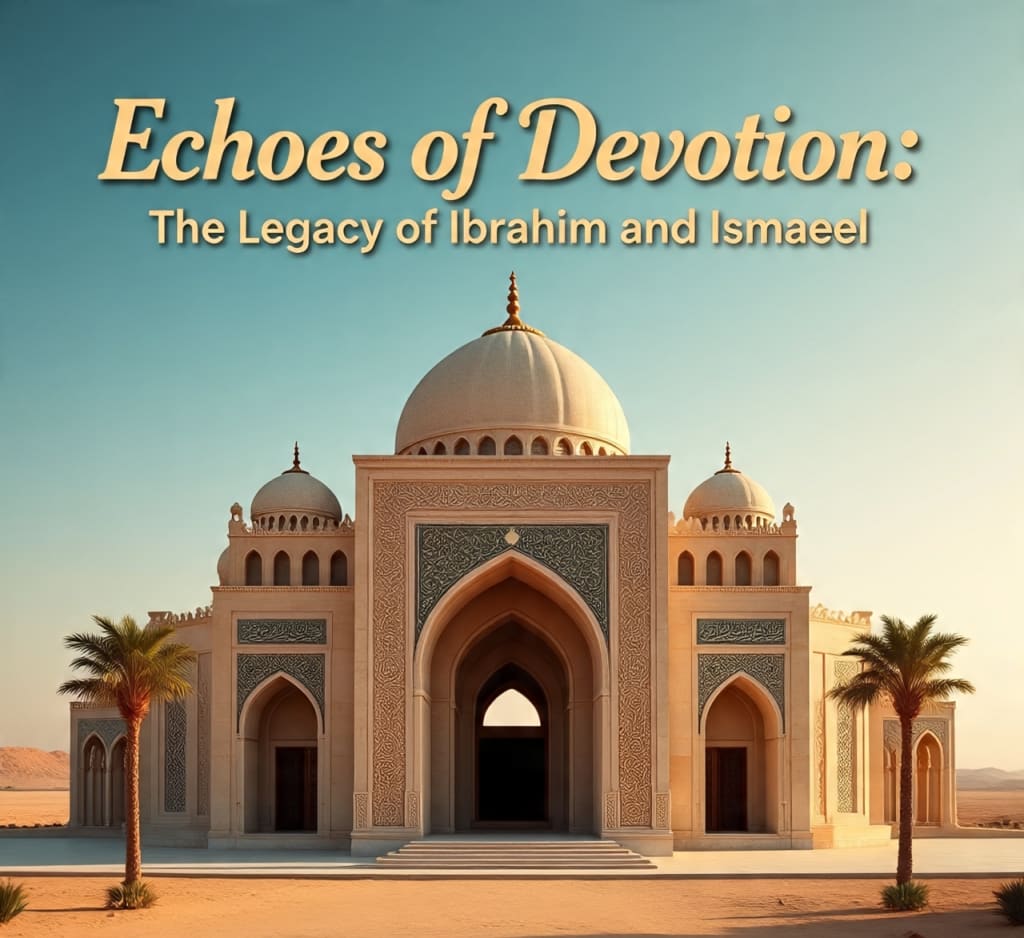
In the sun-scorched deserts of ancient Arabia, beneath vast skies and amidst barren lands, a story unfolded—one not merely of men, but of unwavering faith. It was the story of Hazrat Ibrahim (A.S) and his son, Hazrat Ismaeel (A.S), whose devotion to Allah still echoes through time and hearts.
Hazrat Ibrahim, a man chosen as Khalīlullāh—the Friend of Allah—had already lived a life filled with trials. He had shattered the idols of his people, been cast into fire for his belief in one God, and left his homeland in obedience to the Divine. But perhaps the most heart-wrenching test awaited him in the solitude of the desert, where nothing but sand and the will of Allah prevailed.
Years earlier, Allah had commanded him to leave his wife Hajrah and their infant son, Ismaeel, in the barren valley of Bakkah (later to be known as Makkah). There was no water, no vegetation, no signs of life. Yet, without questioning the command, Ibrahim obeyed. He left them with a few dates and a skin of water and turned to walk away. Hajrah, shocked and desperate, called after him, “O Ibrahim, where are you going? Are you leaving us in this desert alone?” He remained silent. But when she asked, “Has Allah commanded you to do this?” he replied, “Yes.” She submitted calmly, saying, “Then He will not let us perish.”
This submission was not weakness, but strength drawn from tawakkul—complete trust in Allah.
Soon, the water ran out, and baby Ismaeel cried in thirst. Hajrah ran between the hills of Safa and Marwah seven times in search of help. Her heart raced with fear, her feet burned on the scorching earth, yet she did not despair. In her most desperate moment, Allah sent His mercy: a spring of water gushed forth from beneath the baby’s feet. That spring, Zamzam, continues to flow to this day—an eternal sign of divine providence.
Years passed. Ismaeel grew into a strong and obedient boy, gentle in speech and firm in faith. Ibrahim returned to visit his family, and in a vision, he received the most severe command yet:
> “O my son, indeed I have seen in a dream that I must sacrifice you. So what do you think?”
(Surah As-Saffat 37:102)
A lesser man might have hesitated, but not Ibrahim. And what of the boy? What would he say?
Ismaeel, only a youth, looked into his father’s eyes with calm courage and replied:
> “O my father, do as you are commanded. You will find me, if Allah wills, among the patient.”
It was not just the obedience of a son to his father—it was a son’s obedience to his Lord. Their footsteps led them to a plain between the hills of Makkah, where Ibrahim laid down his beloved child, blindfolding himself so he would not falter. He placed the knife upon Ismaeel’s neck and pressed.
But the knife would not cut.
At that moment, Allah called out:
> “O Ibrahim! You have fulfilled the vision.”
(Surah As-Saffat 37:104–105)
A ram from Paradise was sent to be sacrificed instead. The test was complete. The hearts had been proven. Faith had triumphed.
This was not a tale of loss, but of legacy. A legacy of trust so complete that both father and son were elevated in rank and remembrance. Ibrahim’s willingness to sacrifice that which he loved most proved his devotion was pure. Ismaeel’s calm submission showed that even youth can carry the torch of unshakable belief.
Allah immortalized this act, commanding Muslims to commemorate it every year during Eid al-Adha—not to remember a slaughter, but to remember obedience, mercy, and the victory of the spirit over desire.
From their union came future generations of prophets. From Ibrahim’s line came Ishaq (Isaac), and from Ismaeel’s descendants came the final Prophet, Muhammad (PBUH), completing the circle of divine guidance.
But the legacy of Ibrahim and Ismaeel is not confined to books or history. It lives in every act of sacrifice a believer makes for their faith. It echoes in the quiet prayers of a mother, in the patient heart of a father, in the choices of young people who choose righteousness over ease. Their story is a compass for all who seek to please their Creator without compromise.
When pilgrims walk between Safa and Marwah during Hajj, they trace the steps of Hajrah. When they drink from Zamzam, they sip from a miracle born of faith. When they offer the sacrifice on Eid, they carry on the ritual of Ibrahim. These are not hollow rituals but living symbols of devotion that still breathe meaning into Muslim lives.
In a world constantly shifting, the story of Ibrahim and Ismaeel remains unmoved—timeless, powerful, and real. It teaches that true faith is not found only in belief but in action; that love for Allah must surpass all other loves; and that those who submit wholly to Him are never abandoned, but honored.
Their legacy is not just a memory. It is a call. A call to live with courage, to trust the unseen, and to let the echoes of devotion guide every heartbeat.
About the Creator
Keep reading
More stories from Muhammad bilal and writers in BookClub and other communities.
I Found a Hidden Room in My House. What Was Inside Changed Everything
--- I’d lived in that house for nearly four years before I noticed the creak. It wasn’t loud. Just a soft, protesting groan that came from the hallway upstairs every time I stepped on a specific spot. The kind of sound old houses make, which you eventually tune out like background noise.
By Muhammad bilal7 months ago in BookClub
My New Book is Finally Here
My poetry collection Beautiful and Brutal Things is done. It's actually done and finally published over 270 pages. Over a year of my life went into this book. More than a year, really. Long days at my computer, sometimes seven days a week because I couldn't stop even when I probably should have. Then two months of editing that felt harder than the writing itself. But it's finished, and I'm still standing, and the book is real.
By Tim Carmichael2 days ago in BookClub
Cursed Pages & Candlelight
Welcome, brave souls, to The Chapter Cafe—where stories steep like tea and mysteries simmer in the shadows. Tonight, under the flicker of candlelight and the watchful gaze of a harvest moon, we invite you to pull up a chair and sip from our Halloween Mystery Brew.
By Kristen Barenthaler4 days ago in BookClub



Comments
There are no comments for this story
Be the first to respond and start the conversation.