
Think and Grow Rich vs How to Win Friends and Influence People: Which Self-Help Classic Should You Read First?
Success vs Influence: Comparing Two Self-Help Classics

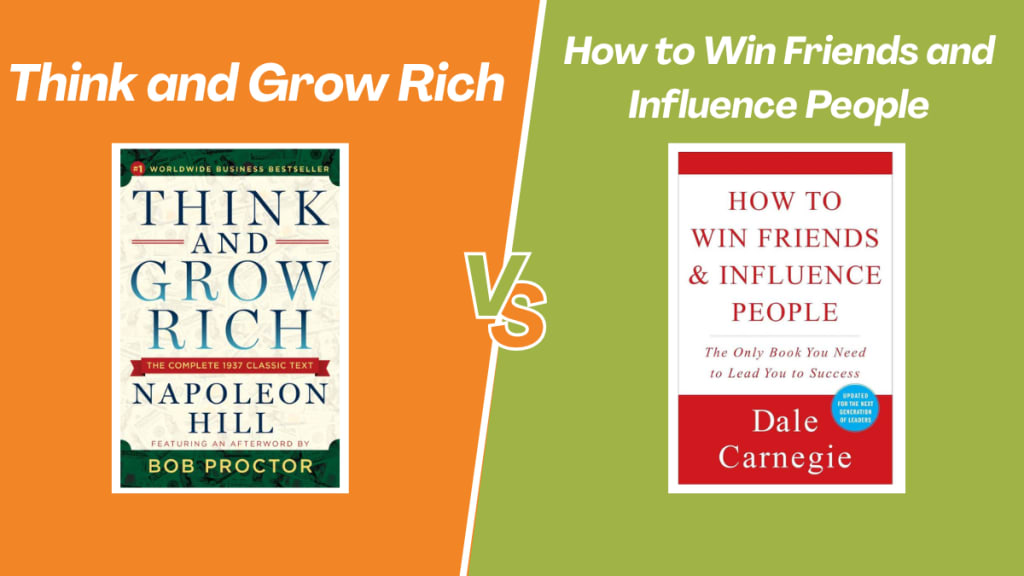
When it comes to personal development, two books have stood the test of time: Think and Grow Rich by Napoleon Hill and How to Win Friends and Influence People by Dale Carnegie. Both have inspired millions of readers around the world, and each offers a unique perspective on success, mindset, and personal growth. But which one should you read first? And what are the key differences between the two?
In short, Think and Grow Rich focuses on mindset, goal-setting, and the principles of achieving wealth and success through inner belief and persistence. How to Win Friends and Influence People teaches practical communication skills to build strong relationships, influence others, and succeed socially. One is about mastering your thoughts; the other is about mastering human interaction. Both are timeless self-help classics but serve very different paths to personal and professional growth.
Think and Grow Rich: A Blueprint for Success
Published in 1937, Think and Grow Rich is considered one of the most influential success books of all time. Napoleon Hill spent over 20 years interviewing over 500 successful individuals, including Henry Ford, Thomas Edison, and Andrew Carnegie. His goal was to uncover the secrets behind wealth, achievement, and prosperity.
At its core, the book is about the power of thought and belief. Hill argues that success starts in the mind. By harnessing desire, faith, and persistence, individuals can turn intangible dreams into tangible realities.
Key Principles of Think and Grow Rich:
- Desire is the starting point of all achievement
- Faith and belief shape our outcomes
- Autosuggestion helps program the subconscious mind
- Specialized knowledge creates leverage
- Imagination turns ideas into plans
- Organized planning turns plans into action
- Persistence overcomes failure
- The Master Mind group accelerates success
- Fear is the biggest obstacle to success
Hill’s philosophy is often described as “success through mindset.” It’s not just about making money; it’s about cultivating a burning desire, aligning with purpose, and building habits that attract wealth and opportunities.
How to Win Friends and Influence People: The Power of Human Connection
First published in 1936, How to Win Friends and Influence People by Dale Carnegie is a timeless guide to effective communication, relationship-building, and leadership. While Hill’s focus is on internal growth and financial success, Carnegie emphasizes external influence and interpersonal skills.
The book provides practical tips on how to deal with people, win cooperation, and become more likable in both personal and professional settings.
Key Principles of How to Win Friends:
- Don't criticize, condemn, or complain
- Give honest and sincere appreciation
- Arouse in others an eager want
- Be genuinely interested in others
- Smile and remember people's names
- Be a good listener and encourage others to talk
- Make others feel important — and do it sincerely
- Avoid arguments and show respect for others' opinions
Carnegie’s approach is empathetic, strategic, and highly actionable. His ideas are widely used by leaders, managers, salespeople, and anyone who needs to interact with people effectively.
Think and Grow Rich vs How to Win Friends: Core Differences

"Think and Grow Rich" by Napoleon Hill and "How to Win Friends and Influence People" by Dale Carnegie are both classic self-help books, but they focus on very different core themes and strategies. Here's a clear breakdown of their core differences:
1. Main Focus
- Think and Grow Rich: Focuses on achieving personal success and wealth through mindset, desire, faith, persistence, and goal setting.
- How to Win Friends: Focuses on building strong interpersonal relationships and influencing others through empathy, communication, and likability.
2. Purpose
- Think and Grow Rich: Helps readers develop a millionaire mindset and create specific plans to achieve financial and personal goals.
- How to Win Friends: Aims to teach people how to interact effectively with others, especially in business and social settings.
3. Approach
- Think and Grow Rich: Philosophical and psychological—based on the idea that thoughts are powerful and can shape your reality.
- How to Win Friends: Practical and behavioral—based on proven techniques in communication, persuasion, and human behavior.
4. Key Principles
Think and Grow Rich:
- Definite purpose
- Desire and faith
- Autosuggestion
- Specialized knowledge
- Persistence
- Mastermind group
- Subconscious mind power
How to Win Friends:
- Don’t criticize, condemn, or complain
- Give honest and sincere appreciation
- Arouse in others an eager want
- Be genuinely interested in others
- Smile and remember names
- Talk in terms of the other person’s interests
5. Target Outcome
- Think and Grow Rich: Internal transformation to achieve financial and personal success.
- How to Win Friends: External transformation in how you deal with people to gain influence and trust.
6. Origin and Influence
- Think and Grow Rich (1937): Based on interviews with wealthy and successful individuals, including Andrew Carnegie, Thomas Edison, and Henry Ford.
- How to Win Friends (1936): Based on Dale Carnegie’s experiences teaching public speaking and communication, with case studies and practical examples.
Which One Should You Read First?

If your current focus is on building relationships, becoming a better communicator, or improving your career through people skills, start with How to Win Friends and Influence People. Carnegie’s insights will immediately impact how you interact with coworkers, friends, clients, and family members.
On the other hand, if you’re feeling stuck, looking to change your life direction, or want to develop a strong mindset around success and ambition, Think and Grow Rich may be the better first choice. Hill’s powerful ideas about belief, visualization, and persistence can help shift your mental paradigm.
That said, both books are most powerful when read together. Success is not just about mindset or relationships — it’s about mastering both. Use Hill’s philosophy to build your purpose and vision, and Carnegie’s techniques to communicate that vision to the world.
Real-World Application
Many successful people have credited both books with changing their lives. For example, self-made millionaires often refer to Think and Grow Rich as the blueprint for setting goals and staying focused, while CEOs and politicians cite How to Win Friends for its influence on their leadership and diplomacy skills.
Entrepreneurs, in particular, benefit from reading both. They need the internal resilience Hill teaches and the external charm and influence Carnegie promotes.
Final Thoughts
Both Think and Grow Rich and How to Win Friends and Influence People are legendary self-help books, and each offers life-changing lessons. Hill teaches you how to believe in yourself and pursue greatness with clarity and focus. Carnegie teaches you how to connect with people and win them over with sincerity and respect.
The truth is: to truly grow rich — in wealth, relationships, or purpose — you need both inner strength and outer grace. So instead of choosing one over the other, read both. Let one book shape your thoughts, and the other shape your interactions. Together, they form the ultimate success toolkit.
About the Creator
pestosol
Hi.
I am Hmimda 30 years old From Algeria. I am a blogger. I like to share articles about decoration and designs
My New Book is Finally Here
My poetry collection Beautiful and Brutal Things is done. It's actually done and finally published over 270 pages. Over a year of my life went into this book. More than a year, really. Long days at my computer, sometimes seven days a week because I couldn't stop even when I probably should have. Then two months of editing that felt harder than the writing itself. But it's finished, and I'm still standing, and the book is real.
By Tim Carmichael3 days ago in BookClub
The Hidden Knowledge: Gnosticism
A World Awakened by Hidden Knowledge Gnosticism emerged during the first centuries of the Common Era within a world shaped by religious experimentation, philosophical exchange, and profound social change. The eastern Mediterranean functioned as a crossroads of Jewish theology, Greek philosophy, Egyptian religion, and emerging Christian thought. Within this environment, Gnostic traditions developed as spiritual systems concerned with the origin of existence, the nature of divinity, and the condition of the human soul. Rather than forming a single religion or centralized movement, Gnosticism encompassed multiple schools and communities bound by a shared conviction that salvation arose through direct, transformative knowledge.
By Marcus Hedarea day ago in BookClub




Comments
There are no comments for this story
Be the first to respond and start the conversation.