
The Top 10 Most Difficult to Spot Writing Mistakes
A Comprehensive Guide Introduction

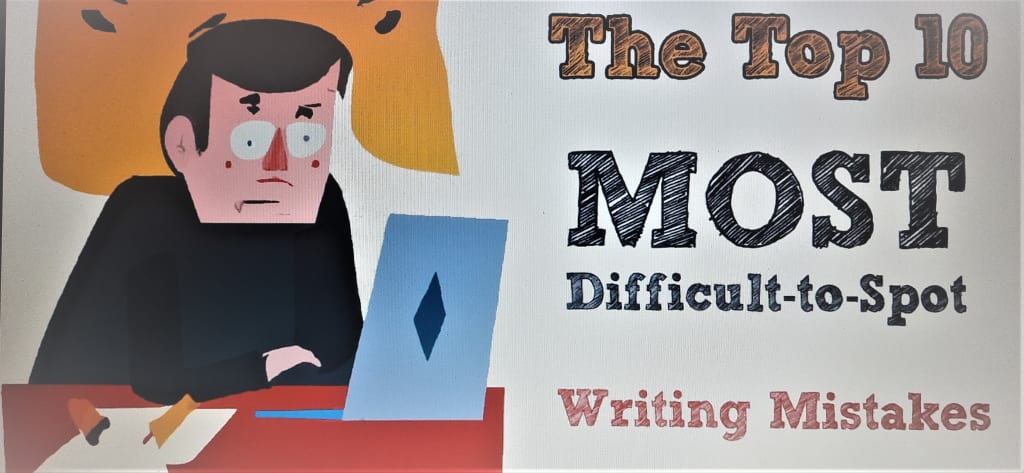
Effective communication through writing is a skill that requires constant refinement. Even the most seasoned writers can fall prey to subtle mistakes that elude detection. These hidden errors can compromise the clarity and impact of your message. In this article, we will delve into the top 10 most difficult-to-spot writing mistakes, offering insights and strategies to help writers enhance their craft.
1. Ambiguous Pronoun References
One common yet elusive mistake is ambiguous pronoun references. This occurs when a pronoun, such as "he," "she," or "it," lacks a clear antecedent, making it challenging for readers to discern to whom or what the pronoun refers. Consider the following example:
"After talking to Sarah, Maria realized she needed to revise her presentation."
In this sentence, it's unclear whether "she" refers to Sarah or Maria. To address this, writers should ensure that pronouns have unambiguous antecedents or rephrase sentences for clarity.
2. Dangling Modifiers
Dangling modifiers are sneaky errors that often slip past even experienced writers. These modifiers are phrases or clauses that don't logically or grammatically connect to the word they are intended to modify. Take a look at this example:
"Running late for the meeting, the car keys were nowhere to be found."
Here, the dangling modifier "running late for the meeting" doesn't logically connect to the subject "the car keys." To correct this, writers should restructure the sentence to establish a clear relationship between the modifier and the subject.
3. Misplaced Commas
Commas can be elusive culprits when it comes to writing mistakes. Misplacing commas can alter the intended meaning of a sentence. Consider the difference between these two sentences:
"Let's eat, Grandma!"
"Let's eat Grandma!"
The placement of the comma transforms the sentence from a dinner invitation to a potentially cannibalistic proposition. Writers should pay careful attention to comma usage to avoid unintentional humor or confusion.
4. Redundancy and Wordiness
Eliminating redundancy and wordiness is a perpetual challenge for writers. It involves distilling complex ideas into concise, clear language. Redundant phrases such as "free gift" or "new innovation" can detract from the overall impact of a message. Writers should strive for brevity without sacrificing meaning, aiming to convey ideas efficiently.
5. Inconsistent Verb Tenses
Inconsistent verb tenses can subtly undermine the coherence of a piece of writing. Writers must maintain consistency in the timeframe of their narrative. Switching between past, present, and future tenses without clear intent can confuse readers. A careful review of verb tenses is essential for ensuring a seamless flow in writing.
6. Subject-Verb Agreement
Subject-verb agreement errors often elude detection because they can occur with more complex sentence structures. Writers must ensure that the subject and verb in a sentence agree in number. For example:
"The team of experts is working on their respective projects."
In this sentence, "team" is a singular subject, but the plural pronoun "their" creates a disagreement. The correct sentence should read, "The team of experts is working on its respective projects."
7. Lack of Parallel Structure
Parallel structure involves using consistent grammatical and structural elements within a sentence or paragraph. This mistake can be challenging to spot, as writers may not immediately recognize the lack of symmetry. Consider this example:
"She enjoys hiking, reading, and to travel."
To maintain parallel structure, the sentence should be revised to read, "She enjoys hiking, reading, and traveling." Consistency in structure enhances readability and overall coherence.
8. Incorrect Word Usage
Selecting the right words is crucial for effective communication, and choosing the wrong ones can lead to confusion. Homophones, words that sound alike but have different meanings, are frequent culprits. For instance:
"Their going to the park there car."
Correcting this sentence involves using the appropriate homophones: "They're going to the park in their car."
9. Passive Voice Overuse
While the passive voice has its place in writing, overusing it can result in a lack of clarity and impact. Passive constructions can obscure the doer of the action, leading to a less engaging narrative. Writers should strive for a balance between active and passive voice, using each strategically to enhance the overall quality of their writing.
10. Lack of Consistent Style and Tone
Maintaining a consistent style and tone throughout a piece of writing is essential for creating a cohesive and professional presentation. Inconsistencies in language, formality, or tone can distract readers and diminish the overall effectiveness of the message. Writers should be mindful of their audience and purpose, ensuring a unified voice throughout their work.
Conclusion
Mastering the art of writing requires a keen eye for detail and a commitment to continual improvement. The most challenging mistakes to spot often involve subtle nuances that can elude even experienced writers. By being aware of these common pitfalls, writers can elevate their craft and produce more polished, effective pieces. Regular self-editing, peer review, and a dedication to honing writing skills will contribute to the development of more refined and impactful written communication.
About the Creator
HEY DUDE
In this page I am giving works related to story and essay history and I request you to support me.
My New Book is Finally Here
My poetry collection Beautiful and Brutal Things is done. It's actually done and finally published over 270 pages. Over a year of my life went into this book. More than a year, really. Long days at my computer, sometimes seven days a week because I couldn't stop even when I probably should have. Then two months of editing that felt harder than the writing itself. But it's finished, and I'm still standing, and the book is real.
By Tim Carmichaela day ago in BookClub
7 Contemporary Romance Books Everyone Should Read In 2026
Love is timeless, but the stories we tell about it evolve with the world around us. Contemporary romance captures the pulse of modern relationships, blending passion, humor, and emotional depth with the realities of our everyday lives. Unlike classic romance, contemporary tales often tackle themes like career challenges, cultural differences, mental health, and personal growth—making them both relatable and inspiring. In a world where connection is increasingly digital, these books remind us of the beauty of vulnerability, the excitement of chemistry, and the transformative power of love.
By Diana Meresc7 days ago in BookClub




Comments
There are no comments for this story
Be the first to respond and start the conversation.