
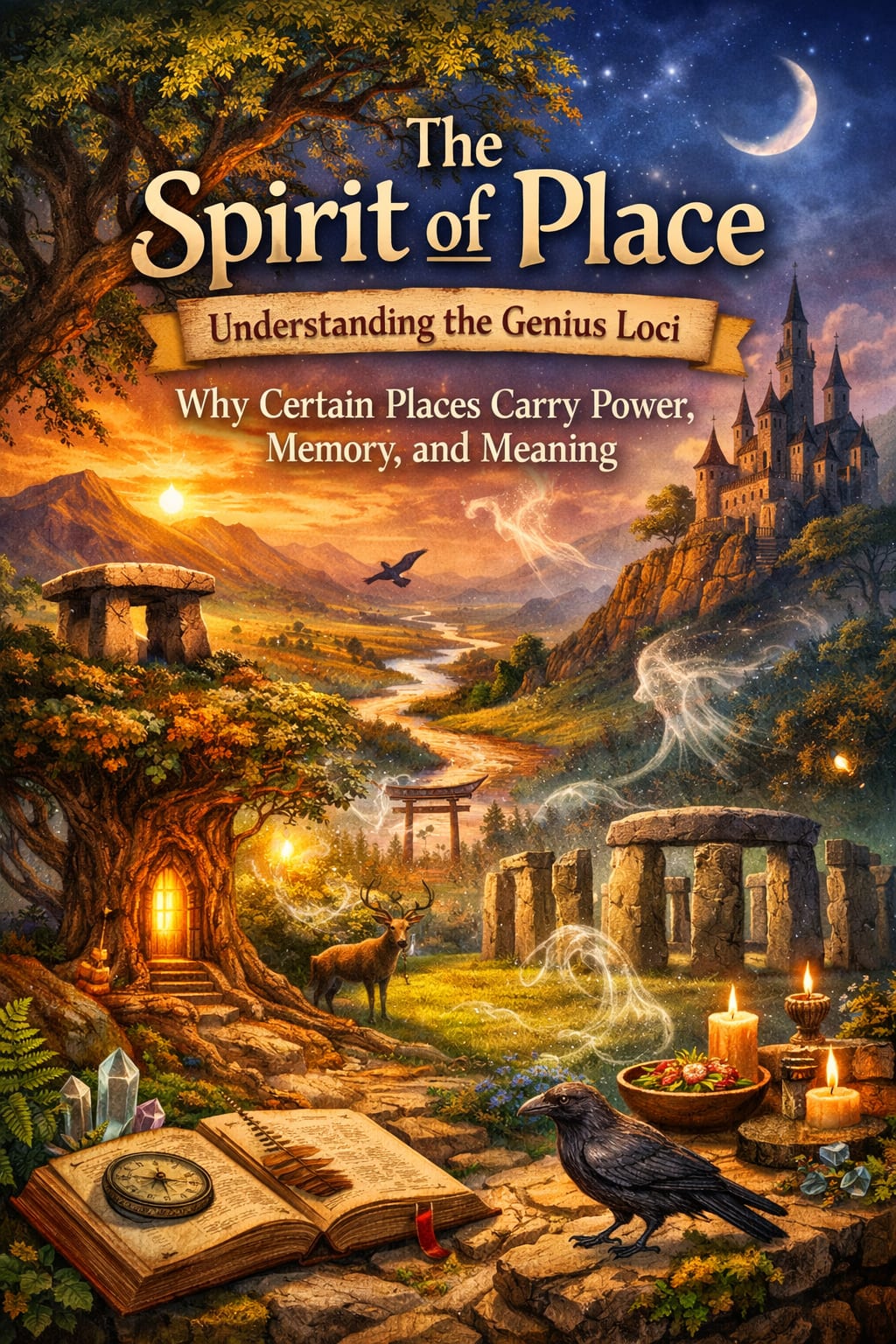
The Spirit of Place: Understanding the Genius Loci
Why Certain Places Carry Power, Memory, and Meaning

When Place Becomes Presence
Across human history, landscapes have rarely been regarded as neutral or empty. Valleys, rivers, forests, shorelines, crossroads, and built environments have consistently been experienced as possessing a distinct presence. Archaeological evidence, religious texts, and oral traditions reveal a shared understanding that land carries character, intention, and memory. Settlements emerged where land felt favorable. Shrines rose where terrain inspired reverence. Routes followed paths believed to be watched over or guided by unseen forces. Geography shaped culture not only through resources and climate, but through perceived meaning.
In the ancient Mediterranean world, this perception found formal expression in the concept known as genius loci. In Latin usage, genius referred to a generative or guiding spirit rather than intellectual ability, while loci denoted a specific place. Together, the phrase described the animating essence believed to dwell within a location. Roman religious practice treated land as something capable of favor, displeasure, protection, or withdrawal. Offerings were made before construction, cultivation, or travel, acknowledging that successful human activity depended upon harmony with local conditions that extended beyond the material.
Similar ideas appear far beyond Roman borders. Sacred groves of the ancient Celts, the kami of Shinto landscapes, the ancestral songlines of Aboriginal Australia, and the geomantic principles of Chinese feng shui all reflect a shared recognition of place as active and influential. These traditions differ in language and ritual, yet converge on a single premise: land remembers, responds, and shapes those who dwell within it.
Historical records suggest that cities, temples, and homes were often positioned according to qualities sensed rather than measured. Ancient builders observed wind patterns, water flow, soil temperament, and the emotional atmosphere of terrain. Such observations informed decisions long before scientific terminology existed to explain environmental psychology or ecological balance. The result was architecture that emerged from dialogue with location rather than dominance over it.
The endurance of this idea speaks to lived experience. Certain places evoke calm without explanation. Others inspire unease, reverence, or belonging. Ruins retain gravity long after stone has fallen. Paths worn smooth by centuries of passage continue to invite movement. Memory settles into land through repetition, story, and event, creating layers of meaning perceptible even to those unfamiliar with local history.
Modern scholarship increasingly supports these ancient intuitions. Fields such as environmental psychology, anthropology, and cultural geography confirm that surroundings influence cognition, emotion, and behavior. Place attachment, spatial memory, and environmental identity demonstrate that landscapes participate actively in human life. What earlier cultures framed as spirit, contemporary disciplines describe through phenomenology and neuroscience, yet the underlying recognition remains unchanged.
The genius loci endures not as relic or superstition, but as a framework for understanding why place matters. Meaning does not arise solely from human projection. Meaning emerges through relationship. Land shapes experience, and experience reshapes land, forming a continuous exchange that anchors culture, memory, and identity within the physical world.
Historical Origins of the Genius Loci
Roman Religious Foundations
The concept known as the genius loci emerged from the religious framework of ancient Rome, where spiritual presence permeated every aspect of daily life. In Roman thought, the word genius did not signify intellect or talent. The term described a generative force, an indwelling essence responsible for vitality, continuity, and protection. Every person was believed to possess a personal genius that guided character and destiny. This same principle extended outward to families, communities, and the land itself.
Roman religion recognized no sharp division between human life and the surrounding environment. Houses, streets, fields, springs, and city boundaries were understood to possess their own localized spirit. The genius loci represented the defining presence of a particular place, shaping its temperament and influencing events that occurred within its bounds. This spirit was neither abstract nor symbolic. The genius loci was treated as an active participant in civic and domestic life.
Material evidence of this belief survives in the form of lararia, household shrines commonly found in Roman homes. These shrines honored the Lares, protective spirits of the household, alongside the genius of the head of the family and, in many cases, the genius loci of the surrounding land. Wall paintings and small statues often depicted the genius as a robed figure holding a cornucopia or libation bowl, visual symbols of fertility and sustenance. Daily offerings of wine, incense, oil, or flowers acknowledged the ongoing relationship between inhabitants and place.
Public spaces received similar attention. City gates, crossroads, bridges, and agricultural boundaries were marked by altars or inscriptions dedicated to local spirits. Before roads were laid, colonies founded, or fields cultivated, rituals were performed to seek consent from the land. These acts were not mere formalities. Roman legal and religious traditions regarded neglect of local spirits as a potential source of misfortune, crop failure, or social disorder.
Literary sources reinforce this worldview. Poets such as Virgil infused landscapes with moral and emotional weight, presenting land as capable of favor or resistance. In the Aeneid, Italy is portrayed not simply as territory but as a destined land that reveals its nature gradually through signs and omens. Ovid’s Metamorphoses repeatedly transforms natural features into witnesses of divine action, binding story to soil. Horace wrote of rural retreats as places where spirit and environment aligned in quiet harmony.
Roman expansion did not erase local sacred geographies. Instead, colonization often absorbed indigenous spirits into Roman religious practice. Local deities were identified with Roman counterparts, and existing sacred sites were preserved beneath new temples. This practice reflected an acknowledgment that land retained its character regardless of political authority.
The Roman understanding of the genius loci reveals a culture deeply attuned to place as presence. Land was not owned in the modern sense. Land was engaged, honored, and negotiated with. Through ritual, architecture, and literature, Roman society expressed a belief that stability and prosperity depended upon respectful coexistence with the spirit that dwelled within each place.
Greek Precursors and Cultural Parallels
Sacred Landscapes Before Rome
Long before Roman religion articulated the idea of the genius loci, Greek culture had already developed a sophisticated understanding of place as animated and spiritually charged. Greek religious life was deeply embedded in landscape, with natural features serving as dwelling places for divine and semi-divine beings. The concept of daimones described intermediary spirits that operated between gods and mortals, often bound to specific locations. These beings were not inherently benevolent or malevolent. Character depended upon context, relationship, and respect.
Springs, caves, groves, and mountains were rarely considered neutral terrain. Freshwater sources belonged to nymphs, whose presence ensured fertility and continuity. Forests and trees were guarded by dryads and hamadryads, spirits whose lives were bound to the health of the trees themselves. Mountains such as Olympus and Parnassus were not merely elevations but abodes of divine order and inspiration. These associations shaped daily practice, seasonal ritual, and patterns of movement across the land.
Sacred geography influenced the placement of temples, sanctuaries, and pilgrimage routes. Oracles such as Delphi and Dodona were established where geological and atmospheric conditions were perceived as conducive to divine communication. Earth fissures, unusual acoustics, and distinctive vegetation contributed to a sense of presence that guided site selection. These locations were not chosen arbitrarily. Terrain itself was regarded as expressive.
Greek philosophical thought reinforced this perception. Plato engaged with the nature of place in dialogues concerned with cosmology, ethics, and the structure of reality. In the Timaeus, space is treated as a receptive medium with qualities that influence form and becoming. While not explicitly spiritual in the religious sense, this framework acknowledged that location shapes existence rather than merely containing it.
Aristotle further refined the concept through the term topos, defining place as the immediate boundary surrounding a body. Place, in this formulation, was not an abstract coordinate system but a relational condition tied to physical presence. This understanding challenged later notions of space as empty and uniform, grounding existence in situated experience. These philosophical insights later informed Roman religious interpretations and architectural theory.
Beyond the Greek world, indigenous European cultures preserved deeply animistic relationships with land. Celtic societies honored rivers, wells, hills, and groves as ancestral and divine. Germanic traditions regarded forests and stones as sites of power and judgment. Italic peoples, including those predating Roman dominance, recognized localized spirits bound to farmland, borders, and burial grounds.
Material remains support these traditions. Archaeological sites across Europe reveal long-standing continuity of ritual use at specific locations. Sacred wells show evidence of offerings spanning centuries. Standing stones and burial mounds were revisited and recontextualized across generations. When Roman administration expanded into these regions, existing sacred sites were frequently preserved rather than erased. Temples were constructed atop older shrines, and local deities were integrated into Roman religious structures through interpretatio Romana, the practice of identifying indigenous gods with Roman counterparts.
This continuity reflects a shared recognition that certain places possess enduring significance independent of political or cultural change. Land retained memory, authority, and presence. The Roman genius loci did not emerge in isolation. It arose from a broader European and Mediterranean understanding that place is active, responsive, and worthy of reverence.
Key Terms Associated with the Genius Loci
Understanding the genius loci requires familiarity with a vocabulary shaped by religion, philosophy, anthropology, and cultural geography. These terms reflect how different societies have articulated the relationship between place, presence, and meaning across time.
Genius
In Roman religious thought, a genius referred to a generative and protective essence rather than intellectual capacity. This spirit was believed to accompany a person from birth, shaping character, fortune, and vitality. The concept extended beyond individuals to families, institutions, and locations. A genius functioned as a sustaining force, responsible for continuity and well-being. In visual representation, the genius was often depicted holding a libation bowl or cornucopia, symbolizing nourishment and abundance.
Locus and Loci
The Latin word locus denotes a specific place or position, while loci serves as its plural form. Within the phrase genius loci, the term emphasizes particularity rather than abstraction. A locus is not interchangeable space but a defined environment shaped by geography, history, and use. Roman legal, religious, and architectural texts consistently distinguished meaningful place from undifferentiated space, reinforcing the importance of localized presence.
Animism
Animism describes a worldview in which spiritual presence inhabits natural features, objects, and landscapes. Rivers, stones, trees, and mountains are understood as living or ensouled rather than inert matter. This perspective is foundational to many indigenous traditions worldwide and closely aligns with ancient Mediterranean religious practices. Animism does not imply uniform belief systems but reflects a shared recognition of agency within the natural world.
Sacred Geography
Sacred geography refers to the structuring of land according to spiritual, mythological, or cosmological significance. Pilgrimage routes, ritual centers, burial grounds, and mythic landscapes form networks of meaning that transcend political boundaries. In ancient societies, sacred geography guided settlement patterns, agricultural calendars, and ceremonial life. Certain locations were regarded as axis points connecting human, natural, and divine realms.
N uminous
The term numinous was introduced by theologian Rudolf Otto to describe the emotional experience associated with encounters with the sacred. This experience combines awe, fascination, and unease, often felt in environments perceived as powerful or otherworldly. The numinous quality of a place contributes to its enduring significance, explaining why certain landscapes inspire reverence without rational explanation.
Topos
Derived from Greek philosophy, topos refers to place as a relational condition rather than an abstract coordinate. Aristotle defined topos as the immediate boundary surrounding a body, emphasizing situational context. This concept influenced later architectural theory and reinforced the idea that existence is inseparable from location.
Topophilia
Coined by cultural geographer Yi-Fu Tuan, topophilia describes the affective bond between people and place. This attachment arises through memory, experience, and sensory engagement. Topophilia provides a modern psychological framework for understanding why certain locations evoke belonging, nostalgia, or comfort, echoing earlier notions of place-based spirit.
Phenomenology of Place
Phenomenology of place examines how environments are experienced through perception, movement, and memory. This approach, influenced by philosophers such as Martin Heidegger and Maurice Merleau-Ponty, emphasizes lived experience over abstract measurement. The genius loci aligns closely with phenomenological perspectives by prioritizing presence and meaning as primary qualities of place.
Liminality
Liminality refers to transitional or threshold spaces where conventional structures dissolve. Crossroads, shorelines, gates, and borders often function as liminal zones in myth and ritual. Such spaces are frequently associated with heightened spiritual activity and transformation, reinforcing the perception of intensified presence.
Place Attachment
Place attachment is a term used in environmental psychology to describe emotional and cognitive bonds formed between individuals and specific environments. Research demonstrates that these bonds influence identity, behavior, and well-being. This concept provides empirical support for longstanding beliefs about the formative power of place.
Axis Mundi
The axis mundi represents a symbolic center connecting heaven, earth, and the underworld. Mountains, temples, trees, and cities have served this role across cultures. Locations associated with an axis mundi often become focal points of ritual and myth, reinforcing their perceived spiritual centrality.
Together, these terms form a conceptual framework that illuminates how the genius loci has been understood and reinterpreted across cultures and disciplines. Each reflects an enduring recognition that place is not merely occupied but encountered, shaping human experience through presence, memory, and meaning.
Core Concepts of the Genius Loci
Place as Living Presence
The genius loci frames landscapes as entities with agency, influencing human perception, action, and cultural formation. Observations in ancient societies extended beyond practical considerations, encompassing ecological, spiritual, and symbolic dimensions. Roman augury, for example, involved reading signs in the natural environment, including birds, winds, and celestial patterns, to determine the favorability of construction or settlement. Such practices reflect a recognition that land possesses qualities that can facilitate or hinder human endeavor.
Architectural orientation in the Mediterranean and Near Eastern worlds further demonstrates this principle. Temples, houses, and urban grids often responded to sun patterns, water flow, and local topography. The placement of a forum or a sanctuary was rarely arbitrary; builders sought to harmonize human activity with inherent qualities of the site. In Japan, Shinto shrines illustrate a parallel approach, where forests, rocks, and waterways are selected as sacred because of perceived spiritual resonance, demonstrating that the recognition of living presence extends across cultures and epochs.
Memory Embedded in Landscape
Land accumulates meaning through historical events, ritual repetition, and communal storytelling. Archaeological sites such as Stonehenge, Newgrange, and Delphi reveal deliberate structuring of space to encode memory, cosmology, and ceremonial significance. Battlefields, sacred groves, and pilgrimage paths become repositories of collective identity, linking physical place to narrative and ritual.
Psychological research in environmental perception shows that humans attach significance to landscapes through repeated interaction, sensory engagement, and emotional investment. The genius loci anticipates this by recognizing that place, once imbued with experience, retains resonance that shapes perception of subsequent events. Memory is layered: myth, history, ritual, and personal experience converge to form complex, enduring associations with specific locations.
Reciprocity Between Humans and Place
Reciprocity between humans and landscape manifests across ritual, architecture, and social organization. Agricultural festivals, such as the Robigalia in Rome, sought protection against blight by offering sacrifices to land spirits. Celtic societies venerated wells and groves, leaving votive offerings to sustain fertility and water quality. Indigenous Australian communities maintain songlines, pathways that encode law, history, and cosmology while sustaining the ecological balance of the land.
This principle underscores the notion that human flourishing depends upon attentive engagement rather than dominion. Landscapes respond to care, respect, and ritual acknowledgment, demonstrating that ethical and practical interaction with the environment is inseparable from cultural stability.
Thresholds and Liminality
Liminal locations amplify the perception of the genius loci, serving as points of transition, negotiation, or transformation. Crossroads, riverbanks, mountain passes, caves, and city gates function as spatial interfaces where ordinary patterns of life are suspended. Anthropological studies of ritual behavior show that such sites are central to ceremonies, initiations, and festivals. These spaces mediate between the human and the sacred, the known and the unknown.
In European folklore, haunted woods, sacred stones, and burial mounds illustrate liminal power, suggesting that thresholds carry historical memory as well as spiritual potency. In Eastern traditions, mountain peaks and river confluences often serve as sites of pilgrimage or meditation, highlighting universality in the perception of liminal significance. Liminality reinforces the genius loci’s capacity to shape experience: engagement with thresholds transforms ordinary understanding, instilling awe, reflection, or caution.
Environmental, Cultural, and Psychological Integration
The genius loci encompasses ecological, social, and cognitive dimensions. Landscapes regulate microclimate, resource availability, and movement patterns, influencing settlement and agriculture. Rituals and narratives embed cultural memory and moral frameworks within these landscapes. Psychological responses, including emotional attachment and aesthetic appreciation, further reinforce the perception of place as alive. Modern environmental psychology, phenomenology, and cultural geography corroborate these observations, demonstrating that spatial experience has measurable effects on human cognition and behavior.
This multidimensional perspective positions the genius loci as a principle that integrates material, symbolic, and experiential qualities. Landscapes are not inert; they are lived, remembered, and engaged. Their influence persists across generations, shaping social, spiritual, and environmental outcomes. Recognition of the genius loci encourages nuanced interaction with space, fostering understanding that enduring relationships with place require attentiveness, respect, and adaptation.
Genius Loci in Architecture and Urban Design
Roman Urban Planning
Roman urbanism exemplifies the integration of sacred presence with practical design. Cities were often delineated by ritual boundaries known as pomeria, which defined the sacred perimeter of settlement and symbolically separated the inhabited space from the surrounding wilderness. Establishing these boundaries was accompanied by augury, a divinatory practice interpreting the flight patterns of birds or other natural omens to determine the favorability of site selection. This process acknowledged the local genius and sought its consent, reflecting a worldview in which urban success depended upon harmony with the inherent character of the land.
Public architecture reinforced this principle. Amphitheaters, forums, and temples were positioned in response to topography, orientation to celestial bodies, and natural water courses. Hills, valleys, and river bends guided the layout rather than being leveled or ignored. The Colosseum in Rome, while monumental, incorporated natural slopes to optimize viewing and acoustics. Similarly, Roman aqueducts and bridges adapted to terrain, demonstrating an understanding that engineering and sacred respect could coexist. Streets and urban grids were often oriented along cardinal directions or aligned with sacred landmarks, embedding cosmological and spiritual order within civic space.
Medieval and Renaissance Continuity
The influence of the genius loci persisted through the medieval period. Cathedral and monastery builders frequently selected sites already associated with spiritual significance. Many Christian churches arose atop earlier temples, sacred groves, or ancient pilgrimage paths, preserving continuity of reverence. Orientation to cardinal points, particularly eastward toward sunrise, symbolized cosmic order and divine presence, reinforcing a sense of place as spiritually charged.
Renaissance architects revived and expanded upon classical principles. Leon Battista Alberti, in treatises such as De Re Aedificatoria, emphasized the importance of responding to site conditions, including climate, slope, soil, and existing natural features. Harmony between structure and terrain became a guiding principle. Gardens, piazzas, and villas were sited with attention to sightlines, sunlight, and natural contours, creating integrated experiences that blended human design with environmental context. Michelangelo’s planning for St. Peter’s Square, for example, carefully considered perspective and movement, shaping the approach to the basilica while respecting the existing urban fabric.
Modern Architectural Theory
In the twentieth century, the concept of the genius loci experienced renewed emphasis in architectural theory. Christian Norberg-Schulz advanced the idea that meaningful architecture arises not from abstract formalism but through engagement with the spirit of place. In Genius Loci: Towards a Phenomenology of Architecture, he argued that buildings must mediate between human life and environmental context, reflecting both material conditions and experiential qualities of location.
Norberg-Schulz drew extensively upon phenomenology, particularly the philosophy of Martin Heidegger, emphasizing dwelling (Dasein) and the lived experience of space. Architecture becomes an interface where perception, memory, and movement intersect with landscape, topography, and climate. Site-specific design, in this view, acknowledges historical layers, cultural memory, and ecological character. Contemporary architects such as Peter Zumthor and Tadao Ando have applied these principles, creating spaces that respond to terrain, light, and atmosphere, thereby activating the genius loci in modern contexts.
Integration of Landscape, Culture, and Experience
Across historical periods, architecture has consistently reflected an awareness of place as a living entity. Roman urban planning, medieval sacred construction, Renaissance site-specific design, and modern phenomenological architecture all demonstrate continuity in engaging with environmental, spiritual, and cultural qualities. Structures are not imposed upon land in isolation; they arise through dialogue with topography, climate, history, and social memory. This approach reinforces the understanding that the genius loci is not a static abstraction but an operative principle, guiding how human environments are conceived, inhabited, and experienced.
Genius Loci in Literature and Art
Classical and Romantic Literature
Classical literature frequently imbued landscapes with moral, spiritual, and emotional significance, reflecting an understanding that places are active participants in human experience. In Roman epic, Virgil’s Aeneid presents Italy as a land of destiny, whose rivers, mountains, and cities guide the journey of Aeneas while reflecting the values and future of Roman civilization. Ovid’s Metamorphoses transforms natural features into witnesses of divine action, embedding mythological and ethical narratives within forests, rivers, and mountains. Land is not passive; it observes, reacts, and participates in human and divine events.
Romanticism revived this sensibility, positioning landscape as a source of inspiration, moral reflection, and psychological transformation. William Wordsworth’s poetry emphasizes the formative influence of nature on consciousness and imagination, portraying rivers, hills, and valleys as active forces shaping ethical and emotional awareness. Landscape painting of the period, by artists such as Caspar David Friedrich and J.M.W. Turner, further explored mood, atmosphere, and spiritual presence. Dramatic light, compositional focus, and topographical specificity conveyed the perception that places possess distinct character and influence human thought and feeling.
Gothic and Folkloric Traditions
Gothic literature often centers on the haunting presence of place rather than individual actors. Castles, abbeys, ruins, and remote landscapes serve as repositories of memory, trauma, or moral tension. Works by Ann Radcliffe and Matthew Lewis illustrate settings where architecture and terrain exert pressure on narrative and emotion, creating a palpable sense of the genius loci as unease, melancholy, or menace.
European folklore preserves a complementary tradition. Hills, woods, wells, and waterways are frequently associated with spirits, historical events, or moral lessons. These stories function as repositories of collective memory and territorial identity, encoding local knowledge, historical trauma, and cultural values within landscape. Sacred groves, boundary stones, and standing monuments demonstrate that myth and narrative extend the presence of place across generations.
Modern Artistic Expressions
Contemporary art continues to explore the genius loci through direct engagement with specific sites. Land artists such as Andy Goldsworthy, Richard Long, and Robert Smithson create works that respond to terrain, climate, and temporality, emphasizing impermanence and environmental dialogue. These site-specific works foreground the interaction between human creativity and environmental context, often revealing qualities of place that remain unnoticed in daily experience. Installations and performance art also investigate how architecture, landscape, and cultural memory intersect, reinforcing the enduring presence of genius loci in artistic practice.
Psychological and Anthropological Perspectives
Modern research provides empirical support for historical intuitions about place. Environmental psychology demonstrates that landscapes influence cognition, emotion, and behavior. Concepts such as restorative environments, environmental identity, and place attachment highlight the capacity of physical surroundings to promote mental health, focus, and social cohesion. Emotional bonds to specific locations reflect layered experience, memory, and cultural narrative, aligning closely with classical notions of the genius loci.
Anthropological research further illustrates the integration of spiritual and social meaning within landscapes. Australian Aboriginal songlines map ancestral journeys, law, and cosmology onto physical geography, transforming terrain into living scripture. Similar practices appear in Native American, African, and Asian cultures, in which mountains, rivers, and groves are simultaneously ecological, spiritual, and social frameworks.
These perspectives demonstrate that the genius loci is not merely metaphorical. Across time and culture, humans experience place as active, imbued with memory, moral significance, and agency. Literature, art, and scholarship reveal that awareness of place shapes imagination, ritual, and identity, validating ancient practices through contemporary observation.
Key Individuals Associated with the Genius Loci
The concept of the genius loci has been shaped and transmitted by thinkers, architects, poets, and geographers who recognized the active presence of place. Each contributed to understanding how landscapes, built environments, and human perception intersect, leaving a lasting influence on culture, art, and architecture.
Vitruvius
Marcus Vitruvius Pollio, a Roman architect and engineer active during the first century BCE, codified principles of site selection, building orientation, and environmental responsiveness in his seminal treatise De Architectura. Vitruvius emphasized that architecture should harmonize with climate, topography, and local resources. Temples, public spaces, and private dwellings were designed with attention to natural light, wind, and landforms, reflecting an early recognition that human activity interacts with the character of place. The Vitruvian framework underlines that structural and environmental alignment produces functional, aesthetic, and spiritual cohesion.
Virgil
Publius Vergilius Maro, one of Rome’s most celebrated poets, conveyed the spirit of place through literary landscape. In the Aeneid, Italy is presented not simply as territory but as a destined land, whose rivers, mountains, and cities guide the actions of Aeneas while embodying historical and divine significance. Ovid, through Metamorphoses, similarly imbued rivers, forests, and mountains with memory and agency, transforming geography into active participants in myth and human affairs. Roman literature consistently treated landscapes as carriers of destiny, moral guidance, and divine witness.
Leon Battista Alberti
A Renaissance polymath and architect, Leon Battista Alberti expanded upon classical principles of site sensitivity in treatises such as De Re Aedificatoria. Alberti advocated for designs responsive to terrain, climate, and cultural context. Villa placement, urban squares, and civic structures were conceived in dialogue with surroundings, integrating human form with natural and social conditions. Alberti’s work reinforced the principle that architecture should reflect the genius loci of a site, combining aesthetic, functional, and moral considerations.
Andrea Palladio
Palladio, a sixteenth-century Italian architect, emphasized harmony between buildings and their environment. Villas such as those in the Veneto region were carefully sited to interact with landscape contours, water features, and agricultural land. Palladio’s treatises codified proportion, perspective, and integration with local geography, creating designs that honored both human need and the inherent qualities of the land.
Martin Heidegger
Heidegger, a twentieth-century German philosopher, examined human dwelling in relation to place and existence. In works such as Building, Dwelling, Thinking, Heidegger argued that authentic human experience arises from engagement with environment and architecture. Place is inseparable from being, and dwelling is an act of attentive interaction with surroundings. Heidegger’s phenomenology influenced architectural theory, emphasizing that built environments must resonate with the character of location.
Christian Norberg-Schulz
Norberg-Schulz, a Norwegian architectural theorist, revived the genius loci as a central principle of contemporary design. In Genius Loci: Towards a Phenomenology of Architecture, he emphasized that architecture must respond to environmental conditions, cultural history, and perceptual experience. Norberg-Schulz drew upon Heideggerian philosophy, promoting designs that mediate between human activity and spatial character. His work bridges ancient understanding of place with modern architectural practice, inspiring site-specific, context-sensitive construction.
Yi-Fu Tuan
Tuan, a geographer and humanist, explored the emotional and psychological dimensions of place through the concept of topophilia. He documented how humans form attachments to landscapes, cities, and natural features, highlighting memory, narrative, and sensory engagement. Tuan’s research demonstrates that place evokes identity, belonging, and ethical response, aligning modern empirical study with the philosophical and literary traditions surrounding the genius loci.
Other Notable Figures
Palladio’s influence extended through subsequent centuries, affecting European and American architectural traditions. Gaston Bachelard, a French philosopher, emphasized phenomenology of space in works such as The Poetics of Space, exploring interior and exterior environments as sites of memory and imagination. William Wordsworth and Caspar David Friedrich, though primarily literary and artistic figures, contributed enduring insights into landscape perception, emotional resonance, and the moral and spiritual presence of place.
Together, these individuals illustrate the breadth of the genius loci concept across disciplines. Architecture, literature, philosophy, geography, and art converge on the recognition that landscapes and built environments possess character, memory, and agency. Their combined contributions demonstrate that human experience of place is never neutral but mediated by history, culture, perception, and design.
Cross-Cultural Parallels of the Genius Loci
The concept of the genius loci extends far beyond the Roman and European context, finding resonance across diverse cultures worldwide. In these traditions, landscapes are not passive backdrops but active participants in human life, imbued with memory, spiritual presence, and moral authority.
Shinto and Japanese Sacred Landscapes
In Japan, Shinto practice embodies the recognition of spiritual presence in natural features. Kami, the spirits or deities of Shinto, inhabit mountains, rivers, forests, and rocks. Sacred groves (chinju no mori) and mountain shrines serve as loci where human activity intersects with divine presence. Rituals, offerings, and festivals maintain harmony with these natural spirits, reinforcing the idea that ecological stewardship and spiritual observance are inseparable. Shinto architecture, such as torii gates and shrine placement, emphasizes integration with topography, highlighting that the built environment must respect the inherent character of place.
Feng Shui and Chinese Geomancy
Chinese geomantic practice, known as feng shui, evaluates landscapes to ensure alignment with natural energy flows, called qi. Site selection for homes, temples, and cities incorporates topography, orientation, water features, and wind patterns. Mountains are considered sources of stability, rivers channels of life force, and flat plains areas of potential growth when correctly aligned. Feng shui integrates cosmology, ecology, and social practice, demonstrating that the human-environment relationship is reciprocal: misalignment disrupts health and prosperity, while harmonious placement enhances well-being and longevity. The concept closely parallels Roman and European attention to site-specific spiritual presence and environmental responsiveness.
Indigenous American Traditions
Indigenous cultures of North and South America recognize land as sacred and animate, often through creation stories, ritual practices, and territorial stewardship. Native American nations, such as the Hopi, Navajo, and Lakota, encode ancestral journeys, law, and spiritual knowledge within specific geographic features, including mesas, rivers, and mountains. Sacred landscapes are both historical and cosmological, linking contemporary communities to ancestors and maintaining continuity of cultural identity. Ritual practices, storytelling, and seasonal ceremonies sustain these relationships, demonstrating that land is a living repository of memory, morality, and social cohesion.
Australian Aboriginal Songlines
Australian Aboriginal cultures offer another profound parallel. Songlines, or Dreaming tracks, map ancestral journeys, law, and creation across the continent. Each rock formation, waterhole, and ridge carries story, ceremony, and practical guidance for navigation. These landscapes are inseparable from identity, law, and spiritual responsibility. Travel along songlines reinforces knowledge, memory, and relational ethics, emphasizing that place is active and relational, not inert.
Common Themes Across Cultures
Although rituals, terminology, and cosmology differ, these traditions converge on central principles shared with the genius loci. Place possesses agency and meaning independent of human imposition. Interaction with the environment requires observation, respect, and adaptation. Memory, story, and cultural practice embed themselves in terrain, creating layered significance across generations. Settlement, architecture, and ritual emerge from dialogue with location rather than domination over it.
These cross-cultural parallels demonstrate that human recognition of place as living, memory-laden, and morally charged is not limited to classical or European thought. Across continents and centuries, humans have consistently acknowledged that meaning arises from relationship with the land. Landscapes are experienced as participants in life, shaping action, identity, and culture while being shaped in turn by human attention and care.
Genius Loci and the Modern Occult
Interest in the spirit of place persists in contemporary occult, esoteric, and earth‑based spiritual traditions. Modern occult thought does not treat landscape as inert or abstract. Instead, it acknowledges that terrain, watercourses, trees, and thresholds possess dynamic qualities that can be felt, engaged with, and worked with as part of spiritual practice. This outlook reflects ancient animistic and geomantic traditions while adapting them to present‑day contexts, creating a living continuity between past and present understandings of environment and presence.
In modern occult practice, geomancy remains one of the primary systems for engaging with place. Traditional geomancy involved interpreting patterns in sand or soil to divine influences of earth forces. Contemporary earth mystics and occultists extend this practice to working directly with landscape features. Sacred sites, stone circles, standing stones, and alignments of natural features are studied to discern how terrestrial energies concentrate, shift, or interact with human intention. Some practitioners map so‑called earth energy lines or meridians, believing these currents influence mood, health, and spiritual insight. While scientific validation of such lines remains debated, the practice continues within occult and earth‑mystery communities as a means of sensing and collaborating with place presence.
Ritual engagement with specific locations appears in neo‑pagan, Wiccan, and druidic circles. Modern Druid orders and Wiccan covens often incorporate seasonal rites performed at solstices, equinoxes, or crossquarter days at outdoor sites, reinforcing connection between ritual act and landscape character. Such practices may include calling the quarters, making offerings to spirits of land and water, or conducting processions that honor local topography. These ceremonial forms echo older customs in which communities acknowledged protective spirits, fertility forces, or guardians of boundaries. The intent is not domination of environment but respectful engagement, seeking harmony with what is sensed in place.
Occult traditions also emphasize sensory and intuitive awareness of landscape. Meditation, trance, and focused observation are used to attune practitioners’ perception to qualities of terrain that are not immediately visible. Trees, rocks, rivers, and hills become interlocutors in these practices, their “voice” discerned through attention and prolonged presence. This reflects a core tenet of the genius loci: place reveals itself through relationship and careful observation, not abstraction or dismissal. Numerous contemporary occult manuals and field guides instruct practitioners in ways to approach land ethically, listen for subtle shifts in atmosphere, and respond to the character of place in ways that respect both community norms and ecological integrity.
Modern occult perspectives engage ancient belief systems without mere imitation. They draw on Celtic animism, Roman genius loci sensibilities, Chinese geomancy, and indigenous landscape reverence while recognizing that contemporary social, legal, and ecological contexts differ. Ethical engagement with land is emphasized: practitioners are encouraged to learn local history, respect private property and cultural heritage sites, and avoid practices that damage ecosystems or disrespect living communities. This orientation mirrors broader shifts in occult communities toward stewardship and conscientious participation in environment rather than appropriation or exploitation of landscape features.
Books, journals, and field reports from earth‑based spiritual traditions document experiences of place that align closely with the themes explored throughout this blog: that landscape holds memory, that human interaction with environment is reciprocal, and that attentive presence reveals depth and meaning not perceivable through superficial observation alone. By situating the genius loci within modern occult practice, the understanding of place expands beyond historical or academic frames into lived, experiential dimensions that continue to shape how people encounter landscape today.
For readers interested in exploring these ideas further, engagement with local historical records, folklore collections, and well‑curated occult and geomancy texts can deepen understanding. Free public libraries offer access to many of these resources, including scholarly works on sacred geography and traditional practice. When using online sources, exercise caution by verifying information across multiple reputable references, and remain mindful of ethical considerations when engaging with landscape in person. The spirit of place invites study, respect, and attentive response rather than idle curiosity.
Book Recommendations: #commissionearned
Magic in the Landscape: Earth Mysteries and Geomancy by Nigel Pennick
This book examines how ancient practices of geomancy and earth magic interpreted landscape as living and charged with unseen forces. Author Nigel Pennick draws on traditional European belief systems to show how ancestors worked with terrestrial energies, ley lines, astrological orientation, and the power of natural features to honor a place and make it a site of power. Field examples include crossroads, fairgrounds, graveyards, and other intersections of human and natural activity that were treated as sacred or threshold zones. Pennick also discusses how boundaries and magic circles framed relationships between human settlement and spiritual presence in the land. The work challenges modern assumptions that landscape is inert, arguing instead that earth mysteries shaped agriculture, architecture, and ritual behavior for centuries. Readers gain insight into the historical roots of thinking that place has character and agency, making this book a practical complement to philosophical and historical approaches to genius loci. It reinforces the blog’s core idea that meaningful engagement with environment integrates physical, cultural, and spiritual awareness.
Demons and Spirits of the Land by Claude Lecouteux
Claude Lecouteux’s work explores medieval European folk traditions in which forests, hills, rivers, and other terrain features were understood as inhabited by spirits, giants, dragons, and wild folk. This book traces how these beliefs shaped local stories, naming practices, ritual negotiations with land spirits, and even architectural decisions in village construction. Through extensive analysis of folklore, mythology, and ecclesiastical records, Lecouteux shows how ancestral lore treated specific places as animate and morally significant. Tales of demons, water spirits, and household guardians illustrate how land was embedded with personality and power long before modern secular views dominated thinking about space. Lecouteux also examines how suppression by institutional religion transformed these beliefs rather than erased them, leaving traces in customs and place names that persist today. Such material connects deeply with the blog’s theme that landscape accumulates memory and spirit through human interaction. This book situates that idea historically within a European context, showing how belief in local spirits influenced everyday life.
Spirit of Place: Artists, Writers & The British Landscape by Susan Owens
Susan Owens’s book surveys British art and literature to reveal how landscapes have been perceived and interpreted as expressive, meaningful places over centuries. Rather than presenting landscape solely as scenic backdrop, this work shows how poets, painters, and writers engaged with terrain in ways that shape cultural identity and emotional attachment. Owens discusses figures from Romantic poets to twentieth‑century artists, presenting case studies that demonstrate how creative expression encodes memory, myth, and aesthetic presence into specific locales. The narrative illustrates how artistic traditions contribute to collective understanding of place, reinforcing that environments possess qualities that inspire and influence human imagination. Through analysis of paintings, prose, and poetry, the book situates land as a partner in creative process rather than a neutral stage. This aligns with the blog’s exploration of genius loci by showing how cultural narratives and artistic perception shape how environments are valued and remembered. The work enriches understanding of how landscapes influence thought and cultural expression.
Genius Loci: Tales of the Spirit of Place, edited by Jaym Gates
This anthology brings together a diverse collection of speculative fiction centered on the ancient idea that places possess agency, memory, and character. Edited by Jaym Gates, the volume features short stories by multiple contemporary authors, including Seanan McGuire, Ken Liu, Amal El-Mohtar, and other established voices in fantasy and science fiction. Each contribution explores landscapes as active forces, presenting cities, wildernesses, ruins, and thresholds as entities that shape human behavior and moral consequence. Although fictional in form, the stories draw heavily on folklore, mythological structures, and long-standing beliefs in guardian spirits and sentient terrain. Locations function not merely as settings but as presences that respond to human actions, sometimes nurturing and sometimes resisting those who inhabit them. The anthology demonstrates how the genius loci continues to inspire modern storytelling by translating ancient intuitions about place into contemporary narrative frameworks. Its range of styles and cultural perspectives reinforces the enduring relevance of place-based meaning across genres and traditions.
Nature Spirits and Elementals: Esoteric Classics by Louise Off
Louise Off’s exploration of elemental beings such as gnomes, undines, sylphs, and salamanders traces the evolution of these concepts from alchemical and Theosophical traditions. While focused on specific types of nature spirits, the work situates them within the broader context of occult thought about how natural features possess character and agency. Off examines both historical sources and literary depictions, showing how elemental lore influenced esoteric traditions and symbolic systems. This book supports the blog’s larger theme by demonstrating that many occult systems treat terrain and environment as imbued with spiritual intelligence rather than inert matter. It offers readers insight into how Western esoteric traditions categorized and conceptualized spirits tied to earth, air, water, and fire. By linking these beings to places and natural phenomena, the book underscores the belief that interaction with landscape involves negotiation with unseen intelligences. Such perspectives deepen appreciation for cultural traditions in which place itself is meaningful and alive.
Earth Power: Techniques of Natural Magic by Scott Cunningham
This practical guide presents methods for engaging with energy in natural settings, including trees, rocks, streams, and open terrain. Scott Cunningham outlines techniques to heighten awareness of environmental energies, strengthen connection with landscape, and recognize subtle forces that traditional practitioners associate with spirit and presence. Activities range from meditation and sensory exercises to rituals designed to tune into local energies. Although written from the perspective of contemporary natural magic practice, the book reflects older traditions in which place was approached as animated and energetic. Cunningham’s emphasis on sensory attention and respectful engagement with place resonates with the blog’s discussion of environment as active and influential. The work demonstrates how modern occult practitioners draw upon ancestral insights about land presence, memory, and reciprocity. It provides accessible material for readers interested in experiential approaches to place dynamics beyond academic or philosophical study.
The Occult: A History by Colin Wilson
Colin Wilson’s comprehensive survey of western esoteric tradition traces the development of occult thought from ancient magic through modern spiritual movements. While not exclusively focused on landscape spirit, the book covers how cultures understood unseen dimensions of reality, including nature spirits, earth powers, and mystical interpretations of environment and existence. Wilson examines figures such as Aleister Crowley, Helena Blavatsky, and other influential occultists, showing how belief in hidden forces shaped cultural and spiritual history. The narrative situates concepts such as animism, elemental beings, and sacred space within the broader evolution of occult philosophy. For readers exploring genius loci through occult frameworks, this history provides context for how esoteric traditions have interpreted the relationship between human consciousness and the unseen aspects of place. Wilson’s writing highlights that belief in spiritual agency within environment has influenced a wide range of mystical and metaphysical systems. The book supports understanding of landscape as meaningful beyond empirical dimensions.
Reflections on Genius Loci
The genius loci is more than an artifact of ancient religion or a literary device. It reflects a universal human understanding that landscapes, buildings, and natural features possess character, memory, and presence. Across centuries, from Roman temples to Shinto shrines, Celtic sacred wells to modern architecture, societies have recognized that place shapes action, belief, and experience. Acknowledging the genius loci encourages an awareness of how every location carries layers of history, story, and cultural significance that interact with human life.
In a world increasingly dominated by urban uniformity, globalization, and ecological disruption, attention to the spirit of place provides both ethical and aesthetic guidance. Sensitivity to local topography, climate, and cultural memory supports sustainable design, nurtures psychological well-being, and reinforces connections between people and their surroundings. Ancient rituals, folklore, and contemporary architectural theory all demonstrate that engagement with the distinct character of a place fosters harmony and respect between humans and environment. Landscapes, when observed carefully, reveal stories embedded in soil, stone, water, and architecture, waiting for attentive witnesses to perceive and honor them.
Exploring genius loci encourages active learning. Readers are invited to examine local history, visit archaeological sites, experience natural landmarks, and engage with built environments in ways that reveal their unique presence. Free public libraries offer access to books, scholarly journals, and historical archives that illuminate the complex relationships between humans and their surroundings. While online resources can be valuable, it is important to approach free websites with caution, verifying information through multiple sources and cross-referencing with established scholarship. Engaging critically with primary texts, local historical societies, and field observation ensures a rich, informed understanding of how place exerts influence.
The genius loci reminds that location is never neutral. Recognizing the spirit of place transforms ordinary walking, living, or designing into a practice of observation, respect, and reflection. Place becomes partner, witness, and teacher. Its character shapes human thought, memory, and creativity, just as human care and attention shape the environment. Rediscovering the genius loci offers not only historical insight but practical guidance for living responsibly, imaginatively, and ethically in any landscape. Every street, hill, river, and garden holds presence; exploration, study, and reflection make that presence legible and meaningful.
About the Creator
Marcus Hedare
Hello, I am Marcus Hedare, host of The Metaphysical Emporium, a YouTube channel that talks about metaphysical, occult and esoteric topics.
https://linktr.ee/metaphysicalemporium
Keep reading
More stories from Marcus Hedare and writers in BookClub and other communities.
The Horned God: Lord of the Wild
Encountering the Horned God Across Paleolithic cave walls, Neolithic standing stones, Iron Age reliefs, ritual masks, and contemporary devotional spaces, a recurring figure emerges with remarkable consistency. Antlers rise from a human brow. Animal limbs merge with upright posture. Surrounding imagery evokes forests, herds, sexuality, decay, seasonal return, and the tension between cultivation and wilderness. Known in modern discourse as the Horned God, this figure represents one of the most persistent and multilayered symbols within the religious imagination of Europe and the wider Indo-European world.
By Marcus Hedare5 days ago in BookClub
My New Book is Finally Here
My poetry collection Beautiful and Brutal Things is done. It's actually done and finally published over 270 pages. Over a year of my life went into this book. More than a year, really. Long days at my computer, sometimes seven days a week because I couldn't stop even when I probably should have. Then two months of editing that felt harder than the writing itself. But it's finished, and I'm still standing, and the book is real.
By Tim Carmichael2 days ago in BookClub
7 Books About Psychology That Are Impossible To Put Down
Psychology is not just an academic discipline—it’s a mirror held up to our inner world. It explains why we think the way we do, why we fall in love, why we sabotage ourselves, and why some habits cling to us like gravity. The best psychology books don’t feel like textbooks; they feel like conversations that change how we see ourselves and others.
By Diana Meresc3 days ago in BookClub



Comments
There are no comments for this story
Be the first to respond and start the conversation.