
The Pentagram
How a Five-Pointed Star Shaped Belief, Mathematics, and Culture

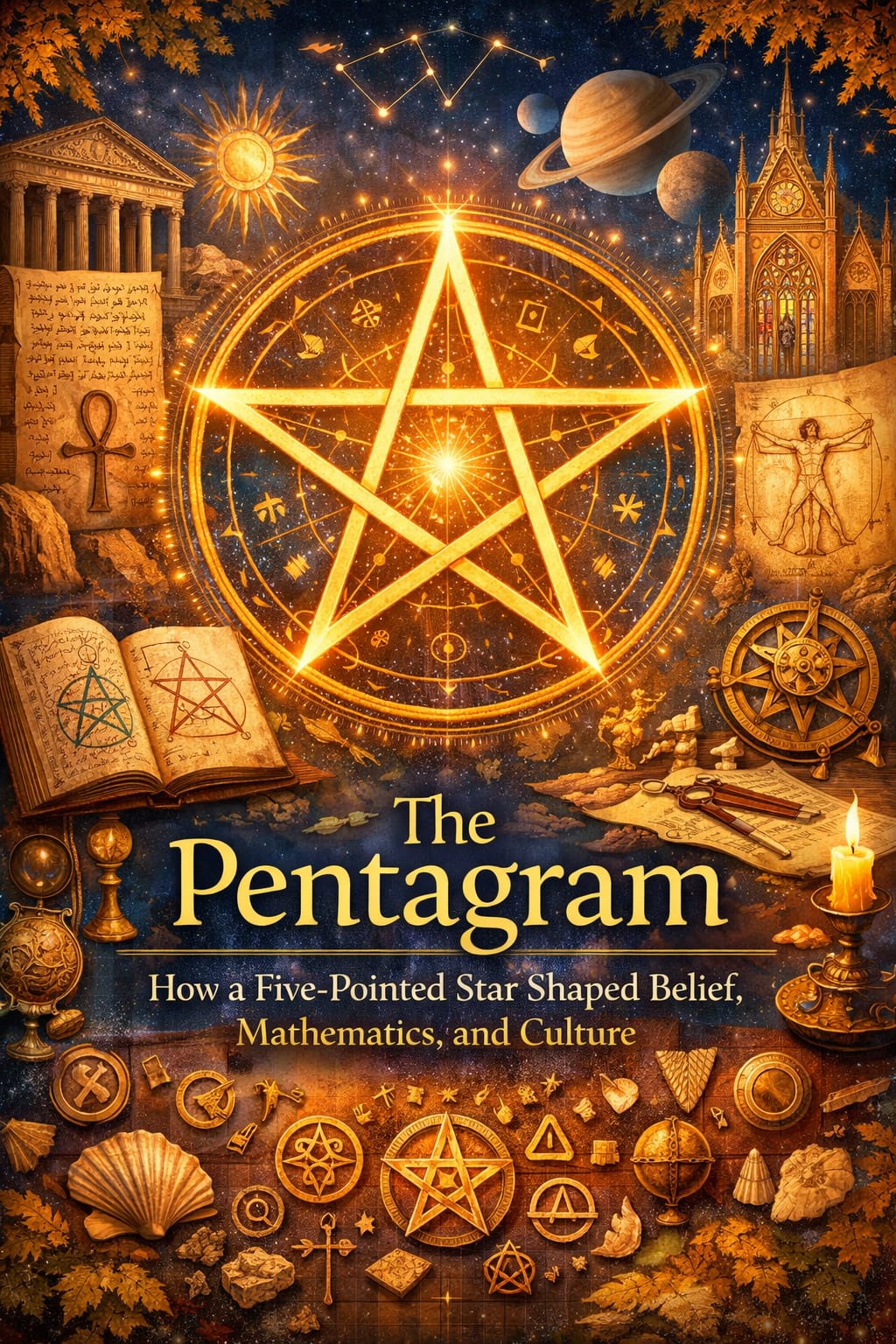
A Symbol Older Than Written Memory
The pentagram ranks among the oldest geometric symbols known to human civilization. Defined as a five-pointed star formed by a single unbroken line, the figure appears in material culture dating back more than five thousand years. Archaeological evidence places early examples in Mesopotamian inscriptions, where the form carried associations with celestial order, spatial direction, and authority. From those earliest appearances, the pentagram moved fluidly across cultures, languages, and belief systems, adapting its meaning while retaining its distinctive structure.
Beyond visual simplicity lies mathematical sophistication. The internal geometry of the pentagram reveals repeated expressions of the golden ratio, a proportional relationship studied by ancient Greek mathematicians and philosophers as an ideal of natural harmony. Pythagorean communities adopted the pentagram as a symbol of balance, health, and cosmic order, viewing geometry as a reflection of universal law rather than abstract calculation. That same mathematical elegance later informed architectural design, sacred art, and philosophical speculation across the ancient Mediterranean world.
Religious and spiritual traditions integrated the pentagram in diverse ways. Medieval Christian symbolism associated the five points with the wounds of Christ and moral virtue, while Jewish and Near Eastern traditions linked fivefold forms to truth, protection, and sacred order. In Islamic and Bahá’í contexts, five-pointed geometry echoed foundational spiritual principles rooted in harmony and structure. Folk traditions across Europe carved the pentagram into homes and churches as a protective mark, reinforcing its role as a sign of guardianship rather than malice.
Modern interpretations often obscure this long history. Popular culture and ideological movements of the twentieth century reframed the pentagram through narrow and sensational lenses, detaching the symbol from its historical foundations. Such reinterpretations represent a recent departure rather than an inherited tradition. When examined across time, the pentagram emerges not as a fixed emblem of any single belief, but as a visual language shaped by mathematics, cosmology, theology, and human attempts to understand order within the natural world.
Form, Structure, and Terminology
A pentagram is a geometric figure composed of five straight lines arranged to form a symmetrical five-pointed star. When drawn as a single, uninterrupted line, the figure is classified as unicursal, a property that contributed to later symbolic associations with continuity, unity, and completeness. The geometry of the pentagram produces a central pentagon, and within that pentagon appear smaller pentagrams repeating inward without theoretical limit. This self-replicating structure has long attracted mathematical and philosophical attention, particularly in traditions concerned with proportion and order.
Each intersection within the pentagram expresses the golden ratio, a proportional relationship approximately equal to 1.618. This ratio was studied extensively in classical antiquity and was regarded as an expression of aesthetic and natural harmony. Ancient Greek mathematicians observed that the lengths of the pentagram’s segments consistently divide according to this ratio, making the figure a natural demonstration of mathematical balance rather than an abstract construction. The pentagram therefore functions not only as a symbol, but also as a precise geometric model embedded with measurable relationships.
Orientation plays a role in interpretation but does not alter the fundamental structure. A pentagram with a single point oriented upward has historically been associated with order, equilibrium, and coherence in philosophical and religious systems. An inverted orientation, with two points upward, appears less frequently in premodern sources and carried no inherent negative meaning prior to the nineteenth century. Historical evidence indicates that orientation became symbolically polarized only in modern ideological contexts, rather than in ancient or medieval traditions.
The term pentacle has a more complex linguistic and historical background. In medieval and early modern sources, a pentacle referred broadly to a talismanic diagram or inscribed symbol used for ritual, devotional, or protective purposes. Such figures were often circular, but the contents varied widely and did not require a five-pointed star. Grimoires and magical manuscripts from the Middle Ages frequently used the word pentacle to describe seals, names of power, planetary symbols, or scriptural inscriptions enclosed within a boundary.
Contemporary usage has narrowed the definition. Within modern Neo-Pagan and Wiccan traditions, a pentacle typically denotes a pentagram enclosed by a circle. The surrounding circle is interpreted as a symbol of unity, boundary, or wholeness, enclosing the five points into a cohesive form. This modern convention has become widespread, though it represents a reinterpretation rather than a continuation of medieval terminology.
Understanding this distinction is essential for historical accuracy. Many misunderstandings surrounding the pentagram arise from retroactively applying modern definitions to ancient texts and artifacts. Careful attention to language reveals that the pentagram and pentacle occupy related but distinct categories, shaped by cultural context, historical period, and intended function rather than by a single fixed definition.
Mathematical Order and the Language of Sacred Geometry
The pentagram holds a distinguished place within the history of mathematics because of precise and measurable relationships embedded in its structure. Central to this significance is the golden ratio, commonly represented by the Greek letter phi. In a regular pentagram, every line segment is divided at its intersections according to this ratio. The proportion appears consistently between the length of each outer line and the smaller internal segments formed by crossing lines. This relationship is exact rather than symbolic, making the pentagram one of the clearest geometric demonstrations of proportional harmony found in classical mathematics.
Greek mathematicians recognized the pentagram as more than a decorative form. Euclid described proportional divisions related to five-sided figures in Elements, and later commentators identified the pentagram as a practical illustration of those principles. The repeated appearance of the golden ratio within the figure reinforced the belief that mathematics reflected natural law. Order observed in geometry was understood as evidence of order governing the cosmos itself. This perspective shaped philosophical thought long before modern scientific frameworks emerged.
Pythagorean communities placed exceptional value on the pentagram as a teaching symbol. Known as the pentalpha, the figure consisted of five interlocking Greek letters alpha, each oriented toward the center. Alpha represented origin, unity, and first principle within Greek philosophical language. The overlapping structure conveyed harmony arising from multiplicity, a central tenet of Pythagorean doctrine. Members of these schools reportedly used the pentagram as a sign of recognition, signaling shared understanding of mathematical and ethical principles.
The pentagram also embodied numerical symbolism. The number five held special significance as the sum of the first even and odd numbers, two and three. This union was interpreted as a balance between opposing forces. In geometric terms, the pentagram unites linear simplicity with internal complexity. The central pentagon mirrors the outer shape at a reduced scale, creating a recursive pattern that continues indefinitely. This self-similarity later attracted interest from mathematicians studying proportion, symmetry, and fractal-like structures.
Architectural design in antiquity reflected these mathematical ideals. Proportions derived from pentagonal and pentagrammatic relationships influenced temple layouts and sculptural balance, particularly in Greek architecture where harmony of ratio was considered essential to beauty. Artistic representations likewise drew upon pentagonal symmetry to achieve visual stability and coherence.
Sacred geometry traditions extended these mathematical observations into metaphysical interpretation. Geometry was regarded as a universal language through which abstract principles could be expressed visually. Within this tradition, the pentagram symbolized balance among dynamic forces rather than static perfection. The figure suggested that complexity could arise from a single continuous line, reinforcing philosophical ideas of unity underlying apparent diversity.
Platonic philosophy further developed these concepts by asserting that geometric forms existed as ideal realities beyond material manifestation. Neoplatonist thinkers expanded this view, interpreting geometric harmony as evidence of a structured and intelligible cosmos. During the Renaissance, humanist scholars revived these ideas, integrating classical mathematics with spiritual and artistic inquiry. The pentagram became a favored illustration of proportional order linking the material world to intellectual and spiritual principles.
Across these traditions, the pentagram remained grounded in measurable reality. Mathematical precision formed the foundation upon which symbolic meaning was later constructed. This union of exact proportion and philosophical interpretation explains the enduring influence of the pentagram as both a scientific figure and a contemplative symbol.
Earliest Traces in Mesopotamian Civilization
Material evidence places the pentagram among the oldest known symbolic forms used by organized societies. Archaeological findings from Mesopotamia, particularly within Sumerian contexts, show five-pointed star markings dating to approximately 3500 BCE. These markings appear on clay tablets, boundary stones, cylinder seals, and ceramic objects associated with early systems of record keeping and governance. The presence of the symbol within administrative artifacts suggests practical and ideological significance rather than decorative intent.
In early cuneiform writing, the five-pointed star functioned as a logogram rather than a pictorial ornament. The sign often represented the concept of divinity or the celestial realm and was used as a determinative placed before the names of gods. While later Mesopotamian iconography favored star forms with more points, the five-pointed star maintained a distinct role within symbolic language tied to cosmic order and authority. Scholars note that the star symbol denoted elevated status, marking divine names and sacred concepts within written texts.
Sumerian and Akkadian cosmology organized space according to cardinal directions and celestial movements. Some interpretations associate the five points of the star with directional systems or planetary observation, although surviving texts do not assign a single fixed explanation. Instead, the symbol appears within a broader visual vocabulary used to express relationships between the heavens, the earth, and human authority. Royal inscriptions and boundary markers employed star imagery to reinforce legitimacy and divine sanction.
Administrative tablets from cities such as Uruk and Lagash demonstrate the integration of symbolic signs into early bureaucratic systems. The pentagram, alongside other geometric and pictographic symbols, contributed to a shared visual language that communicated power, protection, and cosmic alignment. Rather than existing as a standalone religious emblem, the star functioned within interconnected systems of governance, astronomy, and theology.
Astronomical observation played a central role in Mesopotamian society. Priestly scholars tracked planetary movements and celestial cycles to inform agricultural planning, ritual timing, and political decisions. Star symbols within this context represented order imposed upon the apparent chaos of the sky. The five-pointed star likely participated in this symbolic framework, reflecting attempts to codify celestial knowledge into enduring visual forms.
The persistence of the pentagram within early Mesopotamian material culture reveals a foundational relationship between geometry and meaning. Long before later philosophical or religious interpretations emerged, the five-pointed star served as a structured symbol embedded in the daily mechanisms of early civilization. This earliest phase established the pentagram as a visual expression of order, authority, and cosmic structure, themes that continued to shape later interpretations across cultures and centuries.
Philosophical Geometry in Classical Greece
Ancient Greek culture transformed the pentagram from a practical or decorative motif into a symbol of philosophical meaning. Within this intellectual environment, geometry was not viewed as a neutral discipline but as a pathway to understanding the structure of reality. The pentagram, with its precise proportions and internal harmony, became a favored figure among thinkers who believed that numerical relationships governed both the cosmos and human life.
Pythagorean communities are most closely associated with the pentagram’s elevated status in Greek thought. These groups treated mathematics as a sacred science and believed that numbers and geometric forms expressed universal principles. The pentagram functioned as a sign of recognition among initiates, reflecting shared commitment to ethical discipline, intellectual rigor, and harmony of character. Surviving accounts describe the figure as a token of affiliation, signaling adherence to a worldview in which balance and proportion defined moral as well as physical health.
The pentagram was linked to the Greek concept of hygieia, a term encompassing health, balance, and well-being rather than the absence of illness alone. Greek medicine, influenced by philosophical ideas, emphasized equilibrium among bodily elements. The visual balance of the pentagram mirrored this ideal, reinforcing the belief that harmony in form corresponded to harmony in life. Physicians and philosophers alike regarded geometric order as a guide to understanding nature’s processes.
Greek mathematical texts reveal sustained interest in pentagonal and pentagrammatic forms. Euclidean geometry formalized relationships inherent in five-sided figures, while later commentators recognized the pentagram as a practical illustration of proportional theory. The recurrence of the golden ratio within the pentagram reinforced the conviction that beauty, truth, and mathematical precision were inseparable.
Plato further advanced the philosophical status of geometry by asserting that mathematical forms existed as eternal realities accessible through reason. In dialogues such as Timaeus, geometry appears as a framework for understanding the structure of the universe. While Plato did not single out the pentagram extensively, the figure aligned closely with Platonic principles emphasizing order, symmetry, and intelligibility. Geometry served as a bridge between the material world and abstract truth.
Greek artistic and architectural traditions also reflected these philosophical commitments. Sculptural proportions and temple designs followed mathematical ratios intended to evoke balance and permanence. The pentagram, as a concentrated expression of these principles, exemplified the Greek conviction that harmony in form revealed deeper laws governing existence.
Through these intellectual and cultural developments, the pentagram became more than a visual symbol. It emerged as a representation of health, ethical balance, and rational order, rooted in the belief that the universe itself was structured according to intelligible mathematical principles.
Fivefold Symbolism in Jewish and Early Semitic Worlds
Fivefold structures occupied an important place within Jewish and early Semitic symbolic systems, even when the pentagram itself appeared less frequently than other geometric forms. In Jewish tradition, the number five carried inherent significance through the Torah, composed of five foundational books traditionally attributed to Moses. This structure shaped religious law, ethical instruction, and cosmological understanding, embedding fivefold order into the framework of sacred knowledge.
Within Jewish mystical and philosophical thought, geometry functioned as a visual expression of divine order. While the hexagram later gained prominence in medieval and early modern Jewish identity, earlier periods did not privilege a single geometric symbol. Instead, numerical patterns and proportional forms conveyed meaning through repetition and structure. In this context, the pentagram occasionally appeared as an emblem of truth, balance, and integrity, reflecting broader Near Eastern symbolic conventions rather than a uniquely Jewish doctrine.
Archaeological evidence from the Levant and surrounding regions reveals the use of five-pointed stars on seals, amulets, and inscriptions dating to the first millennium BCE and earlier. These objects served protective and apotropaic functions, intended to guard against illness, misfortune, or malevolent influence. The power of such symbols rested not in abstract theology but in the belief that inscribed forms could mediate between the human and divine realms. This understanding was widespread across Semitic cultures and preceded later theological codifications.
Protective symbolism formed an integral part of everyday religious practice. Amulets were commonly worn or placed within homes, combining geometric figures with sacred names, scriptural phrases, or divine epithets. The five-pointed star, when present, operated within this symbolic ecosystem as a mark of order and safeguarding rather than as an object of worship. Meaning emerged through use and context rather than fixed interpretation.
Early Semitic religions emphasized the potency of written signs and visual marks. Language, number, and form were believed to possess intrinsic power when arranged correctly. This worldview informed later mystical traditions, including strands of Jewish mysticism that explored the relationship between letters, numbers, and creation. Fivefold patterns aligned naturally with this symbolic logic, reinforcing concepts of completeness and structured order.
The relative scarcity of explicit textual commentary on the pentagram within Jewish sources reflects historical reality rather than absence of meaning. Symbols functioned fluidly across cultural boundaries, often shared among neighboring civilizations with overlapping cosmologies. The pentagram’s occasional appearance within Jewish and early Semitic contexts illustrates participation in a broader symbolic language rooted in geometry, protection, and reverence for ordered creation rather than adherence to a single doctrinal interpretation.
Sacred Meaning and Moral Order in Christian Europe
Christian use of the pentagram developed gradually during Late Antiquity and became firmly established throughout the Middle Ages. Far from being marginal or controversial, the symbol was understood within orthodox Christian theology as a visual expression of core doctrinal ideas. The five-pointed star was valued for its numerical clarity and geometric balance, qualities that medieval theologians associated with divine order and perfection.
One of the most widespread Christian interpretations linked the five points to the five wounds of Christ received during the Crucifixion. These wounds, inflicted to the hands, feet, and side, held deep devotional significance in medieval spirituality. Artistic and symbolic representations of the wounds served as focal points for meditation, repentance, and gratitude. The pentagram offered a concise visual form through which this theology could be expressed without reliance on text.
Additional layers of meaning emerged through moral and sensory symbolism. Christian writers associated the five points with the five senses, understood as faculties redeemed through faith and disciplined through virtue. Sight, hearing, taste, touch, and smell were framed not as sources of temptation alone, but as channels through which divine creation could be apprehended rightly. In this context, the pentagram represented harmony between the physical body and spiritual intention.
Chivalric culture further expanded pentagram symbolism. Medieval codes of knighthood emphasized five virtues commonly identified as generosity, courtesy, chastity, chivalry, and piety. These ideals shaped both religious devotion and social conduct. The pentagram became a heraldic and literary emblem of moral integrity, reflecting the expectation that inner virtue should align with outward action.
Church architecture and sacred art incorporated pentagrams as structural and decorative elements. Stone carvings, stained glass windows, floor tiles, and altar designs employed five-pointed stars alongside crosses and rosettes. These motifs functioned as visual theology, conveying complex spiritual concepts through form and proportion. In an era when literacy was limited, symbolic imagery served as an essential educational medium, embedding doctrine into physical space.
Illuminated manuscripts likewise reveal consistent use of pentagram imagery. Scribes and artists included the symbol within marginal illustrations, chapter headings, and devotional diagrams. Such usage indicates familiarity and acceptance rather than secrecy or taboo. The pentagram operated as part of a shared symbolic language understood by clergy and lay audiences alike.
Literary evidence reinforces this interpretation. The late fourteenth-century poem Sir Gawain and the Green Knight offers one of the clearest articulations of Christian pentagram symbolism. The poem explicitly describes the pentagram on Gawain’s shield as a symbol of truth, faith, and moral perfection. Each point represents interconnected virtues rooted in Christian belief, and the star is presented as a sign of divine protection rather than occult power.
Throughout Late Antiquity and the medieval period, the pentagram remained firmly embedded within Christian symbolic life. Its meanings were theological, moral, and instructional. Later associations with transgression or heresy do not reflect medieval usage, but rather modern reinterpretations detached from historical context. Within Christian Europe, the pentagram stood as a respected emblem of faith, order, and ethical harmony.
Fivefold Order in Islamic, Bahá’í, and Eastern Traditions
Geometric symbolism holds a central and enduring place within Islamic intellectual and artistic culture. Islamic art developed a sophisticated visual language rooted in geometry, symmetry, and repetition, reflecting theological principles that emphasize unity, balance, and transcendence. While the pentagram itself does not function as a primary or doctrinal symbol within Islam, fivefold structure carries deep resonance through the Five Pillars of Islam, which define the foundational acts of faith, worship, and ethical responsibility. This numerical framework reinforces the importance of ordered practice and spiritual discipline.
Islamic decorative arts frequently employ star patterns constructed from intersecting polygons, including five-pointed and ten-pointed forms. These designs appear in mosque architecture, manuscript illumination, tilework, and metalwork across regions from North Africa to Persia and Central Asia. Such patterns are not symbolic in a figurative sense but convey metaphysical ideas through abstraction. Repetition and symmetry express the infinite nature of creation and the unity of divine order. The occasional appearance of five-pointed stars within these patterns reflects mathematical exploration rather than theological emphasis, consistent with Islamic avoidance of representational imagery.
In the Bahá’í Faith, the five-pointed star holds a defined and explicit symbolic role. Known as the Haykal, meaning temple or structure, the star represents the human form as a vessel for divine revelation. The Báb, one of the central figures of the Bahá’í Faith, employed the five-pointed star extensively in sacred writings, correspondence, and calligraphic compositions. These texts often took the physical shape of a pentagram, integrating form and meaning into a unified expression of spiritual law.
The Haykal symbol reflects the belief that divine guidance is revealed through human messengers and embodied in ethical conduct. Each point of the star corresponds conceptually to aspects of spiritual responsibility, although interpretation emphasizes unity rather than compartmentalization. The pentagram in this context functions neither as ornament nor abstraction, but as a deliberate theological structure linking geometry, revelation, and human purpose.
Eastern philosophical systems likewise demonstrate strong fivefold organization, though visual representations differ from Western geometric forms. In Chinese cosmology, the Wu Xing system describes five phases or movements: wood, fire, earth, metal, and water. These phases govern cycles of change in nature, medicine, music, and governance. Relationships among these elements emphasize balance, generation, and restraint rather than static classification. While not depicted as a star, the conceptual structure mirrors the integrative logic seen in pentagram symbolism.
Japanese traditions developed a related framework known as Godai, identifying earth, water, fire, wind, and void as foundational principles. This system influenced Buddhist philosophy, martial arts, and architectural design. Each element represents both physical and spiritual dimensions, reinforcing the idea that order arises through interaction among distinct forces.
Across these traditions, fivefold systems function as tools for understanding complexity through structure. Whether expressed through architectural geometry, sacred calligraphy, or philosophical models, the recurring emphasis on fivefold order reflects a shared human impulse to interpret the universe through balance, rhythm, and proportion. The pentagram, where it appears, participates in this broader symbolic logic rather than imposing a singular or universal meaning.
Humanism, Hermeticism, and the Geometry of the Cosmos
The European Renaissance witnessed a profound revival of interest in ancient intellectual traditions that had been preserved through Greek, Roman, and Arabic sources. Humanist scholars sought to recover what was understood as a primordial wisdom rooted in classical philosophy, Hermetic texts, and Platonic metaphysics. This revival did not reject Christianity, but rather attempted to harmonize theological doctrine with natural philosophy, mathematics, and symbolic science. Within this environment, the pentagram reemerged as a respected emblem of cosmic order and human potential.
Marsilio Ficino played a central role in reintroducing Neoplatonic philosophy to Western Europe through translations of Plato and the Corpus Hermeticum. These texts emphasized the idea that the universe operated according to intelligible principles accessible through reason and contemplation. Geometry was regarded as a bridge between the material and spiritual realms, offering visible proof of invisible laws. The pentagram, with its precise proportions and internal harmony, aligned naturally with this worldview.
Heinrich Cornelius Agrippa systematized these ideas in Three Books of Occult Philosophy, first published in the early sixteenth century. Agrippa presented the pentagram as a symbol of the human microcosm, reflecting the structure of the divine macrocosm. Each point of the star corresponded to one of the classical elements, earth, air, fire, water, and spirit, governed by celestial and intelligible forces. This correspondence did not imply domination or rebellion, but balance and integration. Human beings were understood as participants within divine order rather than challengers of it.
Renaissance occult philosophy placed strong emphasis on correspondence and proportion. Influenced by Platonic and Hermetic principles, scholars believed that patterns repeated across levels of existence. What appeared in the heavens could be reflected in the human body, the natural world, and symbolic diagrams. The pentagram served as a concise visual expression of this philosophy, illustrating the interconnectedness of elemental forces and spiritual intelligence.
Symbolic literacy was considered essential for understanding creation. Geometry was not viewed as a neutral science, but as a sacred language through which divine wisdom could be read. Astrology, mathematics, music, and theology formed an integrated intellectual system known as the liberal arts. The pentagram appeared in manuscripts, diagrams, and instructional texts as a teaching tool that conveyed complex relationships through form rather than prose.
Ceremonial magic, as practiced and theorized during the Renaissance, emphasized ethical discipline, intellectual preparation, and alignment with divine order. The pentagram functioned within this practice as a diagram of balance and protection. Ritual use focused on purification and harmony rather than transgression or spectacle. Surviving grimoires and philosophical treatises demonstrate that the symbol was embedded in scholarly discourse rather than fringe superstition.
The Renaissance treatment of the pentagram reflects a broader cultural effort to reconcile faith, reason, and observation. Geometry provided a stable foundation upon which metaphysical speculation could rest. Within this framework, the pentagram stood as a visual affirmation of order, proportion, and humanity’s place within a structured and intelligible universe.
Protection, Craft, and Everyday Belief in European Folk Tradition
The pentagram held a prominent place within European folk magic, functioning as a practical symbol embedded in daily life rather than an abstract philosophical concept. Long before modern distinctions between religion, superstition, and folklore emerged, rural communities relied on a shared system of protective signs intended to guard households, livestock, and crops. Within this tradition, the pentagram appeared as a trusted mark of defense against misfortune, illness, and unseen harm.
In many regions of Europe, the symbol was known by vernacular names such as the witch’s foot, endless knot, or drudenfuß. These terms reflected local linguistic traditions rather than uniform belief systems. The pentagram was carved above doorways, scratched into beams, and placed near thresholds, spaces believed to be especially vulnerable to harmful influences. Hearths, regarded as the spiritual and physical center of the home, frequently bore pentagram markings intended to protect the household from fire, disease, and intrusion.
Textile traditions also incorporated pentagram forms. The symbol was embroidered into clothing, woven into belts, or sewn into protective charms worn by travelers and children. These practices treated the pentagram as a stabilizing figure, believed to confuse or repel malevolent forces through its continuous, unbroken structure. The effectiveness of the symbol rested on form and intention rather than invocation of any specific deity.
Importantly, folk use of the pentagram carried no intrinsic association with diabolism or heresy. Medieval and early modern communities understood the symbol as compatible with Christian belief. Protective signs often appeared alongside crosses, biblical inscriptions, and saints’ symbols. Churches, monasteries, and pilgrimage sites throughout Europe display pentagram carvings dating from the Middle Ages, indicating acceptance within sacred as well as domestic spaces.
Surviving architectural evidence supports this interpretation. Barns, door lintels, stone walls, and roof beams across England, Germany, Scandinavia, and Alpine regions retain pentagram marks applied during construction or renovation. These markings functioned as apotropaic symbols, intended to avert harm rather than summon power. Their presence in ordinary structures underscores the pentagram’s role as a familiar and respected protective figure.
Folk belief systems emphasized continuity between the visible and invisible worlds. Symbols were understood to operate through repetition, placement, and tradition. The pentagram’s five-pointed form, drawn without lifting the hand, embodied completeness and closure. This quality made it especially suitable for protective use, reinforcing boundaries and reinforcing order within domestic and agricultural life.
The persistence of these markings offers concrete evidence of how deeply the pentagram was woven into everyday European culture. Far removed from later sensational interpretations, the symbol functioned as a quiet guardian, shaped by communal knowledge and practical necessity rather than ideological confrontation.
The Pentagram in Nineteenth-Century Occult Revival
The nineteenth century witnessed a profound resurgence of interest in esotericism and mystical philosophy, driven by both scholarly study and organized occult societies. Groups such as the Hermetic Order of the Golden Dawn, founded in 1888 in London, provided structured systems of spiritual training that combined ritual, symbolic literacy, and philosophical inquiry. Within these movements, the pentagram emerged as a central visual tool for conveying complex ideas of balance, protection, and human spiritual development.
Occult scholars of the period reinterpreted the pentagram through the lens of symbolic polarity, emphasizing the relationship between spiritual and material realms. Éliphas Lévi, a French ceremonial magician and writer, codified the pentagram as a figure of moral and cosmic significance. In Lévi’s framework, the upright pentagram, with a single point oriented upward, represented the triumph of spirit over matter, ethical discipline, and alignment with universal law. The inverted pentagram, appearing with two points upward, was described as a symbol of material dominance, imbalance, or the subordination of spiritual principles to worldly desires. Lévi’s interpretation was philosophical and allegorical, aimed at clarifying spiritual concepts rather than issuing moral judgment, and became highly influential in subsequent occult literature.
Ceremonial magic of the period incorporated the pentagram as a functional element within ritual practice. Pentagram tracings were used to delineate sacred space, mark elemental directions, and structure meditative exercises. For example, the pentagram was often drawn in the air or on the ground during invocation or evocation rituals to represent the harmonious arrangement of earth, air, fire, water, and spirit. These practices emphasized precision, symbolic literacy, and ethical responsibility, reflecting the belief that mastery over symbols corresponded to mastery over one’s own consciousness.
The nineteenth-century occult revival also highlighted the integration of the pentagram with other symbolic systems, including astrology, numerology, and Kabbalistic correspondence. The pentagram served as a visual anchor linking celestial movements to human psychology and moral development. Artists and writers within these circles often incorporated pentagrammatic forms into manuscripts, illustrations, and ritual implements, creating a rich visual vocabulary that reinforced esoteric teaching.
Despite modern associations between the pentagram and sensationalized notions of magic or danger, historical evidence demonstrates that nineteenth-century practitioners approached the symbol with careful philosophical and ethical consideration. The pentagram functioned as a diagram of alignment and balance, a pedagogical tool for spiritual growth, and a symbol of human participation in cosmic order. Its revival in this period represents a deliberate effort to reclaim geometry and symbolism as instruments of understanding rather than objects of superstition.
The widespread use of the pentagram in this context laid the groundwork for its integration into twentieth-century spiritual movements, illustrating a continuity of intellectual and symbolic engagement rather than sudden innovation or distortion. It remained a bridge between ancient philosophical ideals, Renaissance humanism, and modern mystical practice.
The Pentagram in Modern Paganism and Spiritual Practice
During the twentieth century, the pentagram experienced a renewed cultural and spiritual significance through the emergence of Neo-Pagan movements. Wicca, one of the most influential of these traditions, embraced the five-pointed star as a central emblem of reverence for the natural world, ethical living, and spiritual harmony. Within Wiccan practice, the pentagram typically appears enclosed by a circle, a visual metaphor for unity, wholeness, and the interconnectedness of all existence.
The five points of the pentagram correspond to the classical elements: earth, air, fire, water, and spirit. Each element carries both practical and symbolic meaning. Earth represents stability, fertility, and groundedness; air signifies intellect, communication, and inspiration; fire embodies transformation, energy, and passion; water symbolizes emotion, intuition, and healing; spirit unites the four physical elements, representing consciousness, divinity, and the animating principle that connects all life. The arrangement of these elements within a balanced pentagram conveys harmony between physical reality and spiritual aspiration.
In addition to spiritual symbolism, the pentagram in modern Paganism conveys ethical and ecological principles. Practitioners emphasize personal responsibility, the moral consequences of action, and respectful engagement with the natural world. Ritual and meditative practices often incorporate pentagram imagery to focus intention, align with natural cycles, or mark sacred space. Drawing the pentagram in ritual, visualizing its form during meditation, or wearing it as a talisman functions as a reminder of interconnectedness and ethical mindfulness.
The resurgence of the pentagram in Neo-Pagan contexts also reflects a conscious reclamation of symbols historically misrepresented. Popular culture frequently portrays the pentagram as an emblem of malevolence, a misconception largely stemming from twentieth-century sensationalism and misinterpretation of earlier magical and folk traditions. Historical and archaeological evidence demonstrates that the symbol’s primary associations were protection, balance, and cosmic harmony.
Modern Pagan communities actively address public misunderstanding by emphasizing the symbol’s historical continuity and ethical significance. Educational efforts, workshops, and publications illustrate that the pentagram is a tool for reflection and spiritual engagement rather than an instrument of fear or transgression. Its appearance in jewelry, ritual implements, and art reflects both continuity with earlier protective and symbolic uses and adaptation to contemporary spiritual frameworks.
The pentagram’s enduring appeal in modern practice demonstrates its capacity to convey complex layers of meaning. It functions as a geometric representation of universal principles, an ethical guidepost, and a focal point for ritual and meditation. Within contemporary spiritual traditions, the five-pointed star remains a living symbol, connecting mathematical elegance, historical depth, and ethical philosophy in ways that continue to resonate across cultures and generations.
Inversion and Ideological Reinterpretation in Modern Contexts
The twentieth century introduced a striking reinterpretation of the pentagram through the emergence of modern Satanism. Anton LaVey, founder of the Church of Satan in 1966, formalized the use of the inverted pentagram, often depicted with a goat’s head inscribed within its lines, as the Sigil of Baphomet. In this context, the symbol conveyed a philosophy emphasizing individualism, personal sovereignty, skepticism toward established religious authority, and the assertion of human autonomy.
The inverted orientation, with two points upward, was intentionally chosen to signify the subversion of traditional moral and religious hierarchies. Within LaVeyan Satanism, the emblem functions not as a tool of supernatural power but as a philosophical statement, representing human intellect, personal responsibility, and the deliberate inversion of conventional symbolism. Ritual use emphasizes theatricality, reflection, and ethical engagement rather than invocation of malevolent forces.
Historical evidence demonstrates that prior to the mid-twentieth century, no broad cultural, religious, or philosophical tradition linked the pentagram with Satanic worship. In medieval, Renaissance, and occultist sources, the pentagram retained associations with protection, balance, and ethical order. The notion of inherent diabolical power is largely a product of modern reinterpretation rather than inherited tradition.
Popular media, especially film, literature, and news reporting in the mid-to-late twentieth century, amplified the connection between the pentagram and malevolence. Sensationalized portrayals in horror films, tabloid stories, and public discourse often conflated diverse historical and contemporary uses, obscuring the symbol’s complex history. These portrayals contributed to widespread misconceptions, overshadowing centuries of protective, ethical, and philosophical associations.
Academic and historical study clarifies that the inverted pentagram in LaVeyan Satanism represents ideological creativity rather than continuity. It illustrates how symbolic forms can be adapted to convey modern philosophical messages while drawing selectively from visual tradition. Understanding this distinction provides insight into broader processes by which symbols evolve across time, acquiring new meanings while retaining connections to geometry, proportion, and cultural resonance.
Despite popular associations, careful examination reveals that the pentagram’s historical trajectory is dominated by themes of harmony, protection, and spiritual reflection. Modern Satanic usage represents a deliberate and localized reinterpretation rather than an inherent property of the figure, emphasizing human intention over inherited meaning. This distinction underscores the importance of historical literacy in evaluating symbols whose contemporary meanings diverge sharply from their origins.
The Pentagram and the Persistence of Popular Culture Myths
In modern media, the pentagram has often been reduced to a simplistic emblem of danger, malice, or occult threat. Cinema, television, and sensational literature frequently depict the symbol alongside witchcraft, demonic forces, or malevolent magic. Horror films, pulp fiction, and tabloid reporting have reinforced the association between the five-pointed star and fear, creating a pervasive stereotype in public consciousness. These portrayals often ignore centuries of documented usage in protective, philosophical, and religious contexts.
Historical evidence demonstrates that the pentagram’s meanings are far more diverse and nuanced than modern myth suggests. Across Mesopotamia, Greece, Europe, and the Near East, the pentagram served as a marker of divine order, moral integrity, elemental harmony, and human responsibility. Folk traditions used the figure to protect homes, hearths, and livestock. Renaissance occultists regarded it as a diagram of cosmic relationships and spiritual ascent. In modern Paganism, the pentagram continues to symbolize ecological awareness, ethical practice, and spiritual balance. The repeated distortion of the pentagram in media obscures this multifaceted history and reinforces symbolic illiteracy.
Scholars of religion, art history, and anthropology emphasize that symbols acquire meaning through context, not inherent qualities. A symbol’s interpretation reflects social, cultural, and ideological frameworks as much as its formal characteristics. The pentagram exemplifies this principle: its significance is contingent on historical moment, geography, religious doctrine, philosophical worldview, and artistic practice. Each layer of meaning—whether Pythagorean, Christian, Hermetic, or Neo-Pagan—demonstrates a distinct approach to understanding order, morality, or cosmology.
Educational and scholarly engagement with the pentagram highlights the contrast between lived, functional use and mediated, sensationalized representation. Academic research draws on archaeological artifacts, manuscripts, architectural evidence, and philosophical texts to reconstruct a comprehensive picture of the symbol’s role across centuries. These sources demonstrate that fear-based associations are not universal but culturally contingent, and that centuries of ethical, protective, and intellectual use preceded modern horror portrayals by millennia.
Understanding the pentagram’s complex history encourages critical reflection on how contemporary culture interprets ancient symbols. It challenges assumptions that visual forms carry fixed moral or spiritual qualities and underscores the importance of historical literacy in evaluating symbols widely misunderstood today. By examining the pentagram through the lens of evidence, scholarship, and cultural context, it becomes possible to see beyond myths and recognize the figure’s enduring significance as a tool of geometry, philosophy, protection, and spiritual reflection.
Ethical Considerations in Symbol Interpretation
Engagement with symbols such as the pentagram necessitates careful attention to historical and cultural context. Symbols do not possess inherent moral qualities; their significance emerges through human use, interpretation, and circumstance. Assigning simplistic labels of “good” or “evil” erases centuries of nuance, obscuring the multifaceted roles symbols have played across societies. Responsible study demands acknowledgment of complexity and recognition that meaning evolves over time.
Ethical interpretation begins with primary sources. Archaeological artifacts, medieval manuscripts, architectural carvings, and early modern occult texts provide direct insight into how a symbol was understood in a particular place and era. For example, five-pointed stars in Mesopotamian administrative tablets signified celestial order or authority, not malevolence. Pentagrams in medieval Christian manuscripts often conveyed moral integrity or protective power. Renaissance treatises framed the symbol as a reflection of cosmic and elemental balance. Each context demonstrates that a single symbol can carry multiple, even contrasting, meanings simultaneously.
Historical conditions also shape symbolic meaning. Social structure, religious doctrine, literacy rates, and political circumstance all influence how a symbol is used and understood. In European folk tradition, the pentagram appeared on doors and beams as a protective measure. Within Renaissance ceremonial practice, it functioned as a diagram for ritual and philosophical study. In modern Neo-Pagan communities, it serves as a representation of ecological consciousness and personal responsibility. Recognizing these layers of meaning prevents distortion and encourages a respectful approach to cultural heritage.
Philosophical intent is another critical dimension. Symbols like the pentagram often communicate abstract ideas—balance, unity, harmony, protection, and moral reflection. The figure’s geometric properties, including the golden ratio and recursive internal structure, reinforce these conceptual associations. Interpreting such symbolism requires attention to both form and function, understanding that visual elegance, mathematical order, and cultural significance often intertwine.
Education is the cornerstone of ethical engagement. Reactionary responses to symbols, driven by popular culture, anecdote, or sensationalized media, risk perpetuating misunderstanding and cultural insensitivity. By contrast, informed study emphasizes analysis, contextualization, and critical thinking. Ethical interpretation involves exploring historical sources, examining cultural continuity, and situating the pentagram within a spectrum of human thought that spans mathematics, philosophy, theology, folk practice, and modern spirituality.
Ultimately, ethical interpretation encourages a view of the pentagram not as a static sign of morality but as a dynamic tool for reflection and learning. It fosters appreciation for the human impulse to encode meaning visually and mathematically, highlighting the continuity between aesthetic perception, intellectual inquiry, and spiritual aspiration. By approaching symbols with rigor, scholars and practitioners alike can honor the depth and diversity of human symbolic expression.
Recommended Reading: #commissionearned
Three Books of Occult Philosophy by Heinrich Cornelius Agrippa
This Renaissance tome stands as one of the most influential works in the history of symbolic philosophy and esoteric thought. Agrippa weaves together natural philosophy, astrology, numerology, and celestial intelligences into a unified vision of how the world’s visible and invisible dimensions relate. Geometry occupies a central place in this system, and the pentagram appears as a vivid example of how numerical proportion and symbolic form were understood in the early sixteenth century. Rather than treating figures like the pentagram as curiosities, Agrippa interprets them as keys to celestial and elemental harmony, linking material and spiritual realms. His work influenced later generations of scholars, mystics, and occult practitioners who saw symbolic correspondence as a pathway to deeper knowledge. For modern readers, this text reveals how early thinkers integrated mathematics, philosophy, and sacred symbolism into holistic frameworks. The book invites reflection on the enduring relationship between form, meaning, and human curiosity about the structure of existence.
This substantial work documents the teachings and practices of the Hermetic Order of the Golden Dawn, an influential spiritual society that shaped modern ceremonial symbolism. Regardie presents ritual instructions, lectures, and exercises that illuminate how geometry and symbolic geometry function in practice. The pentagram, within these rituals, serves as a living symbol of elemental forces and spiritual alignment; it is traced and invoked to establish sacred space and inner focus. By situating the pentagram within a graduated curriculum of study and experience, this book shows how symbolic literacy supports disciplined psychological and spiritual development. The material demonstrates that symbolic forms were not seen as decorative or arbitrary but as tools for training perception and intention. Readers interested in the lived use of symbols gain insight into structured systems that regard geometry as a language of transformation. The Golden Dawn thus bridges historical symbolism with practical engagement in symbolic meaning.
Dictionary of Occult, Hermetic and Alchemical Sigils by Fred Gettings
This reference work compiles thousands of symbols used in Western esoteric traditions, offering clear explanations grounded in historical practice. Rather than reducing signs to fanciful motifs, Gettings situates each form within documented cultural and philosophical contexts. The pentagram appears alongside other geometric figures, celestial marks, and alchemical sigils, showing how symbolic vocabulary developed and circulated across time. The entries demonstrate that symbolic meaning arises from use and interpretation, not from inherent properties of form. This makes the volume especially useful for comparative study, helping readers trace connections between figures and understand how different traditions interpreted similar shapes. The comprehensive coverage reveals the breadth of symbolic systems that shaped Western intellectual history far beyond simple magical caricature. Curious readers and serious researchers will find in it a rich landscape of visual thought that clarifies the symbolic life of geometric figures.
The Mystical Qabalah by Dion Fortune
This classic work explores the Qabalistic Tree of Life as a structured symbolic map connecting consciousness, cosmology, and spiritual experience. Fortune’s writing brings clarity to complex ideas by tying abstract symbolism to psychological and metaphysical layers of human existence. Although the pentagram is not a central focus, the book’s discussion of symmetry, proportion, and relational symbolism offers valuable context for understanding how geometric figures operate within wider symbolic frameworks. The Tree of Life itself exemplifies how structured symbolic diagrams can serve as tools for inner work, revealing patterns in experience and perception. By linking geometric relationships with inner states and spiritual principles, Fortune’s approach aligns with historical traditions that see symbolic form as expressive of deeper reality. Readers encountering the pentagram within this context gain a broader appreciation of how structured diagrams function across systems of thought. The book invites reflection on the relational logic that underlies much symbolic geometry and philosophical inquiry.
Sacred Geometry: Philosophy and Practice by Robert Lawlor
This work treats geometry as a universal language that connects nature, art, architecture, and human thought. Lawlor guides readers through geometric principles that recur across cultural traditions, linking shape and proportion with ideas of harmony and design. His discussion of proportion, especially the golden ratio, provides essential context for appreciating why figures like the pentagram have been endowed with symbolic significance. Rather than viewing geometry as abstract calculation, Lawlor reveals how ancient and modern thinkers saw geometric relationships as expressions of order in both physical and symbolic realms. The book uses visual examples and historical narratives to show how geometry informs aesthetic perception and spiritual reflection. It reinforces the blog’s argument that shapes acquire meaning through cultural usage and conceptual resonance. For students of symbolic history and mathematical aesthetics, this text offers a grounded entry into why geometry and symbolism have been intertwined across human cultures.
Symbols and Their Meanings by Jack Tresidder
This accessible guide surveys symbolic forms from around the world, explaining how various cultures have used shape, image, and motif to express ideas about life, nature, and the divine. The text places geometric figures, including star shapes, within broader symbolic networks, showing how meanings shift across time and place. The pentagram appears as part of this visual vocabulary, and Tresidder’s explanations underscore that interpretation depends on cultural context rather than fixed moral value. His concise narratives help readers see symbols as expressions of shared human concerns—identity, protection, cosmology, and ethics—rather than as static emblems. This comparative approach highlights how similar shapes can convey very different messages in different traditions. Readers benefit from a global perspective that reinforces symbolic diversity and complexity. The book supports the blog’s emphasis on contextual interpretation by demonstrating that no symbol can be fully understood in isolation from its cultural and historical environment.
The Occult Philosophy in the Elizabethan Age by Frances A. Yates
This landmark historical study reconstructs the intellectual climate of the sixteenth and early seventeenth centuries, showing how Hermeticism, Neoplatonism, magic, and symbolic thought shaped Renaissance culture. Yates explores figures such as John Dee and others who integrated geometry, cosmology, and metaphysical inquiry into the mainstream of intellectual life. Her research demonstrates that symbols like the pentagram were taken seriously within scholarly, artistic, and scientific circles long before modern misinterpretations arose. By placing symbolic systems within broader currents of Renaissance humanism and scholarly exchange, the book reveals how symbolic literacy flourished in early modern Europe. Readers discover that symbolic diagrams were treated as serious methods for engaging with the structure of the cosmos, nature, and human purpose. Yates’ narrative makes clear that intellectual history cannot be separated from the symbolic systems that thinkers used to organize knowledge. For anyone seeking historical grounding in the cultural forces that shaped today’s symbolic landscape, this work provides deep context and richly detailed analysis.
Continuing Independent Study
The pentagram endures because it occupies a rare intersection of mathematics, philosophy, spirituality, and cultural expression, uniting abstract principles with tangible human experience. Archaeological evidence traces its presence from Mesopotamian administrative tablets and seals, through Classical Greek philosophical treatises, to the cathedrals and illuminated manuscripts of medieval Europe. During the Renaissance, scholars and occultists examined the pentagram as both a symbol of cosmic order and a tool for moral and spiritual reflection. In modern spiritual practice, it serves as a sign of elemental balance, personal responsibility, and reverence for the natural world. Each historical period adds layers of meaning, demonstrating that the pentagram cannot be understood in isolation from its cultural, mathematical, and philosophical context.
Independent study of the pentagram benefits from rigorous engagement with primary sources, peer-reviewed scholarship, and historically grounded interpretations. Free public libraries, university collections, and reputable historical archives provide access to centuries of manuscripts, printed works, and reference volumes that illuminate the symbol’s evolving significance. Readers are encouraged to cross-reference materials and verify sources, as free online resources may contain errors, misinterpretations, or modern sensationalism. Scholarly caution, critical reading, and attention to context are essential when examining symbolism that has accumulated myths and misconceptions over time. Engaging directly with original texts, historical commentaries, and modern scholarly works reveals the pentagram as an enduring reflection of human curiosity, ethical inquiry, and philosophical imagination.
Ultimately, the pentagram invites both observation and participation in intellectual exploration. Thoughtful readers who approach it with historical awareness, mathematical curiosity, and cultural sensitivity will find it to be more than a geometric figure: it is a lens through which humanity’s search for order, harmony, and meaning can be traced across time. The most valuable insight emerges from active, self-directed study, where research, reflection, and critical engagement allow the pentagram to reveal its depth as a living symbol rather than a static or misunderstood emblem.
About the Creator
Marcus Hedare
Hello, I am Marcus Hedare, host of The Metaphysical Emporium, a YouTube channel that talks about metaphysical, occult and esoteric topics.
https://linktr.ee/metaphysicalemporium
Keep reading
More stories from Marcus Hedare and writers in BookClub and other communities.
Artists of the Arcane: Pamela Colman Smith and Arthur Edward Waite
The Visionaries Behind the Rider‑Waite Tarot Few artistic and mystical collaborations in history have left a mark as profound as the partnership between Pamela Colman Smith and Arthur Edward Waite. The Rider‑Waite Tarot deck, first published in 1909, has become a cornerstone of modern tarot, its imagery instantly recognizable and widely studied. Unlike earlier decks, which often relied heavily on abstract symbolism or esoteric shorthand, this deck transformed tarot into a narrative and visual experience accessible to both practitioners and casual observers. Every card is infused with intentional symbolism, storytelling, and emotional resonance, reflecting a fusion of artistic skill and mystical scholarship rarely achieved in a single work.
By Marcus Hedareabout 15 hours ago in BookClub
My New Book is Finally Here
My poetry collection Beautiful and Brutal Things is done. It's actually done and finally published over 270 pages. Over a year of my life went into this book. More than a year, really. Long days at my computer, sometimes seven days a week because I couldn't stop even when I probably should have. Then two months of editing that felt harder than the writing itself. But it's finished, and I'm still standing, and the book is real.
By Tim Carmichael4 days ago in BookClub
7 Books That Take Less Than a Week to Finish
In a world overflowing with information, notifications, and endless to-do lists, finding time to read can feel like a luxury. Yet reading remains one of the most powerful ways to sharpen our thinking, deepen our empathy, and expand our perspective—often in just a few hours a day. The good news? You don’t need months to finish a life-changing book.
By Diana Meresc2 days ago in BookClub
Smart phones, Humans and Aliens.
WARNING. I will be tapping into one of your favorite creative tensions: The absurdity of humans worshipping their glowing rectangles as if they were tiny oracles. There’s something deliciously poetic about that contradiction, and it lends itself beautifully to an instructive proviso.
By Novel Allen5 days ago in Poets



Comments
There are no comments for this story
Be the first to respond and start the conversation.