
Artists of the Arcane: Pamela Colman Smith and Arthur Edward Waite
The Creative Forces Behind Tarot Deck

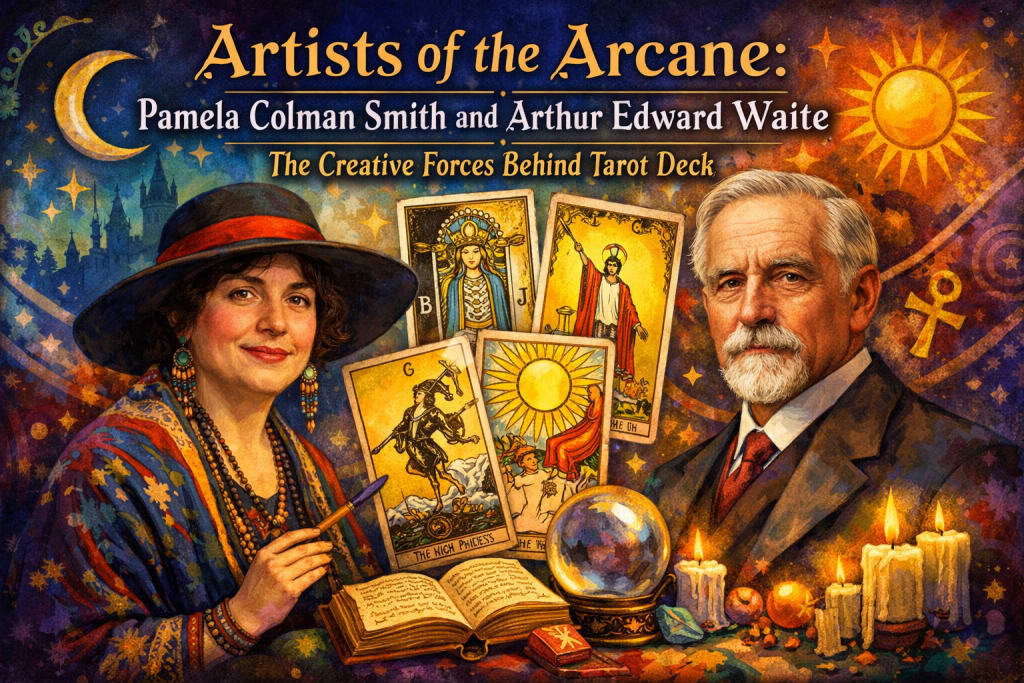
The Visionaries Behind the Rider‑Waite Tarot
Few artistic and mystical collaborations in history have left a mark as profound as the partnership between Pamela Colman Smith and Arthur Edward Waite. The Rider‑Waite Tarot deck, first published in 1909, has become a cornerstone of modern tarot, its imagery instantly recognizable and widely studied. Unlike earlier decks, which often relied heavily on abstract symbolism or esoteric shorthand, this deck transformed tarot into a narrative and visual experience accessible to both practitioners and casual observers. Every card is infused with intentional symbolism, storytelling, and emotional resonance, reflecting a fusion of artistic skill and mystical scholarship rarely achieved in a single work.
Pamela Colman Smith, sometimes referred to as "Pixie" in her personal circles, brought a radical creativity to the project. Born in 1878 in Jamaica to an English father and an American mother, Smith moved to England and later the United States, cultivating a cosmopolitan perspective that would inform her art. Trained at the Pratt Institute in Brooklyn and deeply involved in the artistic movements of her time, she was influenced by theater design, illustration, and the emerging currents of Symbolism and Arts and Crafts. Smith’s illustrations for the Rider‑Waite deck exhibit a keen understanding of narrative, theatrical staging, and human emotion, qualities that make each card a story in itself.
Arthur Edward Waite, born in 1857, was a scholar, mystic, and prolific writer whose work spanned Christian mysticism, ceremonial magic, and the study of esoteric traditions. A member of the Hermetic Order of the Golden Dawn, Waite devoted himself to uncovering the symbolic and mystical dimensions of tarot, seeking a system that was coherent, intelligible, and spiritually meaningful. Unlike some contemporaries who prioritized secrecy and ritual, Waite aimed to create a deck that would communicate esoteric knowledge through clear imagery and layered symbolism, accessible even to those unfamiliar with the occult.
The collaboration between Smith and Waite was more than a simple division of labor. It was a meeting of minds shaped by parallel fascinations with myth, legend, ritual, and the psychological resonance of images. Smith’s artistry gave Waite’s visions form, translating his intricate symbolic system into a visual language that has endured for over a century. The resulting deck was revolutionary: the Minor Arcana, previously depicted with simple pips and abstract numerals, became scenes full of narrative detail, emotion, and allegorical depth, creating a template that has influenced nearly every subsequent tarot deck.
The lives of Smith and Waite, though distinct in background and temperament, intersected at the heart of a transformative moment in the history of Western esotericism. Smith navigated the challenges of being a female artist in a male-dominated world, balancing her work in illustration, theater, and publishing with her passion for occult studies. Waite, ever the scholar and mystic, pursued a lifelong effort to codify and interpret spiritual knowledge, driven by meticulous research and an unyielding vision of tarot as a tool for insight and self-understanding. Together, they produced a work that combines rigorous scholarship, aesthetic brilliance, and humanistic depth.
The Rider‑Waite deck is more than a tool for divination; it is a reflection of two lives devoted to the exploration of symbol, story, and the unseen. Its enduring appeal lies not only in the clarity of its imagery but in the human experiences, artistic brilliance, and spiritual inquiry that underpin every card. Understanding the lives of Pamela Colman Smith and Arthur Edward Waite is essential to appreciating how this deck reshaped tarot, leaving a legacy that continues to inspire artists, mystics, and seekers around the world.
Early Life and Formative Influences
Pamela Colman Smith: Early Years
Pamela Colman Smith entered the world on February 16, 1878, in Pimlico, London, into a family with deep transatlantic connections. Charles Edward Smith, an American merchant from Brooklyn, and Corinne Colman, whose ancestry traced to Jamaica, provided a childhood shaped by diverse cultural influences. Early life unfolded across London, Kingston in Jamaica, and Brooklyn, a rhythm of movement that offered exposure to a wide range of storytelling traditions, spiritual ideas, and visual culture. Jamaican folklore, English theatricality, and the urban energy of Brooklyn created a foundation for an imagination capable of blending the symbolic, the mystical, and the narrative.
The death of Corinne Colman when Smith was around ten cast a shadow over childhood, creating a space in which independence, resilience, and inward reflection took root. This early loss influenced a developing sense of personal myth and emotional depth, qualities that would later emerge in both illustration and storytelling. Childhood experiences became a repository of imagery, gesture, and narrative that informed the dynamic visual compositions seen in later work.
Adolescence brought immersion in London’s theatrical circles, including close observation of Ellen Terry and Henry Irving at the Lyceum Theatre. Exposure to stagecraft, dramatic composition, and the interplay of costume, gesture, and narrative lighting fostered an intuitive understanding of storytelling through imagery. This early engagement with performance encouraged the creation of illustrations that could convey motion, emotion, and layered meaning simultaneously.
Education at the Pratt Institute in Brooklyn, beginning at age fifteen, introduced formal training under Arthur Wesley Dow. Instruction emphasized harmony in line, color, and composition, informed by Japanese art and contemporary design theory. Skills acquired at Pratt reinforced natural talent and nurtured a capacity for synthesizing multiple artistic influences. Return to England after formal training marked the beginning of a professional career that spanned illustration, stage design, and publishing.
Early career achievements demonstrated a polymathic reach. Smith illustrated more than twenty books, combining narrative clarity with imaginative flourishes drawn from Caribbean and European influences. Writing of fairy tales and folklore reflected first-hand experience of Jamaican culture, while editorial and publishing work, including the founding of the Green Sheaf Press, supported women’s creative voices during a period when such platforms were rare. Artistic ventures extended into stage design, miniatures, and folk narrative, consistently displaying attention to detail, dramatic arrangement, and symbolic depth.
Early life and artistic formation reveal a figure molded by cultural multiplicity, loss, and rigorous training, equipped to integrate diverse sources of inspiration into work of lasting significance. Experiences in London, Brooklyn, and Kingston cultivated a visual and narrative sensibility that would later define contributions to tarot, particularly the collaboration that transformed the Rider‑Waite deck into a cultural landmark.
Arthur Edward Waite: Origins of a Mystical Scholar
Arthur Edward Waite entered the world on October 2, 1857, in Brooklyn, New York. The family relocated to London during his infancy, anchoring a life largely spent in England while maintaining an awareness of transatlantic roots. Early years revealed a keen appetite for literature and an innate curiosity about spiritual and philosophical questions. Romantic poetry and mythic narratives sparked an enduring fascination with the symbolic dimensions of human experience, laying the groundwork for a lifetime devoted to the study of esoteric traditions.
Waite’s intellectual pursuits were unusually comprehensive for his time. Interests encompassed ceremonial magic, the Kabbalah, Rosicrucianism, Freemasonry, alchemical theory, and broader mystical philosophies. Each area of study demanded meticulous attention to historical sources, texts in translation, and interpretive commentary. Waite approached these disciplines not as a casual observer but as a researcher intent on uncovering coherent systems of symbolism and meaning. The breadth of this inquiry positioned him as a bridge between historical scholarship and the emerging popular fascination with the occult in late nineteenth- and early twentieth-century England.
A prolific writer, Waite produced works that remain authoritative within esoteric scholarship. The Book of Ceremonial Magic offered detailed accounts of ritual practice and symbolic structure. The Holy Kabbalah provided both historical context and practical insight into one of the most complex mystical systems. A New Encyclopedia of Freemasonry combined encyclopedic rigor with interpretive guidance for students of fraternal and mystical orders. Additional translations, commentaries, and original treatises reflected an ongoing effort to make arcane knowledge intelligible without diluting its complexity.
Waite’s methodology balanced historical precision with spiritual insight. Extensive research into primary sources, often written in Latin, Hebrew, or other classical languages, underpinned a symbolic interpretation informed by decades of study. This approach occasionally drew criticism from contemporary academic scholars, who deemed it speculative. Despite such criticism, Waite maintained a commitment to synthesizing intellectual rigor with mystical intuition. This combination of poetic sensibility, analytical discipline, and devotion to spiritual inquiry became a defining feature of his career.
The formative years of Waite’s life established a foundation for a lifelong engagement with the mysteries of symbolism, ritual, and esoteric philosophy. Early exposure to literature, historical study, and spiritual exploration created an intellectual framework capable of supporting both scholarly research and practical interpretation. This foundation would later converge with Pamela Colman Smith’s visionary artistry, producing a tarot deck in which meticulous symbolic thought found expression through narrative and visual form. The intersection of scholarly discipline and imaginative clarity in Waite’s life shaped not only his written works but also a revolutionary approach to tarot, one that remains influential more than a century after its creation.
Membership in the Hermetic Order of the Golden Dawn
The Hermetic Order of the Golden Dawn emerged in England during the late nineteenth century as a secret society devoted to the rigorous study and practice of mysticism, ceremonial magic, and esoteric philosophy. Its membership included artists, writers, scholars, and intellectual seekers who shared an interest in exploring the symbolic and spiritual dimensions of human experience. The society developed structured teachings in ritual magic, alchemy, the Qabalah, astrology, tarot, and philosophical mysticism, creating a framework that combined practical exercises with theoretical study. This system attracted individuals who sought both personal transformation and a deeper understanding of universal principles.
The Golden Dawn’s influence extended beyond the confines of its lodges. Its ritual practices and symbolic language contributed to the broader cultural fascination with the occult in fin-de-siècle England, inspiring developments in art, literature, and popular spiritual thought. The society emphasized not only technical skill in ceremonial practice but also imaginative and intellectual engagement with archetypal and symbolic systems. Its teachings encouraged members to interpret myth, ritual, and visual symbols in ways that revealed underlying spiritual truths, creating a synthesis of scholarship, creativity, and mystical insight.
Both Pamela Colman Smith and Arthur Edward Waite became associated with the Golden Dawn at pivotal moments in their personal and professional development. Exposure to the order’s teachings provided a shared framework of symbolism, ritual understanding, and philosophical inquiry. For Smith, the Golden Dawn offered access to esoteric motifs that could be translated into visual form, reinforcing her already dynamic narrative and illustrative skills. For Waite, the society supplied rigorous structure for research, interpretation, and practical application of mystical knowledge.
The overlapping membership of Smith and Waite in the Golden Dawn laid the groundwork for collaboration on a project that would transform tarot into a coherent, visually compelling, and symbolically rich system. Knowledge of ceremonial practice, esoteric philosophy, and the structured study of archetypal images allowed both figures to approach tarot not merely as a tool of divination but as a medium capable of conveying complex spiritual and psychological truths. The Golden Dawn thus acted as both a training ground and a shared intellectual space, connecting two individuals whose combined talents would produce one of the most influential tarot decks in history.
Smith and the Golden Dawn
Pamela Colman Smith joined the Hermetic Order of the Golden Dawn in the early years of the twentieth century, entering a network of artists, writers, and mystics dedicated to the study of symbolic systems, ceremonial ritual, and philosophical mysticism. The order provided a structured environment for learning about the correspondences between colors, letters, gestures, and archetypal imagery. These teachings offered a framework for understanding how symbols could convey spiritual truths, philosophical concepts, and psychological insights without relying on words.
Within this context, tarot was regarded as a map of inner processes and cosmic principles. Members explored the cards as part of meditation, pathworking exercises, and ceremonial rituals, studying how each figure, suit, and scene reflected archetypal energies and universal patterns. Despite this rigorous symbolic study, the order did not impose a standard visual representation for the cards. Major Arcana figures were often outlined only broadly, and the Minor Arcana typically appeared as simple arrangements of pips rather than dynamic scenes. The task of visual interpretation remained open to individual creativity.
Smith’s artistic background and personal inclinations made her particularly well suited to this challenge. Experience in illustration, theater, and stage design had cultivated an ability to convey narrative, emotion, and meaning through composition, gesture, and spatial relationships. The symbolic lessons of the Golden Dawn provided additional layers of depth, but it was Smith’s imagination and training that allowed these ideas to be expressed visually with clarity and narrative force. Her work transformed abstract correspondences into scenes that could communicate story, mood, and spiritual resonance at a glance.
The Golden Dawn also connected Smith to a broader cultural and intellectual milieu in which symbolism, mysticism, and the visual arts intersected. Occult societies, literary circles, and artistic networks in England and beyond were experimenting with myth, allegory, and the symbolic representation of inner life. Smith’s exposure to these circles, combined with her interest in folklore, fairy tales, and visual storytelling, encouraged experimentation and innovation. Tarot became a medium through which she could integrate these diverse influences, producing images that were simultaneously evocative, accessible, and layered with esoteric meaning.
Membership in the Golden Dawn offered inspiration, not restriction. Its teachings provided a rich repository of correspondences, ritual practices, and symbolic insights without dictating how those ideas should appear on the page. Smith absorbed these lessons and transformed them into a unique visual language, creating illustrations that combined dramatic narrative, emotional nuance, and symbolic sophistication. This work laid the foundation for collaboration with Arthur Edward Waite, establishing a deck that would revolutionize tarot imagery and make esoteric principles visible to generations of readers.
Waite and the Order
Arthur Edward Waite entered the Outer Order of the Hermetic Order of the Golden Dawn in January 1891, immersing himself in the study of mystical symbolism, ritual theory, and esoteric philosophy. Early involvement exposed him to structured training in ceremonial magic, kabalistic correspondences, and symbolic ritual, providing the intellectual foundation for decades of research into the history and practice of Western mysticism.
Waite’s orientation within the order differed from many of his contemporaries. The focus of study was not the performance of ritual for its own spectacle, but the understanding of underlying spiritual principles encoded in symbols and archetypes. Whereas other members emphasized elaborate ceremonial practice and secretive hierarchical rites, Waite prioritized the interpretation of symbols as tools for inner illumination and contemplative insight. This approach reflected a lifelong interest in the mystical processes that connect human consciousness with spiritual truth, rather than fascination with occult theatrics.
Disagreements with other Golden Dawn members over methodology, secrecy, and the application of ritual eventually led Waite to withdraw from the order at intervals and pursue independent paths. He founded offshoot organizations, including the Independent and Rectified Rite of the Golden Dawn and, later, the Fellowship of the Rosy Cross. These endeavors reflected an effort to synthesize scholarly rigor, spiritual reflection, and practical guidance, creating frameworks in which mystical study could be pursued with intellectual clarity and ethical purpose.
Within the milieu of the Golden Dawn, Waite cultivated a philosophy that shaped his later projects, particularly the tarot collaboration with Pamela Colman Smith. Tarot, in his conception, was not a mere instrument of fortune-telling but a vehicle for spiritual insight. Each card carried layers of meaning, designed to engage the intellect and the imagination, encouraging reflection on archetypal processes and moral principles. Waite’s insistence on clarity, symbolic coherence, and contemplative function defined the purpose of the deck, guiding Smith to translate intricate esoteric correspondences into a visual language that could communicate intuition, ethical nuance, and mystical understanding.
This emphasis on symbol, meaning, and spiritual depth, rather than performative ritual, created a distinctive framework for the Rider‑Waite Tarot. The resulting collaboration produced a deck that combined artistic narrative with rigorous mystical thought, creating images that functioned as teaching tools, meditative aids, and instruments of personal reflection. Waite’s orientation toward inner illumination ensured that tarot could serve not only as a practical system but also as a medium for spiritual engagement accessible to both initiated and curious minds.
The Conception and Creation of the Rider‑Waite Tarot Deck
The year 1909 marked a turning point in the history of tarot with the publication of a deck that would redefine how these cards were seen, used, and understood. The collaboration between Pamela Colman Smith and Arthur Edward Waite produced a deck unlike any that came before, a deck with a clear and comprehensive visual language grounded in esoteric symbolism, narrative depth, and psychological resonance. Commissioned by Arthur Edward Waite and published by William Rider & Son of London, the finished work brought together scholarly interpretation and artistic innovation in a form that would endure for more than a century.
The project originated in Waite’s desire to create a tarot deck that expressed a coherent interpretive framework rather than merely serving as a tool for divination. Waite, whose scholarship spanned ceremonial magic, kabalistic symbolism, alchemy, and mystical philosophy, drafted detailed notes outlining the symbolic meanings he envisioned for each card. These notes reflected decades of research into the Western esoteric tradition, allied with an interest in tarot as a mirror of spiritual development and inner transformation.
Pamela Colman Smith was selected to execute the visual realization of this symbolic system. Well regarded for an imaginative visual sensibility enriched by experience in illustration, theater design, book publishing, and engagement with the Hermetic Order of the Golden Dawn, Smith approached the commission with a singular combination of technical skill and narrative imagination. The resulting artwork stands as a testament to artistic discipline and visionary interpretation.
The creative process was unprecedented in tarot history. Prior to this project, most tarot decks, including those derived from the Tarot of Marseille tradition, presented the Minor Arcana as simple arrangements of suit symbols without illustrative scenes. Court cards and numbered cards placed little emphasis on narrative content, leaving interpretation largely to the reader’s memory of meanings and correspondences. The collaboration between Smith and Waite changed this paradigm.
Every one of the 78 cards in the new deck was given a fully illustrated scene. Major Arcana cards were imbued with layered iconography reflecting archetypal themes of journey, transformation, and cosmic principle. Minor Arcana cards—swords, cups, wands, and pentacles—were depicted in rich, humanized scenes showing figures in action, emotion, and relational exchange. These illustrations invited engagement with story, gesture, and symbolic nuance, making intuitive interpretation more immediate and vivid.
Creation of the complete set of pen, ink, and watercolor illustrations was accomplished in a remarkably compressed period. Work proceeded with intensity and focus, driven by careful coordination between Waite’s symbolic guidance and Smith’s artistic decisions. Complex scenes such as the Three of Swords, the Ten of Cups, and the Page of Pentacles display an ability to convey mood, narrative tension, and archetypal resonance within a compact visual field. The High Priestess, Strength, the Hanged Man, and other Major Arcana figures were rendered with a clarity and psychological presence that invited meditation, reflection, and layered interpretation.
Artistic influences visible in Smith’s work were diverse. Elements of Art Nouveau emerged in flowing lines and ornamental detail. Medieval and Renaissance visual traditions appeared in posture, costume, and compositional structure. Folk imagery and mystical iconography found expression in symbolic objects, gestures, and natural motifs. This blend of styles created a cohesive and distinctive visual vocabulary for the deck, one that balanced clarity with depth.
Publication by William Rider & Son placed the deck in the hands of readers, scholars, and mystics at a moment when interest in esoteric systems was expanding across Europe and North America. The comprehensive visual language of the deck allowed tarot to be approached as a contemplative system, a pedagogical tool for symbolic literacy, and a means of accessing intuitive insight without dependence on memorized interpretive tables. Over time, the deck came to influence the design of virtually all modern tarot decks, setting a new standard for visual symbolism and narrative engagement.
The conception and creation of the Rider‑Waite Tarot Deck stands as a singular achievement in the history of symbolic art. The collaboration between a meticulous scholar of mysticism and an artist of extraordinary narrative imagination produced a work that resonates across cultures and generations, inviting deep engagement with the unseen patterns of psyche and spirit through richly articulated imagery.
Artistic Innovation and Symbolic Narratives
Pamela Colman Smith’s illustrations for the Rider‑Waite Tarot were far more than decorative embellishments. Each card functioned as a self-contained symbolic tableau, combining visual clarity, narrative intelligence, and emotional resonance. Figures, gestures, and compositional arrangements were deliberately orchestrated to communicate subtle psychological and spiritual themes. In the Minor Arcana, numbered suit cards that had previously consisted of simple pip patterns were transformed into fully realized scenes. Interactions between figures depicted cooperative or adversarial relationships, moments of triumph or struggle, journeys across landscapes, and encounters filled with moral and spiritual significance. Even brief glimpses of these cards conveyed layered narratives, inviting interpretation on multiple levels simultaneously.
The Major Arcana likewise demonstrated a synthesis of medieval and mystical visual traditions with inventive storytelling. Archetypes such as the Fool, the Magician, the High Priestess, Strength, the Hanged Man, and the Wheel of Fortune were rendered with careful attention to both simplicity and symbolic depth. The Fool’s poised step forward, the Magician’s focused gesture, and the High Priestess’s quiet composure all communicated principles of inner development, transformation, and ethical reflection. Smith’s visual intelligence allowed abstract archetypes to acquire immediacy and relatability, making profound esoteric concepts accessible through humanized figures and situations. Symbolism was embedded in costume, posture, facial expression, and background, creating a language of imagery that spoke simultaneously to the mind, intuition, and imagination.
The color palette in Smith’s work played an essential role in conveying symbolic narrative. Warm and cool tones, contrasts of light and shadow, and the strategic use of color accents guided attention, conveyed emotional intensity, and highlighted thematic elements. In scenes of challenge or conflict, muted or stark tones heightened tension, while harmonious color schemes accompanied moments of resolution, unity, or spiritual insight. Every choice of hue, shadow, and line reinforced the meaning of the depicted scene, transforming the deck into a coherent visual system rather than a collection of images.
Arthur Edward Waite’s contribution to the project provided the structural and symbolic framework that guided Smith’s artistry. Drawing on Qabalah, Christian mysticism, alchemy, and broader currents of Western esotericism, Waite compiled and organized the correspondences that formed the intellectual backbone of the deck. Each card was assigned specific symbolic references, conceptual associations, and interpretive intent, reflecting decades of meticulous study.
The emotional power, narrative clarity, and evocative composition of the cards arose entirely from Smith’s artistic agency. Waite’s instructions allowed space for creative interpretation, and Smith translated complex and sometimes abstract esoteric principles into imagery that was immediate, intuitive, and psychologically rich. Her scenes conveyed motion, relational dynamics, and moral tension, rendering the symbolic material comprehensible to both the initiated and the casual reader. This combination of disciplined symbolism and expressive narrative established a standard that continues to define tarot illustration today.
Through this integration of scholarly guidance and imaginative execution, the Rider‑Waite deck achieved a level of visual storytelling that had never existed in tarot before. Every card communicated simultaneously on multiple planes: emotional, psychological, spiritual, and narrative. Users could engage deeply with archetypal patterns and personal insight. Smith’s innovation transformed tarot from a static symbolic code into a living, interactive narrative medium. Her work established the foundation for modern approaches to tarot as both an art form and a tool of contemplative practice.
Publication and Immediate Impact
The Rider‑Waite Tarot deck first appeared in London in 1909 through the publisher William Rider & Son. Its release was accompanied by a companion text, The Key to the Tarot, written by Arthur Edward Waite, which provided readers with explanations of symbolism, historical context, and guidance for interpretation. A revised edition, The Pictorial Key to the Tarot, followed shortly thereafter and included black and white reproductions of all seventy-eight cards, allowing readers to study the imagery alongside Waite’s explanations. The combination of deck and guidebook offered an unprecedented level of accessibility, presenting tarot as both a visual and intellectual system that could be approached by scholars, mystics, and the general public alike.
From its earliest circulation, the deck had a profound impact on how tarot was understood and practiced. Prior tarot decks, including the Tarot of Marseille and earlier occultist adaptations, offered limited narrative content. The Minor Arcana consisted primarily of numbered suit symbols, with little guidance for interpretation beyond memorized correspondences. The Rider‑Waite deck introduced fully illustrated scenes for every card, inviting immediate engagement with narrative, emotional, and symbolic content. Figures were depicted in dynamic postures, landscapes suggested movement and context, and interactions conveyed relational, ethical, and spiritual dimensions. This innovation transformed tarot into a tool for contemplation, introspection, and intuitive reasoning rather than a system requiring rote memorization.
The deck also reached beyond the boundaries of esoteric lodges and occult circles. Interest in mysticism, symbolism, and personal spiritual practice was growing in England and North America, particularly among artists, writers, and individuals seeking alternative forms of self-exploration. The evocative imagery of the Rider‑Waite cards resonated with these audiences, offering a medium that combined visual artistry with psychological and spiritual insight. Scenes from the Minor Arcana depicted journeys, challenges, and relationships in ways that readers could interpret intuitively, while Major Arcana figures illustrated archetypal experiences and moral lessons with clarity and emotional resonance.
The accessibility of the deck, paired with Waite’s detailed explanations, helped establish tarot reading as a popular practice outside secret societies. Practitioners could now engage directly with symbolic imagery without requiring initiation into exclusive lodges. Artists and writers were inspired by the visual richness of the deck, finding in it a new language of myth and narrative that could be incorporated into broader creative work. The narrative clarity and psychological nuance of the illustrations also encouraged a more reflective and meditative approach to tarot, laying the foundation for the way tarot would be practiced throughout the twentieth century.
The immediate influence of the Rider‑Waite deck was further reinforced by repeated reprints and wider distribution in the years following its introduction. Its visual vocabulary became familiar, its symbolic framework authoritative, and its approach transformative. By combining scholarly rigor with imaginative artistry, the deck created a new standard for tarot: every card conveyed story, character, and meaning, turning each reading into an encounter with narrative, archetype, and personal reflection. The publication of the Rider‑Waite deck marked a turning point in the history of tarot, establishing it as a widely accessible, visually compelling, and spiritually resonant medium whose influence continues to define tarot practice today.
Careers After the Tarot Project
Pamela Colman Smith’s Later Endeavors
Following the completion of the Rider‑Waite Tarot deck, Pamela Colman Smith continued to pursue a career in illustration and artistic expression, building on the narrative and symbolic sensibilities that had defined her tarot work. She contributed illustrations to a variety of literary projects, including collaborations with prominent writers such as Bram Stoker. In 1911, she produced illustrations for Stoker’s final novel, The Lair of the White Worm, creating imagery that enhanced the text’s gothic and folkloric atmosphere. Her illustrations often combined dramatic narrative, attention to human gesture, and elements drawn from myth, legend, and supernatural themes, reflecting the same imaginative intelligence evident in her tarot designs.
During this period, Smith’s life underwent significant personal transformations. She converted to Catholicism and purchased a home in Bude, Cornwall, where she began to shift her focus toward spiritual practice and community involvement. The coastal environment and quietude of Cornwall offered a reflective space, and her energies turned toward cultivating a life informed by faith, art, and service. Smith engaged in projects that supported social causes, particularly those advancing women’s creative expression and public participation, using visual media to contribute to broader cultural conversations.
Despite early commercial successes in publishing and illustration, financial security proved elusive in later years. Shifts in artistic taste, changing publishing practices, and the limited recognition of women artists in the early twentieth century made it difficult for Smith to maintain a steady income. Work that had once placed her at the forefront of illustration and print publishing became harder to secure. She lived modestly, dedicating her time to small commissions, community projects, and spiritual pursuits rather than high-profile artistic endeavors.
Pamela Colman Smith spent her final decades largely removed from mainstream art circles. Her presence in the public eye diminished, even as the Rider‑Waite Tarot deck continued to circulate and grow in influence. She passed away in Bude on September 16, 1951, leaving behind a body of work that was often overlooked during her lifetime.
Recognition of her contribution to the Rider‑Waite deck emerged only gradually. For decades, the deck was widely known simply as the Rider‑Waite Tarot, with the publisher’s name and Waite’s authorship receiving primary attention. The originality, depth, and artistry of the illustrations were obscured, despite the fact that Smith had executed every image and shaped the visual language of modern tarot. Over time, scholarship and cultural interest began to reclaim her central role, highlighting her distinctive artistic style, imaginative interpretation, and the monogram embedded in many cards that quietly marked her authorship. Today, Pamela Colman Smith is celebrated not only as a pioneering tarot artist but also as a versatile illustrator, storyteller, and visual thinker whose influence continues to resonate across art, literature, and mystical practice.
Arthur Edward Waite’s Intellectual Output
Following the completion of the Rider‑Waite Tarot project, Arthur Edward Waite devoted his life to the study, interpretation, and dissemination of occult and mystical knowledge. His work spanned decades and encompassed a wide range of esoteric disciplines, including ceremonial magic, the Kabbalah, Rosicrucian philosophy, alchemy, Freemasonry, and comparative mysticism. Waite approached these subjects with the aim of making complex spiritual systems accessible to serious students while maintaining a sense of historical depth and scholarly rigor.
Waite’s publications during this period were both prolific and influential. He wrote treatises, commentaries, and reference works that explored the theoretical, symbolic, and practical dimensions of mystical traditions. In works such as The Book of Ceremonial Magic and The Holy Kabbalah, he analyzed ritual procedures, symbolic correspondences, and the philosophical principles underlying mystical practices. These writings were designed to guide students through the conceptual and practical frameworks of esotericism, providing structured interpretation for readers seeking intellectual clarity as well as spiritual insight.
In addition to his written output, Waite remained an active participant in mystical and esoteric communities. He founded and led organizations such as the Independent and Rectified Rite of the Golden Dawn and the Fellowship of the Rosy Cross, fostering study and exploration of spiritual traditions in a communal context. Through these associations, Waite emphasized moral reflection, symbolic literacy, and contemplative engagement with mystical ideas rather than mere ceremonial display. His approach underscored the importance of ethical development and personal insight as outcomes of esoteric study.
The Rider‑Waite Tarot deck remained a central focus of Waite’s work. The Pictorial Key to the Tarot, an expanded and refined companion to The Key to the Tarot, provided readers with detailed explanations of each card, linking Waite’s scholarly research to the visual narratives created by Pamela Colman Smith. This text clarified the symbolic correspondences, archetypal themes, and spiritual principles embedded in the deck, ensuring that tarot could function as a tool for meditation, intuitive insight, and ethical reflection. Waite’s interpretive frameworks helped transform the Rider‑Waite deck into a teaching instrument as well as a divinatory system, bridging scholarship, symbolism, and personal experience.
Waite’s scholarship occasionally faced criticism from academic historians and specialists, particularly for claims that relied on synthesis rather than strict historical documentation. Nevertheless, his ability to integrate diverse mystical streams into coherent interpretive projects resonated with a broad audience of spiritual seekers. Readers were drawn to his combination of historical context, symbolic precision, and ethical guidance, which allowed them to approach esoteric systems with both intellectual and intuitive understanding.
Arthur Edward Waite passed away on May 19, 1942, leaving a legacy defined by meticulous research, imaginative synthesis, and enduring influence on the study and practice of Western esotericism. His work shaped modern understandings of tarot, ceremonial practice, and symbolic study, providing frameworks that continue to inform both scholarly inquiry and practical application in mystical and artistic communities. The Rider‑Waite Tarot remains a testament to his vision, combining scholarly depth with symbolic clarity, and ensuring that his approach to the study of mysticism continues to guide generations of readers, artists, and spiritual explorers.
Legacy and Influence
The Rider‑Waite Tarot’s Long Reach
The Rider‑Waite Tarot deck transformed the practice and perception of tarot through its innovative integration of fully illustrated cards and carefully organized symbolism. For the first time, every one of the seventy‑eight cards carried narrative content, allowing readers to engage directly with the imagery rather than relying solely on memorized interpretations or abstract pips. The Minor Arcana depicted dynamic scenes of human interaction, movement, and circumstance, while the Major Arcana embodied archetypal figures and moral or spiritual lessons rendered with clarity and emotional resonance. This approach made tarot accessible to a broader audience, inviting engagement from artists, writers, spiritual seekers, and the general public.
The visual and symbolic coherence of the deck gave tarot a new versatility. Readers could explore psychological themes, ethical dilemmas, and personal transformations through the gestures, expressions, and arrangements of the figures on the cards. Scenes suggested journeys, challenges, relationships, and opportunities for growth, creating a sense of continuity and story across the deck. Archetypal experiences were no longer abstract concepts to be memorized; they became vivid, relatable narratives capable of evoking reflection, insight, and imaginative exploration. This narrative richness expanded the utility of tarot from private divination to contemplative practice, self-reflection, and artistic inspiration.
The cultural impact of the Rider‑Waite deck has been extraordinary. Its imagery has shaped the design of countless derivative decks, influencing both mainstream and esoteric interpretations of tarot around the world. Over the decades, it has inspired visual artists, writers, psychologists, and storytellers, providing a language of symbolism and myth that crosses disciplines. The expressive detail in every card encouraged creators to explore the emotional, relational, and transformative dimensions of symbolic imagery, reinforcing the tarot as a bridge between inner experience and artistic expression.
The deck’s accessibility also expanded the practice of tarot outside secretive or scholarly circles. Earlier tarot decks were often confined to esoteric lodges or specialized collections, with interpretation dependent on memorized meanings and ceremonial knowledge. The Rider‑Waite deck, in contrast, offered immediate visual engagement and intuitive clarity, enabling readers to work directly with the images to uncover meaning. This democratization of tarot fostered a widespread culture of reading, study, and personal interpretation, positioning the deck as a tool for meditation, storytelling, and imaginative inquiry.
Estimates suggest that more than one hundred million copies of Rider‑Waite style decks have circulated globally since its first publication, a testament to its enduring influence and accessibility. The deck remains the standard against which modern tarot decks are measured, its symbolic language serving as a reference for teaching, artistic adaptation, and mystical practice. Its combination of narrative depth, psychological insight, and archetypal clarity has ensured that the Rider‑Waite Tarot is not only a historical milestone but a living, evolving presence in contemporary spiritual, artistic, and cultural life.
By providing a coherent system of imagery, narrative, and symbolism, the Rider‑Waite Tarot expanded the possibilities of tarot far beyond divination. It encouraged readers to reflect on personal growth, confront inner challenges, explore relational dynamics, and engage with aspirational qualities embedded within archetypal patterns. In this way, the deck has become both a practical tool and a source of inspiration, shaping modern tarot practice and the broader cultural imagination for over a century.
Smith’s Recognition and Rediscovery
For decades following the creation of the Rider‑Waite Tarot deck, Pamela Colman Smith’s contributions remained largely unacknowledged in mainstream art history and tarot scholarship. The deck was frequently identified by the publisher William Rider & Son and by Arthur Edward Waite, obscuring Pamela Colman Smith’s central role in crafting the imagery that transformed tarot for modern audiences. Despite pioneering achievements in illustration, publishing, and visual storytelling, Pamela Colman Smith’s work was often marginalized, and recognition of her originality and technical mastery remained limited.
Renewed scholarship, exhibitions, and publications in the late twentieth century began to restore Pamela Colman Smith’s prominence. Curators and researchers highlighted the innovative visual language of the Rider‑Waite deck, noting the integration of narrative, gesture, composition, and color to convey symbolic meaning and emotional depth. Exhibitions in major art institutions showcased Pamela Colman Smith’s illustrations, stage designs, book plates, and other artistic contributions, situating her within the broader context of early twentieth-century art movements. The range of Pamela Colman Smith’s work demonstrates mastery beyond tarot, encompassing literary illustration, folklore-inspired imagery, and projects connected to social and spiritual themes.
Analysis of Pamela Colman Smith’s artistry emphasizes creative agency and imaginative intelligence. The Rider‑Waite Tarot cards reveal intentionality in every detail, including the arrangement of figures, depiction of gestures, expression of emotions, and symbolic positioning of objects. The interplay of color, line, and composition allows each card to function as a complete narrative, communicating moral, psychological, and spiritual lessons with clarity and depth. Recognition of these qualities affirms Pamela Colman Smith’s status as a transformative artist whose vision defined modern tarot aesthetics and influenced generations of artists, readers, and spiritual practitioners.
The biography of Pamela Colman Smith reflects a life of artistic brilliance, early success, and later financial hardship. Early career achievements, international exposure, and recognition within literary and artistic communities contrasted with later decades of relative obscurity. This trajectory resonates with contemporary artists and tarot practitioners who navigate similar tensions between creative innovation and public acknowledgment. Pamela Colman Smith’s life demonstrates perseverance, originality, and the enduring impact of imaginative mastery in shaping culture and symbolic expression.
Ongoing scholarship and museum exhibitions have reinforced Pamela Colman Smith’s legacy. Inclusion of her works in major collections and detailed study of her contributions to illustration, publishing, and tarot design establish Pamela Colman Smith as a pivotal figure in early twentieth-century visual culture. The Rider‑Waite Tarot, once primarily associated with William Rider & Son and Arthur Edward Waite, is now recognized as a collaboration in which Pamela Colman Smith’s artistry provided the defining visual identity and enduring appeal. Pamela Colman Smith’s legacy continues to inspire artistic innovation, symbolic interpretation, and creative engagement with narrative imagery, demonstrating the lasting power of visual imagination to influence spiritual, cultural, and artistic practice across generations.
Waite’s Enduring Impact on Esoteric Study
Arthur Edward Waite’s contributions to the study of Western esotericism extended far beyond the creation of the Rider‑Waite Tarot deck. Waite’s writings, commentaries, and compilations established a framework for understanding mystical and occult traditions with historical, symbolic, and philosophical rigor. By meticulously documenting ceremonial magic, the Kabbalah, Rosicrucian thought, alchemy, and Freemasonry, Arthur Edward Waite provided a comprehensive overview of Western mystical practice that remained accessible to both scholars and serious spiritual seekers.
The intellectual approach of Arthur Edward Waite emphasized the symbolic and philosophical dimensions of mystical systems. In works such as The Holy Kabbalah and The Book of Ceremonial Magic, Arthur Edward Waite analyzed ritual, symbolism, and ethical principles, demonstrating the interconnectedness of spiritual practices across different schools of thought. His scholarship illuminated the ways in which symbolic imagery could serve as a medium for inner reflection, moral contemplation, and spiritual development, rather than functioning merely as ritual or ceremonial display.
Arthur Edward Waite’s efforts bridged the gap between practical occultism and academic inquiry. By situating mystical practices within historical and cultural contexts, Arthur Edward Waite enabled later researchers to approach tarot, ceremonial magic, and symbolic systems as subjects for serious study. The interpretive frameworks provided in The Pictorial Key to the Tarot exemplify this approach, linking the imagery of the Rider‑Waite deck to archetypal concepts, esoteric correspondences, and moral principles. Arthur Edward Waite’s work allowed tarot to be seen not merely as a tool for fortune-telling, but as a symbolic system capable of fostering introspection, psychological insight, and philosophical reflection.
The legacy of Arthur Edward Waite endures through the ongoing use of his writings in educational, spiritual, and artistic contexts. Generations of tarot scholars, practitioners, and mystical researchers continue to consult his books for guidance on the interpretation of symbols, the history of esoteric practice, and the ethical and philosophical dimensions of spiritual study. Arthur Edward Waite’s insistence on clarity, coherence, and intellectual rigor has influenced both modern tarot practice and broader approaches to Western esotericism, ensuring that mystical systems can be engaged with critically, creatively, and reflectively.
Arthur Edward Waite’s work also shaped the perception of tarot as a tool of symbolic meditation. The interpretive principles articulated in his scholarship provided readers with a methodology for approaching archetypes, life patterns, and moral choices, enabling tarot to function simultaneously as a reflective, educational, and spiritual instrument. Through this contribution, Arthur Edward Waite ensured that tarot would not remain confined to secretive or ceremonial contexts, but could enter broader cultural, artistic, and intellectual discourse.
The enduring impact of Arthur Edward Waite’s scholarship can be observed in both contemporary tarot studies and the wider field of esoteric education. His integration of historical research, symbolic analysis, and practical interpretation created a model for studying mystical systems that continues to inform academic research, spiritual practice, and artistic innovation. Arthur Edward Waite’s work cemented the Rider‑Waite Tarot deck not only as a groundbreaking visual project but also as a foundation for the modern understanding of tarot as a coherent, accessible, and philosophically rich symbolic system.
Recommended Reading: #commissionearned
Ultimate Guide to the Rider Waite Tarot by Johannes Fiebig and Evelin Bürger
This comprehensive guide unpacks the symbolic vocabulary of the Rider‑Waite Tarot card by card, making it an ideal companion to the narrative and visual depth explored in this blog. Rather than offering surface-level definitions, the book explores ten key symbols on each card, revealing layers of meaning that resonate with the creative intentions of Pamela Colman Smith and Arthur Edward Waite. Historical notes, interpretive frameworks, and practical guidance provide a bridge between scholarly insight and intuitive engagement. Each chapter encourages reflection on how individual symbols function within broader narrative arcs of the deck, emphasizing the richness of Smith’s illustrative storytelling. Cultural and mystical influences on the deck are explored in detail, clarifying the interplay between artistry and symbolism. Readers gain a grounded understanding of how each card communicates psychological, ethical, and spiritual themes. The book also provides practical advice for readers seeking to deepen interpretive skill while honoring the historical design of the deck.
This narrative history offers a behind-the-scenes perspective on the creative forces that produced the Rider‑Waite Tarot. Unpublished writings, archival photographs, and biographical research reveal how theatrical influences, personal relationships, and symbolic thinking shaped Pamela Colman Smith’s illustrations and guided Arthur Edward Waite’s conceptual framework. The text connects artistic intuition with mystical philosophy, emphasizing the human stories behind the deck’s creation. Detailed accounts show how Smith used models from the theater and folklore to populate the Minor Arcana with lifelike, narrative scenes. Arthur Edward Waite’s scholarly contributions are contextualized within broader currents of Western esotericism, highlighting the intellectual and spiritual rigor that informed the project. Readers gain insight into the personal and historical circumstances that shaped the deck. This book illuminates the collaboration between Smith and Waite as a fusion of artistry and mystical scholarship, deepening appreciation for the Rider‑Waite Tarot as both a cultural artifact and a symbolic system.
The Pictorial Key to the Tarot by Arthur Edward Waite
This foundational text provides the original interpretive framework for the Rider‑Waite Tarot. Arthur Edward Waite’s commentary guides readers through historical, symbolic, and mystical correspondences embedded in each card. The book situates tarot within the broader context of Western esotericism, explaining the ethical, philosophical, and psychological dimensions of the deck. Attention to archetypal patterns clarifies Waite’s intent to make tarot a tool for reflection, moral insight, and spiritual contemplation rather than mere fortune-telling. Scholars and students of tarot benefit from the depth of research and systematic analysis that underpin each card’s interpretation. The text demonstrates how symbolic clarity and philosophical reasoning informed the guidance provided to Pamela Colman Smith during the creation of the deck. Readers gain a richer understanding of the interplay between Waite’s esoteric scholarship and Smith’s visual imagination.
This volume offers an in depth exploration of the Rider-Waite-Smith Tarot as a landmark collaboration between artistic imagination and esoteric philosophy. Sasha Graham foregrounds Pamela Colman Smith’s role as the architect of the deck’s visual storytelling, demonstrating how illustration, gesture, and symbolic detail transformed tarot from an abstract system into a readable narrative form. Arthur Edward Waite’s interpretive structure is examined alongside the artwork, clarifying how theological, mystical, and symbolic frameworks shaped the deck without overshadowing artistic execution. Historical chapters place the deck within the spiritual and publishing environment of the early twentieth century, reinforcing its emergence at a moment of cultural transition. Card interpretations emphasize visual literacy and contextual understanding, encouraging readers to study imagery as an evolving symbolic language rather than a fixed set of meanings. Attention is given to how Smith’s scenes communicate psychological tension, ethical choice, and spiritual development through composition alone. Practical sections on reading and reflection illustrate how historical awareness deepens interpretive confidence. The book reinforces the Rider-Waite-Smith Tarot as a unified creation whose lasting influence rests on the combined contributions of Pamela Colman Smith and Arthur Edward Waite, aligning closely with the themes explored throughout this blog.
Tarot: The History, Symbolism, and Divination of the Cards by Robert Place
This historical account situates the Rider‑Waite Tarot within the long evolution of tarot imagery and interpretation. Early playing cards, Renaissance iconography, and the late nineteenth-century occult revival are traced to illuminate the origins of Pamela Colman Smith’s visual innovations and Arthur Edward Waite’s conceptual contributions. Place examines how philosophical, mystical, and artistic currents converged to make tarot a vehicle for symbolic exploration. The book highlights shifts in artistic style and interpretive approaches over centuries, clarifying the context in which the Rider‑Waite deck emerged. Readers gain insight into the cultural and intellectual forces that shaped both Smith’s and Waite’s work. Historical analysis emphasizes the continuity of symbolic language across tarot traditions. The book enriches understanding of tarot as a medium that bridges cultural history, personal reflection, and spiritual inquiry.
Seventy‑Eight Degrees of Wisdom: A Tarot Journey to Self-Awareness by Rachel Pollack
This interpretive classic treats the Rider‑Waite deck as a coherent system of archetype, narrative, and psychological insight. Pollack explores both Major and Minor Arcana in depth, connecting symbolic motifs to universal patterns of human experience. Interpretive approaches combine mythic storytelling, psychological reflection, and practical guidance for tarot study. The text respects Pamela Colman Smith’s visual compositions while examining how the deck functions in contemporary life. Archetypes, journeys, and ethical dilemmas depicted in the cards are explored in ways that illuminate inner growth and transformation. Readers encounter a sophisticated integration of imagery, narrative, and reflective practice. The book demonstrates how tarot operates as both a symbolic language and a tool for personal exploration.
This profound work approaches the Major Arcana as a structured series of spiritual meditations grounded in Christian Hermetic thought rather than practical divination. Each card functions as a contemplative gateway into ethical discipline, interior transformation, and metaphysical reflection, positioning tarot as a symbolic language for spiritual development. The text draws extensively from Christian mysticism, biblical theology, hermetic philosophy, and moral inquiry, presenting tarot imagery as a vehicle for inner instruction rather than prediction. This perspective closely parallels Arthur Edward Waite’s own insistence that tarot should be approached as a system of symbols leading toward spiritual insight and moral clarity. Extended reflections encourage sustained engagement with each archetype, reinforcing the value of slow reading, disciplined study, and contemplative practice. The absence of illustrative focus places emphasis on symbolic meaning, complementing the visual narrative created by Pamela Colman Smith in the Rider-Waite-Smith deck. Within the context of this blog, the book serves as an example of how the Rider-Waite Tarot inspired serious theological and philosophical engagement, extending the legacy of Smith and Waite into broader spiritual and intellectual traditions.
An Artistic and Interpretive Partnership
The collaboration between Pamela Colman Smith and Arthur Edward Waite stands as one of the most consequential partnerships in the history of modern symbolic art. This collaboration united visual imagination and disciplined esoteric scholarship in a way that permanently altered how tarot is experienced, studied, and interpreted. The Rider-Waite Tarot endures as a reference point not because of novelty or popularity alone, but because the imagery and structure communicate meaning through narrative clarity, symbolic coherence, and emotional accessibility. The deck speaks across cultural and generational boundaries, offering a visual language capable of addressing inner experience, ethical reflection, and spiritual curiosity.
Pamela Colman Smith’s capacity to embody symbolic ideas through composition, gesture, and atmosphere transformed abstract esoteric concepts into lived scenes of human experience. Arthur Edward Waite’s interpretive framework grounded those scenes within a broader intellectual tradition shaped by mysticism, philosophy, and historical inquiry. Together, this partnership produced a body of work that continues to invite study rather than passive consumption. Each card rewards close observation, contextual reading, and repeated engagement, revealing layers of meaning shaped by art history, ritual symbolism, literary influence, and spiritual thought.
The enduring relevance of the Rider-Waite Tarot reflects the depth of research and creative discipline that informed its creation. Tarot did not emerge in isolation, and understanding its evolution benefits from engagement with primary texts, historical scholarship, and visual analysis. Public libraries remain among the most valuable resources for such study, offering access to academic works, art catalogs, historical documents, and comparative studies without commercial pressure or algorithmic distortion. Library collections often provide editions and scholarly perspectives unavailable through casual online searching, allowing deeper and more reliable engagement with the subject.
Free online resources can offer useful entry points into tarot history and symbolism, yet discernment remains essential. Many digital sources prioritize simplification, repetition, or unverified claims, which can obscure historical nuance and artistic intention. Serious study benefits from cross-referencing information, consulting established scholarship, and approaching interpretation as an evolving dialogue rather than a fixed set of answers. Independent reading and careful research honor the complexity of both Pamela Colman Smith’s artistry and Arthur Edward Waite’s intellectual labor.
The legacy of this partnership extends beyond tarot practice into broader conversations about art, symbolism, and cultural transmission. The Rider-Waite Tarot demonstrates how images can function as repositories of knowledge, memory, and imagination. Through disciplined study and thoughtful engagement, tarot becomes not merely a method of reading cards but a means of encountering symbolic systems that reflect human experience across time and place.
Pamela Colman Smith and Arthur Edward Waite each contributed distinct strengths to a shared vision that continues to shape artistic and spiritual inquiry. That vision endures because it invites participation, study, and reflection rather than passive belief. The Rider-Waite Tarot remains open to reinterpretation precisely because it was built on research, imagination, and respect for tradition. Continued reading, careful observation, and independent exploration ensure that this legacy remains alive, dynamic, and intellectually honest for generations to come.
About the Creator
Marcus Hedare
Hello, I am Marcus Hedare, host of The Metaphysical Emporium, a YouTube channel that talks about metaphysical, occult and esoteric topics.
https://linktr.ee/metaphysicalemporium
Keep reading
More stories from Marcus Hedare and writers in BookClub and other communities.
The Kitchen Witch
The Power of the Hearth Kitchen witchcraft arises from an ancient understanding that spiritual power is embedded in the rhythms of daily life. Across cultures and centuries, the hearth functioned as the physical and symbolic heart of the home. Fire provided warmth, transformed raw ingredients into nourishment, preserved health through boiling and drying, and offered protection against scarcity and illness. In agrarian societies, survival depended on the careful management of food, seasonal knowledge, and domestic order. These responsibilities elevated the kitchen into a space of profound importance, where skill, intention, and continuity sustained entire households.
By Marcus Hedarea day ago in BookClub
My New Book is Finally Here
My poetry collection Beautiful and Brutal Things is done. It's actually done and finally published over 270 pages. Over a year of my life went into this book. More than a year, really. Long days at my computer, sometimes seven days a week because I couldn't stop even when I probably should have. Then two months of editing that felt harder than the writing itself. But it's finished, and I'm still standing, and the book is real.
By Tim Carmichael4 days ago in BookClub
7 Books That Are Easy to Read but Hard to Forget
There’s a unique magic in books that feel effortless to read yet linger in your mind long after you close them. These are the stories that stay with us, shaping how we see the world, how we understand ourselves, and how we connect with others.
By Diana Meresc3 days ago in BookClub



Comments
There are no comments for this story
Be the first to respond and start the conversation.