
"The Lucifer Effect: Understanding How Good People Turn Evil" by Philip G. Zimbardo - Book Club Discussion
book club discussion and prompts

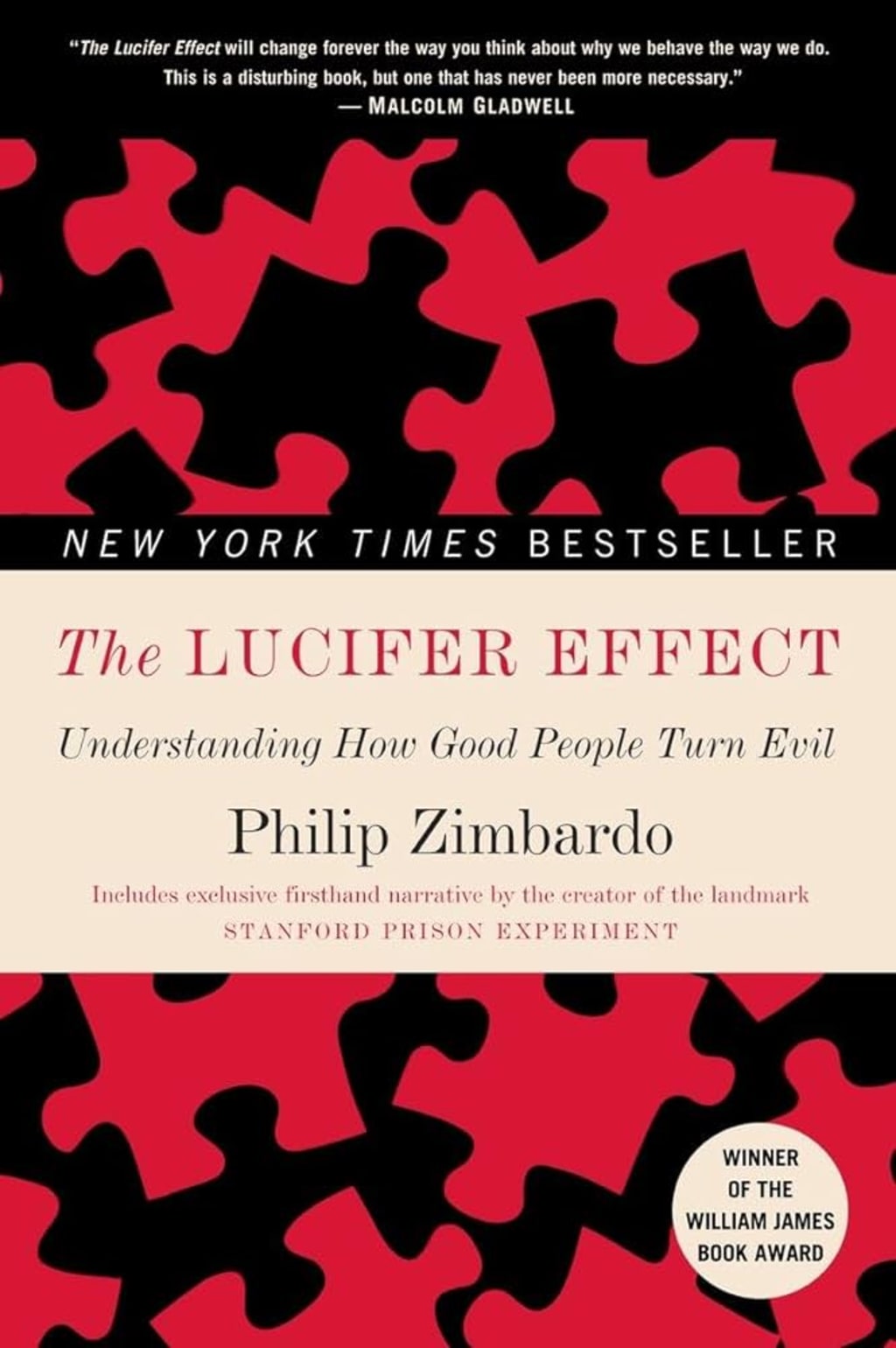
The Lucifer Effect explains how—and the myriad reasons why—we are all susceptible to the lure of “the dark side.” Drawing on examples from history as well as his own trailblazing research, Zimbardo details how situational forces and group dynamics can work in concert to make monsters out of decent men and women. Here, for the first time and in detail, Zimbardo tells the full story of the Stanford Prison Experiment, the landmark study in which a group of college-student volunteers was randomly divided into “guards” and “inmates” and then placed in a mock prison environment. Within a week the study was abandoned, as ordinary college students were transformed into either brutal, sadistic guards or emotionally broken prisoners. By illuminating the psychological causes behind such disturbing metamorphoses, Zimbardo enables us to better understand a variety of harrowing phenomena, from corporate malfeasance to organized genocide to how once-upstanding American soldiers came to abuse and torture Iraqi detainees in Abu Ghraib. He replaces the long-held notion of the “bad apple” with that of the “bad barrel”—the idea that the social setting and the system contaminate the individual, rather than the other way around.
About the Author:
- Philip Zimbardo is perhaps best known for the Stanford Prison Experiment, conducted in the basement of the Stanford University psychology department in 1971.
- participants in the study were 24 male college students who were randomly assigned to act either as "guards" or "prisoners" in the mock prison
- initially slated to last two weeks, but had to be terminated after just six days because of the extreme reactions and behaviors of the participants
- guards began displaying cruel and sadistic behavior toward the prisoners, while the prisoners became depressed and hopeless
- born on March 23, 1933, in New York City
- attended Brooklyn College where he earned a B.A. in 1954, triple majoring in psychology, sociology, and anthropology
- went on to earn his M.A. in 1955 and his Ph.D. in 1959 from Yale University, both in psychology
- taught briefly at Yale before becoming a psychology professor at New York University, where he taught until 1967
- after a year of teaching at Columbia University, he became a faculty member at Stanford University in 1968
- Since the prison experiment, Zimbardo has continued to conduct research on a variety of topics including shyness, cult behavior, and heroism.
- In 2002, Zimbardo was elected president of the American Psychological Association
- After more than 50 years of teaching, Zimbardo retired from Stanford in 2003 but gave his last "Exploring Human Nature" lecture on March 7, 2007.
- he continues to work as the director of an organization he founded called the Heroic Imagination Project
- promotes research, education, and media initiatives designed to inspire ordinary people to act as heroes and agents of social change
- Currently, the only authorized full-length film on the Stanford Prison Experiment is Quiet Rage (The Lucifer Effect)
- Recently, however, Coup d'Etat Films has contracted to make a feature-length movie based on the experiment. Stanford University has granted permission to use the school's name and image, contingent upon the final script conveying the facts and events as they actually happened. (The Lucifer Effect)
- Crime Scene Pictures and Coup d'Etat Films are set to produce Christopher McQuarrie's upcoming feature project "The Stanford Prison Experiment." Set to shoot this fall, the movie is co-written by McQuarrie and Tim Talbott. McQuarrie produces alongside Coup d'Etat Films' Brent Emery and Crime Scene's Adam Ripp/Rob Paris. The movie will be shot partially on the Stanford campus in Palo Alto, California, as well as, outlying areas in California. (The Lucifer Effect)
- In one sentence, how would you describe The Lucifer Effect? What is this book about?
- What did you know about the Stanford Prison Experiment before reading this book?
- Why doesn't Zimbardo see humans as inherently good or evil?
- What was the Stanford Prison Experiment? What was the original purpose of this experiment? What ended up happening? Why was Zimbardo forced to end the experiment early?
- How did you feel while reading Zimbardo's in-depth day-by-day description of the Stanford Prison Experiment? Why do you think Zimbardo provided so much detail? Was this hard to read at times? Why? How does Zimbardo's approach to these events help you to process what you're reading?
- How does Zimbardo connect the results of the Stanford Prison Experiment to real-world events outside of a controlled setting? What other research does he introduce or describe? How did you feel about all of this? What does it mean when it's all brought together?
- How does this book approach the torture of prisoners in Abu Ghraib? What were the situational and systemic forces that led US military personnel to commit acts of torture? Who does Zimbardo ultimately blame for this? How do we balance blame between the people committing evil acts and the leaders who build the institutions and systems that encourage that behavior? What are your thoughts on this?
- If this is a book about simulated and real torture, why doesn't it see people as inherently evil? Does this book end on a cynical or pessimistic note? How does Zimbardo introduce the concept of heroism? What did you think of this definition of a hero?
- What police procedures are used during arrests, and how do these procedures lead people to feel confused, fearful, and dehumanized?
- If you were a guard, what type of guard would you have become? How sure are you?
- What prevented "good guards" from objecting to or countermanding orders from tough or bad guards?
- If you were a prisoner, would you have been able to endure the experience? What would you have done differently than those subjects did? If you were imprisoned in a "real" prison for five years or more, could you take it?
- Why did our prisoners try to work within the arbitrary prison system to effect a change in it (e.g., setting up a Grievance Committee), rather than trying to dismantle or change the system through outside help?
- What factors would lead prisoners to attribute guard brutality to the guards' disposition or character, rather than to the situation?
- What is "reality" in a prison setting? This study is one in which an illusion of imprisonment was created, but when do illusions become real?
- Do you think that kids from an urban working-class environment would have broken down emotionally in the same way as middle-class prisoners? Why? What about women?
- After the study, how do you think the prisoners and guards felt when they saw each other in the same civilian clothes again and saw their prison reconverted to a basement laboratory hallway?
- Was it ethical to do this study? Was it right to trade the suffering experienced by participants for the knowledge gained by the research?
- How do the ethical dilemmas in this research compare with the ethical issues raised by Stanley Milgram's obedience experiments? Would it be better if these studies had never been done?
- If you were the experimenter in charge, would you have done this study? Would you have terminated it earlier? Would you have conducted a follow-up study?
- How can we change our real institutions, such as Attica Prison, when they are designed to resist critical evaluation and operate in relative secrecy from taxpayers and legislators?
- Knowing what this research says about the power of prison situations to have a corrosive effect on human nature, what recommendations would you make about changing the correctional system?
On Writing the Book: “In this book, I summarize more than 30 years of research on factors that can create a "perfect storm" which leads good people to engage in evil actions. This transformation of human character is what I call the "Lucifer Effect," named after God's favorite angel, Lucifer, who fell from grace and ultimately became Satan. Rather than providing a religious analysis, however, I offer a psychological account of how ordinary people sometimes turn evil and commit unspeakable acts.” (The Lucifer Effect)
TV & Movies:
Stanford Prison Experiment:
Carried out August 15-21, 1971 in the basement of Jordan Hall, the Stanford Prison Experiment set out to examine the psychological effects of authority and powerlessness in a prison environment. The study, led by psychology professor Philip G. Zimbardo, recruited Stanford students using a local newspaper ad. Twenty-four students were carefully screened and randomly assigned into groups of prisoners and guards. The experiment, which was scheduled to last 1-2 weeks, ultimately had to be terminated on only the 6th day as the experiment escalated out of hand when the prisoners were forced to endure cruel and dehumanizing abuse at the hands of their peers. The experiment showed, in Dr. Zimbardo’s words, how “ordinary college students could do terrible things.” (Stanford Prison Experiment) Photos
Discussion Questions:
About the Creator
Kristen Barenthaler
Curious adventurer. Crazed reader. Librarian. Archery instructor. True crime addict.
Instagram: @kristenbarenthaler
Facebook: @kbarenthaler
Keep reading
More stories from Kristen Barenthaler and writers in BookClub and other communities.
"Lady Killers" by Tori Telfer - Book Club Discussion
Inspired by author Tori Telfer's Jezebel column "Lady Killers," this thrilling and entertaining compendium investigates female serial killers and their crimes through the ages. When you think of serial killers throughout history, the names that come to mind are ones like Jack the Ripper, John Wayne Gacy, and Ted Bundy. But what about Tillie Klimek, Moulay Hassan, Kate Bender? The narrative we're comfortable with is the one where women are the victims of violent crime, not the perpetrators. In fact, serial killers are thought to be so universally, overwhelmingly male that in 1998, FBI profiler Roy Hazelwood infamously declared in a homicide conference, "There are no female serial killers." Lady Killers, based on the popular online series that appeared on Jezebel and The Hairpin, disputes that claim and offers fourteen gruesome examples as evidence. Though largely forgotten by history, female serial killers such as Erzsébet Báthory, Nannie Doss, Mary Ann Cotton, and Darya Nikolayevna Saltykova rival their male counterparts in cunning, cruelty, and appetite for destruction. Each chapter explores the crimes and history of a different subject, and then proceeds to unpack her legacy and her portrayal in the media, as well as the stereotypes and sexist clichés that inevitably surround her. The first book to examine female serial killers through a feminist lens with a witty and dryly humorous tone, Lady Killers dismisses easy explanations (she was hormonal, she did it for love, a man made her do it) and tired tropes (she was a femme fatale, a black widow, a witch), delving into the complex reality of female aggression and predation. Featuring 14 illustrations from Dame Darcy, Lady Killers is a bloodcurdling, insightful, and irresistible journey into the heart of darkness.
By Kristen Barenthaler2 years ago in BookClub
My New Book is Finally Here
My poetry collection Beautiful and Brutal Things is done. It's actually done and finally published over 270 pages. Over a year of my life went into this book. More than a year, really. Long days at my computer, sometimes seven days a week because I couldn't stop even when I probably should have. Then two months of editing that felt harder than the writing itself. But it's finished, and I'm still standing, and the book is real.
By Tim Carmichael2 days ago in BookClub
Rachel Reviews: Paradise Cove - They Escaped the Cuckoo's Nest by Pini Dunner
On starting Pini Dunner's book, I was grateful for the thorough history that is provided at the start. This gives a much-needed context in order to enjoy the subsequent letters contained therein. The letters belong to George Nagel, an octagenarian pursuing a psychology degree which in itself would be remarkable; however, it is soon clear that this is just one remarkable thing in a life full of them.
By Rachel Deeminga day ago in BookClub
Wild Card Weekend Recap: What Happens Now?
I think I figured out why I love Wild Card Weekend so much. It's because it's the first playoff anything of the calendar year. The NFL season starts in the fall, and once upon a time, the champion was crowned either on or slightly before New Year's. The evolution of the NFL schedule has resulted in the playoffs starting just into the New Year, and currently, the final week of the season falls on the first weekend of the New Year, with Wild Card Weekend coming a week after that. So yes, chronologically, the NFL's Wild Card Weekend serves as the first playoff anything of the calendar year.
By Clyde E. Dawkins6 days ago in Unbalanced



Comments
There are no comments for this story
Be the first to respond and start the conversation.