
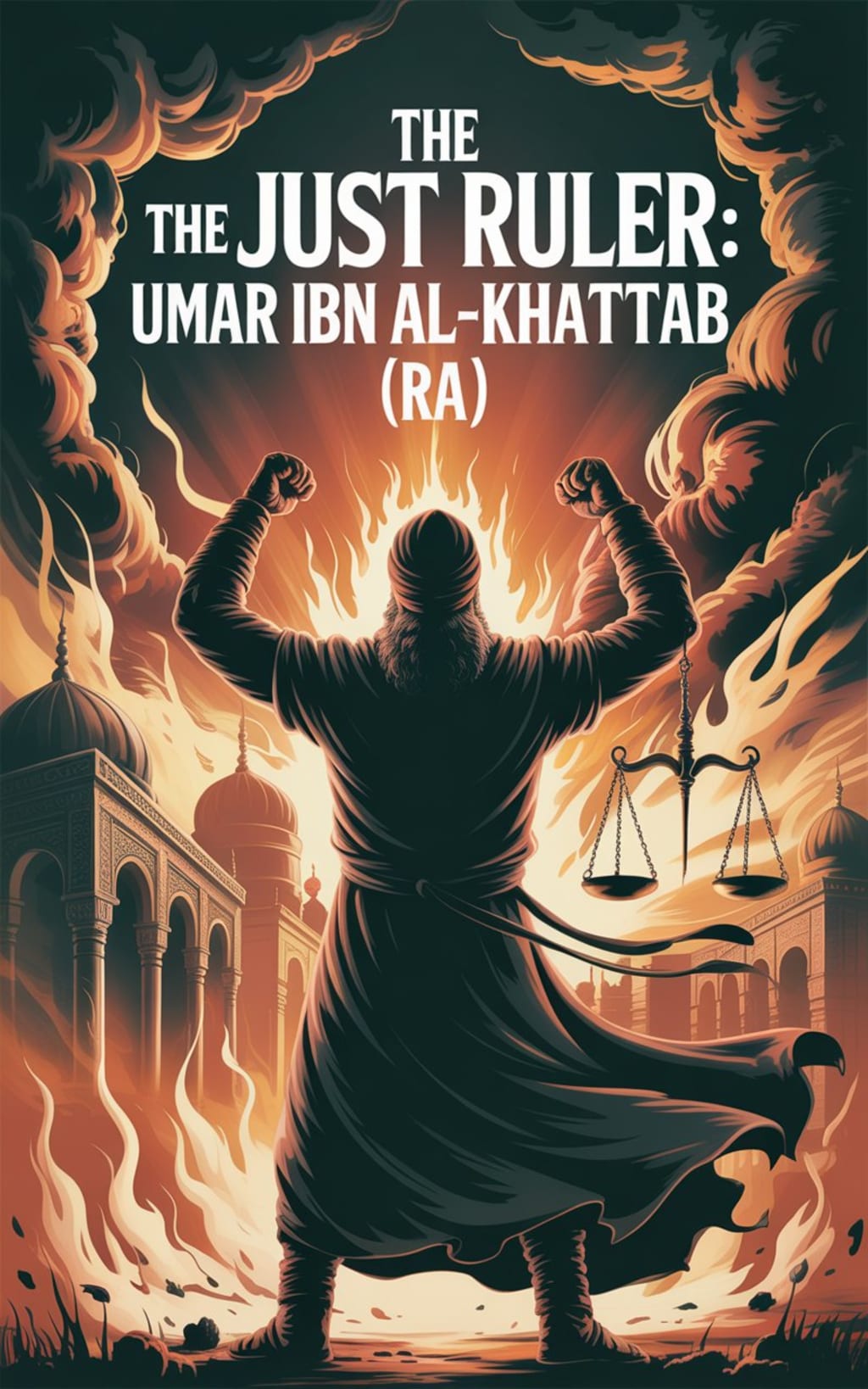
The Just Ruler: Hazrat Umar ibn al-Khattab (RA) in Michael H. Hart’s List of Influential Personalities
Hazrat Umar (RA) is listed at #52 in Michael H. Hart’s ranking.How the Leadership of Umar (RA) Shaped the Islamic Empire and Earned Him a Place in World History

📝 Why Hart Included Hazrat Umar (RA):
Michael H. Hart recognized Hazrat Umar (RA) for:
Expanding the Islamic Empire rapidly and effectively during his rule as the second Caliph.
Laying the foundation of Islamic administrative and legal systems, many of which lasted for centuries.
Ensuring justice and accountability, even when applied to himself.
Helping solidify Islam's political and religious structure after the Prophet Muhammad (SAW).
Hart emphasized that Umar's impact was not just religious, but deeply political, legal, and social, making him one of the most influential men in history.
In the wide landscape of historical greatness, only a few figures have left such a transformative impact on the world that their influence resonates across centuries and civilizations. One such towering personality is Hazrat Umar ibn al-Khattab (RA), the second Caliph of Islam. In his widely-read book, “The 100: A Ranking of the Most Influential Persons in History”, Michael H. Hart, an American astrophysicist and historian, ranked Hazrat Umar (RA) at number 52 — acknowledging his immense contributions to the growth and governance of the Islamic empire.
Hart’s inclusion of Hazrat Umar (RA) in his top 100 was not based on religious reverence, but on measurable historical impact. This essay explores the qualities, decisions, and outcomes of Umar's leadership that earned him a place among the most influential people in world history.
🌟 Early Life and Conversion
Hazrat Umar (RA) was born in 584 CE into the Quraysh tribe of Makkah, one of the most powerful tribes in pre-Islamic Arabia. Before accepting Islam, he was known for his strength, intellect, and firm opposition to the Prophet Muhammad (SAW). However, once he heard the verses of the Qur’an — particularly from Surah Ta-Ha — his heart was moved, and he embraced Islam. His conversion was a turning point for the Muslim community, giving them confidence and boldness.
Hart notes that while Umar (RA) was not the founder of Islam, his later leadership ensured its expansion and endurance, which significantly influenced the course of human history.
🛡️ The Caliphate and Leadership
After the death of Caliph Abu Bakr (RA) in 634 CE, Umar (RA) was appointed as the second Caliph. His caliphate lasted for over 10 years and is widely considered one of the most influential periods in Islamic — and even global — history. During his rule, the Islamic empire expanded dramatically, covering vast parts of the Byzantine and Sassanian Empires.
Under Umar (RA):
Syria, Palestine, Egypt, Iraq, Persia, and parts of Central Asia came under Islamic rule.
The Muslim world grew from a regional faith to a global civilization.
Administrative systems were created that lasted for centuries.
Hart points out that Umar’s (RA) leadership was key in ensuring the survival and spread of Islam after the death of Prophet Muhammad (SAW).
🏛️ Administrative Reforms
What truly sets Umar (RA) apart — and what Hart emphasizes — is his administrative genius. He was not only a military leader but a nation-builder, who structured the Islamic state in ways that were ahead of their time.
Key Reforms Introduced by Umar (RA):
Provincial Governance
Umar (RA) divided the empire into provinces and districts and appointed governors (walis) under strict accountability. He regularly sent investigators to check corruption and remove unjust officials.
Bayt al-Mal (Public Treasury)
He created the institution of Bayt al-Mal to manage state finances and ensure resources were spent for the welfare of the people.
Judicial System
He established separate courts, appointed judges (qadis), and ensured justice was swift and fair — even for the Caliph himself.
Stipends and Welfare System
Umar (RA) introduced a system of monthly stipends for widows, orphans, the poor, and disabled, making his governance one of the earliest welfare states in human history.
Military Structure
He organized standing armies, built garrison towns (like Kufa and Basra), introduced soldier salaries, and developed record systems for military service.
Census and Population Records
He began the practice of keeping records, conducting population censuses, and using written documentation for all state matters.
These systems allowed for a fair, transparent, and efficient administration, and many of his policies were adopted by later empires, both Islamic and non-Islamic.
⚖️ Justice and Personal Integrity
One of the most compelling reasons for Umar’s (RA) high ranking in Hart’s book is his unyielding commitment to justice. He did not view himself as above the law. On multiple occasions, he was seen in ordinary clothes, walking among the people, and many could not even distinguish him from common citizens.
One famous incident illustrates his integrity: A Christian man once filed a case against Umar (RA), and he stood before the judge just like any other citizen. The judge ruled in favor of the Christian, and Umar (RA) accepted the decision without question.
His leadership style was rooted in the principles of equality, fairness, and accountability, and it earned him titles like “Amir al-Mu’minin” (Commander of the Faithful) and “Al-Farooq” (The One Who Distinguishes Right from Wrong).
🌍 Expansion Without Tyranny
Although the Islamic empire expanded rapidly under Umar (RA), his rule was marked by restraint and respect for non-Muslims. He ensured the protection of religious minorities, did not allow forced conversions, and often met personally with leaders of conquered regions to guarantee their rights.
In Jerusalem, when he accepted the city's surrender, he refused to pray in a Christian church out of respect — fearing that future Muslims might convert it into a mosque. Such diplomatic wisdom and cultural sensitivity had a long-lasting impact on interfaith relations in the Islamic world.
Hart notes this balance of military strength and ethical leadership as a critical reason for Umar’s (RA) global influence.
🕊️ Martyrdom and Legacy
Umar (RA) was martyred in 644 CE by a Persian slave named Abu Lu’lu while leading the morning prayer. Even in his final moments, he remained concerned about the well-being of the Muslim community. He appointed a consultation council (shura) to choose the next Caliph, emphasizing the importance of collective decision-making.
Today, he is buried beside the Prophet Muhammad (SAW) and Abu Bakr (RA) in Masjid al-Nabawi in Madinah — a testimony to his closeness in faith and legacy.
📚 Why Michael H. Hart Ranked Him at #52
Michael H. Hart did not base his ranking on religious belief, but rather on objective influence. He stated:
“Umar ibn al-Khattab was instrumental in preserving and expanding the Islamic empire, creating the administrative structure that allowed it to flourish for centuries.”
Hart believed that Umar’s leadership, character, and policies ensured that Islam did not remain a regional religion but became a global force. Without Umar (RA), the fragile post-Prophethood era might have collapsed under external pressure and internal conflict.
🧭 Conclusion
Hazrat Umar ibn al-Khattab (RA) was a statesman, a reformer, a military leader, and a spiritual icon. His governance combined power with compassion, discipline with justice, and expansion with tolerance. His life serves as a golden model of Islamic leadership.
Michael H. Hart’s recognition of Hazrat Umar (RA) as one of the 100 most influential people in history is not just a historical opinion — it is a recognition of a legacy that continues to inspire leaders, scholars, and societies to this day.
About the Creator
Keep reading
More stories from Zain Ul Abedin Khan and writers in BookClub and other communities.
Forged in Unity
Abraham Lincoln’s presidency stands as one of the most pivotal chapters in American history. Leading the nation through the bloodiest conflict it ever faced—the Civil War—Lincoln’s extraordinary leadership ensured the survival of the United States as a unified country. But what truly set Lincoln apart was his unique ability to manage a cabinet full of rivals, individuals who had once been his political competitors, yet who became his closest allies in preserving the Union. Doris Kearns Goodwin’s Team of Rivals highlights how this approach to leadership—embracing dissent and building unity from diversity—was central to Lincoln’s political genius.
By Zain Ul Abedin Khan9 months ago in BookClub
Rachel Reviews: Lakefront Wolves by Joseph Deegan
Meet Finn. He's an 18 year old kid who has potential. He's bright with great school scores and he's also an athlete, a footballer of some prowess. He has it all going for him, it would seem, and yet, he's determined to send what could be a well-planned, stable existence firmly off the rails. He drinks, he smokes, he takes drugs, he has violent tendencies and he's in danger of losing not only his mind but all that he holds dear.
By Rachel Deeming15 days ago in BookClub
The Solitude of The Chupacabra
Many say that the Chupacabra is a rather recent and modern tale, a mangy coyote or rabied dog. Some point out that it’s just twisted evolution. But very few know the true backstory of the shapeshifter that led to the bloodsucking legend. And perhaps once you will come to know and understand more, you might “forget” a few cattle out to wander.
By Oneg In The Arctic3 days ago in Fiction


Comments (1)
Umar's inclusion in Hart's list is well-deserved. His rapid expansion of the Islamic Empire, legal reforms, and justice focus had a lasting impact. It shows influence isn't just about founding, but growing and shaping.