
Druids: Keepers of the Sacred Grove
Wisdom, Ritual, and Power in the Ancient Celtic World

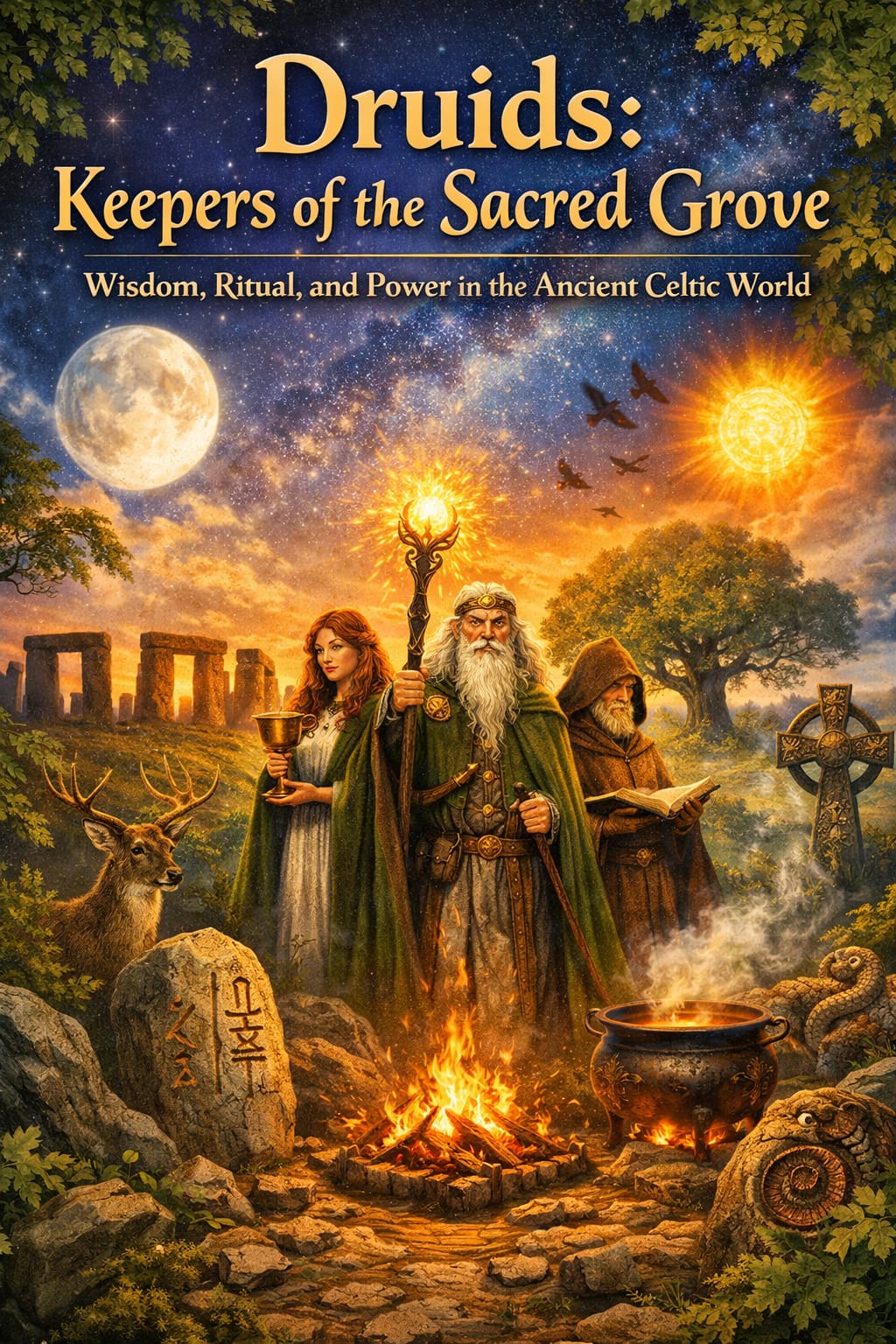
The True Identity of the Druids
The word Druid carries deep historical weight, rooted in the landscapes and societies of Iron Age Europe rather than in later fantasy. Ancient accounts and archaeological evidence point to an educated and influential class embedded within Celtic cultures across Gaul, Britain, and Ireland between roughly the 5th century BCE and the early centuries of the Common Era. Associations with oak groves, sacred springs, and open-air sanctuaries reflect authentic religious practices that emphasized the sanctity of the natural world as a living and ordered system.
Druids occupied a central position within Celtic society, forming an elite intellectual and spiritual class whose authority extended beyond religious ceremony. Classical writers such as Julius Caesar and Strabo described Druids as arbiters of law, instructors of youth, advisors to rulers, and interpreters of cosmological order. Legal disputes, treaties, and matters of social cohesion frequently fell under Druidic jurisdiction, indicating a system in which spiritual authority and civil governance were closely intertwined.
Education under Druidic discipline required years of intensive oral training. Knowledge of theology, astronomy, natural philosophy, poetry, genealogy, and customary law was memorized rather than written, preserving doctrine through structured recitation and disciplined memory. This oral tradition ensured continuity while reinforcing the authority of those who had mastered its complexities. The deliberate avoidance of sacred texts in written form distinguished Druids from contemporary Mediterranean priesthoods and emphasized the living transmission of wisdom.
Spiritual practice centered on an animistic worldview that recognized rivers, forests, stones, and celestial bodies as imbued with spiritual significance. Seasonal cycles governed ritual life, reflecting agricultural realities and cosmological observation. Healing arts, botanical knowledge, and divinatory practices further expanded Druidic influence into daily life, linking physical well-being with spiritual balance.
Rather than existing as isolated mystics, Druids functioned as custodians of collective memory and ethical order. Their role preserved cultural identity in societies without centralized states or written constitutions. Through disciplined learning, ritual authority, and philosophical inquiry, Druids shaped a sophisticated system of knowledge that balanced reverence for nature with structured social responsibility.
The Rise of Druidic Tradition
Druidism developed within the broader framework of Celtic societies during the European Iron Age, with evidence placing its formation between approximately the 5th century BCE and the 1st century CE. This period was marked by complex tribal structures, extensive trade networks, and sophisticated cultural systems long before Roman expansion into northern and western Europe. Druidic tradition arose organically within these societies, reflecting indigenous responses to governance, spirituality, education, and cosmological understanding.
Archaeological and historical records associate Druids primarily with regions inhabited by Celtic-speaking peoples, including Gaul, Britain, Ireland, and portions of the Iberian Peninsula. While material evidence such as ritual sites, votive deposits, and iconography does not explicitly label Druidic practitioners, these findings align closely with descriptions preserved in classical literature. Sacred groves, river offerings, hilltop enclosures, and boundary sanctuaries appear repeatedly across Celtic territories, reinforcing accounts of religious practices conducted in natural settings rather than constructed temples.
The term Druid is widely understood to derive from the Proto-Celtic dru-wid-s. Linguistic analysis links dru to the oak tree and wid to knowledge or vision, yielding interpretations such as “oak-knower” or “one possessing deep knowledge.” Oaks held exceptional symbolic importance in Celtic cosmology, associated with longevity, strength, and divine authority. The linguistic connection suggests a title denoting wisdom grounded in both natural observation and spiritual insight rather than a mere occupational label.
Most written information concerning Druids originates from Greco-Roman authors, including Julius Caesar, Pliny the Elder, Diodorus Siculus, and Strabo. These writers encountered Druidic institutions during military campaigns, diplomatic contact, or secondhand reporting. Julius Caesar’s Commentarii de Bello Gallico provides the most detailed account, describing Druids as a learned class responsible for religious rites, legal judgments, education, and philosophical instruction. Pliny the Elder contributed descriptions of ritual symbolism and botanical practices, while Diodorus and Strabo emphasized the philosophical and judicial authority attributed to Druids within Celtic society.
These accounts must be read critically, as Roman authors often framed foreign cultures through political, moral, and ideological lenses. Roman opposition to Druidism stemmed in part from its unifying influence across tribal boundaries and its resistance to imperial authority. Despite this bias, remarkable consistency appears across independent sources regarding Druidic education, social power, and religious function. Such agreement supports the conclusion that Druids constituted a well-established and influential intellectual class rather than a loosely defined group of local priests.
Taken together, linguistic evidence, archaeological patterns, and classical testimony reveal Druidism as a structured and enduring institution rooted deeply in Iron Age Celtic civilization. Its emergence reflects a society that valued learned authority, oral knowledge, and spiritual engagement with the natural world as foundational elements of cultural identity.
Authority, Learning, and Power in Celtic Civilization
Druids occupied the highest rank within the intellectual hierarchy of Celtic societies, forming a learned elite whose authority rivaled and often surpassed that of warrior nobles. Classical sources consistently distinguish Druids from both the military aristocracy and the artisan classes, presenting a tripartite social structure in which spiritual and intellectual authority functioned as a stabilizing force. This elevated status granted Druids exemption from military service and taxation, privileges that reinforced their independence and underscored the value placed on knowledge and wisdom within Celtic culture.
Druidic authority extended beyond individual tribes, creating a shared legal, religious, and educational framework across large regions of the Celtic world. Caesar records that disputes between tribes were frequently submitted to Druidic judgment, and that major assemblies of Druids drew participants from vast territories. This trans-tribal influence fostered cultural continuity among otherwise independent groups and positioned Druids as guardians of social cohesion and customary law.
Religious leadership formed one of the most visible aspects of Druidic responsibility. Druids presided over communal and private rites tied to agricultural cycles, seasonal transitions, and rites of passage. Sacred festivals aligned with key points in the solar year, reinforcing the relationship between cosmic order and human activity. Ritual practice emphasized mediation between the human world and a populated spiritual landscape inhabited by deities, ancestral forces, and natural spirits. Offerings and ceremonies conducted in groves, near rivers, or at boundary sites reflected a worldview in which nature functioned as both sanctuary and scripture.
Legal authority represented another cornerstone of Druidic influence. Druids served as judges and arbiters, interpreting customary law and issuing binding decisions in matters ranging from land disputes to criminal acts. Punishments could include fines, restitution, or exclusion from religious rites, a sanction regarded as particularly severe in societies where ritual participation defined communal belonging. This legal role positioned Druids as enforcers of ethical norms and social balance rather than merely religious specialists.
Education and preservation of memory formed the foundation of Druidic power. Druids maintained extensive bodies of genealogical records, mythological narratives, cosmological teachings, and historical knowledge through highly structured oral systems. Instruction relied on memorization, poetic forms, and formal recitation, often requiring decades of disciplined study. This mastery of collective memory ensured continuity across generations in cultures without written sacred texts, granting Druids unparalleled authority as custodians of identity and tradition.
Classical writers also attribute scientific and philosophical study to Druidic instruction. Caesar notes teachings concerning the movement of celestial bodies, the nature of the cosmos, and the immortality of the soul. Pliny the Elder references botanical knowledge and medicinal practices, while other sources suggest familiarity with natural philosophy and mathematical principles. These disciplines were not isolated fields but integrated into a holistic worldview that linked observation of nature with spiritual understanding.
Political influence emerged naturally from these combined roles. Kings and chieftains frequently sought Druidic counsel before warfare, treaty negotiations, or major social decisions. The presence of Druids could delay or prevent armed conflict, and their pronouncements carried moral authority capable of shaping political outcomes. Rather than ruling directly, Druids exercised power through persuasion, ritual legitimacy, and control of knowledge.
Within Celtic society, Druids functioned as architects of order rather than agents of domination. Their authority rested on learning, ethical oversight, and spiritual mediation, forming a system in which governance, religion, and education were inseparable. This integration produced a resilient cultural framework that endured for centuries despite political upheaval and external pressure.
Guardians of Memory: Oral Tradition and Sacred Knowledge
Druidic practice was defined by a rigorous commitment to oral transmission, a system in which knowledge was preserved, interpreted, and passed down entirely through memory and recitation. Sacred teachings, legal codes, genealogies, mythological narratives, and cosmological understanding were transmitted without the aid of writing. Classical sources, particularly Julius Caesar and Pliny the Elder, emphasize the extraordinary length and intensity of Druidic training, with some accounts suggesting a period of up to twenty years before full initiation. During this time, students learned complex verse forms, mnemonic devices, and layered narratives designed to encode vast bodies of information in a manner resistant to loss or distortion.
The avoidance of written scripture served multiple strategic and cultural purposes. By confining sacred knowledge to spoken form, Druids ensured that teachings remained adaptable, allowing interpretation to evolve with social and environmental circumstances. Oral transmission also functioned as a protective measure, limiting access to knowledge and maintaining secrecy, especially in matters of ritual, divination, or legal judgment. Mastery of oral lore established clear hierarchies within the Druidic class, as authority depended upon demonstrated recall, interpretive skill, and the ability to apply knowledge in practical and spiritual contexts.
Sacred knowledge was often embedded in poetic and symbolic structures that aided memory while reinforcing cultural meaning. Verse forms, repeated incantations, and formulaic storytelling not only preserved content but also encoded ethical, cosmological, and spiritual principles. Myths and genealogies recited in ceremonial contexts reinforced communal identity, linking contemporary society to ancestral traditions and the cycles of nature. This system transformed memory itself into a sacred instrument, where the act of recitation became both pedagogy and ritual.
Ordinary written records were employed for administrative and mundane matters, such as land transactions or commercial agreements, but religious, philosophical, and legal knowledge remained oral. This deliberate distinction reinforced the sanctity of Druidic authority and ensured that intellectual and spiritual power resided with those who had undergone rigorous training. In effect, Druids acted as living libraries, maintaining continuity in societies without formal literacy and safeguarding cultural memory across generations.
By preserving knowledge in the spoken word, Druids demonstrated a sophisticated understanding of cognition, pedagogy, and social organization. Their oral tradition exemplifies the potential for memory to serve as both repository and instrument of cultural cohesion, linking individuals, communities, and the natural world through disciplined recall, ritual practice, and ceremonial recitation.
The Living World: Spiritual Beliefs and Cosmology of the Druids
Druidic spiritual thought was deeply intertwined with observation of the natural world and understanding of its underlying patterns. Across Celtic regions, belief systems varied in detail, yet fundamental principles consistently emphasized the sacredness of nature, the interconnectedness of life, and the presence of forces beyond the human sphere. Natural landscapes were not merely settings for ritual but active participants in spiritual practice. Groves, springs, rivers, hills, and transitional zones such as crossroads or hilltops functioned as sacred sites, imbued with power and serving as portals between the visible world and other realms. Constructed temples were largely absent, reflecting a cosmology that found divinity in living landscapes rather than in built monuments.
Central to Druidic thought was animism, the belief that all aspects of the natural world possess consciousness or spiritual agency. Trees, stones, rivers, animals, and even the wind were regarded as sentient and influential forces. This perspective informed both ritual practice and ethical conduct, fostering respect for the environment and reinforcing the sense of humans as participants within a larger, conscious ecosystem rather than as masters over it. Certain trees, notably the oak, ash, and yew, held elevated significance due to symbolic associations with longevity, resilience, and divine communication.
Polytheism formed another cornerstone of Druidic cosmology. Druids recognized a multitude of deities, each governing particular domains such as fertility, war, craftsmanship, healing, or the sovereignty of the land. These deities were often associated with natural phenomena or territorial features, creating a spiritual geography in which divine power was mapped onto the landscape itself. Ritual offerings and invocations aimed to maintain harmony with these forces, ensuring prosperity, protection, and balance within both human and natural communities.
Time and ritual were organized around cyclical patterns, reflecting both agricultural necessity and cosmological observation. Seasonal festivals marked the turning points of the solar year, structuring communal life around recurring cycles of birth, growth, harvest, and decline. Samhain, Imbolc, Beltane, and Lughnasadh were among the principal festivals, each corresponding to critical transitions in the agricultural calendar and serving as occasions for ritualized reflection on life, death, and renewal. These festivals also provided opportunities to honor ancestors, reinforce social cohesion, and engage with the spiritual forces believed to govern the land.
Druidic teachings included concepts of the soul and its continuity beyond death. Classical accounts suggest that Druids believed in the transmigration of the soul, a process in which consciousness persisted after physical death, potentially entering new lives or transitioning to otherworldly realms. This belief reinforced ethical behavior, encouraged reverence for life, and connected human existence to broader cosmic cycles. The otherworld was imagined not as a distant abstraction but as an active dimension of existence, accessible through ritual, vision, or liminal spaces in the natural environment.
The spiritual worldview of the Druids integrated observation, reverence, and ethical practice into a coherent cosmology. Nature was sacred, the divine was plural and immanent, and life was understood as a continuous cycle of interrelated forces. Through ritual, ethical conduct, and engagement with sacred landscapes, Druids cultivated a vision of the world in which human activity harmonized with both cosmic order and the vitality inherent in the natural environment.
Ritual Practice and Ceremony Among the Druids
Druidic ritual and ceremonial practice was closely tied to the rhythms of nature, reflecting both agricultural cycles and celestial patterns. Seasonal transitions, particularly solstices and equinoxes, were central to communal observances, linking human activity with the movement of the sun, moon, and stars. These events structured the calendar of public and private ceremonies, providing occasions for thanksgiving, divination, and the reinforcement of social and spiritual cohesion. While medieval sources sometimes attributed precise astronomical calculations to Druids, evidence suggests that their observations were practical, aligning rituals with seasonal change rather than functioning as a formal scientific system.
Offerings formed a central component of Druidic ritual. Material offerings ranged from cultivated food, such as grains and fruits, to crafted items representing skill or wealth. Symbolic sacrifices were conducted to honor deities, appease natural forces, or ensure fertility of the land. Roman sources, including Caesar and Pliny the Elder, reference both animal and, in rare reports, human sacrifices. Archaeological evidence indicates that human sacrifice, if practiced, was limited to exceptional circumstances, ritualized in specific locations, and likely exaggerated by Roman writers as a justification for imperial intervention and as a means of portraying Celtic peoples as “barbaric.” Animal sacrifice, by contrast, appears more consistent with symbolic ritual patterns and agricultural cycles.
One of the most enduring ritual images associated with Druidic practice is the harvest of mistletoe from oak trees, as described by Pliny the Elder. This ceremony employed a golden sickle and symbolized purity, renewal, and divine favor. The ritual underscores the Druidic capacity to integrate natural elements, sacred symbolism, and ritual performance into acts that reinforced both spiritual and social structures. Such ceremonies were not daily occurrences but highly charged events, designed to invoke protection, prosperity, and alignment with cosmic and natural forces.
Rituals also encompassed rites of passage, including initiation, marriage, and funerary observances. Initiation into the Druidic class itself was a protracted and ceremonial process, reinforcing hierarchy, discipline, and mastery over sacred knowledge. Funerary rites reflected beliefs in the continuation of the soul and the sanctity of the body within natural and spiritual cycles, often involving symbolic deposits in rivers, bogs, or other liminal sites connected with the otherworld.
Ceremonial practice combined sensory, symbolic, and performative elements, integrating speech, chant, gesture, and material offerings to create a cohesive spiritual experience. Through these rituals, Druids mediated between the human community and the wider universe, maintaining balance, reinforcing ethical norms, and ensuring continuity between generations. Each ceremonial act, whether simple or elaborate, reflected a worldview in which human life was inseparable from the sacred rhythms of nature and the cycles of the cosmos.
Druids and Astronomy
Observation of the skies played a critical role in Druidic culture, integrating celestial knowledge with ritual, agriculture, and seasonal planning. Classical sources and archaeological evidence suggest that Druids monitored the movements of the sun, moon, and stars to determine the timing of festivals, agricultural activities, and religious ceremonies. Solstices and equinoxes held particular significance, marking transitions in the solar year that structured both ritual and community life.
Megalithic monuments such as stone circles and alignments at sites like Stonehenge, Callanish, and Avebury indicate sophisticated astronomical awareness. Many of these sites demonstrate precise alignment with sunrise or sunset on key solar dates, as well as lunar cycles, suggesting that Druids or their cultural predecessors used these structures for observational and ceremonial purposes. These monuments functioned simultaneously as ritual centers, calendrical tools, and symbolic representations of the connection between human activity and cosmic order.
The Coligny calendar, a bronze tablet found in Gaul, provides further evidence of systematic observation. Its inscriptions reflect detailed tracking of lunar months, intercalary adjustments, and seasonal festivals, illustrating the ability of Celtic societies to integrate astronomical knowledge into religious and social practice. Such calendrical systems reinforced the cyclical view of time central to Druidic cosmology and guided the scheduling of rituals such as Samhain, Imbolc, Beltane, and Lughnasadh.
Druidic engagement with the heavens also encompassed symbolic interpretation. Celestial bodies were often associated with deities, spirits, or cosmological principles, creating a symbolic framework that linked observation of the natural world with spiritual meaning. Knowledge of celestial patterns likely formed part of Druidic instruction, alongside law, medicine, and philosophy, reflecting a holistic understanding of the universe.
The study of Druidic astronomy demonstrates the integration of practical observation, ritual timing, and spiritual symbolism. By aligning human activity with natural and cosmic cycles, Druids embodied a worldview in which ethical, social, and religious responsibilities were informed by careful study of the heavens. This legacy continues to influence modern Druidry, Neo-Paganism, and earth-centered spiritual practices, reinforcing the enduring importance of celestial awareness in both historical and contemporary contexts.
Druidic Symbols and Iconography
Symbols played a central role in Druidic life, serving as tools for memory, ritual, ethical teaching, and cosmological understanding. The oak tree occupied a position of paramount importance, representing strength, endurance, and divine authority. Classical accounts and archaeological evidence indicate that groves of oak were considered sacred spaces where ritual, education, and counsel were conducted. Mistletoe, particularly when harvested from oak, symbolized purity, renewal, and the mediation between human and divine realms.
Stone circles and megalithic monuments were closely associated with Druidic practice. Alignments with solar and lunar events suggest these structures functioned not only as ceremonial spaces but also as calendars and cosmological markers. The Coligny calendar, an inscribed bronze tablet discovered in Gaul, reflects an intricate understanding of lunar months, solar years, and festival cycles, highlighting the integration of symbolic representation with practical knowledge.
Ogham script, primarily found in Ireland and western Britain, provided another symbolic framework. Often carved on standing stones or wood, ogham encoded genealogical, ritual, and linguistic information. The association of individual letters with specific trees reinforces the centrality of the natural world to Druidic cognition and ritual practice.
Animal symbolism was also prominent, with creatures such as deer, birds, and serpents representing aspects of fertility, transition, and spiritual guidance. Such motifs appeared in art, ceremonial objects, and oral narratives, linking myth, ethics, and the observation of natural cycles.
Together, these symbols created a rich, interconnected language that allowed Druids to teach, preserve knowledge, and engage communities without relying on written texts. The study of Druidic iconography illuminates the intellectual sophistication of these spiritual leaders and their ability to communicate complex ethical, cosmological, and ritual concepts through a shared symbolic framework. This symbolic tradition continues to inspire modern Druidry, Neo-Paganism, and earth-centered spiritual practices, providing a living connection to the values, philosophy, and worldview of ancient Celtic societies.
Eclipse of the Oak
The expansion of Roman power into Gaul and Britain during the late first century BCE and early first century CE significantly disrupted Druidic institutions. Roman administrators regarded Druids as a persistent political and cultural threat, due to their trans-tribal authority, capacity to mobilize populations, and influence over both legal and military matters. Julius Caesar, in his *Commentarii de Bello Gallico*, emphasizes that Druids not only presided over religious observances but also settled disputes, instructed the youth in law and philosophy, and held moral authority capable of guiding entire communities. Such concentrated influence across tribal boundaries challenged the hierarchical and centralized control sought by Roman governance.
In response, Rome implemented policies aimed at dismantling Druidic structures. Emperors Tiberius and Claudius issued edicts outlawing Druidic practice, targeting gatherings, ceremonial leadership, and sacred sites. Roman military campaigns destroyed prominent groves, suppressed large-scale assemblies, and persecuted Druids who acted as intermediaries or advisors opposing imperial interests. Archaeological evidence, including ritual deposits interrupted or abandoned during this period, corroborates classical accounts of systematic disruption. The suppression of Druids was not solely a religious initiative but a deliberate political strategy to weaken cultural cohesion and eliminate independent centers of authority within conquered territories.
Beyond the reach of Roman authority, particularly in Ireland and parts of western Scotland, Druidic traditions persisted. These regions maintained oral teachings, ritual practice, and cosmological knowledge for generations, often adapting to changing social and political conditions. Archaeological finds such as standing stones, ceremonial enclosures, and sacred wells suggest continuity of ritual practice long after public Druidic authority had been suppressed elsewhere. Rituals associated with fertility, seasonal cycles, and veneration of ancestors appear to have continued within localized communities, reflecting a gradual evolution rather than complete disappearance.
The arrival of Christianity introduced a transformative phase in the survival of Druidic knowledge. Early Irish monastic communities integrated elements of Druidic expertise into scholastic and literary frameworks. Poets, known as *filid*, inherited the oral and mnemonic skills of Druids, preserving genealogies, heroic narratives, and moral teachings. Legal scholars adapted customary law into codified systems, maintaining ethical principles central to Druidic jurisprudence. Spiritual roles once performed by Druids, including ritual mediation and symbolic engagement with nature, were reinterpreted within Christian cosmology, often through allegorical storytelling or ritualized veneration of sacred landscapes. In this way, Druidic intellectual and spiritual heritage persisted indirectly, influencing literature, law, ritual, and cultural identity in post-Roman Europe.
The suppression and decline of Druidic authority demonstrate both the vulnerability and adaptability of indigenous knowledge systems. Military conquest and legal prohibition curtailed public roles, yet the resilience of oral tradition, ritual adaptation, and cultural memory allowed core principles of Druidic thought to endure. Ethical instruction, cosmological understanding, and integration of human activity with natural cycles survived through transformation, embedding the legacy of Druids within the evolving spiritual and intellectual landscape of medieval Europe. This enduring presence underscores the historical significance of Druids as more than ritual specialists, but as custodians of knowledge, law, and cultural identity whose influence outlasted the political structures that sought to extinguish them.
Druids in Medieval and Modern Thought
The legacy of Druidic tradition persisted long after the collapse of formal institutions, most notably through medieval Irish, Welsh, and Scottish literature. Early Irish texts such as the *Lebor Gabála Érenn* and the *Annals of the Four Masters* feature figures identified as Druids or their equivalents, depicted as magicians, seers, counselors, and keepers of esoteric knowledge. These portrayals often blend historical memory with Christian reinterpretation, casting Druids as wise advisors to kings, mediators of supernatural forces, or wielders of prophetic insight. While these accounts reflect the moral and theological frameworks of medieval Christian authors, they preserve important echoes of pre-Christian social structures, spiritual practices, and cosmological concepts.
Bardic and poetic traditions further contributed to the survival of Druidic influence. Poets maintained genealogical records, mythic narratives, and cosmological lore, employing mnemonic techniques and poetic structures reminiscent of earlier Druidic oral systems. Legal scholars and monastic scribes codified customary law and ethical teachings, integrating elements of Druidic jurisprudence into evolving legal frameworks. In this way, intellectual, ritual, and social components of Druidic culture were adapted to new religious and political contexts, allowing core principles to survive indirectly through literature, ritualized performance, and scholarship.
The modern revival of Druidry emerged during the 18th and 19th centuries, influenced by antiquarian research, Romanticism, and renewed interest in Celtic culture. Scholars such as Iolo Morganwg in Wales and members of Neo-Druidic societies in Britain sought to reconstruct Druidic practices based on classical accounts, folklore, archaeological evidence, and poetic tradition. These early revivalists emphasized the symbolic and ethical dimensions of Druidry, blending historical reconstruction with imaginative interpretation to create accessible spiritual frameworks for contemporary practitioners.
Contemporary Druid organizations continue this legacy, drawing inspiration from history, archaeology, folklore, and ecological philosophy. Modern practice prioritizes environmental stewardship, seasonal festivals, and the ethical integration of human activity with natural systems. Ritual creativity and spiritual pluralism characterize these communities, reflecting the flexible and adaptive nature of Druidic heritage. Rather than claiming unbroken lineage from ancient Druids, modern Druidry represents a revival and reinterpretation, honoring the intellectual, ethical, and spiritual achievements of the past while cultivating relevance for present and future generations.
Through medieval preservation and modern revival, Druidic thought demonstrates remarkable endurance. Ethical guidance, reverence for nature, and the integration of intellectual, spiritual, and social practice have been reinterpreted across centuries, maintaining a continuous, if transformed, presence within Celtic cultural consciousness and the broader landscape of European spiritual history.
Druids and Modern Occultism
The resurgence of interest in Druidic identity and practice during the 18th and 19th centuries extended into the broader landscape of Western esotericism and occult thought. Revivalist movements blended classical sources, folklore, mystical philosophy, ceremonial practice, and allegorical interpretation to form new expressions of spiritual and magical engagement. These reinterpretations influenced occultists and ceremonial magicians seeking pathways grounded in pre-Christian European imagery, nature reverence, and symbolic ritual. Modern occult traditions incorporated elements associated with Druids as archetypes, sources of sacred knowledge, and inspirations for ritual systems.
Early modern fascination with Druids portrayed them as custodians of ancient wisdom. Antiquarians associated Druids with megalithic monuments and seasonal rites, embedding Druidic imagery into theories of esoteric knowledge. Stone circles and other ceremonial sites were interpreted as loci of ancient astronomical and spiritual alignment, reinforcing narratives of Druids as sages in harmony with natural and cosmic forces. These interpretations informed later mystical and occult practices, inspiring ritual frameworks that emphasized the integration of human action with natural and celestial cycles.
Modern occultists, particularly within Neo-Pagan and earth-based spiritualities, draw upon reconstructed or reimagined Druidic concepts in ceremonial practice. Ritual, engagement with mythic deities, and observation of the cyclical rhythms of nature integrate Druidic themes with occult interests in animistic cosmology, spiritual forces of place, and mystical communion with the landscape. These practices reflect revivalist interpretations rather than unbroken continuity, yet they demonstrate a synthesis of Celtic-inspired spirituality with broader occult frameworks.
Symbolic systems derived from Druidic revival, such as ogham and other sacred scripts, have been incorporated into divinatory and ritual practices. Methods of divination using inscriptions on wood, stone, or cards adapt ancient associations of trees and natural features with spiritual significance. Such symbolism extends into modern witchcraft and ceremonial magic, providing tools for guidance, meditation, and ritual connection with natural and spiritual forces.
Seasonal festivals and ritual calendars in modern occult practice also reflect Druidic influence. The eightfold solar cycle observed in Neo-Pagan celebrations integrates Druidic seasonal festivals with occult interpretations of life, death, and renewal. This synthesis became particularly pronounced in the mid 20th century as Paganism, ceremonial magic, and earth-based spiritual movements expanded, demonstrating the adaptability of Druidic imagery to contemporary mystical and ceremonial needs.
While historical Druids left no written manuals of magic, their symbolic and mythic legacy has become a central resource in the modern occult imagination. Druidic motifs serve as a living language of nature, myth, and ritual, providing structure and inspiration for practitioners exploring spiritual and mystical realms. The intersection of Druidic tradition and occult thought exemplifies the enduring power of historical archetypes to shape evolving practices of esoteric and earth-centered spirituality.
The Legacy of the Druids
Druids continue to serve as enduring symbols of indigenous knowledge, ecological awareness, and intellectual authority within European history. Far beyond their depiction in folklore or popular imagination, historical Druids exemplify one of the most advanced non-literate systems of learning in the ancient world. Their integration of law, philosophy, spirituality, and artistic expression created a cohesive worldview in which ethical principles, scientific observation, and ritual practice were inseparable. Druids demonstrate how knowledge could be structured, transmitted, and applied effectively without reliance on written texts, relying instead on disciplined memory, oral pedagogy, and ritualized performance.
The Druidic emphasis on observation of nature and the celestial order reflects a sophisticated understanding of the environment and its cycles. Knowledge of astronomy, plant medicine, meteorology, and seasonal agriculture allowed Druids to guide communities in both practical and spiritual affairs. Legal judgment, genealogical preservation, and moral instruction reinforced social cohesion and continuity across generations, establishing Druids as central pillars of cultural stability. Their ability to harmonize societal governance with ethical and spiritual guidance provides insight into the interconnectedness of human life, community, and natural order in Celtic society.
The symbolic and intellectual heritage of Druids also contributed to later European culture, influencing literature, folklore, and early historiography. Medieval Irish and Welsh texts preserve echoes of Druidic wisdom, myth, and ritual practice, which were often adapted into Christian narrative frameworks. The retention of genealogical, mythological, and legal knowledge within monastic and bardic institutions ensured that aspects of Druidic intellectual culture survived long after Roman suppression of public authority.
Modern engagement with Druidic legacy emphasizes ecological awareness, cultural continuity, and philosophical reflection. Revivalist movements and contemporary spiritual practices draw inspiration from Druidic attention to the natural world, ethical stewardship, and the integration of art, ritual, and learning. Even in popular imagination, Druids represent a model of wisdom rooted in careful observation, ethical responsibility, and communal guidance rather than political domination or military force.
Critical study of Druidism requires careful differentiation between historical evidence, classical reporting, archaeological interpretation, and romanticized or fictionalized accounts. Archaeology, linguistic study, and comparative analysis of early Celtic sources illuminate the structures, roles, and intellectual achievements of Druids. Approached through this lens, Druidism provides a rare perspective on a culture that privileged memory over monument, landscape over urban fortification, and wisdom over conquest. The enduring legacy of the Druids lies in their demonstration of how intellectual rigor, spiritual insight, and ecological reverence can coexist as integrated components of social and cultural life, offering lessons that continue to resonate across centuries.
Comparative Study with Other Indigenous Traditions
Druidic culture can be understood within a broader spectrum of indigenous and non-literate societies that integrated spiritual, legal, and ecological knowledge into cohesive systems. Like Druids, many such societies relied on oral transmission to preserve complex bodies of law, cosmology, and social norms. In Norse culture, skalds and wise men memorized sagas, genealogies, and legal codes, functioning as both historians and ritual specialists. These figures guided communities through ceremonial observances, seasonal festivals, and ethical decision-making, demonstrating the integration of intellectual, spiritual, and social authority. In Greek and Roman societies, priesthoods maintained detailed calendrical systems and ritual schedules connected to agricultural cycles and celestial observation, reflecting the deliberate alignment of communal life with natural rhythms.
Across Europe and beyond, similar structures appear. Native American societies preserved vast bodies of ecological and cultural knowledge through the work of shamans, elders, and storytellers. Oral histories conveyed migration routes, seasonal cycles, medicinal plant knowledge, and ethical codes, while ceremonial practice reinforced social cohesion and spiritual insight. Aboriginal Australian traditions employed songlines, storytelling, and ritual performance to transmit complex information about geography, ecology, law, and cosmology across generations, allowing communities to navigate both physical and spiritual landscapes. In Polynesian societies, navigators used memorized star maps, ocean currents, and wind patterns to traverse vast distances, demonstrating sophisticated empirical observation integrated with ritual and cultural practice.
These examples highlight a universal principle: societies without extensive written records cultivated sophisticated understanding of natural, social, and spiritual systems through memory, observation, and symbolic communication. Like other indigenous traditions, Druids combined ecological observation, ritual practice, and ethical guidance into a coherent worldview. Knowledge was inseparable from action, whether through ritual timing, law, medicine, or seasonal observances, and cultural continuity relied on both training and communal reinforcement. Comparative study reveals that Druids exemplified a European manifestation of a broader human phenomenon: the development of complex, non-literate knowledge systems capable of sustaining community life, guiding spiritual practice, and embedding moral responsibility within daily routines. Understanding these parallels enriches appreciation of Druidic intellectual and spiritual sophistication and situates the tradition within a global context of ancient knowledge preservation and ecological stewardship.
Book Recommendations: #commissionearned
This guide serves as a doorway into the living tradition of Druidry, blending historical insight with practical instruction for modern practice. It covers meditation, ritual design, and connection to seasonal cycles, showing how spiritual engagement can coexist with daily life. Hill explores ethical frameworks, ancestral reverence, and the cultivation of personal wisdom, reflecting the holistic worldview historically associated with Druids. Practical exercises encourage readers to engage actively with nature, echoing the ancient Druidic emphasis on ecological observation and respect for the land. The text also addresses solitary practice, making the tradition accessible without community structures while maintaining integrity and depth. By linking historical principles to contemporary spiritual life, this book exemplifies how memory, ritual, and wisdom can remain active forces in a modern context. It aligns closely with the blog’s focus on Druids as custodians of knowledge, ritual, and ethical guidance.
Secrets of the Druids: From Indo-European Origins to Modern Practices by Teresa Cross
Exploring the historical foundations of Druidic culture, this work traces the tradition from Indo-European roots through its evolution into modern spiritual practice. Cross examines linguistic evidence, archaeological discoveries, and mythological parallels to reconstruct ancient rites and seasonal observances, including detailed discussion of the Coligny calendar. The book bridges history and practice, revealing how ceremonial and cosmological systems of the past continue to inform contemporary understanding. Readers gain insight into Druidic roles as judges, educators, and spiritual guides, emphasizing the integration of knowledge, ritual, and social order. Cross presents both scholarly research and practical applications, allowing historical learning to inform personal and communal spiritual engagement. The text highlights the persistence of core Druidic values, such as memory, observation of natural cycles, and ethical responsibility. This book deepens comprehension of the historical and intellectual sophistication of Druids as discussed throughout the blog.
Healing Plants of the Celtic Druids by Angela Paine
Herbalism and spiritual practice intersect vividly in this exploration of the medicinal and ritual use of plants in Celtic society. Paine examines the cultural and practical significance of herbs used by Druids, providing guidance on identification, preparation, and cultivation. Botanical knowledge is contextualized within ritual and seasonal observances, reflecting the ancient understanding of plants as sacred agents of both healing and spiritual power. Archaeological and historical evidence grounds the work, while practical advice allows readers to engage with ecological and medicinal practices in the present day. The text highlights ethical harvesting and stewardship, reinforcing the Druidic worldview of nature as conscious and sacred. Each chapter emphasizes the relationship between environmental awareness and spiritual practice, showing how observation and care of the natural world underpinned Druidic wisdom. This book illuminates the practical, ecological, and spiritual dimensions of Druids, reinforcing the blog’s portrayal of their integrative knowledge systems.
An accessible yet thorough introduction to Druidic history, philosophy, and practice, this book maps the trajectory from ancient Celtic society to modern spiritual frameworks. Hughes explores cosmology, ritual, and ethical principles, emphasizing connection to nature and ancestral awareness. The text presents practical guidance for meditation, seasonal celebrations, and mythic engagement, demonstrating how spiritual practice can be both reflective and active. By linking historical understanding with modern application, Hughes provides a bridge between ancient intellectual frameworks and contemporary experiential spirituality. Ethical and ecological responsibilities are woven into each chapter, reflecting the Druidic integration of morality, knowledge, and ritual. This resource highlights the sophisticated balance between learning, spiritual insight, and practical action that defined historical Druids. The book complements the blog’s exploration of Druids as holistic practitioners and custodians of wisdom.
The Path of Druidry: Walking the Ancient Green Way by Penny Billington
Billington’s work offers a structured guide for living in harmony with the natural and seasonal rhythms emphasized in Druidic tradition. Drawing upon Celtic mythology, historical context, and practical exercises, the book encourages readers to cultivate spiritual awareness through ritual, meditation, and attunement to landscape. Billington emphasizes experiential practice, helping readers embody ethical and ecological principles rather than simply studying them. Guidance on seasonal festivals, reflection, and mythic engagement mirrors the integrative worldview that allowed Druids to unite law, spirituality, and social responsibility. The text also addresses the cultivation of personal wisdom, ethical discernment, and community awareness, reflecting the historical authority and educational roles of Druids. By combining practical exercises with historical context, this book provides a hands-on approach to applying Druidic principles in contemporary life. It aligns with the blog’s emphasis on experiential knowledge and ethical stewardship rooted in memory, observation, and ritual.
The Druidry Handbook: Spiritual Practice Rooted in the Living Earth
This handbook focuses on structured spiritual practice grounded in natural cycles, including Sun Path and Moon Path frameworks that align with seasonal observation. Ritual exercises, meditation, and reflection encourage a direct connection with ecological rhythms, highlighting the enduring relevance of Druidic environmental awareness. The book provides a framework for cultivating ethical and spiritual discipline through consistent engagement with the natural world. Ancient principles are translated into contemporary practice, allowing readers to integrate observation, ritual, and moral responsibility into daily life. Emphasis on seasonal festivals and devotional observances echoes historical Druidic practices, demonstrating continuity of philosophy and ritual application. The text also explores the symbolic and cosmological dimensions of Druidry, providing insight into the intellectual and spiritual sophistication of ancient practitioners. This handbook reinforces the blog’s focus on Druids as ethical guides, ecological stewards, and keepers of integrated knowledge systems.
The Druid Magic Handbook: Ritual Magic Rooted in the Living Earth by John Michael Greer
Greer’s work explores ritual, symbolism, and magical practice inspired by Druidic tradition, emphasizing connection to the natural and cosmic order. The book guides readers through creating rituals, interpreting symbolic correspondences, and engaging with seasonal observances, blending historical resonance with practical application. Ethical and ecological awareness are central themes, showing how ritual and magic are inseparable from stewardship and social responsibility. Historical context is interwoven with contemporary techniques, situating Druidic-inspired magic as both revival and innovation. Greer emphasizes the importance of aligning spiritual practice with natural cycles and seasonal transitions, reflecting the holistic integration of ritual, philosophy, and observation characteristic of ancient Druids. Practical exercises encourage readers to develop personal engagement with sacred landscapes, symbolic systems, and ethical practice. This book complements the blog by demonstrating the living adaptability of Druidic knowledge, highlighting its application in spiritual, ritual, and ecological contexts.
Continuing the Journey of Druidic Discovery
The study of Druids spans history, archaeology, anthropology, mythology, and contemporary spiritual practice, presenting a field of extraordinary depth and complexity. Ancient Druids left no written records, so knowledge is reconstructed from classical accounts, archaeological evidence, linguistic analysis, and preserved folklore. Modern scholarship and revivalist works contribute additional layers, blending historical insight with ritual practice, ethical reflection, and ecological philosophy. No single source conveys the full scope of Druidic life, thought, or ritual, and every modern interpretation reflects reconstruction and adaptation.
Engagement with the subject requires careful discernment and critical evaluation of sources. Consulting multiple books, archaeological reports, and historical texts allows comparison of perspectives and highlights consistencies across evidence. Public and university libraries offer reliable access to peer-reviewed scholarship, historical editions, and primary sources. Free online resources can provide introductory material, but accuracy and reliability vary widely, and caution is necessary when assessing context or claims.
Exploration of seasonal rituals, ethical frameworks, ecological awareness, and mythological narratives provides insight into the sophisticated integration of knowledge, social responsibility, and spiritual practice that characterized Druidic culture. Combining historical research with experiential or reflective study encourages a deeper understanding of how Druids balanced memory, wisdom, and connection to nature. The Druidic legacy endures as a model of intellectual rigor, spiritual insight, and ecological stewardship, offering lessons that remain relevant across centuries and inviting continued investigation and personal discovery.
About the Creator
Marcus Hedare
Hello, I am Marcus Hedare, host of The Metaphysical Emporium, a YouTube channel that talks about metaphysical, occult and esoteric topics.
https://linktr.ee/metaphysicalemporium
Keep reading
More stories from Marcus Hedare and writers in BookClub and other communities.
Death Walk‑Ins: The Soul Swap Phenomenon
Entering the Realm of Death Walk‑Ins The concept of a walk‑in soul occupies a singular place in metaphysical and occult thought. It represents a radical departure from conventional ideas of identity and consciousness, suggesting that a human soul can completely leave a physical body and be replaced by another consciousness, sometimes in the midst of a lifetime. Unlike reincarnation, where a soul enters a newborn body, or possession, where a spirit may temporarily influence behavior, a walk‑in involves a full exchange of consciousness. Within this framework, death walk-ins occupy a distinct and compelling niche, describing individuals who have experienced clinical death, near-death events, or extreme trauma, and return profoundly altered—often exhibiting new personality traits, enhanced abilities, spiritual insights, or a completely transformed worldview.
By Marcus Hedareabout 21 hours ago in BookClub
7 Books For A Relentless Mindset
In a world that constantly tests our patience, confidence, and resilience, cultivating a relentless mindset is no longer optional—it’s essential. Whether we’re building a career, pursuing financial freedom, training our bodies, or navigating personal challenges, success belongs to those who refuse to quit when progress feels slow or obstacles feel overwhelming.
By Diana Meresc3 days ago in BookClub




Comments
There are no comments for this story
Be the first to respond and start the conversation.