
The First Lesson of My Story
How My Grandmother’s Words Turned a Child’s Scribbles into a Lifelong Passion
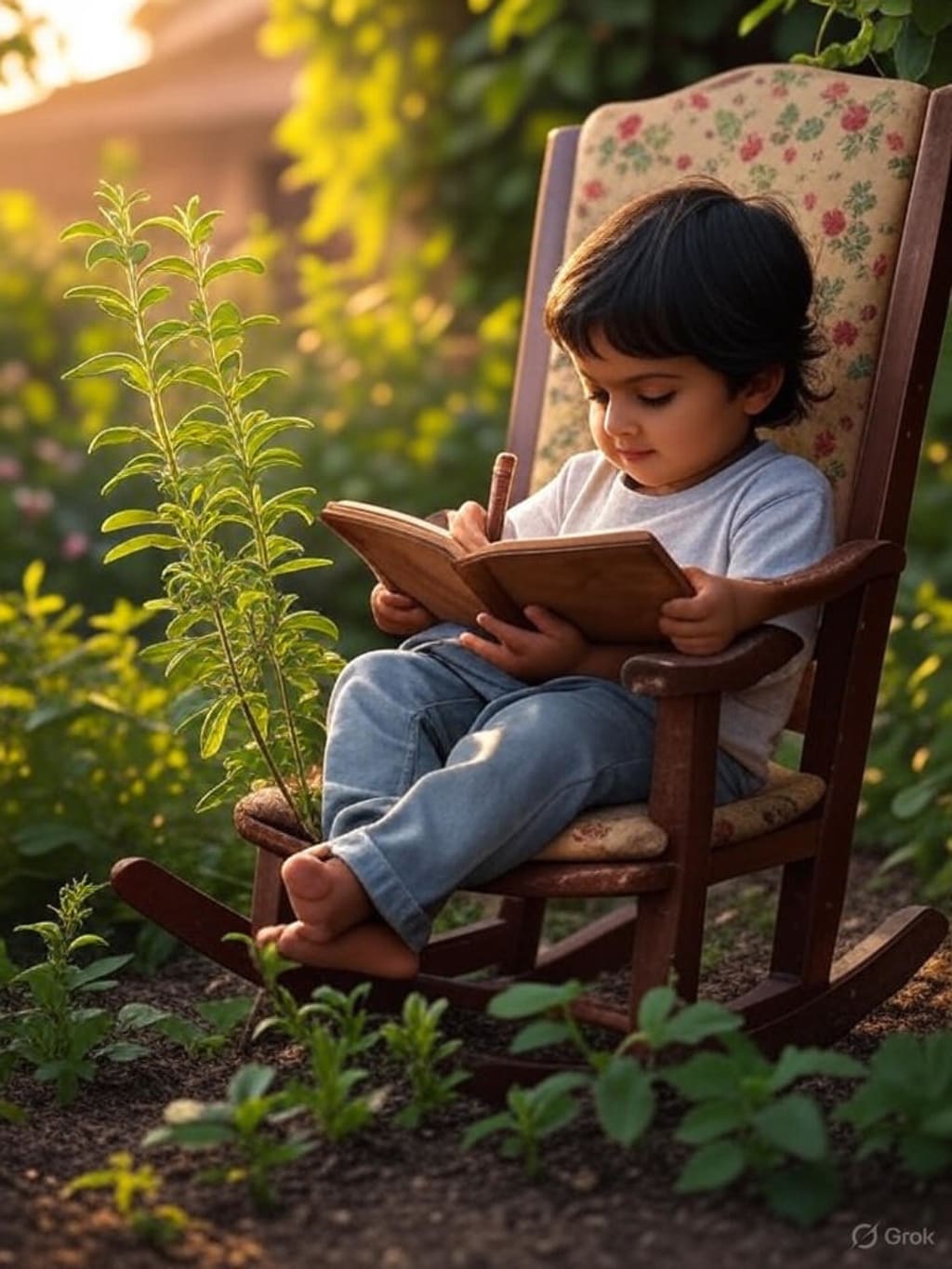
I was seven years old when I first felt I could do something special. Our home was a modest house in a quiet neighborhood of Kanpur, where the streets smelled of earth and the evenings carried the clink of teacups from rooftops. Behind the house was a small garden where my grandmother, Nani, tended to her beloved tulsi plant, talking to it as if it were an old friend. And there I was, sitting nearby, scribbling fragments of dreams in a little notebook—a tattered diary where Nani once kept track of her medicines. That diary was the beginning of my first “novel.”
Every evening, as the sun dipped below the horizon and the neighborhood kids wrapped up their games, I’d sit by Nani’s side. She’d sway gently in her old rocking chair, and I’d settle on the floor, clutching my diary, narrating my “stories” to her. My tales were childish—sometimes about a flying carpet that soared to the moon, sometimes about a lion who dreamed of ruling the jungle but was too afraid. Nani would laugh at times, but other times she’d listen intently, saying, “Oh, Sameer, this is a real story. Put a little more soul into it.” I didn’t quite understand what “soul” meant back then, but the sparkle in her eyes stayed with me.
One day, I wrote a story that felt different. It was about a boy who wrote a letter to his father but never sent it. My father worked long hours at a factory, often staying away from home. I wanted to tell him things from my heart, but I was afraid the words would sound childish. When Nani read that letter, she said, “These words come from the heart, Sameer. Words from the heart reach other hearts.” That night, she handed me an old fountain pen that once belonged to her father and said, “This is the magic of words. Keep it safe.”
With that pen, I began to write—stories, poems, and sometimes my little fears. After school, while my friends played cricket, I’d sit in the garden and let my thoughts spill onto the page. One day, my teacher, Mrs. Sharma, found my diary and chose one of my stories for the school magazine. Seeing my name in print felt like winning an Olympic medal. But the real joy came when Nani read it and hugged me tightly. There were tears in her eyes as she said, “You’ve made my words come true.”
Time passed, and life changed. Nani’s garden grew quiet after she left us. I grew up, went to college, and landed a corporate job. The diary and pen were tucked away in a drawer, forgotten. But one day, while rummaging through old things in the attic of my family home, I found that diary. Its pages had yellowed, but the words were still alive. For a moment, I was that seven-year-old Sameer again, scribbling dreams under Nani’s watchful gaze.
That night, I opened my laptop and started a new story. It was about a boy who learns from his grandmother that words can bridge hearts. I posted it on Vocal, and a few days later, a reader left a comment: “This feels like my own story.” That’s when I realized Nani was right—words have a soul, and that soul can touch someone’s heart.
Today, when I write, I hear Nani’s voice. The creak of her rocking chair, the scent of the tulsi plant, the weight of that old fountain pen—they all live in my stories. With every word, I thank her for teaching me that a story isn’t just written; it’s lived.
About the Creator
7 Contemporary Romance Books Everyone Should Read In 2026
Love is timeless, but the stories we tell about it evolve with the world around us. Contemporary romance captures the pulse of modern relationships, blending passion, humor, and emotional depth with the realities of our everyday lives. Unlike classic romance, contemporary tales often tackle themes like career challenges, cultural differences, mental health, and personal growth—making them both relatable and inspiring. In a world where connection is increasingly digital, these books remind us of the beauty of vulnerability, the excitement of chemistry, and the transformative power of love.
By Diana Meresc5 days ago in BookClub



Comments
There are no comments for this story
Be the first to respond and start the conversation.