
The Bomber Mafia Review
A Tale of Skyborne Dreams and Firelit Realities
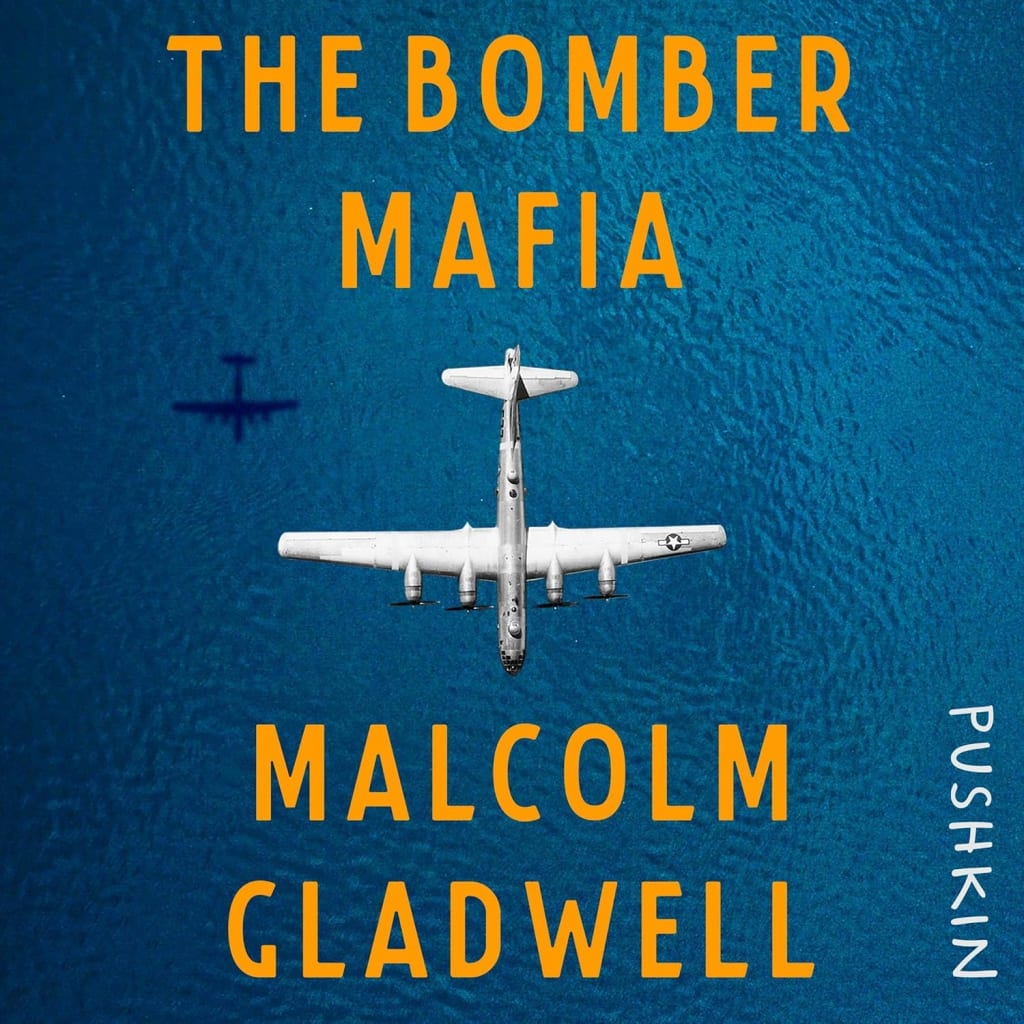
Imagine the weight of a January dawn in 1945, the air thick with salt and the hum of engines on the Mariana Islands. General Haywood Hansell stood there, his chest hollowed out by a quiet ache, watching his command slip through his fingers like sand. General Curtis LeMay stepped into his place, a man carved from steel and certainty, ushering in a shift that still echoes through the corridors of history. This moment—raw, unspoken—anchors Malcolm Gladwell’s The Bomber Mafia: A Dream, a Temptation, and the Longest Night of the Second World War. Published in 2021, this nonfiction tapestry, born from Gladwell’s Revisionist History podcast, unravels the tangled threads of ideology, technology, and morality that defined aerial warfare during World War II.
Gladwell, a storyteller with a knack for peeling back the skin of the past—think The Tipping Point or Outliers—dives into this narrative with the finesse of a seasoned New Yorker scribe. Named one of Time’s 100 Most Influential People, he doesn’t just recount history; he breathes into it, letting the dust of decades swirl around you. Here, the clash isn’t just between nations but between visions: one dreaming of precision, the other surrendering to fire.
Click here to get the audiobook for free
The Dawn of a Vision
Picture Carl Norden, a Dutch immigrant hunched over a Swiss kitchen table, his mind a storm of equations. A solitary genius, he shunned sunlight—claiming it dulled the intellect—and wore hats wide enough to cast shadows over his thoughts. His creation, the Norden bombsight, was no mere gadget; it was a 55-pound promise, an analog brain perched on a gyroscope, whispering of a future where bombs could kiss their targets with surgical grace. Sixty-four algorithms danced within it, wrestling with wind, altitude, and the Earth’s restless spin. Norden didn’t scribble notes; he saw the world in his head, a kaleidoscope of numbers and trajectories. His dream? To end the chaos of war with a pinpoint strike, sparing the innocent from the slaughter of the Somme.
Across the ocean, in Alabama’s humid embrace, the Air Corps Tactical School buzzed with restless pilots. They called themselves the Bomber Mafia, their motto a defiant chant: Proficimus more irretenti—“We push forward, unshackled by the old ways.” Young and brash, they saw the sky as a canvas for revolution. Bombers, they insisted, would always pierce the enemy’s veil—daylight their ally, precision their creed. High above, untouchable, they’d strike choke points—factories, bridges—and choke the life from war machines without soaking the earth in blood. A 1936 flood in Pittsburgh, swallowing aviation plants in its muddy jaws, lit the spark: hit the right spot, and the beast collapses. By 1939, their gospel reached Washington, a whisper of hope as war loomed.
The Fracture of Ideals
Fast forward to 1943, the Casablanca conference, a crucible of clashing wills. Winston Churchill, his voice gravelly with cigar smoke, leaned on Franklin Roosevelt, urging a shift to Britain’s nocturnal barrages—blankets of bombs to smother German resolve. The RAF cared little for Norden’s delicate toy; they craved the roar of firestorms, the shudder of cities undone. Gladwell lingers here, noting the bitter twist: Londoners had endured the Blitz, their spirits forged in defiance, yet Churchill wagered the same terror would break Berlin. Frederick Lindemann, a physicist with a cold eye, fed this hunger, twisting data to sanctify ruin. Arthur Harris, RAF Bomber Command’s iron fist, grinned as he unleashed it.
But Ira Eaker, a Bomber Mafia disciple, wouldn’t bend. Summoned to Casablanca, he faced Churchill’s glare and argued for daylight’s clarity—American bombers carving precise wounds while the RAF pounded by night. A relentless rhythm, no pause for breath. Churchill relented, and Eaker tapped Hansell to prove the dream. Hansell, a Southern son of soldiers, carried a poet’s soul—Gilbert and Sullivan’s whimsy in his heart, Don Quixote’s quixotic fire in his veins. He targeted Schweinfurt’s ball-bearing plants, Germany’s industrial pulse, plotting a feint with LeMay at Regensburg to scatter the Luftwaffe. LeMay, all blunt edges and Ohio grit, honed bomber formations into tight fists, demanding straight runs through flak—accuracy over survival. He flew the missions himself, proving it worked.
Yet the sky betrayed them. Fog cloaked the runways, the Norden bombsight faltered—friction at frigid heights, clouds like a blindfold. Schweinfurt bled: 60 bombers lost, 650 souls gone, a scant 5% of bombs on target. A second raid fared little better, and the U.S. buckled, sliding into Britain’s blunt embrace. Hansell watched, his gut twisting, as Münster’s civilians fell under American bombs—a church emptying into death. LeMay, unmoved, later hung murals of those missions in his home, a silent requiem.
The Pacific’s Inferno
By 1944, the Mariana Islands simmered under a relentless sun, mosquitoes a whining plague. The B-29 Superfortress, a winged titan, stretched its 3,000-mile reach to Japan—barely. Hansell, now leading the 21st Bomber Command, wrestled with overheating engines and runways too short for burdened beasts. LeMay, meanwhile, perched in India, flew over the Himalayas’ jagged teeth—“the Hump”—to Chengdu, burning 12 gallons of fuel for every one delivered. Absurdity shadowed both, but Hansell clung to his Norden, aiming for Tokyo’s Nakajima plant. Then came the jet stream, a howling ghost at 30,000 feet, scattering bombs like leaves. Precision dissolved, and Hansell’s faith trembled.
Enter napalm, born in Harvard’s labs—a sticky, relentless blaze conjured by Louis Fieser and E. B. Hershberg. Tested in Utah’s mock villages, it devoured wood and hope alike. For the Bomber Mafia, it was heresy, a devil’s brew. Hansell, ordered to firebomb Nagoya, dipped a toe in—half-hearted, sparing the city’s heart. His superiors saw weakness; LeMay saw opportunity. In January 1945, command shifted, and LeMay tore the playbook apart. Down he went, 5,000 feet, night cloaking his B-29s, napalm dripping from their bellies. Crews muttered of madness, but LeMay’s stare silenced them. On March 9, 1945, Tokyo burned—1,665 tons of fire, 16 square miles of ash, 100,000 lives snuffed in a night. The longest night, Gladwell calls it, a requiem for precision’s ghost.
The Reckoning
LeMay pressed on, cities crumbling even after Hiroshima’s flash. He claimed the atomic bombs were overkill—his fire had already won. Henry Stimson, war’s weary overseer, toured the wreckage, his breath catching at the scale. Gladwell weighs the scales: LeMay’s brutality may have spared an invasion’s carnage, a blockade’s slow starvation. Japan surrendered in August, aid staving off famine. Yet the question lingers, heavy as smoke: Was it worth it? LeMay, the pragmatist, saw lives as numbers; Hansell, the dreamer, saw souls.
In the end, Gladwell sits with modern generals, their voices crisp with pride. Today’s B-2 bombers slip through skies unseen, bombs threading through windows—a Norden reborn. LeMay won the fight, his fire forging peace. But Hansell? Hansell won the war, his stubborn dream threading through time to shape a future where war might—just might—spare the innocent.
The Human Pulse
Norden, Hansell, LeMay—they’re more than names. Norden, a recluse in oversized hats, built a tool to save lives, only to see it drop annihilation on Hiroshima. Hansell, opera humming in his throat, chased a knight’s honor, losing his command but planting a seed. LeMay, chewing cigars, turned war into math—ugly, effective math. Gladwell doesn’t judge; he holds them up, flawed and human, against the sky’s vast canvas.
This is a story of belief—of clinging to it when the world cracks open, of bending it when survival demands. It’s the hiss of napalm, the whir of a bombsight, the silence after a city falls. Technology promises salvation, then delivers damnation. Morality twists in the heat of necessity. And somewhere, amid the wreckage, a dream endures—imperfect, battered, but alive. That’s the Bomber Mafia’s legacy, pulsing still, like a heartbeat beneath the ash.
Summary and study guide
Click here to get A complete chapter-by-chapter summary and study guide of Malcolm Gladwell´s book The Bomber Mafia.
About the Creator
Francisco Navarro
A passionate reader with a deep love for science and technology. I am captivated by the intricate mechanisms of the natural world and the endless possibilities that technological advancements offer.
Keep reading
More stories from Francisco Navarro and writers in BookClub and other communities.
The Crash Review by Freida McFadden
Freida McFadden, the maestro behind pulse-quickening yarns like The Housemaid and The Locked Door, steps back into the fray with The Crash. This isn’t just a story—it’s a shivering, snow-crusted plunge into survival’s raw edges, a meditation on motherhood’s fierce grip, and a shadowed dance with the hungers that gnaw at the soul. Picture a blizzard howling outside, its icy fingers clawing at the windows, while inside, the air thickens with secrets. That’s where The Crash lives. It’s a jagged little gem in McFadden’s crown—not flawless, mind you, but bristling with enough twists to keep your breath hitching, your fingers flipping pages past midnight.
By Francisco Navarro12 months ago in BookClub
Rachel Reviews: Lakefront Wolves by Joseph Deegan
Meet Finn. He's an 18 year old kid who has potential. He's bright with great school scores and he's also an athlete, a footballer of some prowess. He has it all going for him, it would seem, and yet, he's determined to send what could be a well-planned, stable existence firmly off the rails. He drinks, he smokes, he takes drugs, he has violent tendencies and he's in danger of losing not only his mind but all that he holds dear.
By Rachel Deeming8 days ago in BookClub
7 Books to Find Clarity When You Are Lost in Life
Life can feel overwhelming at times. When you find yourself drifting without direction, struggling with decisions, or questioning your purpose, the right guidance can illuminate your path. Books have a unique ability to provide perspective, awaken insight, and inspire action.
By Diana Meresc5 days ago in BookClub



Comments (1)
Great review! We shall see how it all turns out!