Fiction
Forty Rules of Love by Elif Shafak
Today I am going to write a comprehensive review about the wrting of Turkish author named Elif Shafak. She is the author of the 2009 publication forty rules of love. The basted of Istanbul, The architect's Apprentice, and the forty rules of love are just a few of her masterpieces. Ella, Rumi, Shams of Tabraiz, Kimiya (Rumi's adoptive daughter and student), Kierra (Rumi's wife who converted to Islam and was the Rumi's second wife), Sultan Walad and Aladin (Rumi's sons), Desert Rose, Suleiman, Baybras, and A aziz are the 10 characters in the novel. Zahra. Every chapter is told from the perspective of the characters.
By Mariam Jabeen2 years ago in BookClub
What do you think of the book "In Sheep's clothing"?
Dr. George K. Simon's book "In Sheep's Clothing: Understanding and Dealing with Manipulative People" is a groundbreaking exploration into the realm of manipulative behavior and the tactics used by individuals who disguise their true intentions beneath a facade of innocence. Published in 1996, the book has garnered significant attention for shedding light on a crucial aspect of human interaction that often goes unnoticed. Through a comprehensive analysis of manipulative behavior, Simon provides readers with invaluable insights and practical strategies for recognizing and confronting manipulators in various aspects of life.
By Word Weaver 2 years ago in BookClub
Glimpses of Grandeur and Illusion: Exploring "The Great Gatsby" by F. Scott Fitzgerald
F. Scott Fitzgerald's "The Great Gatsby" stands as a testament to the Roaring Twenties and the glittering allure of the American Dream. Published in 1925, this iconic novel has resonated with readers across generations, capturing the essence of an era while offering a profound commentary on human ambition, wealth, and the fragile nature of illusions.
By Word Weaver 2 years ago in BookClub
Shadows of Deceit: Unraveling the Canvas of Crime
Part 1: The Gallery Heist Rain pelted against the city's pavement, a relentless downpour that seemed to wash the urban landscape clean of its sins. Detective Alex Reynolds stood beneath the awning of a coffee shop across the street from the Cordova Art Gallery. The neon glow of the city was subdued in the evening's mist, casting an eerie ambiance over the scene. His trench coat flapped lightly in the wind, and his eyes, sharp as flint, were fixed on the gallery's entrance.
By Word Weaver 2 years ago in BookClub
The Books That Moved Me (Vol.1)
I, like most writers, have read a lot of books. But there are few five star reads in my back catalogue. Very rarely as both a reader and a book reviewer have I dished out the ultimate accolade. That's not to say that there aren't a lot of wonderful books out there, because there are. But to really earn a five star review, for me, it has to move me.
By Rachel Deeming2 years ago in BookClub
Trilogy of My life...
I have always loved to read. I have loved books since I learned to read. Reading allows me to be completely immersed in another world. When I am reading, I imagine the setting, the characters and the things they say and do. It is my favorite thing to do outside of writing. I will never forget a particular series of book that I read some years ago. I have actually read it again and listened to it on audiobook. It is a set of three books. The first one is God Don't Like Ugly. The second book is God STILL Don't Like Ugly. The last book is God Don't Play. The series focuses on a little black girl. The reader follows her through life across the three novels. The girl ends up fatherless and being raised by a struggling single mother. This is the first thing i can relate to here: being a struggling single mother. The father leaves the family because he falls in love with a white woman. Her race important because this was during the time that interracial couples were taboo, even outlawed in some places. The father is the breadwinner for the family. They were already poor with him working, so when he left, things got worse very fast.
By Latoya Giles 2 years ago in BookClub
Important Things: The Little Prince. Runner-Up in Book Club Challenge.
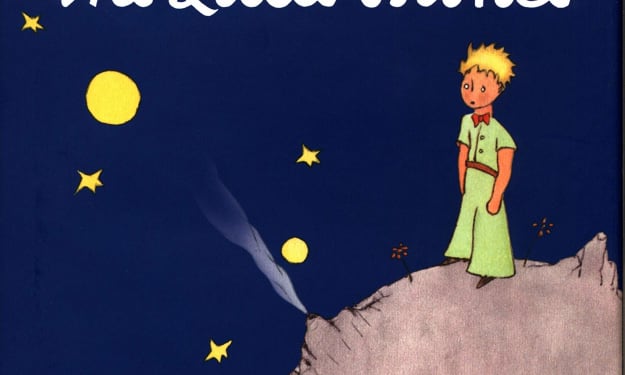
When you see this photo, what is it? Does it frighten you? To many people who are unfamiliar with The Little Prince by Antoine de Saint-Exupery, it looks like a hat. But this is no hat. This terrifying thing represents two things: the death of childhood curiosity and innocence and, more importantly, a boa constrictor so massive, that it can eat an entire elephant as shown below.
By Christopher Michael2 years ago in BookClub
Book Club: Frankenstein
I fought to defend Frankenstein’s creature as if my own life depended on it. This was during my first read in a high school literature class, before understanding that Max (as I preferred to call him, as he was unfairly unnamed) was essentially an incel and not completely innocent of blame.
By Elisabeth Balmon2 years ago in BookClub
Soul Sisters
My soul sister and I first met in 1988, and we’ve taken such journeys together. In my third year of university, I enrolled in American Literature 1850-1920. As a literature class of that caliber should, it covered authors such as Twain, Hawthorne, Melville, Faulkner, and Alger. One author I was unfamiliar with was Kate Chopin. We were assigned to read The Awakening.
By Barb Dukeman2 years ago in BookClub
The Chronicles of Narnia
Reposted for the new Book Club community. Warning: Very academic. Most scholarship centered around the Chronicles of Narnia focuses on the religious imagery C.S. Lewis utilized within his fairytale world. Christianity is undoubtably an important aspect of the Chronicles of Narnia; Aslan represents Jesus, Edmund represents Judas, and countless other religious allegories litter the series, but that is not all the series has to offer. In fact, whether intentional or not, Lewis wrote a compelling tale of the immigrant journey, particularly with the Pevensies. The four siblings are activists and provide a service to the Narnia, freeing them from the White Witch. However, they are deported from their true home, sent back to England. They eventually return, only to make the journey back to England because it is what is best for their people. They are forced to leave their kingdom in the hand of another king, a descendant of colonizers, though Narnia is where they feel they truly belong.
By C.M. Vazquez2 years ago in BookClub