
Summary: Hyperion by Dan Simmons
Hyperion by Dan Simmons is a seminal work of science fiction that has left an indelible mark on the genre since its publication in 1989. The novel is the first in the Hyperion Cantos series and is known for its richly layered narrative structure, deep philosophical questions, and complex characters.

Get Your Free Book Hyperion Here:
Hyperion by Dan Simmons
Hyperion by Dan Simmons is a seminal work of science fiction that has left an indelible mark on the genre since its publication in 1989. The novel is the first in the Hyperion Cantos series and is known for its richly layered narrative structure, deep philosophical questions, and complex characters. Set in a far-future universe on the brink of cataclysm, Hyperion draws heavily on the structure of Geoffrey Chaucer's The Canterbury Tales, with multiple characters recounting their stories as they journey towards a mysterious destination.
In this blog post, we will delve into a comprehensive summary of Hyperion, exploring its intricate plot, the compelling narratives of its characters, the overarching themes, and Simmons’s distinctive writing style. Whether you’re a seasoned science fiction reader or new to the genre, this summary will provide a deeper understanding of why Hyperion remains a cornerstone of speculative fiction.
Get Your Free Book Hyperion Here:
A Journey to the Time Tombs
Hyperion is set in a distant future where humanity has spread across the galaxy, forming the Hegemony of Man, a vast interstellar civilization connected by farcaster portals. The novel’s plot revolves around seven pilgrims who have been chosen to undertake a journey to the distant and mysterious planet of Hyperion. There, they seek answers from the Shrike, a fearsome and enigmatic entity that resides near the Time Tombs—ancient structures that are moving backward through time.
The pilgrims—each selected for reasons that only become clear as the story unfolds—include a Catholic priest, a soldier, a poet, a scholar, a detective, a diplomat, and a Templar. As they travel towards the Time Tombs, they each share their personal stories, revealing their connections to Hyperion, the Shrike, and the events that have shaped their lives. These stories form the core of the novel, each one offering a unique perspective on the universe and the mysteries of Hyperion.
Father Hoyt, the priest, tells the haunting story of his predecessor, Father Paul Duré, and his encounter with the Bikura, a strange and isolated tribe on Hyperion. Colonel Fedmahn Kassad, the soldier, recounts his experiences in the Hegemony's wars and his encounters with the Shrike in visions that blur the line between reality and fantasy. Martin Silenus, the poet, offers a tale of creative obsession and the price of artistic genius, while Sol Weintraub, the scholar, shares the tragic story of his daughter Rachel, who is aging backward in time due to a mysterious condition known as the Merlin sickness.
Detective Brawne Lamia tells a noir-tinged story of intrigue and betrayal, revealing her connection to a powerful artificial intelligence known as the TechnoCore. Consul, the diplomat, recounts the story of a love affair that spanned decades and was deeply intertwined with the fate of Hyperion. Finally, Het Masteen, the Templar, remains an enigma, his silence suggesting a story that is left untold—or perhaps too terrible to tell.
As the pilgrims share their stories, it becomes clear that their destinies are intertwined, and that their journey to Hyperion is about more than seeking answers—it is about confronting the mysteries and horrors that have shaped their lives and the fate of the galaxy itself. The novel ends on a cliffhanger, with the pilgrims reaching the Time Tombs and preparing to face the Shrike, leaving readers eager to learn what happens next.
Get Your Free Book Hyperion Here:
A Diverse Cast with Deeply Personal Stories
One of the defining features of Hyperion is its diverse cast of characters, each of whom brings a unique perspective and personal history to the story. The novel's structure allows each character to take center stage, providing readers with a deep and nuanced understanding of their motivations, fears, and desires.
Father Lenar Hoyt, the Catholic priest, is haunted by the story of Father Paul Duré, whose obsession with the Bikura leads to a horrific discovery. Hoyt’s story delves into themes of faith, suffering, and the quest for redemption, raising questions about the nature of belief and the existence of God in a universe where technology has seemingly made religion obsolete.
Colonel Fedmahn Kassad, the soldier, is a man of honor and duty, shaped by his experiences in the Hegemony's wars. His story explores the horrors of war, the nature of violence, and the thin line between reality and illusion. Kassad's encounters with the Shrike suggest that his fate is tied to forces beyond his control, adding a sense of inevitability and tragedy to his narrative.
Martin Silenus, the poet, is perhaps the most flamboyant and larger-than-life character in the novel. His story is one of artistic obsession, exploring the idea that creativity is both a gift and a curse. Silenus's tale is laced with dark humor and biting satire, offering a critique of art, culture, and the pursuit of immortality through one’s work.
Sol Weintraub, the scholar, presents a heartbreaking story of love, loss, and the passage of time. His daughter Rachel’s condition, which causes her to age backward, is both a personal tragedy and a symbol of the larger mysteries of time and existence that permeate the novel. Weintraub’s struggle to save his daughter raises profound questions about the nature of time, memory, and the human experience.
Detective Brawne Lamia’s story is a gripping tale of noir-inspired mystery, filled with twists and turns. Her investigation into the death of a powerful AI leads her into a conspiracy that reaches the highest levels of the TechnoCore, the collective of AIs that secretly controls much of the Hegemony. Lamia’s narrative explores themes of identity, consciousness, and the dangers of unchecked technological power.
The Consul, the diplomat, provides a story that is both deeply personal and politically charged. His tale of love and betrayal spans decades and is closely tied to the history of Hyperion and the Hegemony’s expansion. The Consul’s story raises questions about loyalty, the cost of progress, and the impact of colonialism on both individuals and civilizations.
Het Masteen, the Templar, remains a mysterious figure throughout the novel. His silence suggests that he carries secrets that are too dangerous to reveal, and his role in the story adds an element of uncertainty and tension to the pilgrims’ journey.
Each character in Hyperion is richly developed, with their own distinct voice, history, and perspective. Through their stories, Dan Simmons explores a wide range of themes and ideas, making Hyperion not just a science fiction novel, but a meditation on the human condition.
Get Your Free Book Hyperion Here:
Time, Religion, Technology, and the Human Experience
Hyperion is a novel that is as much about ideas as it is about characters and plot. Dan Simmons uses the framework of science fiction to explore a variety of themes that resonate on both a personal and cosmic level.
One of the central themes of Hyperion is time. The novel’s setting, with the Time Tombs moving backward through time, creates a sense of temporal dislocation that permeates the entire story. Each character's narrative is shaped by their relationship with time—whether it be Rachel's reverse aging, Kassad's visions of the future, or Silenus's quest for immortality through his art. Simmons uses time as both a narrative device and a philosophical concept, challenging readers to consider the nature of time and its impact on human existence.
Religion is another prominent theme in Hyperion. Through characters like Father Hoyt and Sol Weintraub, Simmons explores the role of faith in a technologically advanced society. The novel raises questions about the relevance of religion in a world where science and technology have seemingly provided all the answers, yet it also acknowledges the enduring power of belief and the human need for meaning in the face of suffering and death.
Technology, and its potential dangers, is a recurring theme in Hyperion. The TechnoCore, the collective of AIs that plays a central role in the story, represents the pinnacle of technological achievement, but also a source of existential threat. Simmons explores the implications of advanced technology on identity, consciousness, and freedom, raising questions about the limits of human control and the potential for technology to surpass its creators.
The human experience, in all its complexity, is at the heart of Hyperion. Each character's story is a reflection on different aspects of what it means to be human—whether it be the pursuit of knowledge, the search for love, the struggle for survival, or the desire for redemption. Simmons's exploration of these themes adds depth and resonance to the novel, making it a rich and thought-provoking read.
Hyperion is not just a science fiction epic; it is a novel that grapples with fundamental questions about time, existence, faith, and the human condition. Through its exploration of these themes, Simmons invites readers to reflect on their own lives and the world around them, making Hyperion a work that lingers in the mind long after the final page is turned.
Get Your Free Book Hyperion Here:
A Blend of Literary and Speculative Fiction
Dan Simmons's writing style in Hyperion is a masterful blend of literary and speculative fiction. The novel’s structure, inspired by The Canterbury Tales, allows Simmons to experiment with different narrative voices and styles, each tailored to the character telling the story. This approach gives Hyperion a rich and varied texture, making it feel like a collection of short stories that together form a cohesive and powerful narrative.
Simmons’s prose is both elegant and accessible, with a lyrical quality that enhances the novel’s more introspective and philosophical passages. His descriptions of the far-future universe are vivid and imaginative, yet grounded in a sense of reality that makes the world of Hyperion feel both familiar and alien.
One of the strengths of Simmons’s writing is his ability to balance complex ideas with compelling storytelling. While Hyperion is filled with deep philosophical questions and speculative concepts, it is also a gripping and emotionally resonant story that keeps readers engaged from beginning to end.
In Hyperion, Simmons has created a work that transcends the boundaries of genre, combining the best elements of science fiction, fantasy, and literary fiction. His writing is both thought-provoking and entertaining, making Hyperion a novel that appeals to a wide range of readers.
Get Your Free Book Hyperion Here:
Conclusion: A Science Fiction Masterpiece
Hyperion by Dan Simmons is a masterpiece of science fiction, a novel that combines a richly layered narrative, complex characters, and profound themes into a work that is both epic in scope and deeply personal. Through the stories of the seven pilgrims, Simmons explores questions of time, faith, technology, and the human experience, creating a novel that is as thought-provoking as it is engaging.
About the Creator
Marcos Martins da silva
Unlock the power of reading with book summaries across all genres. Discover how great your next read can be.
Keep reading
More stories from Marcos Martins da silva and writers in BookClub and other communities.
Summary: The Name of the Wind by Patrick Rothfuss
Get Your Free Book The Name of the Wind Here: Summary: The Name of the Wind by Patrick Rothfuss The Name of the Wind by Patrick Rothfuss is a fantasy novel that has captivated readers since its publication in 2007. As the first book in The Kingkiller Chronicle series, it introduces readers to the world of Temerant and the extraordinary life of Kvothe, a legendary figure whose name is spoken in whispers. The novel combines lyrical prose with a deeply personal narrative, drawing readers into a richly imagined world filled with magic, mystery, and music.
By Marcos Martins da silvaabout a year ago in BookClub
Rachel Reviews: The Spiral Archive by Pieter Hendrik
It's difficult for me to know where to start with a review of this book as it was, for me, an entirely unique experience and one that I'll probably never have again. I don't want that to be interpreted as unenjoyable but it has left me scratching my head a little and ruminating on its content, its themes and its characters.
By Rachel Deeming7 days ago in BookClub
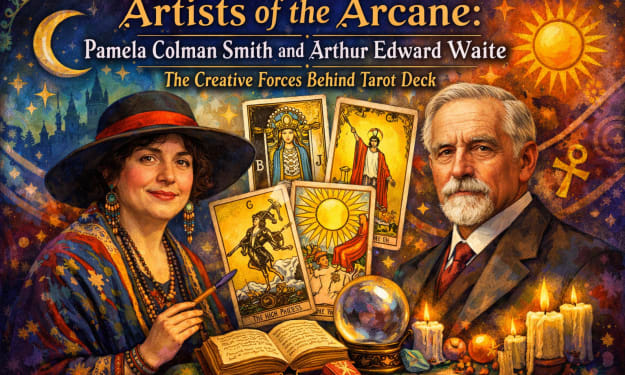
Artists of the Arcane: Pamela Colman Smith and Arthur Edward Waite
The Visionaries Behind the Rider‑Waite Tarot Few artistic and mystical collaborations in history have left a mark as profound as the partnership between Pamela Colman Smith and Arthur Edward Waite. The Rider‑Waite Tarot deck, first published in 1909, has become a cornerstone of modern tarot, its imagery instantly recognizable and widely studied. Unlike earlier decks, which often relied heavily on abstract symbolism or esoteric shorthand, this deck transformed tarot into a narrative and visual experience accessible to both practitioners and casual observers. Every card is infused with intentional symbolism, storytelling, and emotional resonance, reflecting a fusion of artistic skill and mystical scholarship rarely achieved in a single work.
By Marcus Hedare5 days ago in BookClub



Comments
There are no comments for this story
Be the first to respond and start the conversation.