
Sophie’s World: A Journey That Redefines Reality
Where Philosophy Becomes an Adventure

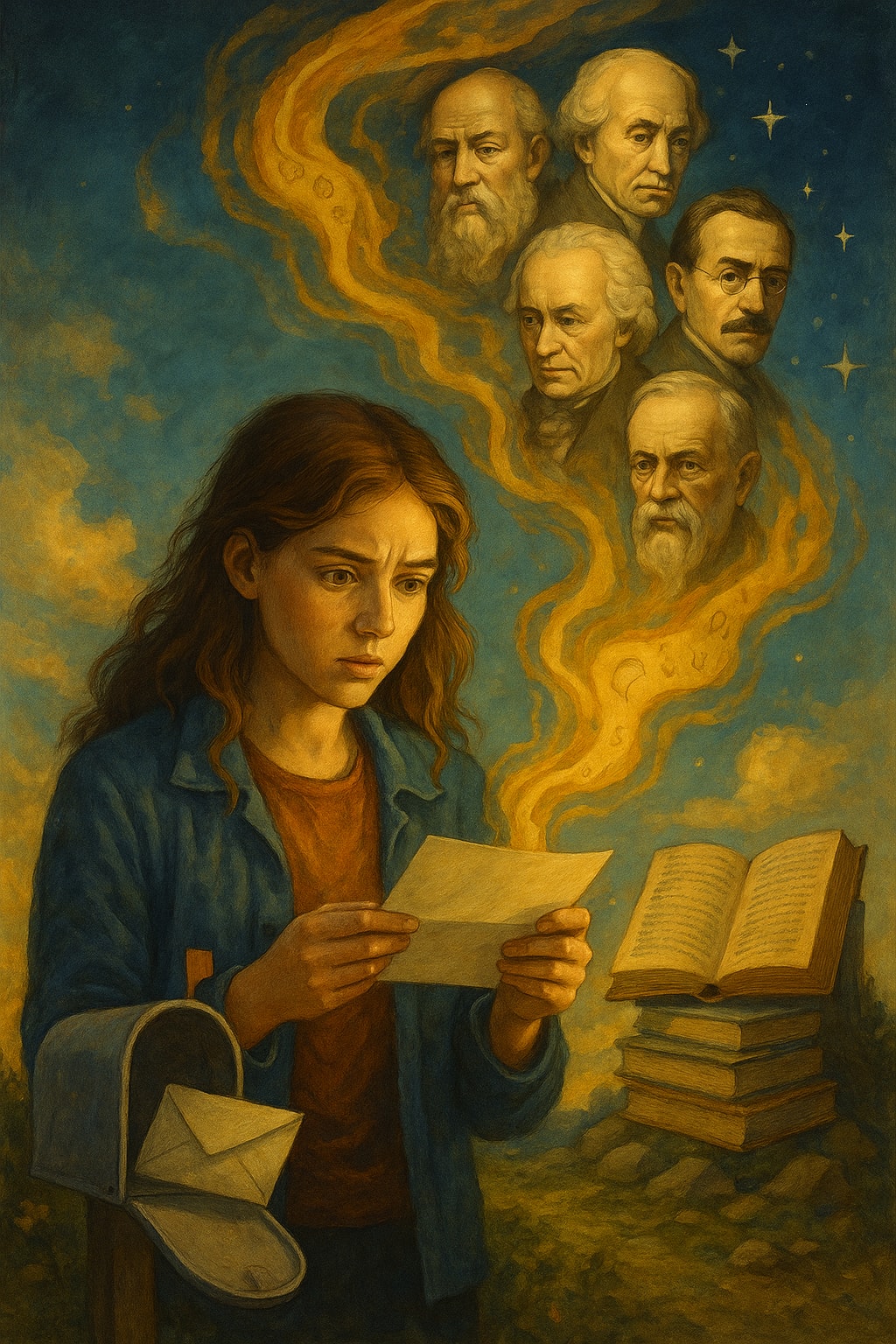
What if a simple letter in your mailbox could unravel the mysteries of existence? What if the history of human thought wasn’t confined to textbooks but played out in a thrilling story filled with riddles, revelations, and philosophical twists? Sophie’s World by Jostein Gaarder is not just a novel—it’s a literary portal into the heart of philosophy, disguised as a coming-of-age mystery. First published in 1991, the book has captivated millions of readers around the globe with one deceptively simple question: Who are you?
At its core, Sophie’s World tells the story of Sophie Amundsen, a 14-year-old girl living in Norway, who begins receiving mysterious letters that challenge everything she knows about life, reality, and herself. As Sophie is drawn into an anonymous philosophy course via these letters, her world begins to shift. Through vivid lessons, she meets the great thinkers of history—from Socrates and Plato to Kant, Marx, Darwin, and Freud—not as abstract names, but as personalities who changed how humanity sees the world. But the deeper she goes, the stranger things become. She begins to suspect that her reality might not be entirely real. The result is a mind-bending fusion of fiction and philosophy, like a philosophical version of The Matrix.
One of the most powerful aspects of the book is how it makes complex ideas accessible. Gaarder doesn’t water down philosophy; he brings it to life. In short, engaging chapters, readers discover how each philosopher contributed to humanity’s quest for meaning. Whether it’s Aristotle’s classifications, Descartes’ doubt, or Sartre’s existentialism, the ideas are introduced in ways that are both understandable and deeply thought-provoking. The narrative structure allows these teachings to land with emotional weight, as Sophie herself wrestles with the same questions. This emotional connection is what makes the book more than just an intellectual exercise—it becomes a mirror for the reader’s own inner dialogue.
Equally fascinating is the metafictional twist. Without spoiling too much, Sophie’s World turns into a story about stories, reality within reality, questioning not only the nature of the universe but the nature of fiction itself. As Sophie begins to realize she might be part of someone else’s narrative, the book forces readers to confront the limits of their own perception. Are we truly free? Or are we shaped by narratives—cultural, religious, political—that we rarely stop to question? It’s a brilliant device that transforms the act of reading into a philosophical experiment in itself.
What sets Sophie’s World apart is its ability to ignite curiosity. It doesn’t try to convert readers to a particular viewpoint. Instead, it invites them to wonder, to question, to dig deeper. It’s a book that both educates and entertains, reminding us that philosophy isn’t just for academics—it’s for anyone who’s ever looked up at the stars and asked, Why?
Sophie’s World is more than a novel—it’s an awakening. It shows that philosophy isn’t a dry subject but a living, breathing exploration of what it means to be human. By the end, readers aren’t just more knowledgeable—they’re more awake. Gaarder masterfully transforms the abstract into the unforgettable, proving that philosophy is not about having the right answers, but about asking the right questions. And in a world saturated with noise, that kind of inquiry has never been more necessary.
About the Creator
Bubble Chill Media
Bubble Chill Media for all things digital, reading, board games, gaming, travel, art, and culture. Our articles share all our ideas, reflections, and creative experiences. Stay Chill in a connected world. We wish you all a good read.
Keep reading
More stories from Bubble Chill Media and writers in BookClub and other communities.
Voltaire’s Double Punch
What if the most powerful critiques of society came not from lectures or revolutions, but from biting wit hidden in short, fictional tales? Voltaire’s Candide and Zadig might seem like simple stories at first glance—adventures full of absurdity and misfortune—but behind the satire lies a depth that continues to echo through centuries. Why do these two works, written in the 18th century, still resonate today? Because they strip humanity bare with humor, irony, and uncomfortable truths. Voltaire doesn’t just make you laugh—he makes you think, sometimes without you even realizing it.
By Bubble Chill Media 7 months ago in BookClub
Valentine in Montréal
Don't be fooled by the title. The story is actually very interesting: My name is Valentine. I am twenty-three years old and I work at a little store at Berri-UQAM métro. I am very ordinary-looking and Barney, who works the same shift as me at the store, says I do not know how to dress. I have been working there for four years, and I have never missed a day. This is why sometimes I seem familiar to people, even though they can't place me.
By Kendall Defoe 3 days ago in BookClub



Comments
There are no comments for this story
Be the first to respond and start the conversation.