
Self-Publishing Advice
Avoiding Common Editing Pitfalls

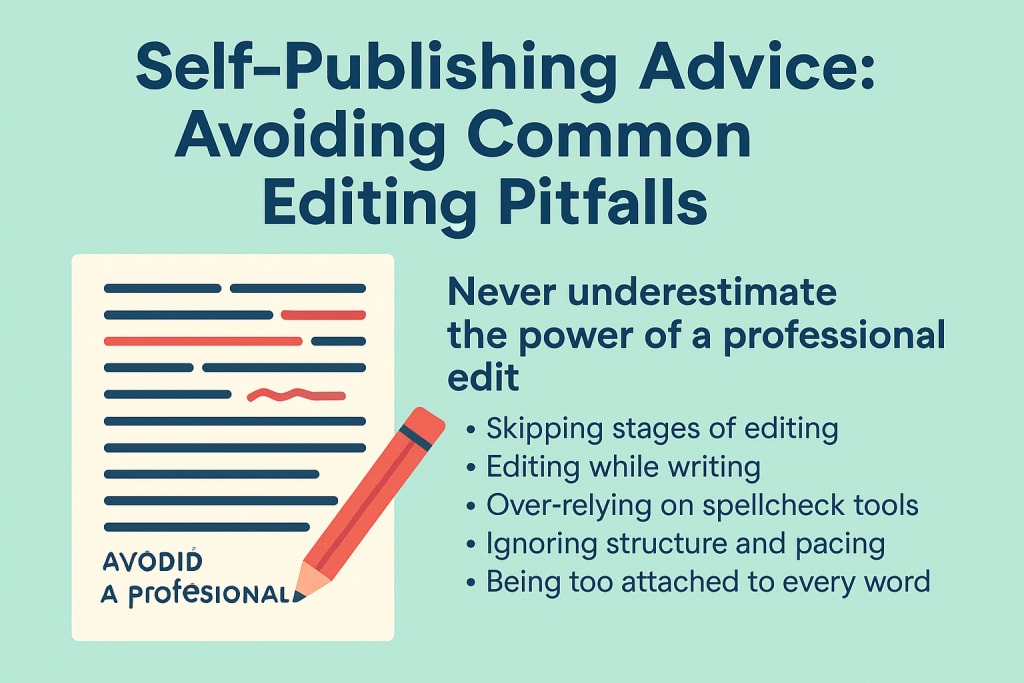
Self-publishing has given authors unprecedented control over their work, but with that freedom comes responsibility—especially when it comes to editing. A well-written book can still fail if it's riddled with grammatical errors, inconsistencies, or poor structure. Whether you're a debut author or a seasoned writer, here are some common editing pitfalls to avoid—and how to sidestep them.
1. Skipping the Editing Process Entirely
One of the biggest mistakes self-published authors make is thinking they can skip editing altogether. Even if you’re confident in your writing skills, your eyes will eventually gloss over mistakes. Always plan for at least one round of professional editing, ideally after self-revision.
Solution: Budget time and money for editing early in your publishing plan. At minimum, hire a professional for a line or copy edit.
2. Overediting and Losing Your Voice
In the effort to perfect every sentence, some authors overedit their work, stripping away the natural tone and rhythm that makes it unique.
Solution: Be clear on your voice and purpose. Work with editors who aim to enhance—not replace—your style. Ask for sample edits to see how they handle your manuscript.
3. Neglecting Different Types of Editing
Many authors assume editing is just about catching typos. In reality, good editing involves multiple layers—developmental, line, copy, and proofreading—each serving a different purpose.
Solution: Understand the four key editing stages:
Developmental Editing: Big-picture story structure, pacing, character arcs.
Line Editing: Flow, clarity, tone, sentence structure.
Copy Editing: Grammar, punctuation, word usage.
Proofreading: Final error check before publishing.
4. Not Fact-Checking or Verifying Details
Inaccurate facts, misused terms, or cultural inconsistencies can break reader trust and credibility.
Solution: Double-check names, places, historical details, and dialogue if it reflects specific dialects or professions. Consider a sensitivity reader if your work includes diverse perspectives.
5. Editing as You Write
While light self-editing during the writing process can help, obsessively polishing paragraphs as you draft can hinder your creative flow.
Solution: Separate your writing and editing phases. Focus on getting the first draft done—then switch gears to edit with fresh eyes.
6. Ignoring Beta Reader Feedback
Many self-published authors underestimate the value of beta readers. While they’re not editors, their feedback can point out story issues you might miss.
Solution: Share your manuscript with trusted beta readers before final edits. Look for patterns in their feedback and revise accordingly.
Final Thoughts
Great editing is invisible—it lets the reader focus entirely on your story. By avoiding these common pitfalls and embracing the editing process as a vital part of publishing, you’ll elevate the quality of your book and enhance your credibility as an author.
Remember: A well-edited book isn't just cleaner—it's more engaging, professional, and market-ready.
About the Creator
Prime Publishing Studio
We are one of the top-class agencies for all your publishing requirements. We have helped many authors become successful. Our highly qualified staff can provide a multitude of services that range from editing to book marketing.
Keep reading
More stories from Prime Publishing Studio and writers in BookClub and other communities.
📖 Your Book Deserves a Cover That Shines
Let’s be real—readers do judge a book by its cover. It’s the first thing they see, the spark that makes them pause and think, “Ooh, this looks good!” A great cover isn’t just pretty; it’s your book’s chance to stand out, tell its story, and invite readers in. At Prime Publishing Studio, we get how much that matters, and we’re here to create a cover that makes your book impossible to ignore.
By Prime Publishing Studio11 months ago in BookClub
Rachel Reviews: Lakefront Wolves by Joseph Deegan
Meet Finn. He's an 18 year old kid who has potential. He's bright with great school scores and he's also an athlete, a footballer of some prowess. He has it all going for him, it would seem, and yet, he's determined to send what could be a well-planned, stable existence firmly off the rails. He drinks, he smokes, he takes drugs, he has violent tendencies and he's in danger of losing not only his mind but all that he holds dear.
By Rachel Deeming4 days ago in BookClub
I Reread Life of Pi—And Discovered a Lifehack for Survival, Resilience, and Unlocking Inner Strength
When I first read Life of Pi by Yann Martel, I was captivated by the story of Pi Patel, a young boy stranded on a lifeboat in the Pacific Ocean with a Bengal tiger. At first, it seemed like an incredible tale of survival and adventure. Revisiting it with a focus on personal growth, I realized that hidden within the narrative is a lifehack: the novel provides lessons on resilience, resourcefulness, mental focus, and emotional strength that can be applied to life challenges, personal development, and navigating uncertainty.
By Lukáš Hrdlička7 days ago in BookClub
Tatt~Master
— Assembly Line Tatt Machine ~ Impressions to Impress — As I begin to understand more about the Tattoo Phenomenon. I've written silly, yet verbatim, dating site anecdotes in 'Frazzled.' So let me ask you: Would you be More attracted to someone slathered with tattoos, or Less?
By Jay Kantor5 days ago in Humor


Comments
There are no comments for this story
Be the first to respond and start the conversation.