
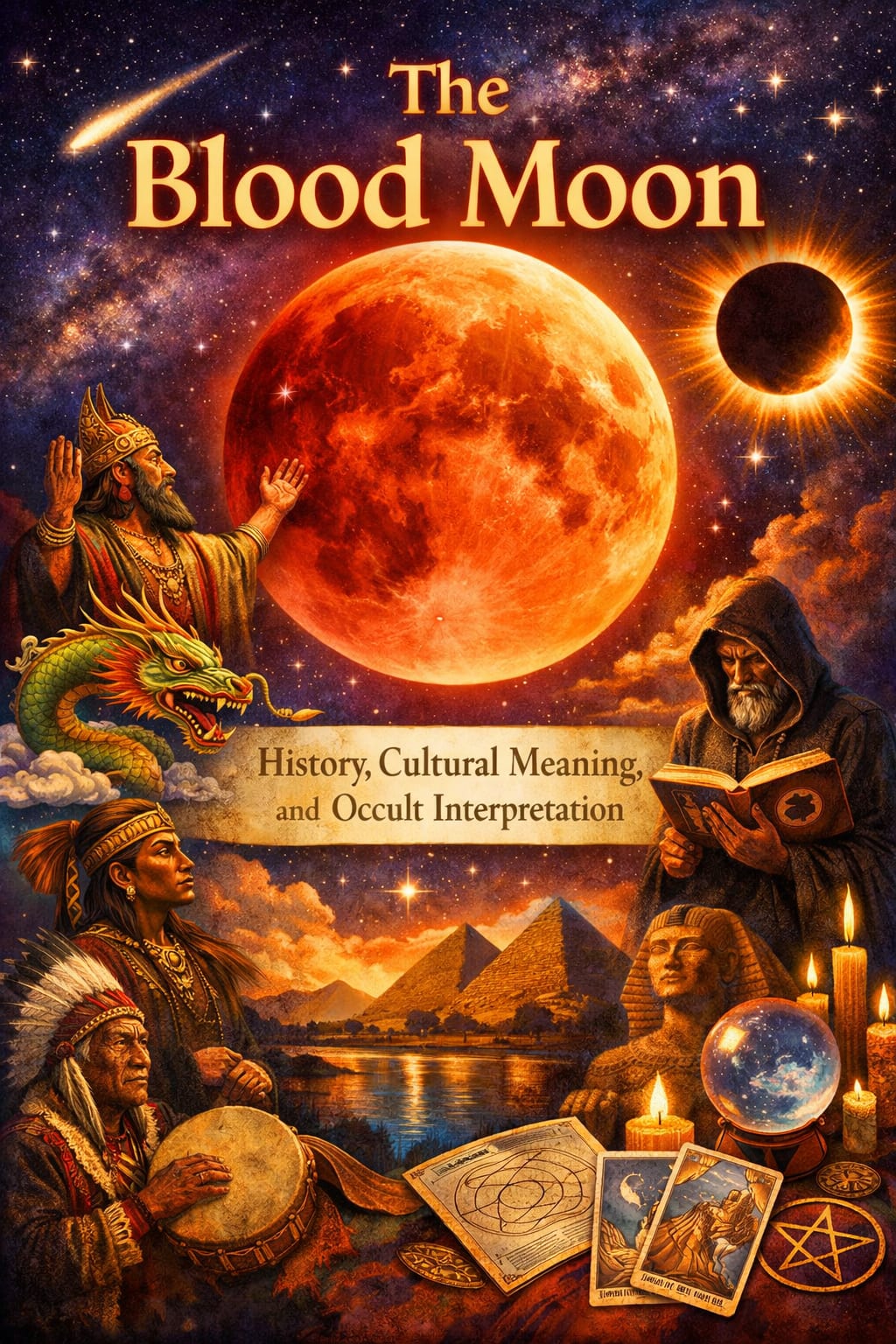
The Blood Moon
History, Cultural Meaning, and Occult Interpretation

When the Moon Turns Red
For millennia, the sudden darkening of the full Moon has stirred awe, fear, reverence, and speculation. A total lunar eclipse transforms a familiar celestial body into something uncanny, as Earth’s shadow slowly overtakes the lunar surface and replaces silver light with deep copper and crimson tones. This phenomenon, commonly called the Blood Moon, occurs through a precise interaction of orbital mechanics and atmospheric physics. Sunlight passing through Earth’s atmosphere bends and scatters, filtering out shorter wavelengths and allowing red and orange light to reach the Moon. The result is neither illusion nor omen, but a predictable yet visually arresting event grounded in natural law.
Despite its scientific explanation, the Blood Moon has never existed solely within the realm of astronomy. Long before telescopes and mathematical models, ancient skywatchers recorded eclipses with meticulous care, often linking the reddened Moon to terrestrial affairs, divine displeasure, or moments of transition. Clay tablets from Mesopotamia, imperial records from China, and oral traditions from the Americas reveal a shared human impulse to interpret the altered Moon as meaningful. In many cultures, a red Moon was associated with blood, sacrifice, warfare, or the disruption of cosmic order. These interpretations shaped ritual behavior, political decisions, and religious observance across centuries.
In the modern era, the Blood Moon continues to occupy a unique space between science and symbolism. Advances in astronomy have clarified the mechanics of lunar eclipses with extraordinary precision, yet cultural and esoteric interpretations persist. Contemporary occult traditions often regard the Blood Moon as a liminal moment, one marked by heightened intensity and symbolic potency. Religious movements, mythic revivals, and popular media have further reinforced its resonance, ensuring that the sight of a darkened red Moon still carries emotional and symbolic weight. The Blood Moon stands as a reminder that celestial events do not exist in isolation, but are continually shaped by human perception, belief, and historical memory.
Scientific Overview
Definition and Mechanics
The term Blood Moon is most commonly used to describe a total lunar eclipse, an astronomical event governed by predictable orbital mechanics. A total lunar eclipse occurs when Earth passes directly between the Sun and the Moon, causing the Moon to move fully into Earth’s umbral shadow. Unlike a solar eclipse, which is visible only from a narrow path on Earth, a lunar eclipse can be observed from any location on the night side of the planet where the Moon is above the horizon.
During this alignment, direct sunlight is blocked from reaching the lunar surface. Complete darkness does not occur because Earth’s atmosphere bends and refracts a portion of incoming sunlight toward the Moon. As sunlight passes through the atmosphere, shorter wavelengths such as blue and violet are scattered outward by gas molecules through a process known as Rayleigh scattering, the same mechanism responsible for blue daytime skies and red sunsets. Longer wavelengths such as red, orange, and deep amber are refracted more efficiently and continue along curved paths that intersect the Moon’s surface. This filtered light gives the eclipsed Moon its characteristic red or copper coloration.
The exact hue observed during a total lunar eclipse can vary significantly. Factors influencing color include atmospheric clarity, cloud cover, dust, volcanic ash, and pollution levels present in Earth’s atmosphere at the time of the eclipse. Following major volcanic eruptions, lunar eclipses often appear darker or more brownish due to increased particulate matter blocking refracted sunlight. Astronomers use the Danjon Scale to classify the brightness and color of total lunar eclipses, ranging from very dark eclipses where the Moon nearly disappears to bright copper or orange eclipses with high visibility. This scale provides observational consistency and reinforces the atmospheric dependency of the Blood Moon’s appearance.
Earth’s shadow during a lunar eclipse consists of two distinct regions. The penumbra is the outer shadow where sunlight is only partially blocked, producing subtle shading that can be difficult to detect with the unaided eye. The umbra is the central, darker shadow where direct sunlight is fully obstructed. A Blood Moon occurs only when the Moon enters the umbra completely. Partial and penumbral eclipses do not produce the red coloration commonly associated with the Blood Moon, though slight dimming or shading may still be visible.
From an astronomical standpoint, the phrase Blood Moon holds no formal classification. Professional literature and observatories universally refer to the event as a total lunar eclipse. The term Blood Moon exists within popular language and cultural discourse rather than scientific taxonomy. Its widespread usage reflects visual impact and symbolic resonance rather than observational necessity. Time and Date and other astronomical authorities consistently note that Blood Moon is a descriptive label rather than a technical designation, emphasizing that the phenomenon itself remains fully explained by established physical laws.
Unlike rare or unpredictable celestial events, total lunar eclipses follow well documented cycles. The most notable of these is the Saros cycle, approximately eighteen years, eleven days, and eight hours in length. Eclipses separated by one Saros cycle share similar geometric characteristics, allowing astronomers to predict eclipses thousands of years into the past and future. This predictability stands in stark contrast to the uncertainty and fear that historically surrounded eclipses, underscoring the evolution of human understanding without diminishing the visual and cultural power of the event.
The Blood Moon therefore represents an intersection of precision and spectacle. Orbital motion, atmospheric physics, and light scattering converge to produce a transformation that remains visually arresting despite complete scientific clarity. The red Moon rising from Earth’s shadow serves as a reminder that even fully understood phenomena can retain a sense of wonder rooted in scale, rarity, and the shared experience of watching the night sky change.
Types of Lunar Eclipses
A complete understanding of the Blood Moon depends on recognizing the distinct forms a lunar eclipse can take. Each type results from the Moon’s position relative to Earth’s shadow and produces markedly different visual effects. Astronomers classify lunar eclipses into three primary categories based on how deeply the Moon enters Earth’s shadow. These classifications are well established in observational astronomy and are documented by major scientific references, including astronomical observatories and academic literature.
Penumbral Lunar Eclipse
A penumbral lunar eclipse occurs when the Moon passes only through Earth’s outer shadow, known as the penumbra. In this region, Earth blocks only a portion of direct sunlight, allowing the majority of illumination to still reach the lunar surface. As a result, the visual impact of a penumbral eclipse is subtle. The Moon may appear slightly dimmer, with a faint shading along one edge, but the change is often difficult to detect without careful observation or photographic enhancement.
Many penumbral eclipses go unnoticed by casual observers, especially when atmospheric conditions or light pollution interfere with visibility. Unlike other eclipse types, no dramatic darkening or color change occurs. From a scientific standpoint, penumbral eclipses demonstrate the geometry of Earth’s shadow without producing the striking visual effects associated with deeper alignments. These eclipses are nonetheless important for astronomical study, as they help refine models of shadow projection and orbital precision. Wikipedia and other astronomical references consistently note that penumbral eclipses rarely draw public attention due to their subtle nature.
Partial Lunar Eclipse
A partial lunar eclipse takes place when only a portion of the Moon enters Earth’s umbra, the central and darkest part of the planet’s shadow. During this event, the umbral shadow appears as a curved, darkened area gradually advancing across the lunar surface. The curvature of the shadow historically provided early astronomers with evidence of Earth’s spherical shape, as the shadow remains round regardless of the Moon’s position in the sky.
As the Moon moves deeper into the umbra, contrast between the illuminated and shadowed regions becomes more pronounced. The shadowed portion may appear gray, brown, or faintly red depending on atmospheric conditions. However, because part of the Moon remains outside the umbra, the full red coloration associated with a Blood Moon does not occur. Partial eclipses are visually compelling and easily observable without protective equipment, offering a clear demonstration of celestial motion and alignment. Wikipedia classifies partial eclipses as intermediate events that combine both subtlety and dramatic shading.
Total Lunar Eclipse
A total lunar eclipse occurs when the Moon passes entirely into Earth’s umbra. At this stage, direct sunlight is completely blocked, and the Moon becomes illuminated only by light refracted through Earth’s atmosphere. This refracted light, dominated by red and orange wavelengths, bathes the lunar surface in copper, brick, or deep crimson tones. This visual transformation is what gives rise to the popular term Blood Moon.
Total lunar eclipses are the most widely observed and culturally significant form of eclipse. Visibility extends across vast regions of Earth, allowing millions of observers to witness the event simultaneously. The duration of totality can vary from a few minutes to over an hour, depending on the Moon’s path through the umbra. During longer eclipses, subtle shifts in color and brightness may be observed, reflecting variations in atmospheric transparency and light refraction.
From an astronomical perspective, the total lunar eclipse represents the culmination of precise orbital alignment rather than an exceptional anomaly. Wikipedia and professional astronomical sources emphasize that while the Blood Moon label is informal, the underlying phenomenon remains one of the most accessible and well understood events in observational astronomy. The visual impact of a total eclipse continues to resonate across cultures, bridging scientific explanation with enduring human fascination.
The Term “Blood Moon”
Origins of the Phrase
The phrase Blood Moon is relatively new within the history of astronomical language. It entered broad public awareness in the early twenty‑first century, particularly around 2013 through 2015, when media coverage, online platforms, and religious writers used the term to describe a series of total lunar eclipses occurring in close succession. These discussions often emphasized symbolism and prophecy, which contributed to the term’s rapid spread in popular culture. Scientific organizations, including EarthSky and major observatories, clarify that Blood Moon is not an official astronomical designation. Professional astronomers refer to the underlying event as a total lunar eclipse, reserving formal terminology for descriptions grounded in orbital mechanics and observational precision. Despite its vivid imagery, Blood Moon remains a popular label rather than a technical term recognized in scientific literature.
Long before the phrase appeared in modern discourse, observers across continents and civilizations documented the reddened appearance of the Moon during total eclipses. Ancient astronomers in Mesopotamia maintained detailed records of lunar eclipses on clay tablets dating back more than four thousand years. These records served both astronomical and astrological purposes, linking celestial patterns to seasonal cycles and, in some contexts, human affairs. In imperial China, eclipse observations were part of state science. Court astronomers tracked lunar and solar eclipses systematically, preserving not only dates and durations but also descriptions of color and brightness. Oral traditions in many Indigenous cultures from North America, South America, and Oceania recount stories of the Moon darkening or turning red, often interpreted through mythic narratives tied to community values and cosmic balance. None of these early records used the modern phrase Blood Moon, but they established a long heritage of human engagement with the reddened eclipse Moon.
Descriptions of the Moon turning red appear in classical literature across regions. Greek philosophers such as Aristotle noted that Earth’s shadow cast during a lunar eclipse was always round, an early observational argument for Earth’s spherical shape. These scholars remarked on the color changes during eclipses, noting rich hues ranging from copper to deep crimson. Roman writers observed the same phenomena, interpreting color variation through atmospheric effects. During periods of volcanic activity, when atmospheric particles increased light scattering, eclipsed Moons appeared especially dark or intensely colored. These documented variations align with modern understanding of the influence of atmospheric conditions on eclipse coloration.
Alternate Definitions
Although the most common association of Blood Moon remains the total lunar eclipse, other usages of the phrase exist in both astronomical discussion and cultural tradition. One such application involves the concept of a lunar tetrad. A tetrad consists of four consecutive total lunar eclipses occurring approximately six months apart over a two‑year span, with no partial eclipses intervening. Astronomical authorities, including Time and Date and historical eclipse catalogs maintained by research institutions, recognize that tetrads represent patterns within eclipse cycles without implying any extraordinary physical event. Tetrads recur periodically according to predictable orbital dynamics. The phenomenon of four total eclipses in succession captures public interest precisely because it highlights the regularity and rhythm of celestial motion.
In addition to the tetrad concept, some folklore and cultural naming systems have applied the term Blood Moon to specific full moons that exhibit a reddish appearance for reasons unrelated to eclipses. Seasonal naming conventions such as Harvest Moon, Hunter’s Moon, and Hunter’s Moon variants historically guided agricultural and hunting practices. When these full moons rise near the horizon, the increased thickness of Earth’s atmosphere scatters shorter wavelengths of light, enhancing red and orange tones. In regions with particular climatic conditions, these effects can be pronounced, leading to descriptive names tied to the visual appearance of the rising Moon. While not connected to lunar eclipse geometry, these seasonal associations demonstrate the enduring human impulse to name and interpret lunar phenomena according to lived experience and seasonal rhythms.
Other cultural interpretations extend into astrological or symbolic frameworks. In some modern esoteric circles, the term Blood Moon refers not only to the visual phenomenon but also to symbolic cycles of transformation, release, or heightened emotional awareness. These interpretations emerge from particular philosophical or ritual contexts rather than observational astronomy. In this sense, the term operates across domains of science, culture, and meaning. Its evolution reflects how human beings have used language to bridge empirical observation and symbolic interpretation over time. The layered history of the phrase Blood Moon reveals both continuity and change in how lunar events are perceived across societies and epochs.
Historical Interpretations
Ancient Civilizations
Lunar eclipses have consistently evoked awe, fear, and reverence across cultures worldwide. The reddened appearance of the Moon during total eclipses often inspired interpretations that linked celestial events with terrestrial and spiritual matters. Before the advent of modern astronomy, many societies attributed these phenomena to supernatural forces, divine will, or cosmic conflict, integrating the events into governance, ritual practice, and mythology.
In Mesopotamia, lunar eclipses were considered significant omens, particularly concerning the wellbeing of rulers. Astronomical records from Babylonian clay tablets, dating back over four thousand years, indicate detailed tracking of eclipse patterns for predictive purposes. Mesopotamian astrologers and priests believed that a total lunar eclipse could portend danger or death for the king. To mitigate perceived threats, temporary surrogate kings were sometimes installed, or elaborate protective rituals performed to absorb negative influence. These actions reveal the intertwining of empirical observation and symbolic interpretation, illustrating an early form of applied astronomy as part of political and religious life.
Among the Inca civilization, the Blood Moon was interpreted through mythic narratives involving the jaguar, a potent symbol in Andean cosmology. A lunar eclipse was believed to represent a jaguar attacking the Moon, signaling potential imbalance in the cosmic order. Communities responded with ritual noise-making, including drums, shouting, and ceremonial dances, intended to frighten the jaguar away and restore harmony. Such practices underscore the integrative nature of cosmology and social cohesion, as celestial events were linked to both myth and communal action.
In ancient China, lunar eclipses were often depicted as dragons or other celestial creatures consuming the Moon. Court astronomers recorded eclipses meticulously, noting time, color, and duration, while popular culture developed folklore in which a dragon’s attack had to be averted through human intervention. Communities traditionally beat drums, lit fireworks, or otherwise created loud sounds to repel the dragon, reflecting the belief that human effort could influence cosmic events. Chinese eclipse records not only provide cultural context but also constitute some of the earliest systematic astronomical observations, forming the basis for modern eclipse prediction and historical reconstruction.
Across other global traditions, the Blood Moon carried similarly potent significance. Native American tribes, such as the Cherokee and Lakota, interpreted a reddened Moon as a signal of transformation or warning, often tied to natural cycles or seasonal events. African societies, including the Dogon of Mali, regarded lunar eclipses as messages from ancestors or indicators of social and agricultural balance. In Norse and Germanic mythology, eclipses were sometimes associated with cosmic wolves devouring the Moon, echoing themes of chaos and cosmic struggle. In each culture, the reddened Moon functioned as an omen or marker of critical temporal periods, influencing decision-making, ritual calendars, and community behavior.
Biblical and Religious Associations
Lunar eclipses also appear prominently in the Hebrew Bible and subsequent religious literature. Verses describing the Moon turning “into blood” appear in prophetic texts, including Joel 2:31 and Acts 2:20. These passages associate a reddened Moon with upheaval, judgment, or the advent of transformative spiritual events. During the medieval and early modern periods, interpreters of scripture connected such descriptions with observable lunar eclipses, framing them as signs of divine intention or forewarning.
In Christian, Jewish, and later Islamic commentary, these associations extended to moral and eschatological narratives, where the Blood Moon was incorporated into frameworks of prophecy, repentance, and cosmic order. While contemporary science demonstrates that the red coloration of the eclipsed Moon results from atmospheric refraction and scattering of sunlight, historical and religious interpretations reveal the enduring human impulse to find meaning in celestial patterns. The combination of observable phenomenon and symbolic interpretation helped anchor social practices, moral teaching, and ritual timing across generations.
Through these historical lenses, the Blood Moon emerges not only as an astronomical event but also as a catalyst for cultural expression. From ancient Mesopotamia to Inca highlands, from China to biblical texts, the reddened Moon has consistently shaped human understanding of the natural and spiritual worlds, influencing rituals, governance, and mythology in profound and enduring ways.
Ritual Responses to the Blood Moon in Historical Cultures
For much of human history, a total lunar eclipse was not simply observed but actively answered. The sudden darkening of the Moon and its transformation into shades of red disrupted the expected order of the night sky, signaling a moment when normal boundaries were believed to weaken. Across cultures, this disruption prompted ritual action. These responses were shaped by local cosmology, social structure, and environmental experience, yet they shared a common purpose: to restore balance during a moment of celestial uncertainty.
In ancient Mesopotamia, lunar eclipses carried serious political implications. Astronomical records and ritual texts describe eclipses as threats directed toward the king rather than the general population. In response, a substitute king ritual was enacted when an eclipse was predicted. A temporary figure assumed the symbolic role of the ruler, absorbing the danger associated with the event. Once the eclipse period passed, the substitute was removed, and the true king resumed authority. This practice demonstrates both the sophistication of Mesopotamian eclipse prediction and the belief that ritual intervention could redirect cosmic danger away from the state.
Chinese historical sources describe lunar eclipses as moments requiring collective action. The Moon was believed to be under attack by a celestial creature, often described as a dragon. To counter this threat, communities gathered to create loud noise using drums, gongs, and shouted chants. These acts were not spontaneous but culturally prescribed responses reinforced over generations. Court astronomers held responsibility for forecasting eclipses, ensuring that ritual preparations could be carried out in proper time. The ritual itself reinforced social unity, linking cosmic order with communal responsibility.
In the Andes, Inca interpretations of a reddened Moon were closely tied to the natural world. A lunar eclipse was sometimes understood as a jaguar attacking the Moon, an image drawn from both mythology and lived experience with powerful predators. Ritual responses included shouting, rhythmic noise, and symbolic gestures of defense aimed at driving the attacker away. Tools and weapons were sometimes raised toward the sky as expressions of protection. These actions reflect a worldview in which human behavior and cosmic events were deeply interconnected.
South Asian traditions developed a different ritual approach to lunar eclipses, emphasizing discipline and purification rather than confrontation. In Hindu practice, eclipses were associated with temporary spiritual imbalance linked to mythological narratives. Ritual observance often included fasting during the eclipse and refraining from daily activities. After the eclipse, purification rites such as bathing in rivers or flowing water were performed. These practices framed the eclipse as a period of restraint followed by renewal, reinforcing moral and spiritual order rather than fear.
Among Indigenous cultures of North America, lunar eclipses were interpreted through oral tradition and ceremonial practice rather than written doctrine. Responses varied widely between nations. Some communities treated the eclipsed Moon with quiet reverence, offering songs or prayers meant to restore harmony. Others viewed the event as a time for reflection on balance between human life and natural forces. The absence of uniform response underscores the adaptability of ritual to local belief systems and environments.
Despite their differences, historical Blood Moon rituals share notable patterns. They were communal rather than solitary, temporary rather than permanent, and closely tied to the timing of the eclipse itself. These practices were not expressions of superstition alone but structured cultural responses to an extraordinary visual event. The rituals acknowledged that the sky mattered, that changes in celestial light carried meaning, and that human participation played a role in maintaining order.
Taken together, these traditions reveal how lunar eclipses occupied a meaningful place in daily life, governance, and spirituality. The Blood Moon was not an abstract symbol but a lived experience that demanded attention and response. Through ritual, communities affirmed connection to the cosmos and to one another, leaving behind a record of human engagement with the sky that continues to inform modern understanding of lunar eclipses and their enduring significance.
Timeline of Key Blood Moon Events
The history of the Blood Moon can be traced through both scientific records and cultural documentation. Lunar eclipses, particularly those producing a reddish hue, have been observed, interpreted, and recorded for millennia. Establishing a timeline of representative events provides insight into the intersection of celestial mechanics, human observation, and cultural significance. While the following chronology is not exhaustive, it illustrates patterns of continuity and human engagement with eclipses across time and geography.
Pre-Modern Era
Ancient Eclipse Records – Chinese astronomers maintained detailed records of lunar eclipses as early as 2500 BCE. Court astronomers tracked dates, duration, and visual characteristics, including color changes associated with total eclipses. These systematic observations served dual purposes: they allowed the prediction of future eclipses and supported astrological interpretations connected to imperial governance and ritual practice. Surviving manuscripts and oracle bone inscriptions demonstrate a sophisticated understanding of lunar motion, predating Western astronomical models by millennia. NASA eclipse archives corroborate the reliability of these early observations, offering precise reconstructions of ancient lunar alignments.
Mesopotamian Reports – Babylonian astrologers recorded eclipses on clay tablets with remarkable precision. Lunar eclipses were closely associated with the wellbeing of kings and the state. The appearance of a red Moon was often interpreted as an omen of danger to the sovereign. Ritual measures, such as appointing temporary substitute rulers or performing protective ceremonies, were designed to counteract perceived celestial threats. These records highlight the integration of astronomy, astrology, and governance in one of the earliest complex civilizations. Almanac historical sources document these practices as examples of early applied astronomy in societal contexts.
Classical Greece and Rome – Philosophers and astronomers in the Greco-Roman world began to seek natural explanations for lunar eclipses. Aristotle observed the curvature of Earth’s shadow on the Moon, noting that the roundness provided evidence of a spherical Earth. While early interpretations acknowledged the red coloration during total eclipses, Greek and Roman scholars emphasized shadow geometry and light behavior rather than purely supernatural explanations. Eclipse simulations, reconstructed from classical observations, confirm that ancient astronomers recognized the regularity of lunar cycles and could predict eclipses with significant accuracy. NASA and historical scholarship affirm the continuity of these observations, marking a transition from symbolic to empirical understanding.
Modern Epoch
1903–1904 Tetrad – The early twentieth century witnessed a sequence of four consecutive total lunar eclipses, known as a tetrad. These events drew the attention of astronomers and skywatchers alike, establishing early frameworks for understanding patterns in lunar eclipses. Observational records from this period contributed to the refinement of eclipse prediction techniques and inspired renewed public interest in celestial phenomena. Eclipse Wise archives detail the dates and visibility ranges of these eclipses, confirming the regularity and scientific significance of tetrads.
2003–2004 Tetrad – Another tetrad occurred in the early 2000s, consisting of four total lunar eclipses visible from multiple continents. This sequence underscored the astronomical principles governing tetrads, highlighting the predictability of lunar motion. Scholars noted the consistency in orbital mechanics, and public interest increased due to the visual spectacle and widespread media coverage. NASA eclipse data catalog these events with precise timing and global visibility maps, illustrating the systematic study of eclipses in the modern era.
2014–2015 Tetrad – A globally visible tetrad during this period popularized the term Blood Moon in contemporary culture. Each total eclipse produced the characteristic reddish hue, capturing widespread attention in religious, cultural, and scientific discussions. While astronomers emphasized the natural causes of the coloration, media narratives and religious commentary amplified the symbolic interpretation, linking the eclipses to prophecy and social discourse. Wikipedia and contemporary news sources document both the scientific and cultural impact of this sequence.
March 14, 2025 Eclipse – This total lunar eclipse will be visible across broad regions of the Western Hemisphere and parts of Europe and Africa. The Moon’s reddish appearance during totality has prompted references in popular media as a Blood Moon, continuing the trend of linking dramatic celestial visuals to public engagement. People.com and astronomical forecasts detail the expected duration, timing, and visibility of this event, confirming both its predictability and visual prominence.
September 7–8, 2025 Eclipse – Among the longest total lunar eclipses of the decade, this event will be visible across Asia, Australia, and parts of the Americas. Extended duration of totality allows for prolonged observation of red and copper hues, offering both scientific data and a compelling visual experience. Media coverage, including The Times of India, anticipates public interest and community observation events, reflecting the enduring appeal of the Blood Moon phenomenon.
Future Tetrads – Astronomical predictions indicate additional tetrads will occur in the twenty-first century, including clusters in the 2030s and 2040s. Time and Date and other scientific resources provide schedules, global visibility maps, and detailed timing for these events. Tetrads remain an important tool for studying orbital patterns and the predictability of lunar eclipses, offering continuity between ancient observation, historical interpretation, and modern scientific understanding.
This timeline demonstrates the dual nature of the Blood Moon as both a scientifically predictable phenomenon and a culturally resonant event. From ancient imperial courts to modern public observatories, total lunar eclipses continue to inspire observation, documentation, and interpretation, bridging millennia of human engagement with the sky.
Blood Moon in Modern Occult and Esoteric Thought
The Blood Moon holds a unique position in contemporary occult, esoteric, and neo-pagan traditions. Its striking red hue, observable across vast regions of the Earth during a total lunar eclipse, has inspired symbolic, ritualistic, and spiritual interpretations that extend beyond its physical causes. In modern mystical frameworks, the Blood Moon functions as a liminal event—one that marks transitions, facilitates introspection, and emphasizes the cyclical nature of energy, both celestial and personal.
Transformation and Transition
In many esoteric systems, the Blood Moon is associated with transformation and liminality. Total lunar eclipses are viewed as powerful catalysts for personal change, prompting practitioners to engage in shadow work, a concept drawn from psychological and mystical traditions in which hidden or suppressed aspects of the self are confronted and integrated. The eclipse’s red coloration is interpreted symbolically as a reminder of impermanence, renewal, and the potential for emotional or spiritual purification. Rituals aligned with lunar eclipses often emphasize release: letting go of patterns, emotions, or influences that no longer serve individual or collective growth. Such practices are rooted in a recognition of natural cycles, aligning human activity with observable astronomical phenomena.
Divination and Ritual Work
Blood Moons occupy a central role in modern ritual calendars, particularly within neo-pagan and Wiccan communities. Lunar eclipses are often considered optimal for ceremonies involving divination, intention-setting, and ancestral connection. Some practitioners time meditative or magical work to coincide with the eclipse, believing that the Moon’s altered light amplifies insight, perception, or energetic potency. Divination methods may include scrying, tarot, or other symbolic tools, while ritual practices frequently involve reflection, ceremonial objects, and offerings designed to honor natural cycles. The alignment of celestial observation and ritual practice underscores the integration of empirical awareness with symbolic interpretation in contemporary esoteric systems.
Archetypal and Psychological Symbolism
Beyond ritual and divination, the Blood Moon carries archetypal significance within Jungian and mythopoetic frameworks. Its sudden red transformation evokes the threshold between night and day, light and shadow, conscious and unconscious. In this context, the Blood Moon represents liminal spaces where hidden forces emerge, compelling attention to unseen or suppressed energies. Mythopoetic interpretations link the eclipsed Moon to stories of cosmic struggle, cycles of destruction and renewal, and the revelation of hidden truths. Symbolic readings emphasize human engagement with the Moon as a mirror of psychological, social, and spiritual dynamics.
Scientific and Experiential Integration
While symbolic interpretations thrive within mystical communities, it remains essential to distinguish between experiential significance and empirical explanation. The red appearance of the eclipsed Moon is fully explained through orbital mechanics and atmospheric refraction. Occult literature frequently emphasizes the coexistence of science and symbolism: the observable mechanics of the Moon’s transformation serve as a canvas for human imagination, ritual, and reflection, rather than a challenge to scientific understanding. This dual perspective allows the Blood Moon to maintain both aesthetic and spiritual resonance, bridging measurable celestial phenomena with human perception and meaning.
In contemporary practice, the Blood Moon continues to inspire creativity, contemplation, and communal engagement. From ritual observances to psychological reflection, it functions as a potent symbol of transition, offering a visible reminder of natural cycles and the interplay between the observable universe and human interpretation.
Key Terms
Understanding the Blood Moon requires familiarity with both astronomical terminology and the physical processes that govern lunar eclipses. A lunar eclipse occurs when Earth passes directly between the Sun and the Moon, causing Earth’s shadow to fall upon the lunar surface. This alignment is only possible during the full Moon phase, when the Moon is opposite the Sun, and can be observed from any location on the night side of the planet where the Moon is visible. Lunar eclipses are classified by how much of the Moon enters Earth’s shadow, producing distinct visual phenomena that have been recorded by civilizations for millennia.
A total lunar eclipse occurs when the entire Moon enters Earth’s umbra, the central and darkest part of the shadow. During totality, sunlight is completely blocked from reaching the lunar surface, and illumination comes solely from light refracted through Earth’s atmosphere. The refracted light appears predominantly red or orange due to Rayleigh scattering, a process by which shorter wavelength light such as blue and violet is scattered by molecules in the atmosphere while longer wavelengths pass through. Variations in atmospheric conditions, including volcanic ash, dust, or pollution, can influence the Moon’s color and brightness during totality. Observers often classify total eclipses using the Danjon Scale, a system ranging from L = 0 for very dark eclipses to L = 4 for bright copper-red eclipses, which provides a standardized method for recording the visual appearance of the Moon during eclipses.
The term Blood Moon refers to the reddish coloration of the Moon during a total lunar eclipse. While the phrase has gained widespread popularity, it is not an official scientific designation. The label became widely circulated in modern culture during the 2010s, often in connection with symbolic, religious, or prophetic interpretations. Despite its informal nature, the term remains useful for describing the striking visual transformation of the Moon during totality.
Another important concept is the lunar tetrad, a sequence of four consecutive total lunar eclipses occurring within approximately two years without intervening partial eclipses. Tetrads are a natural consequence of orbital cycles, particularly the Saros cycle, which spans approximately 18 years, 11 days, and 8 hours. Eclipses separated by a Saros cycle share similar geometrical characteristics, making it possible to predict their occurrence with precision. Historical and contemporary tetrads have drawn public attention due to their rarity and visual spectacle, further cementing the association of Blood Moons with cultural and symbolic significance.
Partial and penumbral eclipses are closely related phenomena that highlight the structure of Earth’s shadow. The penumbra is the outer portion of the shadow where sunlight is only partially blocked, producing subtle shading on the Moon that can be difficult to detect with the naked eye. A partial lunar eclipse occurs when a portion of the Moon enters the umbra, creating a noticeable darkened segment without the full red coloration of totality. Understanding these distinctions allows for precise observation and classification of lunar events, linking the visual experience to predictable celestial mechanics.
Traditional cultural associations, such as the Harvest Moon and Hunter’s Moon, demonstrate how the Moon’s appearance near the horizon can produce red or copper hues due to atmospheric scattering, a phenomenon similar to the effect seen during eclipses. These names, originating from agricultural and seasonal practices, illustrate the long-standing human tendency to interpret and integrate lunar events into societal, ritual, and symbolic frameworks.
A comprehensive grasp of these terms—lunar eclipse, total lunar eclipse, Blood Moon, lunar tetrad, Saros cycle, Rayleigh scattering, umbra, penumbra, partial eclipse, and traditional full Moon names—provides the foundation for understanding both the scientific mechanics and the cultural significance of the Blood Moon. The phenomenon represents a convergence of observable celestial dynamics, atmospheric physics, and human perception, demonstrating the richness of the natural world and its enduring impact on human culture.
Recommended Reading: #commissonearned
Four Blood Moons: Something Is About to Change by John Hagee
This influential work examines the occurrence of four consecutive total lunar eclipses, known as a tetrad, and interprets them within the framework of biblical prophecy. Hagee argues that these eclipse patterns coincide with significant events in sacred history, suggesting that celestial phenomena communicate messages of spiritual and cultural significance. The text blends historical examples, scriptural interpretation, and observational data to support this claim, making it a key reference for understanding the popular discourse surrounding Blood Moons. While controversial among scientists for its prophetic interpretation, it demonstrates how astronomical events can become deeply integrated into religious and cultural frameworks. The book also highlights the public fascination with lunar eclipses, showing how a red Moon captures imagination and inspires reflection. Readers gain insight into the modern symbolic importance of Blood Moons within faith-based communities. Its narrative bridges empirical observation and cultural meaning, offering a lens to view the Blood Moon as both a visual spectacle and a symbol of change.
Nordgren’s book explores the human fascination with eclipses from ancient times to the present, demonstrating how celestial events have shaped both culture and scientific inquiry. Though primarily focused on solar eclipses, the work contextualizes the significance of all eclipse phenomena, including lunar events. It details how eclipses were perceived as omens, portents, and tools for understanding the mechanics of the cosmos. The author traces discoveries that emerged from careful observation, such as insights into planetary motion and the validation of general relativity. The book also highlights the cultural and psychological impact of eclipses, showing why events like the Blood Moon inspire awe and ritual across societies. Readers learn to appreciate the balance between empirical observation and human interpretation in eclipse study. The narrative demonstrates that lunar and solar eclipses alike have profoundly influenced both scientific progress and collective imagination.
The Book of the Eclipse by David Ovason
Ovason’s book combines historical, cultural, and scientific perspectives to explore eclipses and their significance throughout human history. The text details how eclipses, including notable lunar events, were observed, recorded, and interpreted by ancient civilizations. Ovason examines the rituals and myths surrounding these celestial phenomena and traces the gradual transition from superstition to scientific understanding. The work emphasizes the interplay between human experience and celestial mechanics, showing how societies interpreted lunar darkening in symbolic and practical terms. Readers gain a thorough understanding of why a reddened Moon became culturally and spiritually significant. The book also presents historical eclipse data and observational patterns, making it both a scientific reference and a cultural study. It offers context for modern fascination with the Blood Moon and illustrates the continuity of human engagement with lunar phenomena.
Myths & Legends Related to Eclipses by Various Authors
This anthology compiles myths, folktales, and legends connected to eclipses from civilizations worldwide. Stories from Asia, Europe, Africa, and the Americas reveal how lunar and solar darkenings were interpreted as omens, cosmic battles, or spiritual transformations. Each narrative is paired with cultural and historical context, allowing readers to understand the significance of eclipses in everyday life, ritual, and belief systems. The collection highlights the symbolic weight of a red Moon, showing how such events were incorporated into moral, religious, and societal frameworks. By connecting storytelling to observable phenomena, the book illustrates the human tendency to find meaning in celestial events. It provides insight into why lunar eclipses like the Blood Moon resonate psychologically and culturally. The text emphasizes the universality of eclipse fascination and its role in shaping human understanding of the cosmos.
Signs, Symbols & Omens by Raymond Buckland
Buckland’s book examines the symbolic language of celestial events, including eclipses, across cultures and traditions. It surveys hundreds of symbols, offering insight into how humans assign meaning to astronomical phenomena. The text includes discussions of lunar events such as the Blood Moon, showing how they are integrated into divination, ritual practice, and magical frameworks. Readers gain a deeper understanding of archetypal and cultural interpretations, connecting visual phenomena to human imagination and spiritual practice. The book provides historical context, demonstrating how eclipses were incorporated into symbolic systems that guided behavior and belief. By framing the Blood Moon within this wider system of interpretation, the text complements scientific and observational study. It encourages readers to explore the intersection of astronomy, mythology, and cultural expression.
Eclipses (The Night Sky and Other Amazing Sights in Space) by Nick Hunter
This book provides an accessible introduction to lunar and solar eclipses, explaining their mechanics, timing, and appearance. Hunter combines scientific explanation with historical and cultural context, illustrating how eclipses have been recorded and interpreted throughout history. The text includes information on lunar tetrads, total lunar eclipses, and the visual characteristics that define a Blood Moon. By connecting astronomical observation with human interpretation, the book offers readers a holistic understanding of eclipses. It emphasizes predictability, the importance of observation, and the cultural impact of celestial events. The narrative is clear and educational, making complex concepts understandable for general audiences. It also highlights how red Moons and other phenomena have inspired ritual, symbolism, and curiosity across societies.
Totality: The Great American Eclipses of 2017 and 2024 by Mark Littmann
Littmann’s work focuses on two major solar eclipses but also provides context relevant to understanding public engagement with lunar eclipses like the Blood Moon. The book explores scientific preparation, historical parallels, and community observation, showing how major celestial events capture widespread attention. It examines the social, cultural, and educational impact of eclipses, highlighting how shared experiences around the sky foster curiosity and collective observation. The author includes historical examples of eclipses to contextualize contemporary phenomena, illustrating the continuity of human fascination. Although centered on solar eclipses, the themes and analysis apply to lunar events by explaining the ways humans respond to dramatic celestial displays. The book underscores the interplay between observation, cultural meaning, and scientific study. Readers gain insight into why events like the Blood Moon resonate both visually and symbolically.
Reflections Beneath a Shadowed Moon
A Blood Moon is, at its core, a natural consequence of orbital alignment and atmospheric physics. Earth moves into precise position, sunlight bends through layers of air, and the Moon takes on shades of copper, rust, or deep red. The process is exact, measurable, and repeatable. Yet the response it provokes has never been purely technical. Across centuries, the sight of a darkened Moon glowing red has invited attention, speculation, reverence, and careful record keeping. Science explains how the event occurs, but human history reveals why it has always mattered.
Civilizations observed lunar eclipses long before telescopes and equations refined understanding. Stone tablets, manuscripts, and oral traditions preserved accounts of eclipses with remarkable consistency. These records shaped calendars, rituals, political decisions, and spiritual narratives. As astronomical knowledge advanced, older interpretations were not erased but reframed. The Blood Moon became an example of how empirical study and cultural meaning can develop side by side, each offering insight into different dimensions of the same phenomenon.
Modern readers benefit from approaching the subject with both curiosity and discipline. Astronomy provides clarity on mechanics, timing, and atmospheric influence. History and anthropology reveal how societies responded to uncertainty, fear, wonder, and pattern recognition in the sky. Occult and symbolic traditions illustrate how celestial events were woven into systems of meaning that addressed transformation, cycles, and thresholds. Studying these perspectives together creates a more grounded and nuanced understanding than any single approach alone.
Independent research remains one of the most valuable tools available. Public libraries hold extensive collections on astronomy, ancient history, mythology, and cultural studies, often including academic works that are otherwise difficult to access. Many universities and scientific institutions make eclipse data, star charts, and historical catalogs freely available online. These resources allow careful readers to verify claims, compare interpretations, and explore primary sources without cost or gatekeeping.
The Blood Moon endures not because it defies explanation, but because it invites reflection. Each total lunar eclipse offers a moment when the familiar night sky changes character, reminding observers that even well understood phenomena can inspire depth and inquiry. Continued reading, observation, and cross disciplinary study strengthen appreciation for how humanity has engaged with the Moon across time. Through thoughtful exploration, the Blood Moon remains a powerful example of the enduring dialogue between the natural world and human understanding.
About the Creator
Marcus Hedare
Hello, I am Marcus Hedare, host of The Metaphysical Emporium, a YouTube channel that talks about metaphysical, occult and esoteric topics.
https://linktr.ee/metaphysicalemporium
Keep reading
More stories from Marcus Hedare and writers in BookClub and other communities.
The Living Jesus and the Eastern Mind
When Jesus Sounds Unfamiliar Across two millennia of Christian tradition, Jesus of Nazareth has most often been portrayed as a divine savior, miracle worker, and cosmic mediator between humanity and God. This image is deeply embedded in Western theology, art, liturgy, and cultural memory. Creeds, sermons, and devotional practices have reinforced a Jesus defined primarily by crucifixion, resurrection, and redemptive sacrifice. For many readers, this portrayal feels settled, authoritative, and complete.
By Marcus Hedare9 days ago in BookClub
7 Best Historical Fiction Books In 2026
Historical fiction has a rare power: it transports us across time while illuminating timeless truths about humanity. Through richly imagined characters and meticulously researched settings, the best historical fiction novels allow us not just to learn history, but to feel it. We walk alongside soldiers, queens, rebels, healers, and ordinary people caught in extraordinary moments—discovering how their choices echo into our own lives.
By Diana Meresca day ago in BookClub




Comments
There are no comments for this story
Be the first to respond and start the conversation.