
Occult Linguistics
The Hidden Power of Words, Symbols, and Sound

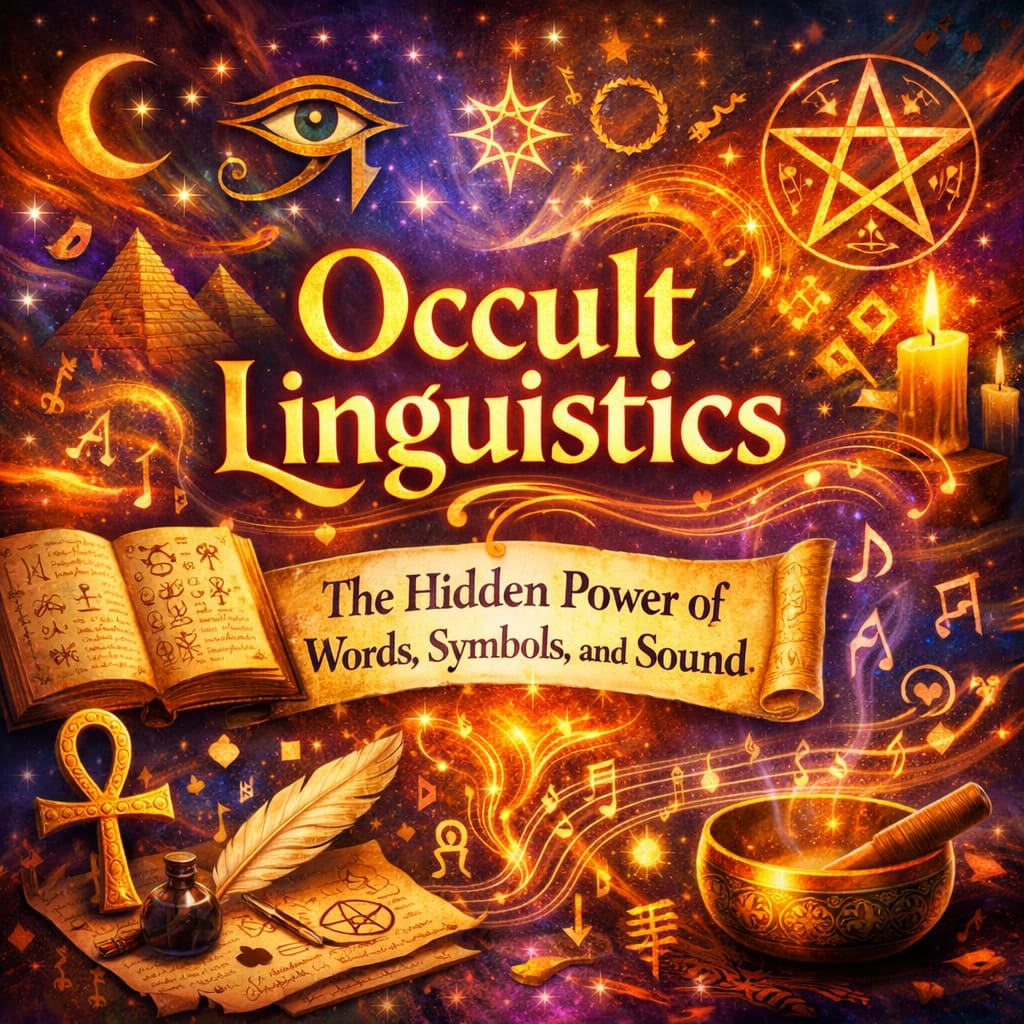
The Hidden Architecture of Sacred Language
Occult linguistics occupies a distinctive intellectual and spiritual territory where language is understood as an active, formative force rather than a passive vehicle for meaning. In this framework words, letters, sounds, and symbols are treated as living structures capable of shaping perception, consciousness, and reality itself. Language functions not only as representation but as participation, embedding human thought within cosmological, ritual, and metaphysical systems that have developed over thousands of years. Across esoteric traditions language is regarded as an extension of creation, a medium through which invisible principles become perceptible and operative.
This perspective is deeply rooted in antiquity. In many ancient cultures the act of naming was believed to confer power over the named object or concept. Mesopotamian incantation texts reveal a worldview in which correct pronunciation and formulaic precision were essential for influencing divine and natural forces. Egyptian hieroglyphs were not conceived as abstract symbols but as sacred images known as medu netjer, often translated as “words of the gods.” These signs were believed to participate in the essence of what they depicted, which is why damaged hieroglyphs in tombs were sometimes deliberately altered to prevent symbolic harm from manifesting in the afterlife. Language, image, and metaphysical function were inseparable within this system.
Occult linguistics also draws heavily from the idea that language possesses an intrinsic vibrational quality. Sound was understood as a structuring principle of the cosmos long before modern acoustics. In Vedic traditions sacred sound, or śabda, was considered eternal and self existent. Mantras were not symbolic representations of divine forces but direct expressions of them. Accurate articulation, rhythm, and tonal precision were viewed as essential because sound itself was believed to shape mental and spiritual states. Similar concepts appear in ancient Greek philosophy, particularly in Pythagorean thought, where harmony, number, and sound were linked to cosmic order.
Within Jewish mystical traditions, especially Kabbalah, language assumes a central metaphysical role. Hebrew is treated as a sacred language whose letters are fundamental building blocks of creation. The Sefer Yetzirah, an early Kabbalistic text, describes the universe as formed through combinations of Hebrew letters and numbers. Each letter carries phonetic, numerical, and symbolic dimensions, forming a multilayered system of meaning. Divine names are not merely titles but expressions of specific aspects of cosmic structure. Practices such as gematria, notarikon, and temurah developed as formal methods for uncovering hidden relationships within sacred texts, reinforcing the belief that language encodes realities beyond surface meaning.
Medieval and Renaissance esoteric traditions further expanded this view through the development of ritual languages, magical alphabets, and structured invocations. Grimoires from this period emphasize precision in wording, timing, and symbolic arrangement. The power of an incantation was believed to depend on exact linguistic form rather than personal interpretation. Latin, Hebrew, Greek, and invented or revealed alphabets were often combined within the same ritual framework, reflecting the belief that certain languages possessed inherent spiritual authority. Speech acts within these traditions were performative in the strongest sense, intended to effect change in both the visible and invisible worlds.
Occult linguistics is also informed by semiotics, the study of signs and symbols, long before the term existed as an academic discipline. Esoteric systems treat symbols as condensed repositories of meaning capable of operating simultaneously on intellectual, psychological, and spiritual levels. A single word or character may function as sound, image, number, and metaphysical principle at once. This multilayered structure distinguishes occult language from ordinary discourse, which tends to privilege clarity and unambiguous reference. In contrast, esoteric language often values opacity, concealment, and multiplicity of meaning as necessary conditions for deeper understanding.
Anthropological evidence supports the universality of these ideas. Shamanic traditions across Siberia, the Americas, and Africa employ sacred speech, secret languages, and altered vocal patterns as tools for entering non ordinary states of consciousness. Such linguistic forms are often restricted to ritual contexts and initiated practitioners, reinforcing the association between language, power, and spiritual authority. The use of archaic or intentionally obscure language further separates sacred speech from everyday communication, marking it as a threshold practice between worlds.
In modern esoteric and mystical movements these principles continue to shape practice and interpretation. Chanting, sigilization, and symbolic writing systems are frequently employed as methods of focusing intention and altering awareness. Even when stripped of traditional cosmologies, language remains central as a mechanism for internal transformation. Words are selected not only for semantic meaning but for rhythm, sound, and emotional resonance, reflecting enduring beliefs about linguistic influence on consciousness.
Occult linguistics therefore represents a long standing human engagement with language as a formative force. Across cultures and historical periods, sacred and magical traditions consistently treat words as carriers of power, symbols as gateways to hidden knowledge, and sound as a bridge between inner experience and cosmic order. This enduring perspective reveals a view of language that is neither arbitrary nor neutral but profoundly embedded in humanity’s attempts to understand, navigate, and participate in the deeper structures of existence.
Historical Roots and the Meaning of Occult Linguistics
The word occult originates from the Latin occultus, meaning hidden, concealed, or secret. In classical Latin usage the term did not inherently imply superstition or irrationality. Instead it referred to that which was obscured from ordinary sight or understanding. Over time, particularly within Western intellectual history, the term came to describe bodies of knowledge concerned with unseen forces, hidden correspondences, and underlying structures of reality that lay beyond sensory perception. Within esoteric traditions, occult knowledge was not viewed as fictional or speculative but as advanced understanding accessible through study, discipline, and initiation.
Occult linguistics emerges directly from this worldview. Language within esoteric systems was treated as one of the primary mechanisms through which hidden knowledge could be accessed, preserved, and transmitted. Rather than functioning solely as a descriptive tool, language was believed to encode metaphysical principles and cosmic laws. Words, letters, and sounds were understood to operate simultaneously on visible and invisible levels, revealing truths to those equipped to interpret them while remaining opaque to the uninitiated.
Western occult traditions developed within a complex intellectual environment shaped by Greco Roman philosophy, Jewish mysticism, Islamic scholarship, and Christian theology. Hermeticism, attributed to the legendary Hermes Trismegistus, emphasized symbolic language and allegory as vehicles for spiritual truth. Hermetic texts such as the Corpus Hermeticum employ layered language that blends philosophy, theology, and cosmology, reinforcing the idea that meaning unfolds through contemplation rather than literal reading. Alchemy likewise relied on coded terminology and symbolic imagery, not to obscure knowledge maliciously but to reflect the belief that true understanding required inner transformation alongside intellectual comprehension.
Kabbalah represents one of the most developed linguistic metaphysical systems in Western esotericism. Hebrew was regarded not merely as a sacred language but as the structural language of creation itself. Letters were understood as dynamic forces, each embodying numerical values, elemental qualities, and spiritual attributes. The act of studying sacred texts was therefore inseparable from meditative engagement with linguistic form. Meaning resided not only in narrative content but in spelling, letter placement, numerical equivalence, and phonetic resonance. This approach profoundly influenced later Christian and Hermetic Kabbalists during the Renaissance, who sought universal spiritual principles through comparative linguistic analysis.
Ceremonial magic further formalized the role of language within ritual practice. Grimoires from the medieval and early modern periods demonstrate meticulous attention to wording, pronunciation, and sequence. Ritual speech was believed to function as a legal or cosmological contract, invoking divine or spiritual forces through precise verbal formulas. Deviations in language were thought to compromise efficacy, reflecting a belief that language operated according to fixed metaphysical laws rather than subjective interpretation. This emphasis parallels contemporaneous theological debates about the power of sacramental words within Christian liturgy, illustrating how esoteric and orthodox traditions often shared underlying assumptions about sacred speech.
Beyond Western traditions, similar linguistic philosophies appear across ancient cultures. Long before the development of writing systems, spoken language was regarded as a creative act. In many mythological narratives the universe itself is brought into existence through speech. Vedic hymns describe creation as emerging from sound, with sacred utterance shaping order from chaos. The syllable Om occupies a central position within Hindu and Buddhist traditions as an expression of primordial vibration. It is not interpreted as a metaphor but as a sonic manifestation of cosmic unity, used in meditation to align consciousness with universal rhythms.
Greek philosophical traditions contributed additional conceptual frameworks. The concept of Logos evolved from early Heraclitean thought into a foundational principle within Stoic philosophy and later Christian theology. Logos encompassed reason, speech, proportion, and cosmic order, uniting language with the rational structure of the universe. This philosophical lineage reinforced the belief that language mirrors the architecture of reality itself, a view that deeply influenced later mystical and esoteric interpretations.
Across these traditions a consistent pattern emerges. Sacred language is treated as performative, generative, and structurally significant. Words are not neutral symbols but active participants in spiritual processes. Symbols condense vast networks of meaning into accessible forms, allowing the microcosm of human thought to engage with the macrocosm of cosmic order. Sound is believed to affect consciousness through rhythm and vibration, while ritualized language functions as a mechanism for intentional change.
Occult linguistics draws these historical strands together into a coherent field of inquiry. It reflects humanity’s enduring conviction that language possesses depth beyond grammar and syntax, that within speech and symbol reside pathways to hidden dimensions of knowledge. Through centuries of philosophical, mystical, and ritual practice, language has been treated not only as a means of expression but as a foundational element of reality itself, capable of revealing structures that remain invisible to ordinary perception.
Mystical Alphabets and Esoteric Scripts
One of the most distinctive expressions of occult linguistics appears in the development and use of mystical alphabets and esoteric writing systems. These scripts were not designed primarily for everyday communication. Instead, they functioned as symbolic technologies, encoding metaphysical concepts, ritual authority, and cosmological order within visual form. Across cultures and historical periods, such alphabets served as mediators between visible language and invisible principles, often reserved for initiatory contexts where literacy carried spiritual consequence.
Among the most widely discussed esoteric languages is Enochian. This system was recorded in the late sixteenth century by the English mathematician, astronomer, and court advisor John Dee, working alongside the scryer Edward Kelley. Dee believed that humanity had lost a primordial language spoken before the Fall, and that angelic intelligences could restore fragments of this divine speech. Through extended sessions involving crystal gazing and ritual prayer, Kelley reported visions of angelic beings who dictated letters, words, and structured calls. Dee meticulously transcribed these communications in detailed journals that survive today.
The Enochian system includes a unique alphabet, grammatical patterns, and a series of complex invocations known as the Calls or Keys. While modern linguistic analysis suggests that Enochian lacks the full consistency of a naturally evolved language, its internal structure is sufficiently organized to support ritual use. The system was later incorporated into ceremonial magic traditions, most notably those associated with the Hermetic Order of the Golden Dawn in the nineteenth century. Within these contexts Enochian was treated not as a symbolic invention but as an operative language believed to access specific spiritual forces through sound, rhythm, and visual form.
Another significant example is the Theban script, often referred to in modern practice as the Witches’ Alphabet. The script appears in European occult texts as early as the fifteenth century, most notably in works attributed to Johannes Trithemius. Theban characters correspond directly to the Latin alphabet, functioning as a substitution cipher rather than an independent linguistic system. Its purpose was not secrecy for its own sake but symbolic separation. Writing sacred names, ritual texts, or magical formulas in Theban marked them as distinct from mundane language, reinforcing the psychological and ritual boundary between ordinary life and esoteric practice.
The continued use of Theban script in contemporary Wiccan and pagan traditions reflects its symbolic function rather than any claim of ancient origin. The act of writing in an unfamiliar alphabet slows cognition, increases focus, and transforms writing into a deliberate ritual act. In this way the script functions as a tool of consciousness rather than communication, aligning with broader occult linguistic principles.
Runic systems represent a different but closely related approach. The Elder Futhark, the oldest known runic alphabet, was used across Germanic cultures from roughly the second to eighth centuries. While runes served practical purposes such as inscriptions and memorial stones, archaeological and literary evidence indicates that they also carried ritual and symbolic significance. Norse mythology attributes the discovery of runes to Odin, who gained them through sacrifice and ordeal, emphasizing their association with hidden knowledge and spiritual power.
Each rune possesses a phonetic value alongside a name and symbolic meaning connected to natural forces, ethical concepts, or cosmic principles. In magical and divinatory contexts, runes were carved, drawn, or cast as symbolic representations of fate and transformation. The belief that runes embodied forces rather than merely representing sounds reflects a worldview in which written symbols participate directly in the structure of reality.
Kabbalistic engagement with the Hebrew alphabet offers one of the most sophisticated examples of esoteric linguistics. Hebrew letters are treated as foundational elements of creation, each containing layers of meaning that extend far beyond phonetics. In classical Kabbalistic texts, letters are associated with numbers, elements, astrological influences, and divine attributes. The practice of gematria assigns numerical values to words, allowing relationships to be drawn between seemingly unrelated concepts based on shared numerical equivalence.
Additional interpretive methods such as notarikon, which derives meaning from acronyms, and temurah, which rearranges letters according to fixed systems, further illustrate how language is treated as a multidimensional matrix. Reading sacred texts becomes an act of decoding cosmic structure rather than extracting narrative meaning. Letters function as points of connection between divine emanation and human consciousness, forming an integrated symbolic network.
Across these diverse traditions, mystical alphabets and esoteric scripts share a common function. They reposition language as a structural force rather than a descriptive convenience. Alphabet, number, sound, and symbol converge into systems that reflect an underlying belief in ordered correspondences between mind, cosmos, and spiritual reality. Writing becomes ritual. Reading becomes initiation. In this framework language itself serves as an architecture of meaning, shaping not only what is known but how knowledge is encountered and transformed.
Sound, Vibration, and Sacred Utterance
Across esoteric traditions, sound is understood not as a secondary feature of language but as one of its most potent dimensions. Speech, chant, and vocalization are treated as forces that act directly upon consciousness and the surrounding environment. This view rests on the assumption that reality itself is structured through vibration and rhythm, and that sound provides a means of entering into alignment with those underlying patterns. Sacred utterance therefore becomes an act of participation in cosmic order rather than an expression of personal thought.
The association between sound and creation appears repeatedly in ancient religious and philosophical systems. In Vedic traditions, sound is regarded as eternal and self originating. The concept of śabda brahman identifies sacred sound as a manifestation of ultimate reality. Mantras are not symbolic phrases intended for contemplation alone but precise sonic forms believed to produce specific effects when spoken correctly. Pronunciation, tempo, and tonal quality are essential, as efficacy is attributed to vibration itself rather than semantic interpretation. This emphasis on sonic accuracy reflects the belief that sound operates according to objective metaphysical laws.
The syllable Om occupies a central position within Hindu, Buddhist, and Jain traditions. It is traditionally described as the primordial sound from which all manifestation arises. Classical sources such as the Mandukya Upanishad analyze Om as a composite of phonetic elements representing waking consciousness, dreaming, deep sleep, and transcendent awareness. Chanting Om is understood as a means of synchronizing breath, mind, and nervous system while symbolically aligning individual awareness with universal rhythm. The use of Om in meditation is not devotional alone but technical, intended to stabilize attention and induce altered states of consciousness through controlled resonance.
Similar principles appear in Buddhist mantra practice, particularly within Vajrayana traditions. Mantras such as Om Mani Padme Hum are treated as sonic embodiments of enlightened qualities. Repetition serves both as a meditative anchor and as a method of internalizing specific states of compassion and clarity. The power of the mantra is believed to reside in sound itself rather than in conceptual meaning, which is why mantras are often preserved in their original languages even when practitioners do not speak them fluently.
In Western esoteric traditions, ceremonial magic places comparable emphasis on vocalization. Divine names, angelic hierarchies, and sacred formulas are spoken aloud to establish authority, focus intention, and structure ritual space. The act of naming is understood as a means of alignment rather than command, with correct pronunciation viewed as essential to successful operation. Historical grimoires repeatedly stress the importance of vocal clarity, breath control, and rhythm, indicating that sound was regarded as a technical component of ritual efficacy.
The spoken word in ceremonial contexts often functions as a performative act. Utterance is believed to bring about a change in spiritual conditions rather than merely describing them. This understanding parallels older theological debates surrounding the power of liturgical speech, where sacramental words were thought to effect transformation through their articulation. In esoteric ritual, sound becomes a tool for structuring intention and directing attention toward specific symbolic or spiritual aims.
Contemporary esoteric practices continue to reflect these principles, even when stripped of traditional cosmologies. The creation and activation of sigils provides a clear example. A sigil condenses intention into a visual symbol, but activation frequently involves vocalization, chanting, or focused breath. Sound serves to disengage analytical thought and facilitate entry into a concentrated mental state where symbolic intent can take root. In this context vocalization functions as a bridge between conscious formulation and subconscious integration.
Across cultures and historical periods, invocation and prayer reinforce the belief that speech operates on multiple levels simultaneously. Words convey meaning, but they also carry rhythm, tone, and emotional charge. Sacred utterance is therefore understood as an embodied act involving breath, posture, and attention. Language is not confined to abstract thought but engages the entire sensory and psychological system.
The enduring emphasis on sound within occult linguistics reflects a broader recognition of language as a dynamic force. Vibration, resonance, and rhythm are treated as fundamental properties through which speech interacts with consciousness and environment alike. Sacred utterance transforms language from a descriptive medium into an experiential practice, one capable of shaping inner states and opening pathways to altered perception. Through sound, language becomes an instrument of alignment, resonance, and transformation rather than mere communication.
Cross-Cultural Comparisons of Sacred Language
Across civilizations, language has repeatedly been regarded as more than a tool for ordinary communication. In ancient Egypt, hieroglyphs were treated as living symbols, each imbued with metaphysical significance and connected to cosmic principles. The Pyramid Texts, Coffin Texts, and the Book of the Dead illustrate that the precise arrangement of hieroglyphs could influence the soul’s journey in the afterlife. Scribes were trained not only in literacy but in ritual precision, reflecting the belief that mistakes in writing could disrupt spiritual outcomes. Words were understood to carry an intrinsic power capable of affecting divine, natural, and human realms, demonstrating that language itself was considered an active agent in the world.
In Mesopotamia, Sumerian and Akkadian cuneiform inscriptions likewise reveal a perception of language as functional and sacred. Incantations, prayers, and hymns were recorded on clay tablets to ensure correct recitation, preservation, and transmission of spiritual efficacy. Rituals such as the exorcism of malevolent spirits relied on precise spoken and written formulas, emphasizing that sound, sequence, and symbol combined to achieve metaphysical effect. The role of the scribe was therefore not merely administrative but sacred, tasked with maintaining the integrity of words as instruments of cosmic and social order.
South Asian traditions offer a sophisticated perspective on language as a vehicle of vibration and consciousness. Sanskrit, meticulously preserved through oral tradition, demonstrates a belief that phonetic precision is inseparable from spiritual efficacy. Vedic mantras such as the Gayatri mantra or Om aim to align practitioners with universal principles, employing specific intonation, duration, and rhythm. Buddhist mantras, particularly in the Vajrayana school, employ phonemes as vehicles for embodying compassion, wisdom, and transformative energy. In tantric practice, mantras are often visualized through letters in yantras or mandalas, linking written form, sound, and meditative visualization in an integrated system. This intricate layering of visual, sonic, and symbolic language illustrates the multidimensionality of sacred communication.
East Asian traditions present parallel but distinct approaches. Daoist talismans and ritual scripts employ a combination of calligraphy, symbolic imagery, and verbal incantation to invoke protection, healing, and spiritual authority. The arrangement and brushstroke of characters in these talismans is considered as important as the verbal recitation that accompanies them. Japanese Shingon Buddhism preserves Sanskrit mantras through the Siddham script, maintaining phonetic integrity and symbolic structure while emphasizing meditative practice. In these contexts, writing is both an aesthetic and a ritual discipline, where precision in form channels spiritual energy and intention.
Indigenous oral traditions from Australia, Africa, and the Americas further illustrate the sacred function of language. In Australian Aboriginal cultures, songlines encode cosmological knowledge, navigation, law, and ceremonial instruction. Spoken and sung words map both physical and spiritual landscapes, serving as living repositories of ancestral wisdom. In African traditions, ritual speech, incantations, and proverbs are believed to influence natural phenomena, social cohesion, and spiritual relationships. Among Native American cultures, chants and ceremonial speech carry historical memory, cosmology, and ritual instruction, often structured to guide participants through spiritual journeys or communal rites. Across these contexts, the human voice functions as a conduit of continuity between past, present, and metaphysical dimensions.
Despite cultural differences, consistent themes emerge in the treatment of sacred language. Language is structured to bridge human experience with spiritual, cosmological, or metaphysical realities. Symbols, letters, sounds, and vocal intonations are treated as active instruments for transformation, protection, and insight. Accuracy, rhythm, repetition, and intentionality are universally emphasized, suggesting a widespread human recognition that language operates beyond literal communication. Furthermore, the interplay between oral, written, and visual forms of language highlights the multidimensionality of sacred speech, where meaning is reinforced across multiple sensory and cognitive channels. These examples underscore a shared human intuition that words are both expressive and constitutive of reality itself.
Examining these cross-cultural examples reveals that occult linguistics is not an isolated phenomenon but part of a global human pattern. From the codified symbols of Egypt and Mesopotamia to the vibrational mantras of South Asia, the meditative scripts of East Asia, and the oral ceremonial traditions of Indigenous peoples, language repeatedly functions as a medium of transformation. Understanding these practices enriches the study of occult linguistics by situating symbolic speech and writing within diverse historical, cultural, and ritual contexts. It demonstrates that the power attributed to words, letters, and sounds is both a cultural constant and a practical tool for shaping consciousness, perception, and reality.
A Multicultural Perspective on Occult Linguistics
Occult linguistics is not confined to a single culture or religious system. Its principles emerge wherever language is treated as a conduit between human awareness and deeper structures of reality. Across civilizations, sacred speech, symbolic writing, and ritualized sound appear as parallel developments rather than isolated inventions. These traditions differ in form and cosmology, yet they share a consistent assumption that language participates in the ordering of the world rather than merely describing it.
In ancient Egypt, writing was inseparable from cosmology and theology. Hieroglyphs were conceived as living images rather than abstract signs. Known as medu netjer, often translated as “divine speech,” hieroglyphs were believed to embody the essence of what they represented. A written word or image was not symbolic alone but ontologically connected to its referent. This belief influenced funerary practices, temple inscriptions, and ritual texts, where linguistic precision was essential for maintaining cosmic balance, or ma’at. The power attributed to hieroglyphs was such that potentially dangerous symbols were sometimes intentionally altered to prevent them from exerting unwanted influence in the afterlife.
Greek philosophical traditions approached sacred language through a different lens, emphasizing reason, proportion, and order. Thinkers such as Heraclitus and later the Stoics articulated the concept of Logos as a rational principle underlying both speech and the cosmos. Language was viewed as an expression of universal reason, capable of revealing the structure of reality when properly understood. Plato’s dialogues explore the relationship between names and essence, suggesting that words, when correctly formed, reflect the true nature of things. This philosophical groundwork shaped later mystical interpretations in which language served as a bridge between human intellect and cosmic law.
Jewish Kabbalah presents one of the most intricate linguistic metaphysical systems in recorded history. Hebrew letters are treated as primordial forces through which creation unfolds. Divine names are not metaphorical but functional, each associated with specific aspects of divine emanation. Texts such as the Sefer Yetzirah describe creation as a process enacted through combinations of letters, numbers, and sounds. Language becomes a map of existence itself, with each letter acting as a point of connection between the infinite and the finite. Study and contemplation of sacred text are therefore acts of spiritual alignment rather than intellectual analysis alone.
In South Asian traditions, particularly within Hindu and Buddhist tantra, sound occupies a central ritual and philosophical role. Mantras are understood as sonic forms that carry specific energetic and psychological effects. The emphasis on repetition, breath control, and tonal accuracy reflects a belief that sound operates directly upon consciousness. Sanskrit, preserved with extraordinary phonetic precision, is treated not simply as a liturgical language but as a vibrational system capable of structuring awareness. In these traditions, sound and silence are equally meaningful, forming complementary aspects of meditative discipline.
Western esoteric traditions of the medieval and Renaissance periods synthesized many of these ideas. Influenced by Neoplatonism, Kabbalah, and classical magic, Renaissance magicians viewed language as part of a unified symbolic system that included number, planetary influence, and geometric proportion. Grimoires from this period demonstrate careful integration of divine names, angelic languages, musical tones, and astrological timing. The Ars Notoria exemplifies this approach by combining prayer, visual symbols, and vocalized formulas into a disciplined practice intended to cultivate knowledge and spiritual insight. Language in this context functions as a structured interface between human intellect and transcendent sources of understanding.
In the modern era, occult linguistic theory has adapted to changing cultural frameworks. Movements such as chaos magic emphasize flexibility, psychological impact, and symbolic efficiency over traditional notions of sacred language. Words and symbols are treated as tools that acquire power through belief, repetition, and emotional engagement rather than through inherited sanctity. Semiotics and linguistic theory influence these practices, reframing occult language as a means of influencing perception and behavior at subconscious levels. Despite this shift, the underlying principle remains consistent with older traditions: language shapes experience.
Across cultures and centuries, occult linguistics reflects a shared human intuition that speech, sound, and symbol participate in the fabric of reality. Whether expressed through hieroglyph, mantra, divine name, or sigil, language is repeatedly positioned as a mediator between inner awareness and cosmic structure. This multicultural continuity underscores that occult linguistics is not a fringe curiosity but a recurring response to fundamental questions about meaning, creation, and the limits of ordinary communication.
Occult Linguistics and the Interpretation of Hidden Meaning
Interpretation occupies a central position within occult linguistics, where meaning is rarely fixed or singular. Words, symbols, and sounds are understood to operate across multiple levels of significance, often simultaneously. This approach aligns closely with established linguistic concepts such as polysemy, metaphor, and semantic layering, yet extends them into metaphysical and symbolic domains. Language in occult contexts is not designed to be immediately transparent. Its depth is intentional, requiring sustained engagement, contextual knowledge, and interpretive discipline.
Occult texts frequently employ polysemy as a structural feature rather than a byproduct of language. A single term may reference a physical object, a psychological state, a cosmic principle, and a spiritual process at once. This multiplicity is not viewed as ambiguity but as completeness. Meaning unfolds through association rather than definition, allowing language to mirror the layered nature of reality itself. Symbols operate in a similar fashion. An image or glyph may simultaneously represent elemental forces, moral qualities, planetary influences, and stages of inner development.
This method of meaning making has deep historical precedent. Ancient hermeneutic traditions recognized that sacred texts could not be exhausted by literal reading alone. In Jewish interpretive practice, multiple levels of meaning were formally acknowledged, including literal, allegorical, ethical, and mystical interpretations. Each level was considered valid, with deeper readings building upon rather than negating surface meaning. Early Christian and Islamic scholars adopted comparable frameworks, recognizing that spiritual truth often required symbolic mediation.
Within occult traditions, this layered approach became especially pronounced. Alchemical texts, for example, describe physical processes such as calcination and distillation while simultaneously encoding psychological transformation and spiritual refinement. The language is deliberately paradoxical and metaphorical, intended to resist purely literal interpretation. Understanding depends on familiarity with symbolic systems, mythological references, and philosophical principles. Without this interpretive context, texts appear obscure or contradictory, reinforcing the idea that knowledge must be earned through study and reflection.
Metaphor functions as a primary vehicle for this depth of meaning. Rather than serving as decorative language, metaphor becomes a cognitive tool for expressing relationships that cannot be captured through direct description. Spatial metaphors describe inner states, celestial imagery conveys ethical and psychological dynamics, and natural processes illustrate spiritual transformation. Language thus becomes a bridge between experiential knowledge and abstract understanding.
Occult linguistics also emphasizes the role of interpretive keys. These may include knowledge of numerology, astrology, sacred geometry, or mythic symbolism. Such systems provide frameworks for decoding relationships between symbols and for recognizing patterns across texts and traditions. Interpretation is therefore not subjective improvisation but a disciplined practice grounded in established symbolic correspondences. Meaning emerges through the interaction between text, symbol, and informed reader.
This emphasis on layered interpretation reflects a broader belief that reality itself is structured in strata. Just as language contains visible and hidden meanings, existence is understood to operate across physical, psychological, and spiritual dimensions. Language becomes a mirror of this structure, encoding complexity within accessible forms. The act of interpretation is therefore not merely intellectual but transformative, reshaping perception through engagement with symbolic depth.
In occult linguistics, symbols are not passive signs awaiting explanation. They are active vessels of knowledge, capable of revealing different truths depending on context, experience, and level of understanding. Interpretation becomes a method of initiation, guiding the reader beyond surface meaning into deeper patterns of relationship and significance. Through this process, language transcends its communicative function and becomes a medium for insight, reflection, and transformation.
Reading Recommendations: #commissionearned
Language history is presented in this book as a living process shaped by migration, conquest, trade, and social change. Detailed explanations of creolization, sound shifts, and grammatical simplification reveal how languages absorb influence and transform meaning over time. This perspective is essential for understanding occult linguistics, which often treats words as carriers of accumulated cultural power. Sacred or magical languages gain authority not through divine origin alone but through longevity, repetition, and collective belief. The book demonstrates how linguistic change can appear mysterious or hidden when viewed across centuries, echoing esoteric interpretations of ancient tongues. McWhorter’s scholarship grounds mystical ideas about language in observable linguistic behavior. The result is a clear illustration of how historical processes create the illusion of sacred permanence within evolving systems of speech.
The Esoteric Structure of the Alphabet and Its Hidden Mystical Language by Alvin Boyd Kuhn
This book presents the alphabet as a symbolic system encoded with metaphysical meaning rather than a neutral phonetic tool. Drawing on comparative mythology, ancient religion, and early Christian mysticism, the text argues that letters preserve fragments of spiritual doctrine. Alphabetic sequence is examined as a philosophical progression reflecting stages of consciousness and cosmological development. Such ideas resonate strongly with occult linguistics, where letters are often treated as archetypal forces. The book illustrates how writing systems can function as symbolic maps rather than practical inventions alone. Although rooted in early twentieth century esoteric scholarship, the work remains influential for understanding symbolic language. Its relevance lies in framing alphabets as repositories of hidden meaning shaped by spiritual tradition.
Language Myths, Mysteries and Magic by K. Stollznow
This work explores the persistent belief that words possess supernatural power across cultures and historical periods. Linguistic myths surrounding naming, curses, secret languages, and sacred speech are examined through folklore and documented practices. The book provides clear explanations of why humans consistently attribute power to language beyond communication. These insights directly support the study of occult linguistics by contextualizing magical language as a universal cultural phenomenon. Rather than dismissing mystical beliefs, the analysis shows how cognitive patterns and social structures reinforce them. Examples of ritual speech and taboo language illustrate how words shape perception and behavior. The book bridges academic linguistics and esoteric tradition through careful cultural analysis.
Symbolic communication is examined here as an intentional system for shaping experience and perception. The book explores how words, sigils, and constructed symbols function as compressed carriers of meaning. Semiotics plays a central role, explaining how signs influence cognition through repetition and emotional association. This framework aligns closely with occult linguistics, which treats language as an operative structure rather than a descriptive one. Historical magical practices are connected to modern symbolic theory without relying on mystical authority alone. Language is shown to gain power through context, structure, and belief. The book offers a contemporary articulation of how linguistic systems become tools for transformation.
Modern communication systems provide the foundation for this exploration of symbolic influence. Memes are analyzed as evolving linguistic units that spread ideas through repetition and adaptation. The book draws parallels between viral digital language and traditional magical symbols. Both systems rely on compression, emotional resonance, and rapid transmission. This approach reframes occult linguistics within contemporary culture rather than historical ritual alone. Language is presented as an engine of belief formation operating at collective scale. The book demonstrates that symbolic magic adapts naturally to new technological environments.
The Words of the Witch: Writing and Speaking Your Magic by Ember Grant
Language is treated here as a practical and intentional act rather than an abstract concept. Writing and speech are explored as tools for shaping emotional states and personal ritual practice. The book emphasizes clarity, symbolism, and repetition as sources of linguistic power. This perspective reflects core principles of occult linguistics focused on function rather than tradition. Words are shown to acquire meaning through deliberate use and emotional engagement. The text connects folk magic traditions with modern linguistic awareness. It offers insight into how everyday language becomes ritualized through intention.
Word Witch: How to Call Upon and Cultivate the Creative Magic Within You by Kate Belew
Creative language forms the central focus of this book, emphasizing storytelling and metaphor as transformative acts. Writing and speech are framed as methods for reshaping internal narratives and perception. This approach aligns with occult linguistics by treating meaning as an active process. Language is presented as a tool for self-transformation rather than formal ritual alone. Symbolic expression becomes a method of engaging subconscious patterns. The book highlights how creativity and magic intersect through linguistic choice. It reinforces the idea that words shape reality through imagination and structure.
Language as Cognitive and Psychological Tool
Language functions as more than a conveyor of meaning; it acts as a tool that shapes thought, perception, and consciousness. In esoteric traditions, repeated utterance of sacred names, incantations, or mantras is believed to influence mental and emotional states, creating conditions conducive to altered awareness. Chant, recitation, and ritualized speech are employed to focus attention, regulate breathing, and induce meditative or trance-like states. In this context, the psychological impact of sound and rhythm becomes a central component of the magical or spiritual effect, demonstrating a direct link between language and cognitive modulation.
Ancient Hindu and Buddhist texts provide detailed instructions on mantra recitation, emphasizing precision in pronunciation, tone, and rhythm. The syllable Om, regarded as the primordial vibration, is used to synchronize breath, calm the mind, and generate alignment with universal patterns. Vajrayana Buddhist practice extends this principle by combining vocalized mantras with visualization, hand gestures, and symbolic imagery, creating multilayered cognitive engagement. This integration of sensory and symbolic input illustrates how esoteric traditions understood language as a system for structuring attention and shaping consciousness simultaneously.
Western ceremonial magic also demonstrates the cognitive dimension of language. In Renaissance grimoires, precise articulation of angelic names, ritual phrases, and incantations is emphasized, reflecting the belief that words, when spoken with focused intention, organize mental and spiritual energy. Repetition and memorization serve as methods of embedding symbolic patterns into the practitioner’s mind, aligning thought with desired outcomes. Sigils, often created through abstraction of written intent, are “charged” through visualization, meditation, or vocal engagement, demonstrating how symbolic language interacts with memory, focus, and psychological association.
Modern cognitive research provides a framework for understanding these historical practices. The psychology of attention, the role of repetition in memory formation, and the impact of rhythm and tonality on mood offer scientific parallels to ancient and esoteric insights. Language operates as both a symbolic system and a psychophysiological tool, influencing perception, emotional states, and internalized belief structures. This dual function highlights why structured, intentional language has been employed across cultures for spiritual, magical, and ritual purposes.
Even everyday language demonstrates similar effects when used intentionally. Affirmations, meditative chanting, or creative writing can redirect cognitive patterns, reinforce desired mental states, and cultivate focus. In this sense, esoteric language techniques exemplify broader principles of human cognition: repetition, symbolic association, and multisensory engagement enhance learning, memory, and mental focus. By recognizing the cognitive and psychological dimensions of sacred speech, occult linguistics bridges historical ritual practice with contemporary understanding of how language shapes thought.
The study of language as a cognitive tool underscores that the power attributed to words in occult systems is not purely symbolic or mystical. Words, symbols, and structured sound sequences operate on both conscious and subconscious levels, altering perception, reinforcing intention, and facilitating states of heightened awareness. This perspective positions language as a medium of transformation that functions simultaneously in the mind, body, and symbolic imagination, revealing why ritualized speech has been a central component of esoteric practice throughout history.
Language as Threshold and Instrument
Occult linguistics stands as a reminder that language has never been limited to the exchange of information. Across cultures and historical periods, words, sounds, and symbols have been treated as forces that shape perception, structure belief, and mediate access to hidden dimensions of understanding. Sacred alphabets, ritual speech, symbolic writing systems, and vocal practices reveal a long standing conviction that language participates in reality rather than merely describing it. This perspective positions speech and symbol as technologies of meaning that operate simultaneously on intellectual, psychological, and spiritual levels.
The continuity of these ideas from ancient civilizations through medieval esoteric traditions and into modern practice demonstrates their resilience and adaptability. While cosmologies change and symbolic systems evolve, the underlying assumption remains consistent: language carries depth that extends beyond grammar and syntax. Mystical traditions preserve this understanding through layered symbolism, encoded texts, and ritualized utterance. Modern scholarship, drawing from linguistics, anthropology, religious studies, and semiotics, has begun to reexamine these traditions with renewed rigor, offering tools for understanding how symbolic language functions within human cognition and culture.
Engagement with occult linguistics benefits from careful and methodical study. Primary sources, historical texts, and reputable academic works provide essential context for interpreting esoteric language systems. Public libraries remain among the most valuable resources for this type of research, offering access to scholarly books, translations of classical texts, and peer reviewed studies at no cost. Many libraries also provide digital databases and interlibrary loan services that expand access far beyond local collections. Such institutions support informed inquiry while grounding exploration in verified scholarship.
Caution is warranted when relying on freely available online materials. While the internet offers unprecedented access to information, it also contains unverified claims, modern reinterpretations presented as ancient fact, and sources that lack historical or academic accountability. Esoteric subjects are particularly susceptible to misinformation due to their symbolic complexity and interpretive flexibility. Critical evaluation of sources, cross referencing of claims, and familiarity with original texts help safeguard against distortion and oversimplification.
Occult linguistics rewards patience, discernment, and sustained study. The field invites readers to examine how language shapes consciousness, how symbols encode layered meaning, and how sound and structure influence perception. Continued research deepens understanding not only of esoteric traditions but of language itself as a formative force within human experience. Through careful reading, critical inquiry, and respect for historical context, the study of occult linguistics remains a rich and evolving exploration of how meaning is created, preserved, and transformed.
About the Creator
Marcus Hedare
Hello, I am Marcus Hedare, host of The Metaphysical Emporium, a YouTube channel that talks about metaphysical, occult and esoteric topics.
https://linktr.ee/metaphysicalemporium
Keep reading
More stories from Marcus Hedare and writers in BookClub and other communities.
Sacred Geometry
Foundations of Sacred Geometry Sacred geometry refers to the study of recurring geometric forms, numerical ratios, and proportional relationships that manifest throughout the natural world and across human civilizations. These patterns appear in biological growth, mineral formation, astronomical movement, and the built environment, suggesting that geometry functions as a fundamental organizing principle rather than a human invention. Long before geometry became a formal branch of mathematics, early societies recognized that shape and proportion governed stability, harmony, and continuity in both nature and human life. Observation, measurement, and symbolic interpretation developed side by side, forming systems of knowledge that linked mathematics with cosmology and meaning.
By Marcus Hedarea day ago in BookClub
Ludacris and Nelly draw backlash over bookings at MAGA-coded music festival
Ludacris and Nelly headlining a mostly right-wing event is good for them. It’s also great for the genre of hip hop. The two rap veterans have showcased their talents on other stages. Why can’t they perform for mostly MAGA folks and grab that bag?
By Skyler Saunders2 days ago in Beat




Comments
There are no comments for this story
Be the first to respond and start the conversation.