

In 621 AD, a burial mound was discovered outside the Chinese city of Luoyang. Inside was the armor of a general — small in stature, delicate in build — and beneath it, the bones of a woman. The inscription read:
“She who fought as a man to bring honor to her house.”
Her name was Fa Mulan. Unlike the legend, she did not return home. When her disguise was revealed after a decade of battle, the Emperor ordered her execution for treason. But soldiers who witnessed it said her sword shattered before it could strike — and that she vanished in a gust of wind, leaving only her armor standing upright.
Centuries later, entire units claimed to see a female warrior leading them in the mist before battle. The Qing army kept her name on their rolls as an honorary commander.
When Western scholars studied the legend, they dismissed it as myth — until 1978, when archaeologists unearthed the Jingshan armor, the same dimensions, engraved with the phrase:
“Loyalty above breath.”
Military officers in modern China still leave flowers there before deployment. Some say that when war is near, her tomb grows warm — as if the spirit within is waking once more.
About the Creator
Keep reading
More stories from GoldenSpeech and writers in BookClub and other communities.
Rachel Reviews: Lakefront Wolves by Joseph Deegan
Meet Finn. He's an 18 year old kid who has potential. He's bright with great school scores and he's also an athlete, a footballer of some prowess. He has it all going for him, it would seem, and yet, he's determined to send what could be a well-planned, stable existence firmly off the rails. He drinks, he smokes, he takes drugs, he has violent tendencies and he's in danger of losing not only his mind but all that he holds dear.
By Rachel Deeming7 days ago in BookClub
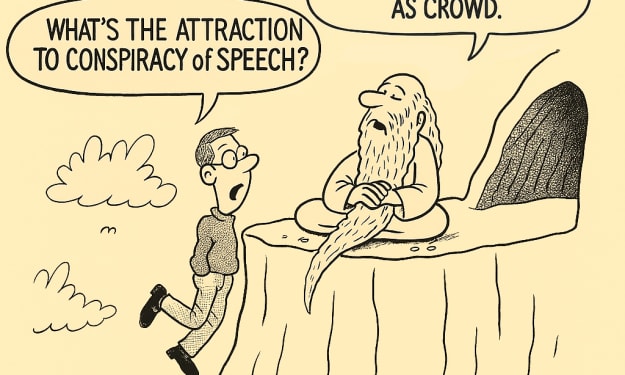
The Conspiracy of Speech
Breathing Together in an Age of Noise: A Review of The Conspiracy of Speech The Conspiracy of Speech, the second part of Volume I with the same name in THE MISCOMMUNICATION TRILOGY, is an ambitious and penetrating study of how speech itself becomes the engine of distortion in contemporary society. If the earlier theoretical groundwork of the volume diagnosed the structural decay of language, this book moves from structure to performance. It asks not merely how language deteriorates, but how speech actively produces the conditions for misunderstanding, ideological capture, and social fragmentation.
By Peter Ayolov2 days ago in BookClub



Comments
There are no comments for this story
Be the first to respond and start the conversation.