
"Manson: The Life & Times of Charles Manson" by Jeff Guinn - Book Club Discussion
Book club prompts

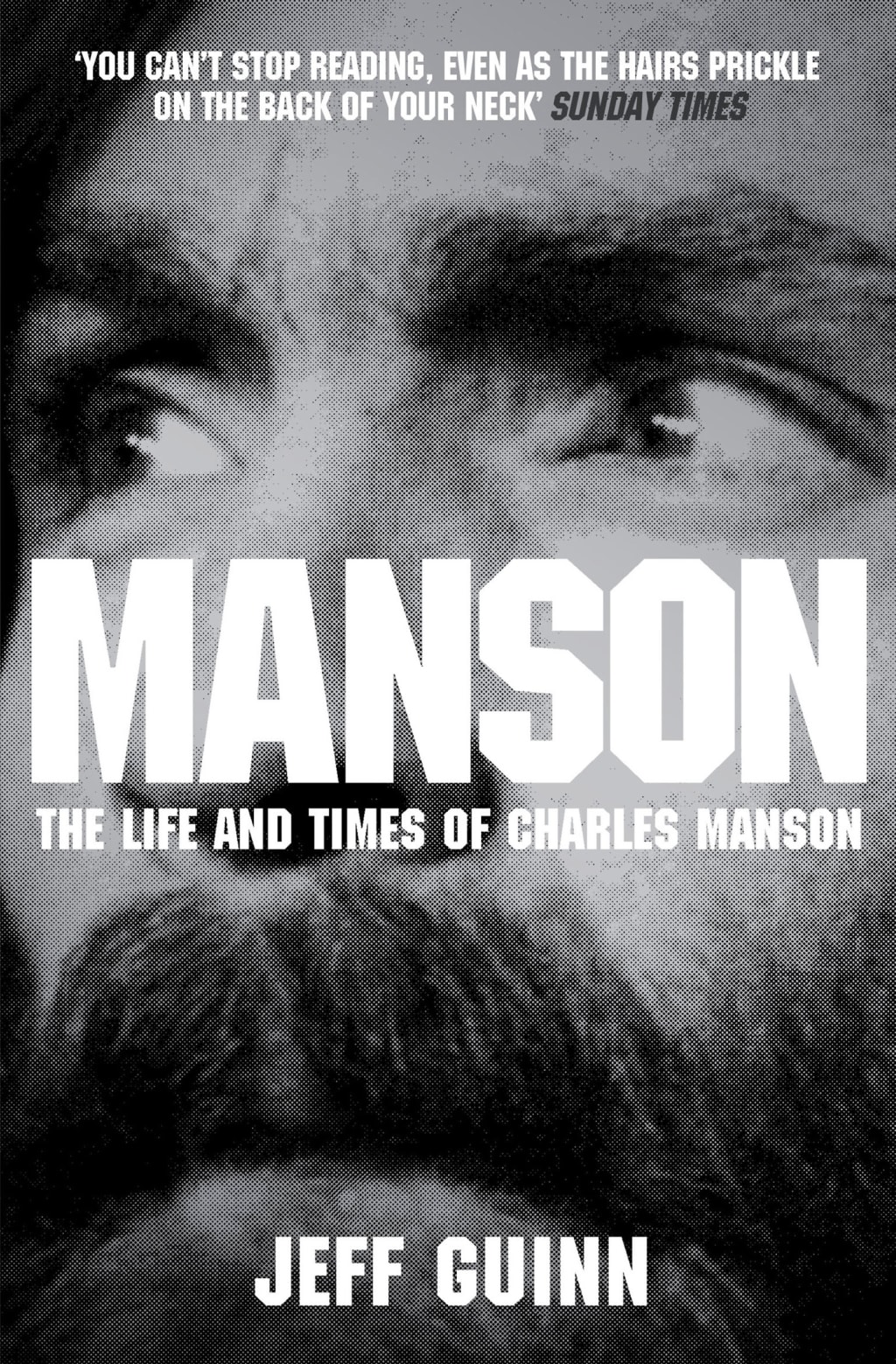
Based on new interviews, this revealing account of one of the most notorious criminals in American history puts Manson in the context of his times, the turbulent end of the 60s, revealing a rock star wannabe whose killings were directly related to his musical ambitions. After more than forty years, Charles Manson continues to mystify and fascinate us. Manson and members of his mostly female commune killed nine people, including pregnant actress Sharon Tate. Now, drawing on new information, the author tells the definitive story of how this ordinary juvenile delinquent became a murderer whose crimes still shock and horrify today.
Manson: Fact vs. Fiction:
- Charles Manson, (born November 12, 1934, in Cincinnati, Ohio, U.S.- died November 19, 2017, in Kern county, California). (Britannica)
- Even as a child, Manson was a genius at pulling strings and deflecting blame, either running from trouble or flummoxing his accusers with a saintly smile. He was the bad seed turned jailbird turned spiritual guru; the catalyst for a notorious 1969 killing spree that claimed the life of the Hollywood actor Sharon Tate among numerous others, selected almost at random. (The Guardian)
- There's nothing mystical or magical about Charles Manson. He's a gifted psychopath who's a talented liar who's lied about just about everything. (Jeff Guinn, USA Today)
- I don't think he was ever insane. I do think he was always selfish, self-absorbed, and deliberately manipulative. It is also possible having kept up the "Crazy Charlie" act for so long, that this has become more of his persona than the old calculating Charlie. There's no way to know. I don't think he would know. But I do think much of what we've seen is a deliberate act. He knows how to get attention, he knows how to hold attention. Let's face it, he's done that now for going on half a century. He's a performer. (Jeff Guinn, USA Today)
- Manson was born Charles Milles Maddox on November 12, 1934, in Cincinnati, Ohio, to Kathleen Maddox, a 16-year-old girl who was both an alcoholic and a prostitute. (Biography)
- "The Family" was a group of around 100 followers of Manson who shared his passion for an unconventional lifestyle and habitual use of hallucinogenic drugs, such as LSD and magic mushrooms. (Biography)
- Tate Murders:
- Charles Manson directed Charles Watson, Susan Atkins, Linda Kasabian, and Patricia Krenwinkel to enter the Tate residence (formerly the Melcher residence, who rejected Mason’s music compilation) and to “destroy everyone in it – as gruesome as you can.” Watson, Atkins, Kasabian, and Krenwinkel all climbed up a brushy platform to gain entrance into the property. While they were trespassing, Steven Parent, a visitor of the residence’s caretaker, William Garretson, was leaving the property in his vehicle. Watson stopped Parent, swung a knife at him, and then shot him four times in the chest and abdomen.
- Watson entered the residence by cutting the screen of a window and opened the front door for Atkins and Krenwinkel. Kasabian was at the end of the driveway to “keep watch.” Watson and the group entered the residence and found Tate, Folger, Frykowski, and Sebring. Tate and Sebring were tied together by their necks, and Folger was taken into a nearby bedroom. Sebring was shot and stabbed seven times. Frykowski was bound by a towel but managed to free himself. After doing so, he became involved in a physical altercation with Atkins resulting in her stabbing him in the legs. Frykowski continued to flee, but Watson struck him with the gun multiple times over the head, shot, and stabbed him multiple times. The gun grip broke off as a result of Watson striking Frykowski over the head.
- Folger fled the room she was taken to and then was chased by Krenwinkel. Folger was stabbed by Krenwinkel and eventually stabbed by Watson as well. Folger was stabbed a total of 28 times by both Krenwinkel and Watson. Meanwhile, Frykowski was struggling across the lawn when Watson came to stab him again. Frykowski was stabbed a total of 51 times.
- While witnessing the horrific crimes, Tate pleaded with Atkins for mercy but was rejected. Tate was stabbed a total of 16 times. Tate’s unborn child did not survive the incident. (Crime Museum)
- LaBianca Murders:
- Manson and six of the Manson family members (Leslie Van Houten, Steve Grogan, Susan Atkins, Linda Kasabian, Patricia Krenwinkel, and Charles Watson) committed another murder. Unlike the Tate murder, Manson joined in on the LaBianca murder because he felt that there was not enough panic among the victims from the Tate murder. Manson and the family members drove around looking for prospective murder victims when they arrived in the neighborhood of a home in which they had attended a party a year prior. The neighboring home belonged to a successful grocery company owner, Leno LaBianca, and his wife, Rosemary.
- There are several differing accounts from Manson and six Manson family members, so the exact happenings of the murder are not certain. Manson claims he approached the home alone and returned later to bring Watson along. When Manson and Watson were in the residence, they tied up the LaBianca couple with a lamp cord and with pillowcases covering their heads. Manson reassured the couple that they would not be hurt and that they were being robbed. All the cash was collected, and the bound Rosemary was returned to her room. Soon after, Van Houten and Krenwinkel entered the premises with instructions from Manson to kill the couple. Manson left the residence and instructed Van Houten and Krenwinkel to follow Watson’s orders.
- Watson began stabbing Leno multiple times. Afterward, in the bedroom, Rosemary began to swing the lamp still attached to the cord wrapped around her neck. Van Houten and Krenwinkel yelled for Watson’s aid and stabbed Rosemary multiple times. Watson gave the knife to Van Houten, and she continued to stab Rosemary. Rosemary was stabbed a total of 41 times by Watson, Van Houten, and Krenwinkel.
- Watson returned to the living room and continued to stab and kill Leno. Krenwinkel carved the word “WAR” into Leno’s stomach, stabbed Leno multiple times, left a carving fork sticking out from his stomach, and left a knife in Leno’s throat. Leno was stabbed a total of 26 times.
- On the walls of the living room, “Death to pigs” and “Rise” were written in Leno’s blood. On the refrigerator door, a misspelled “Healter Skelter” was smeared.
- Frank Struthers, Rosemary’s son from a prior marriage, returned from a campaign trip and found it suspicious that the shades were drawn. He also found it suspicious that Leno’s speedboat was still parked in the driveway. Struthers called his sister to alert her, and she came with her boyfriend, Joe Dorgan. Dorgan and Struthers entered the home through the side door and found Leno’s body. LAPD was alerted. (Crime Museum)
- During the trial, Manson released an album titled Lie in an effort to raise money for his defense. He reveled in the media attention, and during court proceedings, he turned up with an X carved into his forehead. Some of his female followers copied the act and shaved their heads, sometimes sitting outside the courthouse. The X was gradually modified until it turned into a swastika. (Biography)
- The jury took a week to deliberate and came to a verdict of guilty for all charges of murder and conspiracy for all defendants. During the penalty phase of the trial, the jury declared the penalty of death. Under the California Supreme Court ruling in 1972, the death penalties for all defendants were commuted to life in prison. (Crime Museum)
About the Author:
- Jeff Guinn is the bestselling author of numerous books, including Go Down Together, The Last Gunfight, Manson, The Road to Jonestown, War on the Border, and Waco.
- He lives in Fort Worth, Texas, and is a member of the Texas Literary Hall of Fame.
- Jeff Guinn is the winner of the 2016 TCU Texas Book Award.
- The former books editor at the Fort Worth Star-Telegram and award-winning investigative journalist, he is a member of the Texas Institute of Letters.
On Writing the Book:
Guinn’s book is a “tour de force of a biography…Manson stands as a definitive work: important for students of criminology, human behavior, popular culture, music, psychopathology, and sociopathology…and compulsively readable” (Ann Rule, The New York Times Book Review).
Based on new interviews with previously undiscovered relatives and filled with revelations and unpublished photographs, this is the most authoritative account of the life of Charles Manson (BookClub.com).
Guinn’s book is three-pronged: there’s the rise and fall of Manson; a thorough look at the 1960s music industry; and the bizarre ambiance of the ’60s — Berkeley and the Haight-Ashbury, Los Angeles and the Spahn Ranch, the sprawling property where the Manson Family settled for a time (Ann Rule, The New York Times Book Review).
Although it’s difficult to compare Manson to anyone in terms of psychopathy, Adolf Hitler seems most apt. Both men were megalomaniacs and completely amoral. Both were charming and terrifying, and ultimately failures (Ann Rule, The New York Times Book Review).
“To me, what was amazing is how much of this supposed Manson craziness and spontaneous violence was calculated,” Guinn said. “The guy is a puppet master. He is a performer. He definitely is not insane, just evil.” (AZ Central)
Guinn’s book relies on exclusive interviews with Manson’s sister and cousin, childhood friends, cellmates, and some of his most ardent former followers to provide a complete picture of a troubled boy who grew into one of history’s most iconic criminals. (AZ Central)
“I wanted to write a book that captured the craziness and confusion of the 1960s. ... There were hundreds of Manson books but not the one I wanted to write. The rest of the books almost universally present him as sort of a full-blown monster suddenly showing up in LA. I wanted to know if he is a monster, how did we grow him?” (Jeff Guinn, AZ Central)
“It’s getting harder to find those kinds of nonfiction books now because the way a lot of people buy nonfiction books has changed over the last five, 10 years,” Guinn said. “A lot of people no longer want to buy nonfiction to learn things. They want nonfiction books to reflect what they already believe, want books that reinforce their opinions. They want books that tell them everything they believe is absolutely right and that the other side is even worse than they thought.” (Cleburne Times Review)
But what makes Jeff Guinn's biography so rich, knotty and gripping is the way it stitches the man into his environment. It shows how the humid climate of late-60s California harbored Manson and allowed him to flourish, at least on the fringes, at least for a while. And by the time it recoiled, the damage was done. (The Guardian)
What I do with all my books is to write about an era in American history, and to get readers interested, I usually try to pick an iconic individual event. History doesn't happen in a vacuum. And I wanted to find out with Manson: If he's so terrible, how did we grow such a monster? He didn't just emerge full-blown running around in Los Angeles directing followers to kill people. (Jeff Guinn, USA Today)
Discussion Questions:
- Did you enjoy this book? Why or why not?
- Did you find yourself racing to the end? Or was it more of a struggle to finish?
- Did you find yourself researching more information about anything in the book? Certain Family members? The time period or setting? Etc.?
- How was Manson able to draw people into joining “The Manson Family”?
- How did Manson utilize language to gain followers?
- Do you believe Manson was a psychopath or a sociopath? What are the similarities and what are differences? Was he just antisocial?
- Do you think Manson would’ve been as successful of a cult leader in a different time or place? What made him so successful in the 60s in Los Angeles?
- Manson never actually committed any of the murders himself. Do you think he was still guilty of murder? Assisting in a crime? How would you have charged him if you’d been on the prosecution team?
- Manson was sentenced to death, but a change in California law commuted his sentence to life in prison. Do you think certain crimes should hold a death sentence? Should he have been grandfathered in? What would you have thought as a jury member?
- Linda Kasabian received an immunity plea for her testimony against other members of the Manson Family. Do you think she deserved immunity? How about a reduced sentence?
- Manson’s crimes took place over fifty years ago and yet he is still one of the most well-known criminal celebrities. How do you think we as a society should combat this celebration of evil? Is it better to know the evil lurking in the world or to hide it in disgust?
- How is the book structured? Does the author use any narrative devices like flashbacks or multiple voices in telling the story? How did this affect your reading of the story and your appreciation of the book? Do you think the author did a good job with it?
- If this book were to be made into a movie, who would you cast for the main characters?
- Does the author present information in a way that is interesting and insightful, and if so, how does he achieve this?
About the Creator
Kristen Barenthaler
Curious adventurer. Crazed reader. Librarian. Archery instructor. True crime addict.
Instagram: @kristenbarenthaler
Facebook: @kbarenthaler
Keep reading
More stories from Kristen Barenthaler and writers in BookClub and other communities.
"The Devil in the White City" by Erik Larson - Book Club Discussion
The true tale of the 1893 World's Fair in Chicago and the cunning serial killer who used the magic and majesty of the fair to lure his victims to their death. Two men, each handsome and unusually adept at his chosen work, embodied an element of the great dynamic that characterized America's rush toward the twentieth century. The architect was Daniel Hudson Burnham, the fair's brilliant director of works and the builder of many of the country's most important structures, including the Flatiron Building in New York and Union Station in Washington, D.C. The murderer was Henry H. Holmes, a young doctor who, in a malign parody of the White City, built his "World's Fair Hotel" just west of the fairgrounds--a torture palace complete with dissection table, gas chamber, and 3,000-degree crematorium. Burnham overcame tremendous obstacles and tragedies as he organized the talents of Frederick Law Olmsted, Charles McKim, Louis Sullivan, and others to transform swampy Jackson Park into the White City, while Holmes used the attraction of the great fair and his own satanic charms to lure scores of young women to their deaths. What makes the story all the more chilling is that Holmes really lived, walking the grounds of that dream city by the lake. The Devil in the White City draws the reader into a time of magic and majesty, made all the more appealing by a supporting cast of real-life characters, including Buffalo Bill, Theodore Dreiser, Susan B. Anthony, Thomas Edison, Archduke Francis Ferdinand, and others. Erik Larson's gifts as a storyteller are magnificently displayed in this rich narrative of the master builder, the killer, and the great fair that obsessed them both.
By Kristen Barenthaler2 years ago in BookClub
Rachel Reviews: Lakefront Wolves by Joseph Deegan
Meet Finn. He's an 18 year old kid who has potential. He's bright with great school scores and he's also an athlete, a footballer of some prowess. He has it all going for him, it would seem, and yet, he's determined to send what could be a well-planned, stable existence firmly off the rails. He drinks, he smokes, he takes drugs, he has violent tendencies and he's in danger of losing not only his mind but all that he holds dear.
By Rachel Deeming15 days ago in BookClub
7 Best Books on Mindfulness and Living in the Moment
In our fast-paced, distraction-filled world, finding inner peace can feel like chasing a mirage. Mindfulness and living in the moment have become essential practices for reducing stress, improving focus, and fostering emotional resilience. But where do we start? While meditation apps and online courses are popular, there is nothing quite like the depth and insight found in a great book. Books not only teach us techniques but also help us understand the philosophy and science behind mindfulness.
By Diana Meresc2 days ago in BookClub


Comments
There are no comments for this story
Be the first to respond and start the conversation.