
Madame Guyon: Voice of Interior Prayer
Life, Theology, Imprisonment, and Influence in Early Modern Christianity

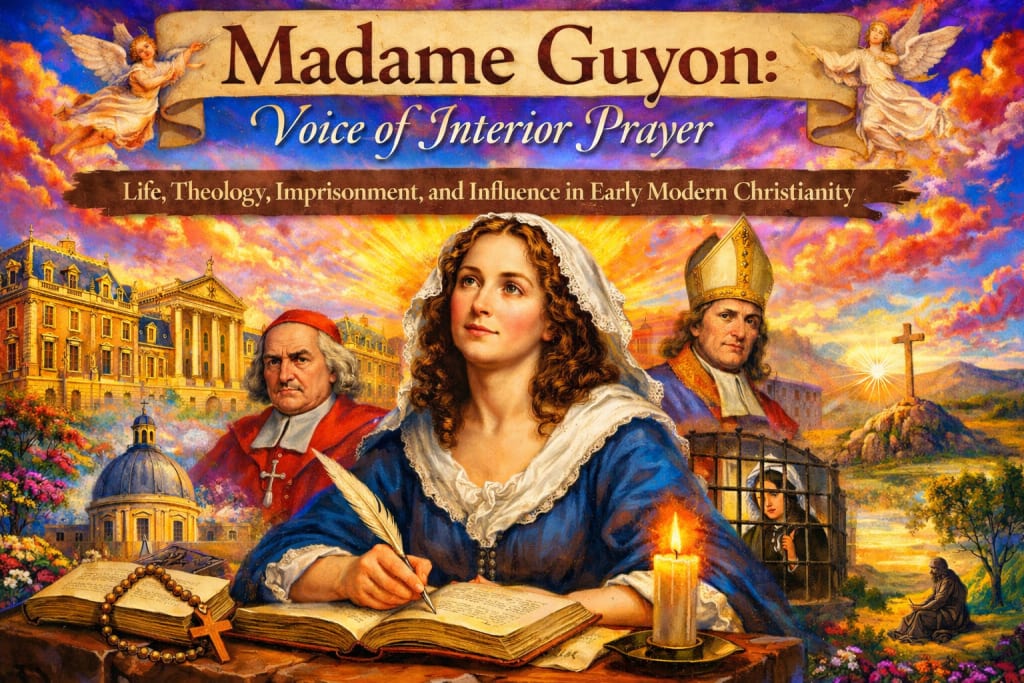
A Mystic Formed by Fire and Silence
Jeanne Marie Bouvier de la Motte Guyon, remembered in history as Madame Guyon, occupies a singular place in early modern Christian spirituality. Born in seventeenth century France during an age of religious consolidation, political absolutism, and theological anxiety, Madame Guyon emerged as a spiritual writer whose emphasis on interior prayer unsettled ecclesiastical authorities while quietly transforming countless readers. Within a culture shaped by ritual, hierarchy, and clerical mediation, Madame Guyon articulated a vision of spiritual life centered on inward stillness, surrender, and direct communion with God. That vision proved both magnetic and dangerous.
Madame Guyon lived at a moment when Catholic Europe remained deeply marked by the aftershocks of the Reformation and Counter Reformation. The French Catholic Church, closely allied with royal authority under Louis XIV, sought doctrinal uniformity and strict oversight of religious expression. Mysticism, though part of a long Christian tradition, increasingly drew suspicion when spiritual experience appeared to bypass institutional control. Against this backdrop, Madame Guyon’s insistence that divine union could be cultivated through quiet interior attention rather than elaborate spiritual effort placed established assumptions under strain. The result was admiration among spiritual seekers and alarm among theologians and bishops charged with guarding orthodoxy.
The roots of this spiritual vision lay not in rebellion but in suffering and discipline. Madame Guyon’s early life unfolded amid physical fragility, emotional hardship, and constrained autonomy. Childhood illness, a rigid education, and a marriage arranged without affection shaped an inner life marked by endurance and longing. Widowhood at a young age brought both freedom and vulnerability, opening a path toward intense spiritual devotion that unfolded outside convent walls. That path led through prolonged prayer, spiritual direction, and an increasing confidence that divine action required not striving but surrender.
Madame Guyon’s writings arose from lived experience rather than academic theology. Biblical commentaries, spiritual treatises, poetry, and letters conveyed a consistent conviction that transformation occurred through inward consent to divine presence. Language emphasized simplicity, silence, and abandonment of self directed will. Such themes resonated with readers across social classes, including laypeople with little access to formal theological education. At the same time, this accessibility provoked concern among clergy who feared moral passivity, doctrinal confusion, or erosion of sacramental authority.
The public response to Madame Guyon revealed deep fault lines within French Catholicism. Support from influential figures such as Madame de Maintenon brought temporary protection and broader exposure. Opposition from theologians such as Jacques Bénigne Bossuet framed the spiritual teachings as dangerous deviations from orthodox discipline. Imprisonment in multiple locations, including the Bastille, underscored the seriousness with which royal and ecclesiastical authorities regarded the perceived threat. Despite confinement, censorship, and sustained scrutiny, spiritual conviction remained unbroken, expressed in writing that continued even under severe restriction.
Madame Guyon’s significance extends beyond personal biography. The life and work illuminate enduring tensions between inner experience and external authority, between contemplative freedom and institutional order, and between women’s spiritual expression and male dominated religious structures. The reception of the writings across Catholic, Protestant, and later pietist circles demonstrates a reach that surpassed national and confessional boundaries. Long after death in 1717, the language of interior prayer continued to circulate, shaping devotional movements that valued inward attentiveness over external display.
Within the history of Christian mysticism, Madame Guyon represents neither isolated eccentricity nor marginal heresy. Instead, the legacy reflects continuity with earlier contemplative traditions while also revealing the costs of articulating such traditions in an era of heightened surveillance and doctrinal enforcement. The name Madame Guyon remains associated with courage under persecution, fidelity to spiritual insight, and a radical trust in divine action within the human soul.
Origins, Formation, and the Weight of Expectation
Jeanne Marie Bouvier de la Motte was born on April 13, 1648, in the town of Montargis in central France, during the early years of the reign of Louis XIV. The family belonged to the lesser French nobility and maintained social and legal connections to regional aristocratic networks. Though formally Catholic, the household reflected a climate shaped by lingering Protestant influence common in post Reformation France, particularly in regions where confessional boundaries had not yet fully settled. This environment fostered both religious seriousness and intellectual openness, conditions that quietly shaped an early disposition toward spiritual reflection.
Childhood was marked by persistent physical illness and emotional restraint. Contemporary accounts describe frequent sickness, long periods of isolation, and a temperament inclined toward inwardness rather than sociability. At an early age, Jeanne Marie Bouvier de la Motte was placed in convent settings for education, a common practice among families of status. These institutions functioned not only as schools but as centers of devotional formation, literacy, and disciplined routine. Instruction included reading, writing, catechesis, and exposure to structured prayer. Silence, obedience, and contemplation formed part of daily life. Within this environment, a pronounced sensitivity to spiritual experience emerged, accompanied by an early attraction to prayer that exceeded formal obligation.
The convent experience introduced a vision of religious life shaped by withdrawal from the world and dedication to divine service. This vision left a lasting impression. Desire for a religious vocation developed during adolescence, including a sustained interest in entering a cloistered order. Such aspirations, however, conflicted with family priorities. In seventeenth century France, marriage among noble families functioned as a social contract designed to preserve property, lineage, and influence. Personal inclination rarely governed such decisions, particularly for women. Family authority prevailed, and plans for a convent life were set aside.
At the age of sixteen, Jeanne Marie Bouvier de la Motte entered marriage with Jacques Guyon, Seigneur du Chesnoy, a widower more than twenty years older. The union reflected the customs of the period rather than emotional compatibility. Domestic life proved demanding and emotionally constraining. Chronic illness continued, compounded by the pressures of household management, childbirth, and social obligation. Several children were born, though not all survived infancy, a common tragedy of the era. The rhythm of family life imposed responsibilities that limited solitude and formal devotional practice. Despite these constraints, interior prayer persisted, often practiced quietly amid domestic duties rather than within structured religious settings.
Marriage exposed the tension between outward conformity and inward devotion. The absence of spiritual companionship within the household intensified reliance on silent prayer and private reading. Religious discipline during this period was not marked by public expression or theological experimentation but by endurance, restraint, and inward attentiveness. Spiritual longing deepened in proportion to suffering, shaping a religious sensibility grounded in patience rather than ecstasy.
The death of Jacques Guyon in 1676 brought decisive change. Widowhood occurred at the age of twenty nine and altered social status in ways both liberating and precarious. In early modern France, widows occupied a unique legal position. Control over property increased, personal movement faced fewer restrictions, and social autonomy expanded within defined limits. At the same time, vulnerability increased due to the absence of male protection. For Jeanne Marie Bouvier de la Motte Guyon, widowhood marked release from marital obligation and the beginning of deliberate spiritual reorientation.
Freed from domestic authority, religious devotion intensified. Extended periods of prayer, sustained reading of spiritual texts, and renewed engagement with devotional discipline characterized this phase. Mystical writings and devotional literature circulated widely during this period, particularly among educated lay Catholics seeking deeper spiritual experience outside monastic life. Engagement with these texts encouraged a spirituality centered on interior transformation rather than external performance. This inward turn did not arise from novelty or rebellion but from long familiarity with suffering, silence, and endurance.
By the late 1670s, a distinct spiritual identity had formed, shaped by illness, constraint, loss, and perseverance. Early experiences of confinement within both convent walls and domestic obligation contributed to a theology rooted in inward freedom rather than outward escape. The foundations of a spiritual path emphasizing interior surrender were laid not in defiance of tradition but through lived experience within its strictest boundaries.
Historical and Religious Context of Seventeenth-Century France
Seventeenth-century France was a period of extraordinary centralization of political power, cultural flourishing, and intense religious control. The reign of King Louis XIV, known as the Sun King, established a model of absolute monarchy in which the monarch wielded unprecedented influence over both secular and ecclesiastical affairs. Religious conformity became a key instrument of state policy, with the Catholic Church tightly intertwined with royal authority. The Edict of Nantes, which had previously granted limited toleration to Huguenots, was revoked in 1685, resulting in forced conversions and heightened suspicion of religious heterodoxy. This environment left little tolerance for divergent spiritual movements, particularly those perceived as undermining clerical authority or promoting unconventional forms of devotion.
The Catholic Church in France held enormous sway over social and intellectual life. Bishops and theologians monitored religious teaching closely, ensuring conformity with the decrees of the Council of Trent. Education and spiritual formation were largely mediated through ecclesiastical structures, with convents, monasteries, and seminaries serving as centers for both doctrinal instruction and moral discipline. Lay involvement in theological debate was rare, and spiritual authority was generally reserved for ordained clergy or religious figures with recognized institutional standing. Within this context, a laywoman articulating a systematic approach to mystical prayer was an unusual and potentially disruptive figure.
Quietism emerged as a notable spiritual trend in this era, emphasizing interior passivity, self-abandonment, and the surrender of personal will to divine guidance. Originating in Spain with figures such as Miguel de Molinos, Quietist ideas circulated widely among devout elites and mystically inclined communities, attracting both followers and critics. Church authorities, including the papacy and French bishops, condemned aspects of the movement for perceived theological errors and potential moral danger. Any association with Quietist thought risked suspicion of heresy, making engagement with interior prayer highly politicized.
Social structures and gender norms also shaped the reception of spiritual authority. Women’s roles in society were heavily circumscribed, particularly in relation to theological teaching and public instruction. Noble birth provided limited avenues for influence, yet avenues such as convent education or royal patronage were tightly regulated. A woman of intelligence and spiritual acuity navigating the intersections of family obligation, societal expectation, and mystical devotion faced both extraordinary opportunity and acute vulnerability. The visibility of a female mystic teaching outside traditional hierarchies challenged both ecclesiastical norms and social conventions, amplifying scrutiny and criticism.
Cultural life in France further informed spiritual discourse. The court at Versailles functioned as both a political and religious stage, where reputation and alignment with official orthodoxy determined access to patronage and protection. Intellectual currents, literary salons, and theological debate flourished in a climate that prized refinement, eloquence, and social navigation alongside personal piety. Spiritual innovation was possible, yet it required careful negotiation of courtly, clerical, and societal expectations.
Economic, familial, and local conditions also played a role in shaping religious experience. Education in convents, exposure to classical and theological texts, and opportunities for travel or correspondence enabled certain individuals to cultivate advanced interior spiritual practices. Conversely, pressures from marriage arrangements, household responsibilities, and local religious authorities limited the options for independent spiritual development. The interaction of personal devotion with these structural forces created a dynamic tension that would characterize much of Madame Guyon’s life.
Understanding this context illuminates the risks inherent in articulating and practicing a form of interior spirituality that emphasized personal experience over prescribed ritual, passive surrender over active exertion, and lay participation over clerical mediation. These social, religious, and political conditions provide the backdrop for both the achievements and the controversies of Madame Guyon’s life, highlighting how extraordinary devotion intersected with structures of authority in early modern France. This contextual awareness allows readers to grasp why her mystical theology was both revolutionary and controversial, and why the tension between interior experience and institutional oversight became central to her enduring legacy.
The Shaping of a Contemplative Vision
The spiritual formation of Madame Guyon unfolded through prolonged interior struggle, disciplined devotion, and exposure to currents of mystical theology circulating across seventeenth century Europe. This formation did not emerge within academic institutions or formal theological faculties but developed through lived experience, spiritual reading, and sustained prayer practiced under conditions of physical weakness and social limitation. The resulting spirituality bore the marks of suffering refined by attentiveness, producing a theology grounded in interior transformation rather than external observance.
During the latter decades of the seventeenth century, devotional literature emphasizing interior prayer circulated widely among educated lay Catholics. Works by earlier mystics such as Teresa of Ávila, John of the Cross, Francis de Sales, and Benedict of Canfield were read alongside more recent texts that explored interior recollection and abandonment to divine will. Within this context, The Spiritual Guide by Miguel de Molinos gained particular attention. Molinos, a Spanish priest active in Rome, articulated a theology of interior stillness that emphasized passive surrender and the quieting of human effort in prayer. Though Madame Guyon later rejected formal association with Molinos and denied direct reliance on his system, the intellectual climate shaped by Quietist controversy formed part of the environment in which spiritual ideas developed.
Quietism, as defined by ecclesiastical authorities, proposed that the highest stage of spiritual life consisted in complete passivity before God. According to this view, the human will ceased active striving, allowing divine grace to operate without resistance. Critics feared that such passivity diminished moral responsibility and undermined sacramental discipline. Defenders argued that surrender represented not indifference but perfect trust. Madame Guyon’s spirituality intersected with these debates while remaining rooted in personal experience rather than systematic doctrine. Interior prayer, as practiced and described, emphasized attentiveness, consent, and simplicity rather than philosophical abstraction.
A decisive influence during this period came through the guidance of François Lacombe, a Barnabite friar known for ascetic discipline and mystical inclination. Lacombe served as a spiritual director during the early 1680s and encouraged travel for both devotional retreat and spiritual instruction. Between 1681 and 1686, extended journeys took place through regions of France, Italy, and Switzerland, including stays in Geneva, Turin, Grenoble, and surrounding areas. These travels exposed Madame Guyon to diverse religious communities, pastoral environments, and devotional practices, reinforcing a sense of interior vocation independent of local custom.
During these years, written reflections on prayer and spiritual abandonment multiplied. Manuscripts circulated privately, often copied by hand and shared among those seeking guidance in contemplative practice. The central theme emphasized relinquishment of self directed striving in favor of inward attentiveness to divine presence. Prayer was described not as effortful meditation but as gentle repose, marked by silence, simplicity, and trust. Such ideas challenged prevailing models of spiritual progress that emphasized methodical asceticism, structured exercises, and clerical oversight.
Hospitality became an extension of spiritual practice. Private homes served as spaces for conversation, prayer, and instruction. Visitors sought counsel not through formal sermons but through quiet guidance shaped by lived experience. This mode of instruction departed from ecclesiastical norms that restricted theological teaching to ordained clergy or religious orders. The accessibility of such guidance, especially to women and laypeople, contributed to growing interest as well as suspicion.
One of the most influential texts to emerge from this period was A Short and Very Easy Method of Prayer. The work distilled years of lived devotion into clear, direct language accessible to readers without formal theological training. Emphasis rested on interior stillness, continual prayer of the heart, and receptive awareness of divine action. The text rejected elaborate techniques in favor of simplicity, presenting prayer as an inward turning available to all who sought sincerity rather than mastery. This accessibility accounted for the work’s rapid circulation and enduring appeal, while also provoking concern among authorities wary of unregulated spiritual instruction.
The mystical development of Madame Guyon reflected continuity with earlier contemplative traditions while articulating those traditions in language shaped by domestic life, suffering, and perseverance. Rather than withdrawing from the world into cloistered isolation, interior prayer unfolded amid travel, illness, hospitality, and correspondence. This fusion of contemplative depth with lay experience contributed to both the vitality and the controversy surrounding the spiritual vision that took shape during these formative years.
Quietism and Its Controversies
Quietism emerged in the seventeenth century as a mystical movement that emphasized total interior passivity and absolute surrender to the divine. It originated in Spain with the writings of Miguel de Molinos, whose treatise The Spiritual Guide advocated a form of prayer in which the individual ceased all self-directed striving and allowed God to act freely within the soul. Molinos’ ideas quickly attracted followers across Europe, particularly among the devout laity and certain members of religious orders seeking a direct and contemplative approach to God. While Quietism proposed an intensive inner discipline, church authorities feared that its emphasis on passivity could lead to moral neglect, spiritual self-deception, or rejection of ecclesiastical guidance. The movement became a focal point of theological controversy, culminating in the papal condemnation issued by Pope Innocent XI in 1687 through the bull Coelestis Pastor.
In France, the reception of Quietism was highly contentious. Its principles were viewed with suspicion because they appeared to minimize the importance of sacramental life, confession, and clerical mediation. Critics argued that extreme passivity could allow sinful impulses to persist unchecked, since individuals might interpret interior promptings as divine guidance without accountability. Theologically, Quietism challenged prevailing Aristotelian-influenced understandings of virtue, moral effort, and spiritual progress. Asceticism, meditation on scripture, and disciplined prayer had traditionally been understood as essential instruments of moral and spiritual formation. Quietist teachings disrupted this framework by prioritizing receptivity to God over active human exertion.
Madame Guyon became closely associated with Quietist thought, though she consistently maintained that her own teachings were distinct from Molinos’ doctrines. Her emphasis on interior prayer, stillness, and abandonment to God’s will reflected similar spiritual objectives, particularly the cultivation of divine union and the diminution of self-centered desire. Church authorities, however, perceived alignment with Quietism as problematic. Even indirect association with the condemned movement exposed individuals to scrutiny, surveillance, and the threat of censure. For a laywoman teaching spiritual practice independently, such scrutiny intensified both the theological and social pressures she faced.
The controversies surrounding Quietism also highlighted the role of gender in the evaluation of mystical authority. Male clerics and theologians dominated theological debate and had the authority to define orthodoxy, while women’s spiritual insight was often interpreted through the lens of suspicion. Madame Guyon’s writings and guidance circulated widely among lay believers and students of Saint-Cyr, provoking concern that her teachings encouraged spiritual autonomy outside male-controlled structures. Critics feared that enthusiastic followers might prioritize interior guidance over obedience to Church authority, potentially destabilizing both moral discipline and hierarchical order.
Quietist debates intersected with broader questions of power and institutional control. The movement underscored the tension between personal mystical experience and ecclesiastical oversight, revealing the challenges faced by those seeking to cultivate direct communion with God. While the principles of interior surrender offered profound spiritual insight, they also required careful interpretation and disciplined guidance to avoid misapplication. The controversies surrounding Quietism thus illustrate the delicate balance between the pursuit of mystical depth and the maintenance of doctrinal conformity in early modern Catholicism.
Madame Guyon’s engagement with Quietist principles positioned her at the center of these debates, even as she sought to define her theology as a pathway of interior prayer accessible to the laity. The debates contextualize subsequent events in her life, including her move to Paris, her interactions with influential patrons, and the ecclesiastical conflicts that eventually led to her imprisonment. Understanding Quietism and the controversies it generated is essential for grasping both the theological stakes of her work and the extraordinary courage required to articulate a vision of mystical devotion that challenged conventional structures of authority.
Analysis of Key Writings
The writings of Madame Guyon demonstrate a sophisticated and deeply structured approach to prayer, mystical theology, and interior transformation. The body of work includes treatises on contemplative prayer, autobiographical reflections, letters, biblical commentaries, and devotional poetry. Recurring themes throughout these writings include the primacy of interior surrender, the necessity of detachment from self-directed desire, and the transformative action of divine love within the soul. Close examination of these texts clarifies both the theological distinctiveness of this mystical vision and the practical methods offered for achieving spiritual depth within everyday life.
A Short and Very Easy Method of Prayer provides a concise and influential articulation of interior prayer. The work emphasizes stillness, simplicity, and attentive receptivity to divine presence. Structured guidance outlines a method of prayer in which transformation occurs through divine initiative rather than human effort. Practical instruction addresses obstacles such as distraction, attachment to self, and impatience, offering exercises designed to cultivate inner attention and surrender. This text has remained widely read for its clarity, providing laypeople and religious practitioners with accessible methods for contemplative engagement without requiring withdrawal from social or familial responsibilities.
The Autobiography of Madame Guyon presents an invaluable account of spiritual formation and theological reflection. Detailed narratives recount early education, marriage, widowhood, mystical experiences, and prolonged periods of institutional confinement. Beyond recounting events, the work communicates the internal logic of spiritual development: the interaction between personal suffering, disciplined prayer, and transformative mystical experience. The text also documents the tensions between interior devotion and external authority, illustrating the historical challenges faced by individuals pursuing radical contemplative practices.
The Complete Madame Guyon, edited by Nancy C. James, offers a comprehensive collection of letters, commentaries, devotional works, and manuscripts. The collection highlights the breadth of theological reflection and scriptural engagement, with particular attention to the Song of Songs as a metaphor for union between the divine and the soul. Scholarly annotation situates the writings within seventeenth-century religious and cultural contexts, emphasizing distinctions between this mystical approach and condemned aspects of Quietism. The volume demonstrates the integration of interior ethics, emphasizing moral alignment and spiritual formation emerging from inward consent rather than externally imposed rules.
Letters and personal correspondence reveal applied theology in guiding students, disciples, and spiritual seekers. These texts illustrate methods for cultivating interior growth while negotiating social expectations, gendered limitations, and ecclesiastical scrutiny. The correspondence demonstrates that mystical practice functioned as relational and adaptable, fostering development in diverse contexts.
Biblical commentaries and devotional poetry exemplify both exegetical skill and imaginative engagement with scripture. Allegorical interpretation conveys the dynamic relationship between divine love and the human soul, while poetic works evoke interior experience through vivid and emotive language. Together, prose and poetry construct a cohesive theological vision that unites reflective study, imaginative engagement, and practical guidance.
Collectively, these writings present a coherent and integrated approach to mystical practice. Experiential insight, scriptural reflection, ethical formation, and practical instruction converge to form a comprehensive framework for contemplative life. This body of work exemplifies an accessible path to interior transformation, while simultaneously challenging prevailing ecclesiastical structures and norms of spiritual authority. Detailed engagement with these texts illuminates the depth, originality, and enduring significance of this seventeenth-century mystical theology.
Paris, Patronage, and the Weight of Suspicion
The move to Paris in 1687 marked a decisive turning point in the life of Madame Guyon. Paris functioned as the intellectual, religious, and political center of France, where theological innovation attracted immediate scrutiny. Spiritual movements that flourished quietly in provincial settings often faced severe examination once introduced into the capital. Madame Guyon arrived in a city governed by close collaboration between the Catholic Church and the absolutist monarchy of Louis XIV, a regime committed to religious uniformity and wary of devotional expressions that escaped clerical control.
By the late 1680s, concern over Quietism had intensified throughout Catholic Europe. The publication of Coelestis Pastor in 1687 by Pope Innocent XI formally condemned propositions associated with Miguel de Molinos, particularly teachings that emphasized interior passivity and the suspension of human effort in prayer. Although Madame Guyon consistently denied direct dependence on Molinos and rejected identification with his system, theological overlap in language and emphasis proved sufficient to provoke suspicion. Ecclesiastical authorities increasingly interpreted interior prayer without structured mediation as a threat to moral discipline and sacramental theology. The climate in Paris was especially unforgiving, shaped by heightened vigilance following decades of confessional conflict.
Within this atmosphere, Madame Guyon’s growing circle of readers and spiritual correspondents attracted attention. Manuscripts circulated rapidly, and gatherings for prayer and instruction expanded beyond private homes into influential social networks. Such visibility proved dangerous. Informal spiritual authority exercised by a laywoman challenged established hierarchies and unsettled bishops tasked with enforcing doctrinal conformity. Accusations of doctrinal ambiguity and spiritual excess followed, leading to formal investigation.
A significant shift occurred through the patronage of Françoise d’Aubigné, known as Madame de Maintenon, the second wife of King Louis XIV. Madame de Maintenon held extraordinary influence at court and demonstrated sincere interest in moral reform and spiritual seriousness. Drawn to the emphasis on interior devotion, Madame de Maintenon offered protection and access to elite circles otherwise closed to non clerical spiritual teachers. This association elevated Madame Guyon’s profile while simultaneously intensifying scrutiny, as any religious influence connected to the royal household attracted immediate attention from ecclesiastical authorities.
In 1688, formal arrest followed. Detention occurred under ecclesiastical authority, reflecting the seriousness with which the teachings were regarded. Intervention by Madame de Maintenon secured release after several months, though the episode signaled the precariousness of continued activity in Paris. Rather than retreat, Madame Guyon entered a new phase of visibility through appointment at the Maison Royale de Saint Louis at Saint Cyr, an educational institution founded by Madame de Maintenon for daughters of impoverished noble families.
At Saint Cyr, responsibility centered on spiritual instruction rather than formal teaching. The environment valued moral discipline, devotion, and formation of character. Within this setting, contemplative prayer emphasizing interior stillness and attentiveness was introduced. Students encountered prayer as an inward disposition rather than a sequence of prescribed formulas. This approach resonated with many, fostering deep seriousness and reflection. At the same time, critics within clerical ranks expressed alarm. Concerns focused on the fear that interior prayer detached from structured catechesis encouraged subjectivism and weakened obedience to ecclesiastical authority.
Opposition intensified as reports circulated regarding devotional practices at Saint Cyr. Bishops and theologians questioned the appropriateness of mystical instruction for young women outside convent discipline. Anxiety increased over the perceived bypassing of clerical mediation and the elevation of interior experience over doctrinal formation. The convergence of royal patronage, female spiritual authority, and mystical theology proved combustible within the rigid religious framework of late seventeenth century France.
The Paris years thus combined unprecedented opportunity with escalating danger. Protection offered by proximity to power existed alongside relentless surveillance by theological authorities. Admiration and suspicion grew in equal measure, setting the stage for deeper conflict as institutional patience wore thin.
Theology, Authority, and the Crisis at Issy
The encounter between Madame Guyon and François de Salignac de la Mothe Fénelon marked one of the most consequential intersections of mysticism and ecclesiastical authority in late seventeenth century France. Fénelon, a priest of noble background, had already gained distinction as a theologian, spiritual writer, and tutor to the Duke of Burgundy, heir to the French throne. Educated within orthodox Catholic theology and admired for eloquence and pastoral sensitivity, Fénelon approached questions of prayer and spiritual perfection with intellectual rigor and moral seriousness. Engagement with the writings of Madame Guyon introduced a vision of interior prayer that resonated deeply with existing concerns about the limitations of purely external devotion.
Correspondence between Madame Guyon and Fénelon reveals sustained theological exchange focused on the nature of divine love, self abandonment, and the transformation of the will. Fénelon perceived in Madame Guyon’s spiritual language an articulation of disinterested love for God that echoed earlier mystical traditions, including elements found in Augustine, Bernard of Clairvaux, and Francis de Sales. This vision emphasized love purified of self interest and spiritual reward, a theme that appealed to Fénelon’s own pursuit of moral and spiritual perfection. Defense of this interior spirituality became increasingly public, drawing Fénelon into controversy not merely as a correspondent but as a theological advocate.
Opposition emerged forcefully through Jacques Bénigne Bossuet, Bishop of Meaux and one of the most powerful theological voices in France. Bossuet stood as a defender of doctrinal clarity, hierarchical order, and disciplined ascetic practice. Known for eloquent sermons and polemical strength, Bossuet viewed mystical theology with caution, particularly when mystical language appeared to diminish the role of effort, moral vigilance, or sacramental discipline. From this perspective, the teachings associated with Madame Guyon risked encouraging spiritual complacency and confusion between divine inspiration and personal inclination.
The disagreement between Fénelon and Bossuet extended beyond personal rivalry and reflected deeper tensions within Catholic spirituality. Bossuet emphasized gradual progress through disciplined effort, guided by ecclesiastical authority and doctrinal precision. Fénelon, while committed to orthodoxy, defended a form of mystical prayer that emphasized interior surrender and pure love. Madame Guyon’s writings stood at the center of this dispute, serving as both inspiration and lightning rod. The question was not merely whether mystical prayer belonged within Catholic tradition, but how such prayer should be defined, regulated, and taught.
These tensions culminated in the Conference of Issy in 1695, convened to examine the theological legitimacy of teachings associated with interior prayer and spiritual passivity. The conference brought together prominent church figures tasked with clarifying acceptable boundaries for mystical theology. Madame Guyon was not present, but the writings and practices attributed to this spiritual vision formed the basis of deliberation. Fénelon participated actively in defense of interior prayer, seeking to distinguish authentic mystical surrender from condemned Quietist excesses.
The outcome of the conference was the formulation of the Articles of Issy, a set of propositions intended to articulate an orthodox framework for mystical theology. These articles affirmed the value of interior prayer while rejecting absolute passivity, spiritual indifference, and neglect of moral responsibility. Bossuet interpreted the articles as a decisive correction of teachings associated with Madame Guyon. Fénelon, while formally accepting the articles, maintained that Madame Guyon’s core insights remained compatible with Catholic tradition when properly understood.
Although the Articles of Issy stopped short of formal condemnation, the impact was unmistakable. The documents provided theological justification for intensified scrutiny and emboldened critics who viewed Madame Guyon as a destabilizing influence. The conference exposed the fragility of mystical theology within an institutional context increasingly committed to control and uniformity. It also marked a turning point in the relationship between spiritual experience and ecclesiastical authority, demonstrating the limits of tolerance for religious expression that resisted precise doctrinal containment.
The conflict surrounding Issy revealed more than a disagreement between theologians. The episode illuminated structural anxieties concerning authority, gender, and spiritual legitimacy. A laywoman without formal theological credentials had become the focal point of debate among bishops, royal advisors, and leading intellectuals. The resulting crisis underscored the power of interior spirituality to unsettle established systems and exposed the risks faced by those whose religious insight transcended accepted boundaries.
Captivity, Endurance, and the Quiet Years at Blois
After the Conference of Issy, the position of Madame Guyon deteriorated rapidly. Support once extended by Madame de Maintenon diminished as political and ecclesiastical pressure intensified. The royal court, increasingly aligned with theological hardliners, viewed continued association with contested mystical teaching as a liability. In this climate, tolerance gave way to decisive action. In December 1695, an order of arrest was issued under the authority of King Louis XIV, marking the beginning of one of the most severe periods of confinement endured by a spiritual writer in early modern France.
Detention unfolded in stages. Initial imprisonment took place at the Visitation convent in Paris, followed by transfers to the convent of Saint Marie at Vincennes and later to the Bastille. Each location imposed varying degrees of isolation and restriction. The Bastille, reserved for prisoners considered politically or ideologically dangerous, symbolized the seriousness with which the case was treated. Confinement extended for nearly eight years, lasting until 1703. Throughout this period, access to writing materials was limited, correspondence was closely monitored, and movement was tightly controlled.
Autobiographical accounts and contemporary testimony describe harsh conditions marked by physical discomfort, psychological pressure, and repeated interrogation. Attempts were made to elicit recantation or admission of doctrinal error. Spiritual resolve was tested through isolation, intimidation, and deprivation. Despite these conditions, interior prayer continued, sustained without external support or formal religious practice. The endurance displayed during imprisonment became a defining element of the spiritual reputation that followed.
The severity of confinement reflected institutional anxiety rather than personal misconduct. No formal trial produced a definitive condemnation. Instead, prolonged detention functioned as a means of silencing influence and discouraging continued circulation of contested ideas. The absence of clear charges underscores the ambiguous status of mystical theology within the late seventeenth century Catholic Church, where suspicion alone could justify extreme measures. The imprisonment of a laywoman without clerical authority illustrated the extent to which interior spirituality was perceived as destabilizing within a tightly regulated religious order.
Release came quietly in 1703, without public vindication or formal apology. Conditions of freedom included continued surveillance and expectation of withdrawal from public spiritual activity. Madame Guyon chose retirement in the town of Blois, located along the Loire River. Life in Blois was marked by simplicity, physical frailty, and sustained interior discipline. Public teaching ceased, yet spiritual influence continued through correspondence and manuscript circulation. Letters addressed to readers across France, Switzerland, Germany, and the Netherlands offered guidance in prayer and encouragement rooted in lived experience rather than theory.
Writing resumed with renewed intensity. Biblical commentaries composed during this period reflected a contemplative reading of scripture shaped by years of silence and suffering. Psalms, the Song of Songs, and the Gospels received particular attention, interpreted through the lens of interior transformation and divine love. Poetry expressed themes of abandonment, trust, and inward freedom refined through loss. Devotional treatises expanded upon earlier insights while adopting a quieter, more reflective tone shaped by confinement and age.
Between 1712 and 1720, many of these writings were published, often without direct involvement in editorial decisions. Protestant communities, particularly within German Pietism, received the works with interest and sympathy. Translations circulated widely, extending influence beyond Catholic France. Despite continued controversy, the texts found readers seeking a spirituality grounded in inward attentiveness rather than institutional mediation.
The final years at Blois were marked by physical decline and continued spiritual discipline. Death occurred on June 9, 1717. Burial passed without ceremony, consistent with a life that ended far from court and controversy. Yet the quiet years following imprisonment proved decisive in shaping lasting influence. Endurance under confinement, refusal to renounce interior conviction, and continued generosity toward spiritual seekers secured a legacy defined not by institutional approval but by fidelity to an inward vision cultivated through suffering and silence.
Prayer as Interior Consent and Spiritual Transformation
The theological vision articulated by Madame Guyon centered on prayer understood as interior consent to divine action rather than disciplined exertion of the human will. Prayer, within this framework, functioned not as a technique to be mastered but as a state of attentiveness cultivated through simplicity, silence, and surrender. This understanding emerged from prolonged experience rather than speculative theology and reflected a conviction that transformation occurred through yielding rather than striving.
Interior stillness occupied a central place within this vision. Silence was not regarded as absence or emptiness but as a condition in which divine presence could act freely within the soul. Language describing prayer emphasized repose, quiet attention, and rest in God. Mental effort, imaginative meditation, and discursive reasoning were viewed as preparatory stages rather than the summit of spiritual life. When excessive effort ceased, prayer was believed to deepen into a wordless awareness marked by trust and availability.
Abandonment to divine will formed the ethical and spiritual core of this theology. Abandonment did not signify resignation or moral passivity but voluntary relinquishment of self directed desire. Personal ambition, spiritual pride, and attachment to religious success were identified as obstacles to authentic transformation. The highest state of prayer was described as a condition in which divine love operated without resistance, shaping intention and action from within. In this state, virtue arose not from effort alone but from interior alignment with divine movement.
Critics frequently misunderstood this emphasis as encouragement of indifference or moral neglect. Such concerns arose from fear that passive receptivity undermined ethical responsibility. The spiritual writings, however, consistently affirmed moral seriousness and interior vigilance. Abandonment did not abolish conscience or discipline but redirected attention from self generated holiness toward receptive fidelity. Moral action remained essential, yet such action flowed from interior transformation rather than anxious striving.
External practices retained value within this framework but were assigned secondary importance. Sacraments, scripture, and communal worship were respected as supports for interior life rather than substitutes for it. Ritual observance without inward consent was regarded as insufficient for transformation. Intellectual theology, while valuable, was considered incomplete when detached from lived experience. Theological knowledge served prayer best when subordinated to love rather than mastery.
This approach placed interior prayer within reach of lay believers living amid domestic responsibility and social obligation. Spiritual depth was no longer confined to cloistered life or advanced asceticism. Interior surrender could unfold within ordinary circumstances through attentiveness and trust. This emphasis challenged prevailing assumptions that serious mystical prayer required withdrawal from the world or formal religious vows.
The theology of interior surrender aligned with earlier Christian contemplative traditions while presenting them in accessible language shaped by lived hardship rather than monastic discipline. Continuity existed with figures such as Augustine, Bernard of Clairvaux, and Francis de Sales, all of whom emphasized love over effort. Distinctiveness emerged through insistence on simplicity and availability across social boundaries. The result was a spirituality that privileged interior freedom over external conformity and trust over control, offering a vision of prayer rooted in surrender rather than achievement.
Controversy, Authority, and the Challenge to Ecclesiastical Structures
The disputes surrounding Madame Guyon reflected profound tensions within seventeenth-century French Catholicism, touching on theology, authority, and gender. At the theological level, her emphasis on interior experience and surrender directly challenged prevailing conceptions of spiritual formation. Mainstream ecclesiastical teaching emphasized disciplined ascetic practices, structured devotional routines, and obedience to clerical guidance. Prayer was typically framed as a methodical exercise, with moral and spiritual progress monitored through confession, guidance from spiritual directors, and adherence to doctrinal instruction. In contrast, Madame Guyon advocated an interior path in which transformation arose primarily through quiet consent to divine action, a method that minimized formal ritual and de-emphasized clerical mediation.
Critics interpreted this approach as a potential avenue for spiritual disorder. Jacques Bénigne Bossuet, among the most influential theologians of the period, argued that such emphasis on passive interiority could lead to moral laxity and spiritual self-deception. The fear was that individuals might believe themselves guided solely by private inspiration, bypassing ecclesiastical oversight and sacramental discipline. To opponents, unchecked mystical enthusiasm risked eroding the hierarchical structure of the Church and fostering a form of religious individualism that appeared dangerously autonomous.
Institutional scrutiny intensified in part due to Madame Guyon’s gender. In seventeenth-century France, authority over theology and spiritual instruction was overwhelmingly male. Laywomen were rarely recognized as credible teachers of mystical or doctrinal truth. The combination of visibility, intellectual influence, and the bold articulation of interior spirituality provoked alarm. Teaching and correspondence that circulated widely, often beyond convent walls or formal ecclesiastical channels, amplified both admiration and hostility. In effect, spiritual authority exercised by a woman challenged both hierarchical and gendered assumptions embedded in institutional structures.
The institutional response included extensive surveillance, denunciation by theologians, and ultimately imprisonment. Confinement was justified not on the basis of public heresy but on perceived danger to ecclesiastical order and moral discipline. These measures demonstrated the capacity of religious authorities to control not only doctrinal teaching but also the social networks and literary circulation of spiritual influence. The response extended beyond Madame Guyon herself. François de Salignac de la Mothe-Fénelon, a supporter and correspondent who defended her approach to interior prayer, faced formal condemnation in 1699. The Church’s rebuke, while carefully framed to maintain doctrinal orthodoxy, reflected concern over the destabilizing effect of mystical theology when associated with lay and female authority.
The controversies illuminate larger tensions within French Catholicism at the turn of the eighteenth century. Debates over the nature of mystical experience, the role of interior prayer, and the legitimacy of lay teaching revealed fault lines between personal devotion and institutional oversight. The case of Madame Guyon exemplifies the challenges posed by innovative spiritual insight that operated outside conventional channels. It also underscores the intersection of religious authority, gender, and social hierarchy in determining what forms of spiritual expression were tolerated or suppressed. In this context, her writings and imprisonment become emblematic not only of theological debate but also of the struggle over who had the authority to define, teach, and authorize religious experience.
The enduring fascination with Madame Guyon lies in this intersection of theology, social structure, and personal courage. Opposition by figures such as Bossuet and formal censure of Fénelon highlight the stakes involved when mystical teaching challenged institutional norms. These controversies reveal the precarious position of individuals whose spiritual vision conflicted with the Church’s concerns for uniformity, discipline, and doctrinal control, demonstrating the profound tension between interior devotion and hierarchical authority that shaped early modern Catholicism.
Enduring Influence and Spiritual Legacy
The impact of Madame Guyon’s writings and spiritual practice extended far beyond the confines of seventeenth-century France, resonating across confessional and national boundaries. Within Catholicism, her mystical theology inspired devotion among laypeople and clergy alike, even as it provoked suspicion and censorship. Beyond Catholic circles, her works found particular resonance among Protestant communities, notably within German Pietism. Leaders such as August Hermann Francke incorporated her emphasis on interior prayer, surrender, and direct engagement with scripture into educational, devotional, and pastoral programs. Her biblical commentaries offered a model of reading that prioritized experiential understanding of God’s presence rather than solely doctrinal memorization, influencing generations of pietist teachers, ministers, and spiritual directors.
The enduring appeal of Madame Guyon’s vision lies in its universality. Interior prayer and contemplative surrender do not depend on monastic enclosure or clerical instruction, a quality that allowed her teachings to cross denominational boundaries. Practices emphasizing inward attentiveness, receptivity to divine action, and moral transformation through interior consent anticipate developments in later mystical and devotional movements. Quaker spirituality, emerging in the seventeenth century, reflects a similar focus on the inner light and the cultivation of direct communion with God, underscoring the wider relevance of her approach. Modern contemplative practice, including meditative and centering prayer traditions, demonstrates conceptual parallels in its emphasis on silence, interior stillness, and surrender as pathways to spiritual insight.
Madame Guyon’s influence also shaped the evolving understanding of the role of women in religious life. By exercising spiritual authority through teaching, correspondence, and writing, she challenged prevailing assumptions about who could guide others in matters of faith. The circulation of her works and her sustained mentorship of students and followers revealed the potential for female spiritual leadership in a context otherwise dominated by male clergy. This legacy continues to inform contemporary discussion of gender, authority, and access to spiritual practice within Christian communities.
Her life offers a case study in the dynamic tension between personal devotion and institutional control. The controversies surrounding her writings, the imprisonment that sought to silence her, and the formal condemnation of her supporters illuminate the ways in which ecclesiastical structures have historically responded to spiritual innovation. At the same time, the continued circulation of her texts after death demonstrates the resilience of ideas rooted in lived experience and the enduring hunger for approaches to spirituality that emphasize interior transformation over external compliance.
The writings of Madame Guyon retain relevance as living texts. Commentaries on scripture, devotional treatises, and letters convey insights into the cultivation of interior life that remain compelling for modern readers. Her emphasis on stillness, abandonment, and trust challenges habitual assumptions about the nature of prayer, moral effort, and the human relationship with the divine. Scholars, theologians, and spiritual seekers study her works both historically and practically, recognizing in them a model of devotion that combines intellectual rigor, experiential authenticity, and courage in the face of opposition.
Ultimately, the legacy of Madame Guyon demonstrates the enduring power of mystical theology to inspire transformation across generations. Influence extends not only through written works but also through the practices and communities shaped by those texts. By cultivating a vision of prayer that prioritizes interior surrender, she opened pathways for devotion that transcend institutional boundaries, cultural contexts, and historical moment. The resonance of her teachings among pietists, mystics, and modern contemplatives alike confirms that the central truths of interior transformation remain vital, challenging each generation to explore the depths of spiritual experience with courage, discipline, and openness to divine guidance.
Recommended Reading: #commissionearned
Autobiography of Madame Guyon by Jeanne-Marie Bouvier de la Motte Guyon
Composed during periods of confinement and spiritual reflection, this autobiography stands as the most direct testimony of Madame Guyon’s interior life and external trials. The narrative records early religious sensitivity, a constrained marriage, the freedoms of widowhood, and prolonged imprisonment under royal authority. Spiritual suffering and interior surrender are presented as lived realities rather than abstract ideals. The text reveals how prayer functioned as sustenance during isolation and interrogation. Descriptions of institutional pressure illuminate the broader conflict between mystical devotion and ecclesiastical control. This work anchors the blog’s theological themes in firsthand historical experience. The autobiography remains indispensable for understanding how interior prayer shaped an entire life.
A Short and Very Easy Method of Prayer by Jeanne Guyon
This influential work articulates a theology of prayer grounded in interior stillness, simplicity, and consent to divine action. Prayer is presented not as verbal effort or structured technique but as an inward turning of attention and love. Such accessibility disrupted prevailing spiritual hierarchies and generated suspicion among theologians concerned with discipline and order. The clarity of the text explains both its wide circulation and the controversy that followed. The book embodies the same principles that brought institutional scrutiny during Madame Guyon’s lifetime. Its themes directly support the blog’s examination of interior prayer as a transformative spiritual path. The work remains central to discussions of early modern mysticism.
Spiritual Torrents Jeanne Guyon
This work employs extended metaphor to describe the movement of the soul through successive stages of spiritual purification and divine action. Imagery of flowing water conveys both gentleness and force, suggesting transformation beyond conscious control. Interior surrender is depicted as dynamic rather than static, marked by loss, renewal, and increasing simplicity. The absence of scholastic structure allows experiential insight to take precedence over formal argument. Such expression clarifies why readers found vitality where critics perceived danger. The text offers one of the most vivid portrayals of mystical transformation in early modern spirituality. Its themes reinforce the blog’s analysis of lived contemplative theology.
Union with God Including Selected Poems Jeanne Guyon
This collection gathers poetic and devotional writings that reveal the affective dimension of Madame Guyon’s spirituality. Poetry becomes a vehicle for expressing intimacy, longing, and surrender that prose alone cannot fully capture. The language reflects deep interior states shaped by prayer rather than doctrinal formulation. Emotional vulnerability and theological confidence appear together in striking balance. These writings illuminate how mystical theology extended beyond instruction into artistic expression. The poems give voice to the inner life described throughout the blog. This volume enriches understanding of how interior prayer shaped both thought and imagination.
Arthur Lillie’s historical biography presents Madame Guyon as a figure shaped by conviction, controversy, and spiritual courage. The narrative situates her life within the political and religious tensions of seventeenth century France. Attention is given to relationships with major figures such as Fénelon and Bossuet. Theological conflict is explained in accessible language without diminishing its seriousness. Social expectations and gendered limitations receive careful treatment throughout the account. This biography complements the blog’s institutional and historical analysis. Lillie’s work helps readers see how personal spirituality intersected with public consequence.
Madam Guyon A Great Heroine Bessie G Olson
This biographical portrait emphasizes endurance, moral strength, and spiritual resolve. The narrative traces Madame Guyon’s development from early religious sensitivity through persecution and confinement. Interior prayer appears as a sustaining force rather than an abstract ideal. The author highlights courage in the face of isolation and misunderstanding. Historical context is presented with clarity and restraint. The tone humanizes a figure often reduced to theological dispute. This book aligns closely with the blog’s focus on lived mysticism under pressure.
Exploring the Life and Legacy of Madame Guyon
The life and writings of Madame Guyon offer an unparalleled window into the convergence of mystical devotion, theological reflection, and historical controversy. Her emphasis on interior prayer and surrender to the divine illuminates a spiritual path in which transformation arises not from ritual observance or intellectual mastery but from attentive, receptive engagement with God. The controversies surrounding her work reveal the tensions inherent in balancing personal devotion with institutional authority, illustrating how one individual’s pursuit of interior truth could challenge entrenched structures and provoke enduring debate. Her legacy is evident not only in the mystical traditions she influenced but also in broader conversations about the accessibility of spiritual experience beyond formal religious hierarchies.
Engaging with her writings directly is essential to understanding the subtlety and depth of her thought. The autobiography of Madame Guyon provides firsthand insight into her lived experiences, while her method of prayer offers practical guidance on cultivating interior stillness and consent to divine action. Complementary scholarly studies contextualize her life within the social, cultural, and ecclesiastical frameworks of seventeenth‑century France, illuminating both the personal and systemic forces that shaped her path. Modern biographies and comparative studies place her alongside other women mystics, highlighting the ways in which gender and societal expectation influenced reception of mystical authority. Each text presents a distinct lens through which to consider her contributions, inviting careful reading, reflection, and analysis.
For readers wishing to explore further, public libraries provide access to both primary and secondary sources without cost, making careful research both possible and reliable. Using library databases, interlibrary loans, and well‑established academic collections ensures engagement with vetted, credible materials. Caution is advised when consulting free online sources, as errors, incomplete texts, or unverified translations can distort historical and theological nuance. Engaging critically with sources, comparing editions, and seeking scholarly commentary enhances understanding and prevents misinterpretation.
The study of Madame Guyon extends beyond historical interest; it encourages reflection on the ongoing dynamics between spiritual insight and institutional structure, personal devotion and doctrinal authority, and the enduring role of mystical experience in shaping human understanding of the divine. Pursuing her works with patience and discernment opens opportunities for personal and intellectual growth. Readers are invited to explore her writings, contextual studies, and related mystical traditions, cultivating both historical knowledge and spiritual awareness. The journey into Madame Guyon’s world is therefore simultaneously scholarly, devotional, and transformative, offering lessons in perseverance, interior attentiveness, and the enduring relevance of mystical thought.
Engagement with her legacy is best approached as a careful dialogue with both text and context. Each recommended book provides a unique perspective, and by combining close reading, historical study, and critical reflection, readers can form a richer understanding of the life, thought, and enduring influence of this remarkable mystic.
About the Creator
Marcus Hedare
Hello, I am Marcus Hedare, host of The Metaphysical Emporium, a YouTube channel that talks about metaphysical, occult and esoteric topics.
https://linktr.ee/metaphysicalemporium
Keep reading
More stories from Marcus Hedare and writers in BookClub and other communities.
The Pentagram
A Symbol Older Than Written Memory The pentagram ranks among the oldest geometric symbols known to human civilization. Defined as a five-pointed star formed by a single unbroken line, the figure appears in material culture dating back more than five thousand years. Archaeological evidence places early examples in Mesopotamian inscriptions, where the form carried associations with celestial order, spatial direction, and authority. From those earliest appearances, the pentagram moved fluidly across cultures, languages, and belief systems, adapting its meaning while retaining its distinctive structure.
By Marcus Hedarea day ago in BookClub
My New Book is Finally Here
My poetry collection Beautiful and Brutal Things is done. It's actually done and finally published over 270 pages. Over a year of my life went into this book. More than a year, really. Long days at my computer, sometimes seven days a week because I couldn't stop even when I probably should have. Then two months of editing that felt harder than the writing itself. But it's finished, and I'm still standing, and the book is real.
By Tim Carmichael5 days ago in BookClub
7 Books That Don't Look Powerful Until You Read Them
Books can be deceptive. A plain cover or a modest title often hides profound insights, transformative ideas, or storytelling that lingers long after the last page. Some books may not look like much on a shelf, but once opened, they change the way we think, feel, or perceive the world. Below is a list of 7 books that don't look powerful until you read them.
By Diana Meresca day ago in BookClub




Comments
There are no comments for this story
Be the first to respond and start the conversation.