
Lupercalia: The Pagan Festival Reclaimed
From Rome to Satanism

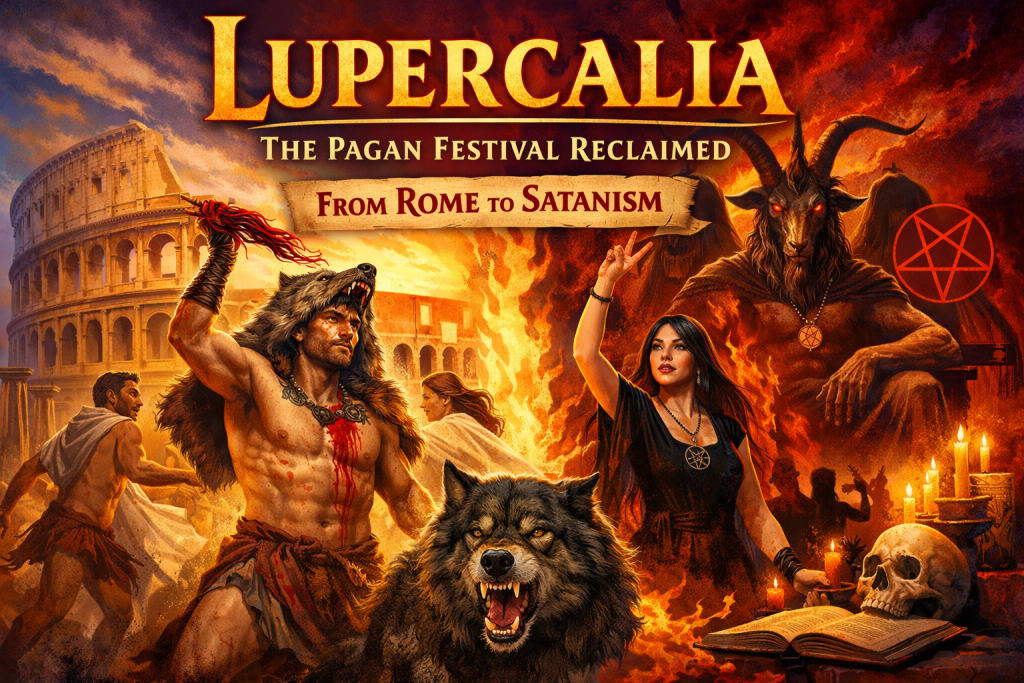
Lupercalia and the Ritual Life of Ancient Rome
Lupercalia endures as one of the most arresting festivals of the ancient Roman world, shaped by blood, myth, and the raw realities of survival in an early agrarian society. Observed annually on February 15, the festival occupied a liminal moment in the Roman calendar, positioned between the hardships of winter and the promise of renewal. Its rites addressed concerns that were immediate and physical: fertility of land and body, protection of the city, and the maintenance of cosmic and civic order.
The festival was anchored to the Lupercal, a sacred cave at the base of the Palatine Hill, traditionally identified as the place where the she-wolf sheltered and nursed Romulus and Remus. This mythic origin tied Lupercalia directly to Rome’s foundational narrative, reinforcing the idea that the city’s vitality depended on periodic acts of ritual renewal. The priests of the festival, known as the Luperci, were drawn from Rome’s elite and embodied a sanctioned inversion of decorum through ritual nudity, blood anointing, and ecstatic movement through the streets.
Animal sacrifice stood at the heart of Lupercalia. Goats, animals long associated with sexuality and vitality in Mediterranean cultures, were offered in ritual slaughter. Blood from the sacrifice was smeared across the foreheads of the Luperci and then wiped away with wool soaked in milk, a gesture interpreted by ancient writers as both purification and rebirth. From the hides of the sacrificed animals, strips called februa were cut and used during the ritual run, striking participants and bystanders alike. Far from being avoided, these blows were often sought after, particularly by women who believed the contact promoted fertility and eased childbirth.
Classical authors including Plutarch and Ovid recorded these practices with a mixture of fascination and unease, noting the festival’s persistence even as Roman society grew increasingly formalized. Lupercalia resisted sanitization. Its power lay in physical immediacy, public participation, and the deliberate crossing of boundaries between sacred and profane. The body was not treated as something to be subdued or concealed, but as an instrument through which communal and spiritual well-being were restored.
As Rome transitioned from polytheistic religion to Christian dominance, Lupercalia became a symbol of everything the new order sought to suppress. Church leaders condemned the festival as indecent and superstitious, yet its endurance into the late fifth century reveals how deeply embedded it was within Roman identity. Suppression did not erase its memory. Instead, Lupercalia became a cultural ghost, lingering in historical texts, seasonal symbolism, and later ideological reclaiming.
What remains striking is not merely the survival of Lupercalia in record, but the continued relevance of its core themes. Fertility, bodily autonomy, ritualized transgression, and resistance to imposed moral restraint remain points of tension in religious and philosophical discourse. Lupercalia stands as a reminder that ancient religion often confronted life directly, without abstraction or apology, and that such confrontations continue to unsettle modern sensibilities.
Lupercalia: Origins and Historical Context
The Ancient Festival
Lupercalia emerged from the earliest layers of Roman religious life, shaped by pastoral tradition, mythic ancestry, and the demands of communal survival. Celebrated annually on February 15, the festival occupied a critical position within the Roman calendar, a period associated with cleansing, transition, and preparation for the agricultural cycle ahead. February itself derives from februum, a term connected to purification rites, underscoring the seasonal importance of ritual cleansing in Roman thought.
The festival took its name from the Lupercal, a sacred cave located at the base of the Palatine Hill. According to Rome’s foundational myth, this cave served as the shelter where the she-wolf, or lupa, nursed the abandoned twins Romulus and Remus. This mythological association linked Lupercalia directly to the origin of Rome itself, framing the festival as an act of renewal not only for individuals but for the city as a living entity. The Palatine Hill, later home to imperial residences, reinforced the connection between religious ritual and political identity.
Central to the observance were the Luperci, a college of priests traditionally divided into two groups, the Luperci Fabiani and Luperci Quinctiales, named after prominent Roman families. Membership was drawn from the elite, emphasizing the civic importance of the rites. Despite aristocratic participation, the rituals themselves were marked by deliberate rejection of social restraint. This contrast reflected a belief that temporary disorder, when ritually controlled, restored balance to the community.
The purpose of Lupercalia extended beyond fertility in the narrow biological sense. Roman writers described the festival as a safeguard against disease, infertility, and civic stagnation. Purification of the city was understood as both physical and spiritual, ensuring divine favor and social continuity. The rites addressed anxieties surrounding reproduction, lineage, and survival, concerns that defined life in the ancient Mediterranean world.
Ancient sources such as Plutarch, Livy, and Ovid attest to the antiquity of Lupercalia, often presenting it as older than the Roman Republic itself. Even as Roman religion evolved and absorbed foreign influences, Lupercalia retained its archaic character. This persistence suggests that the festival fulfilled functions too fundamental to abandon, binding myth, body, and state into a single ritual expression.
Through Lupercalia, early Romans articulated a worldview in which purification required physical action, fertility demanded ritual acknowledgment, and civic identity depended upon reenacting sacred origins. The festival stood not as a symbolic abstraction, but as an embodied reaffirmation of Rome’s mythic and material foundations.
Ritual Practice
The ritual structure of Lupercalia was deliberately physical, visceral, and public. Ancient Roman religion did not separate belief from action, and nowhere was this more evident than in the rites performed by the Luperci. These ceremonies unfolded at the Lupercal cave and radiated outward into the city itself, transforming Rome into an active ritual space rather than a passive audience.
Animal sacrifice marked the formal opening of the festival. Goats were the primary offerings, selected for their long-standing associations with vitality, sexual potency, and untamed natural force within Mediterranean symbolism. Some ancient sources also record the sacrifice of a dog, an animal linked to guardianship and liminality in Roman religious thought. The shedding of blood was not incidental but essential, understood as the release of life force necessary for purification and renewal.
Following the sacrifice, the blood of the animals was applied to the foreheads of the Luperci. This act symbolized direct contact with the sacred and with death, an acknowledgment that renewal required confrontation rather than avoidance. The blood was then wiped away using wool soaked in milk, a substance associated with nourishment, infancy, and rebirth. Classical authors interpreted this sequence as a ritual cycle of death and restoration, reinforcing the festival’s function as a rite of regeneration rather than destruction.
From the hides of the sacrificed goats, strips of leather known as februa were cut. These ritual instruments gave February its name and embodied the concept of purification through contact. The Luperci, partially or fully unclothed, ran through designated routes of the city, striking those they encountered with the februa. Far from being an act of violence, this ritual contact was widely understood as beneficial. Women, in particular, often sought these blows, believing the touch would promote fertility, ease childbirth, and protect reproductive health.
The ritual run suspended ordinary social boundaries. Rank, gender, and decorum were temporarily set aside under religious sanction. This controlled inversion served a stabilizing function within Roman society, allowing collective release while reaffirming communal cohesion. The body was treated as an active participant in religious life, capable of receiving blessing through sensation rather than contemplation.
Following the public rites, sacrificial feasting and communal celebration reinforced the collective nature of the festival. Consumption of the sacrificial animals completed the ritual cycle, returning sacred offerings to the community in shared meals. This act reinforced reciprocity between human and divine forces, a central principle in Roman religion.
The fusion of purification (februatio) and fertility ritual reflected fundamental Roman concerns regarding continuity, survival, and prosperity. Agricultural renewal, healthy lineage, and civic stability were not abstract ideals but existential necessities. Lupercalia addressed these concerns through embodied action, ritual risk, and sanctioned transgression, revealing a religious worldview that embraced the physical realities of life as sacred rather than profane.
Through its rites, Lupercalia affirmed that renewal demanded engagement with blood, movement, and communal participation. The festival functioned as a reminder that order was not maintained through restraint alone, but through deliberate and ritualized encounters with chaos, fertility, and the limits of the human body.
Cultural Significance and Decline
Lupercalia occupied a singular position within Roman religious life, not only as a seasonal observance but as a reaffirmation of Rome’s archaic identity. The festival endured for centuries because it addressed foundational concerns of health, fertility, and civic continuity in ways that later, more regulated religious forms did not. Its persistence into the late Roman Empire demonstrates the resilience of ritual traditions rooted in embodied practice rather than abstract doctrine.
As Roman society evolved, Lupercalia increasingly stood in contrast to emerging moral and theological frameworks. The rise of Christianity introduced a worldview that emphasized restraint, spiritual purity, and the subordination of the body to moral law. Within this context, Lupercalia was interpreted by Christian authorities as an expression of pagan excess. Public nudity, animal sacrifice, and fertility rites conflicted with Christian teachings on modesty and sanctity, rendering the festival a visible symbol of religious resistance rather than simple tradition.
The official condemnation of Lupercalia occurred in the late fifth century during the papacy of Gelasius I. Correspondence from this period reflects concern not only with theological incompatibility but with the festival’s enduring popularity among Rome’s elite. Lupercalia was not a marginal folk practice but a public rite still capable of mobilizing collective participation. Its suppression represented an effort to consolidate religious authority and redefine acceptable expressions of sacred life.
Later popular narratives often claim that Lupercalia was directly replaced by the Christian feast of Saint Valentine. Historical scholarship, however, does not support a direct substitution. While both observances occupy adjacent dates in February, the romantic associations now linked to Valentine’s Day emerged much later, shaped by medieval poetry and courtly tradition rather than early Christian liturgy. The connection between the two reflects retrospective symbolism rather than historical continuity.
Although public observance of Lupercalia ceased, the festival did not vanish from cultural memory. Themes central to the rite, including fertility, renewal, and seasonal transition, continued to surface in folklore, literature, and symbolic observances tied to mid-February. The endurance of these motifs suggests that suppression altered the form of expression without erasing the underlying human concerns the festival addressed.
Lupercalia’s decline illustrates a broader pattern in religious history. Rituals grounded in physical experience and communal participation often outlast official sanction, reemerging in altered forms across time. The festival’s legacy persists not as a continuous tradition, but as a reminder of a world in which the sacred was encountered through the body, the city, and the deliberate crossing of boundaries imposed by social order.
Key Terms and Concepts
Lupercalia
An ancient Roman religious festival observed annually on February 15, rooted in rites of purification, fertility, and civic renewal. Lupercalia predates the Roman Republic and reflects pastoral traditions inherited from early Italic religion. The festival combined sacrifice, ritual movement, and sanctioned social inversion to restore balance within the city and its population. Classical sources such as Ovid and Plutarch describe Lupercalia as one of Rome’s most archaic and enduring observances.
Lupercal
A sacred cave located at the base of the Palatine Hill, traditionally identified as the site where the she-wolf sheltered Romulus and Remus. The Lupercal functioned as both a mythological and ritual focal point. Its association with Rome’s founders positioned the cave as a symbolic womb of the city, reinforcing ideas of origin, protection, and renewal. Archaeological and literary evidence confirms the cave’s long-standing religious significance.
Luperci
The priesthood responsible for conducting the rites of Lupercalia. The Luperci were traditionally divided into two colleges, the Luperci Fabiani and Luperci Quinctiales, named after prominent Roman lineages. Membership was restricted to elite males, underscoring the festival’s civic importance. Despite aristocratic status, the Luperci performed rites marked by ritual nudity, blood anointing, and ecstatic movement, reflecting a sanctioned suspension of social norms.
Februa
Strips cut from the hides of sacrificial goats and used during the ritual run of Lupercalia. The term februa derives from an ancient Latin root associated with purification and cleansing. These ritual implements gave rise to the name of the month February. Contact with the februa was believed to confer fertility, protection, and purification, especially in matters of reproduction and childbirth.
Februatio
The broader concept of purification within Roman religion, closely associated with the month of February and with rites intended to cleanse individuals, households, and the city as a whole. Februatio emphasized physical acts of cleansing rather than abstract moral repentance. Lupercalia functioned as one of the most visible expressions of this principle.
Purification
A central religious aim of Lupercalia, understood as the removal of spiritual, physical, and communal pollution. Purification was achieved through sacrifice, blood contact, ritual movement, and symbolic cleansing with milk. Roman purification rites addressed threats such as disease, infertility, and divine displeasure rather than personal moral guilt.
Fertility
A foundational concern of the festival encompassing agricultural productivity, human reproduction, and civic continuity. Fertility was not limited to biological reproduction but extended to the vitality of the state itself. Ritual contact with the februa and participation in the festival were believed to promote conception, ease childbirth, and ensure generational stability.
Sacrifice
The ritual killing of animals, primarily goats and occasionally dogs, as offerings to divine forces associated with protection and vitality. Sacrifice functioned as an exchange between human and divine realms, releasing life force necessary for renewal. Consumption of sacrificial meat reinforced communal bonds and completed the ritual cycle.
She-Wolf (Lupa)
The mythic animal associated with the founding of Rome and central to the symbolism of Lupercalia. The she-wolf represented protection, ferocity, and maternal nourishment. Her presence in the festival’s mythological framework linked wild nature to civic survival.
Ritual Inversion
A controlled suspension of ordinary social hierarchies and behavioral norms permitted during Lupercalia. Public nudity, physical contact, and the temporary breakdown of decorum served a stabilizing religious function. Such inversions were believed to release accumulated social tension and restore order through disruption.
Civic Religion
The integration of religious practice with political identity in ancient Rome. Lupercalia exemplified civic religion by involving elite participation, public ritual space, and mythic reinforcement of Rome’s origins. The festival affirmed the interdependence of religious observance and state continuity.
Archaic Roman Religion
An early form of Roman religious practice characterized by animism, pastoral symbolism, and embodied ritual. Lupercalia retained many archaic features even as Roman religion absorbed Greek and Eastern influences. Its survival into the late empire highlights its foundational role within Roman spiritual life.
Together, these terms reveal Lupercalia as a complex system of myth, ritual, and social function. The festival cannot be reduced to fertility spectacle alone. Instead, it represents a comprehensive religious response to the vulnerabilities of human life, seasonal transition, and the perpetual need for renewal within both body and state.
Timeline and Historical Development
Pre–Sixth Century BCE: Archaic Origins
The origins of Lupercalia extend beyond the limits of Roman written history and are generally understood to arise from early Italic and pastoral religious practices. These pre-urban traditions emphasized animal husbandry, seasonal cycles, and ritual purification as mechanisms for survival. The association with wolves, goats, and caves reflects an animistic worldview in which natural forces were directly engaged through ritual action. Later Roman authors consistently described Lupercalia as a festival inherited from a distant and semi-mythic past, reinforcing its status as one of Rome’s most ancient observances.
Sixth to First Century BCE: Republican Consolidation
During the Roman Republic, Lupercalia became firmly embedded within the civic and religious calendar. The festival was no longer solely pastoral in character but had evolved into a public rite tied to Roman identity and state continuity. The priesthood of the Luperci was formalized, and elite participation signaled the importance of the festival to political life. Despite increasing institutional structure, Lupercalia retained its archaic features, including ritual nudity, blood rites, and public participation, resisting the refinement seen in other Roman religious ceremonies.
44 BCE: Julius Caesar and Political Symbolism
One of the most historically documented moments associated with Lupercalia occurred in 44 BCE. During the festival, Mark Antony, acting in his capacity as a Lupercus, publicly offered Julius Caesar a diadem. Caesar’s refusal of the crown was a calculated political gesture, signaling rejection of kingship while exploiting the public visibility of the festival. This episode illustrates how Lupercalia functioned as a stage for political messaging as well as religious ritual, reinforcing its prominence within Roman public life.
Fourth to Fifth Century CE: Christian Opposition and Suppression
As Christianity gained dominance within the Roman Empire, Lupercalia increasingly came under scrutiny. Church leaders criticized the festival for its ritual nudity, animal sacrifice, and fertility symbolism, viewing these elements as incompatible with Christian moral theology. By the late fifth century, ecclesiastical authority moved toward formal prohibition. Pope Gelasius I explicitly condemned the festival, marking the effective end of its public observance. This suppression was part of a broader effort to dismantle pagan civic rituals that challenged emerging Christian norms.
Medieval Period and Cultural Memory
Although Lupercalia ceased to exist as an active religious festival, its symbolic residue persisted. Medieval writers occasionally referenced the festival when discussing pagan antiquity, often framing it as an example of moral excess. Seasonal themes associated with mid-February, including love, pairing, and renewal, continued to surface in folklore and later cultural practices. Modern scholarship emphasizes that these developments represent symbolic inheritance rather than direct ritual continuity.
Modern Reinterpretations: Lupercalia and Contemporary Satanism
The Satanic Temple and Symbolic Reclamation
In the late twentieth and early twenty-first centuries, Lupercalia experienced renewed visibility through reinterpretation rather than revival. Contemporary Satanic organizations, particularly The Satanic Temple, have adopted Lupercalia as a symbolic observance aligned with secular humanist values. Within this framework, the festival is presented as a celebration of bodily autonomy, sexual self-determination, and resistance to coercive moral authority.
The Satanic Temple explicitly frames Lupercalia as a “Hail Yourself” holiday, emphasizing personal sovereignty and self-respect rather than ancient sacrificial practice. This observance rejects literal reenactment of Roman ritual and instead draws selectively from Lupercalia’s symbolic associations with the body, fertility, and liberation from imposed restraint. The emphasis lies on affirmation of individual rights, particularly in matters of reproductive autonomy.
Contemporary Cultural Context
This modern interpretation reflects broader trends within non-theistic Satanism, which employs historical and mythological symbols as tools for philosophical expression and social critique. Lupercalia’s ancient confrontation with bodily reality and rejection of moral austerity make it particularly resonant within this context. The festival functions not as a claim to historical lineage, but as a deliberate act of symbolic reclamation.
Through this modern lens, Lupercalia becomes a site where ancient themes intersect with contemporary debates surrounding bodily freedom, consent, and personal agency. The transformation underscores how suppressed or marginalized rituals often reemerge as symbols within new ideological frameworks, shaped less by continuity than by relevance.
The timeline of Lupercalia reveals a festival continually reshaped by power, belief, and cultural need. From pastoral rite to civic ceremony, from suppression to symbolic revival, Lupercalia illustrates how ritual meaning evolves while core human concerns remain unchanged.
Misconceptions and Clarifications
Lupercalia is frequently misunderstood through the lens of modern religious and cultural assumptions. One of the most persistent misconceptions is the belief that the ancient Roman festival possessed any direct connection to Satanism or to a figure resembling the Christian concept of Satan. No such association existed within Roman religious thought. Lupercalia developed within a polytheistic framework that predates Christianity and the later theological construction of Satan as a singular embodiment of evil.
Ancient Roman religion operated through a complex system of deities, spirits, and numinous forces tied to nature, ancestry, and civic order. The rites of Lupercalia were addressed to protective and generative forces associated with fertility, pastoral life, and the safeguarding of the city. The wolf symbolism central to the festival derived from Rome’s foundational myth and carried no adversarial or infernal meaning. Interpreting Lupercalia through a Christian moral binary imposes a retrospective framework that did not exist at the time of its practice.
Modern associations between Lupercalia and Satanism arise from reinterpretation rather than historical lineage. Contemporary Satanic organizations engage with Lupercalia symbolically, selecting elements that align with modern philosophical values such as bodily autonomy, personal sovereignty, and resistance to moral authoritarianism. This process reflects a broader pattern of cultural reclamation rather than an attempt to revive ancient Roman religion in its original form.
Another common misunderstanding involves the assumption that modern observances seek historical authenticity. In reality, contemporary interpretations explicitly reject literal reenactment of Roman sacrifice, ritual nudity, or blood rites. The emphasis lies on meaning rather than replication. Lupercalia functions as a symbolic reference point, not as an unbroken tradition preserved across centuries.
Confusion also arises from popular claims that Lupercalia was directly transformed into later Christian holidays. While chronological proximity has encouraged speculation, scholarly research indicates no direct institutional replacement. Such narratives reflect modern storytelling impulses rather than evidence-based history.
Clarifying these distinctions is essential for understanding both the ancient festival and its modern adaptations. Lupercalia belongs to a pre-Christian religious world shaped by agricultural necessity, mythic origin, and embodied ritual. Contemporary Satanic observances belong to a secular, pluralistic environment that employs historical symbolism to express modern ethical and political commitments. Treating these as separate cultural phenomena allows for a more accurate and respectful engagement with both.
Understanding Satanism: An Overview
Definitions and Diversity
Satanism refers to a broad and internally diverse set of religious, philosophical, and cultural movements rather than a single unified belief system. The term encompasses traditions that treat Satan as a literary symbol, a philosophical archetype, or, in some cases, a literal supernatural entity. What unites these varied expressions is not doctrine, but the use of Satan as a figure associated with opposition, autonomy, and challenge to imposed authority.
Historically, Satanism as a self-identified movement is a modern phenomenon. Prior to the twentieth century, accusations of Satan worship were largely polemical tools used by religious authorities against perceived heretics, political enemies, or marginalized groups. Documented, organized Satanic traditions did not exist in antiquity or the medieval period. Modern Satanism emerged in the United States during the mid-twentieth century, shaped by secularism, countercultural movements, and renewed interest in individualist philosophy.
Contemporary scholars generally distinguish between symbolic or non-theistic Satanism and theistic Satanism. Each category contains further variation, reflecting differing views on metaphysics, ritual, ethics, and the role of religion in public life.
LaVeyan Satanism
LaVeyan Satanism represents the earliest organized form of modern Satanism. Founded in 1966 by Anton Szandor LaVey with the establishment of the Church of Satan in San Francisco, this tradition frames Satan as a symbolic representation of human instinct, self-interest, and rebellion against ascetic moral systems. LaVeyan Satanism explicitly rejects belief in supernatural beings, including a literal Satan.
The philosophical foundation of this tradition draws heavily from individualist thinkers such as Friedrich Nietzsche, Ayn Rand, and social Darwinist ideas prevalent in mid-twentieth-century American culture. Central values include personal sovereignty, rational self-interest, skepticism toward spiritual claims, and rejection of altruism when framed as moral obligation.
The Satanic Bible, published in 1969, serves as the primary text of LaVeyan Satanism. The book combines philosophical essays, ritual templates, and symbolic declarations such as the Nine Satanic Statements and the Eleven Satanic Rules of the Earth. Ritual within this framework is understood as psychodramatic expression rather than spiritual invocation, designed to focus will and emotional release rather than commune with external forces.
LaVeyan Satanism positions itself as a religion of the self, asserting that human beings are inherently animal and should embrace rather than deny instinctual nature. Moral frameworks are situational rather than universal, grounded in personal responsibility rather than divine command.
Theistic Satanism and Luciferian Traditions
In contrast to symbolic forms, theistic Satanism includes traditions that regard Satan, Lucifer, or related figures as literal spiritual beings. These belief systems are not unified and often lack centralized organization. Practices and theology vary widely, ranging from devotional worship to esoteric exploration influenced by ceremonial magic, Gnosticism, and left-hand path traditions.
Luciferianism is sometimes grouped within or adjacent to theistic Satanism, though distinctions exist. Luciferian traditions often emphasize enlightenment, knowledge, and self-deification, drawing inspiration from classical, Gnostic, and Romantic interpretations of the Lucifer myth. In these frameworks, Lucifer is viewed less as an adversary and more as a liberator or bringer of wisdom.
Theistic Satanic traditions frequently incorporate ritual magic, invocation, meditation, and symbolic cosmologies. Ethical systems tend to emphasize self-mastery, personal evolution, and conscious opposition to perceived spiritual authoritarianism. These paths remain relatively small and decentralized, with practices shaped by individual interpretation rather than institutional doctrine.
Rationalist and Non-Theistic Satanism
Rationalist Satanism encompasses non-theistic approaches that emphasize reason, skepticism, and ethical autonomy without reliance on supernatural belief. While LaVeyan Satanism occupies this category, other movements have emerged that depart from LaVey’s social philosophy while maintaining symbolic use of Satan.
Within rationalist frameworks, Satan functions as a metaphor for questioning authority, defending personal freedom, and affirming bodily autonomy. Religious symbolism is employed deliberately, often to critique the privileging of dominant religious traditions within public institutions. Ritual expression is valued for psychological, cultural, or communal significance rather than spiritual efficacy.
The Satanic Temple
The Satanic Temple represents a distinct contemporary expression of non-theistic Satanism founded in 2013. Unlike the Church of Satan, this organization emphasizes collective activism, secular governance, and legal advocacy. Satan is employed as a literary and cultural symbol representing resistance to tyranny, defense of minority rights, and commitment to reason and compassion.
The Satanic Temple articulates its values through a set of Seven Fundamental Tenets, which prioritize bodily autonomy, justice, scientific understanding, and personal freedom aligned with the well-being of others. These tenets function as ethical guidelines rather than commandments.
Ritual within this movement is expressive and communal, often designed to foster solidarity, emotional processing, or symbolic protest. Practices are explicitly non-theistic, and the organization publicly rejects belief in a literal Satan. Legal activism forms a central component of its identity, particularly in efforts to challenge religious privilege in public spaces and defend reproductive rights under the framework of religious liberty.
Satanism as Cultural and Philosophical Expression
Across its forms, modern Satanism functions less as a continuation of ancient religious practice and more as a response to contemporary social, political, and ethical concerns. Whether symbolic or theistic, Satanic traditions engage with themes of autonomy, resistance, identity, and the limits of moral authority.
Understanding Satanism requires careful distinction between historical myth, religious polemic, and self-identified practice. Modern Satanism is a product of the twentieth and twenty-first centuries, shaped by secularization, pluralism, and ongoing debates over individual rights and religious power. Treating Satanism as a diverse and evolving set of traditions allows for a clearer understanding of how ancient symbols are repurposed to address modern realities.
Key Influences on Lupercalia Interpretation
Interpretations of Lupercalia have been shaped as much by later cultural frameworks as by the ancient festival itself. Historical distance, religious transformation, and evolving social values have all contributed to how Lupercalia is remembered, misunderstood, and reimagined. Scholars emphasize that many popular associations attached to the festival reflect retrospective interpretation rather than documented continuity.
One of the most persistent influences on modern understanding is the assumed connection between Lupercalia and Valentine’s Day. While both observances occupy mid-February, academic consensus holds that the relationship is chronological rather than genealogical. Lupercalia ceased as a public festival by the late fifth century, while Valentine’s Day did not acquire romantic significance until the High Middle Ages. Literary works by figures such as Geoffrey Chaucer played a decisive role in linking February 14 with courtship and romantic pairing. No evidence supports the claim that Christian authorities deliberately transformed Lupercalia into a celebration of romantic love.
Another significant influence comes from Christian polemical sources that framed Lupercalia as morally transgressive and socially dangerous. These critiques emphasized ritual nudity, animal sacrifice, and fertility symbolism while ignoring the festival’s role in civic cohesion and public health. Such portrayals shaped later historical narratives, encouraging interpretations that reduce Lupercalia to spectacle rather than recognizing its function within Roman religious life.
Enlightenment-era scholarship introduced additional layers of interpretation by treating Roman religion as a subject of antiquarian curiosity. During this period, Lupercalia was often presented as an example of primitive superstition, reinforcing linear narratives of religious progress. These frameworks downplayed the sophistication of Roman ritual logic and its integration with political and social structures.
Modern reinterpretations are further influenced by contemporary philosophical and political concerns. Secular humanism, bodily autonomy discourse, and critiques of institutional authority have shaped how Lupercalia is reclaimed in modern contexts. Within non-theistic Satanic movements, the festival’s emphasis on the body and ritualized transgression resonates with broader commitments to self-determination and resistance to moral absolutism.
Media representation also plays a role in shaping public perception. Simplified explanations, sensationalized imagery, and algorithm-driven content often detach Lupercalia from its historical complexity. These portrayals contribute to persistent myths while obscuring the nuanced relationship between ancient practice and modern symbolism.
Interpretive frameworks surrounding Lupercalia therefore reflect the values and anxieties of each historical period that encounters it. From Christian condemnation to romantic speculation to symbolic reclamation, each layer reveals more about the interpreter than the original rite. Understanding these influences allows Lupercalia to be approached as a historical phenomenon shaped by ongoing reinterpretation rather than a static relic frozen in antiquity.
Recommended Reading: #commissionearned
The Lupercalia by Alberta Mildred Franklin
This in-depth work provides a thorough examination of the ancient Roman festival of purification and fertility, reconstructing its rituals, mythic foundations, and civic importance. The book analyzes the roles of symbolic animals, particularly the wolf and goat, and explores their significance in early Italic religious culture. It situates Lupercalia within the broader network of Mediterranean seasonal rituals, emphasizing continuity and cultural logic. Franklin highlights the festival’s connection to Rome’s foundation myths and the Palatine cave, linking ritual practice to civic identity. The book provides insight into how purification and fertility rites shaped communal life and maintained social cohesion. Its detailed scholarship helps modern readers understand why the festival’s themes continue to resonate. This print edition is widely available, making it a reliable resource for study.
Wolves of Rome: The Lupercalia from Roman and Comparative Perspectives
This scholarly study contextualizes Lupercalia within Roman myth, ritual, and comparative Mediterranean practices. The book explores how the festival integrated civic, seasonal, and symbolic concerns, connecting mythic narrative with embodied ritual performance. Detailed attention is given to purification rites, fertility symbolism, and the relationship between humans and animals in ritual. The text examines the festival’s endurance, even as official religious structures changed, showing how cultural memory preserves essential ritual motifs. It provides a nuanced understanding of Lupercalia’s role in shaping Roman identity and influencing later interpretations. The book’s approach illuminates why modern groups may reclaim elements of the festival symbolically. Available in print, it serves as a valuable resource for deeper exploration.
The Satanic Bible by Anton Szandor LaVey
This foundational text of modern Satanism presents a philosophy of self-empowerment, personal responsibility, and symbolic rebellion against imposed moral authority. Satan is framed as an archetype of human instinct rather than a supernatural being, allowing for practical application of ritual and philosophy. The book combines essays and ritual instructions designed as expressive psychodrama to focus emotion and will. Its philosophical perspective informs modern reinterpretations of ancient festivals like Lupercalia, emphasizing autonomy, bodily affirmation, and symbolic engagement. The text is central to understanding how secular Satanic thought repurposes ancient ritual motifs. The paperback edition remains widely available, providing a primary reference for modern Satanic philosophy.
The Little Book of Satanism: A Guide to Satanic History, Culture and Wisdom by La Carmina
This accessible guide traces the evolution of Satanic imagery from biblical and medieval demonization to contemporary philosophical and symbolic practice. It emphasizes the transformation of Satan from an adversary into a figure of resistance, personal freedom, and ethical autonomy. The book clarifies misconceptions and situates modern movements within cultural and historical context. Its coverage includes contemporary organizations and explores how symbolic ritual is used for identity and empowerment. Themes of transgression, bodily autonomy, and ritual expression connect directly to the reinterpretation of ancient festivals like Lupercalia. This print edition makes it an approachable resource for both general readers and researchers.
The Satanic Witch by Anton Szandor LaVey
This text explores applied psychology, social influence, and ritualized personal strategy, often referred to as “lesser magic.” LaVey emphasizes conscious awareness, self-empowerment, and the symbolic use of ritual to affect perception and social dynamics. While controversial, the work parallels the embodied and performative nature of ancient rites, illustrating how symbolic action functions outside literal supernatural belief. The themes of personal agency, ritual intention, and societal engagement resonate with modern reinterpretations of Lupercalia. Its print edition is available and provides insight into the intersection of symbolic ritual and secular philosophy.
The Satanic Rituals by Anton Szandor LaVey
This companion to The Satanic Bible presents a series of structured ceremonies designed for communal engagement, symbolic expression, and psychological focus. The rituals explore themes of identity, empowerment, and controlled transgression, mirroring the performative aspects of ancient rites. By focusing on the social and symbolic dimensions of ritual rather than supernatural belief, the book provides a framework for understanding modern reinterpretation of ceremonial practice. Its print edition ensures accessibility for those studying ritual function, symbolism, and the role of performance in spiritual and philosophical contexts.
This concise print edition introduces readers to the history, practice, and cultural significance of the Roman festival. It covers purification rites, fertility symbolism, and the mythic narratives surrounding the Palatine cave and Rome’s foundation. The book bridges academic research and accessible storytelling, making complex ritual and historical material understandable for a wide audience. It highlights how Lupercalia’s themes of renewal, bodily engagement, and seasonal transition persisted in cultural memory. This edition serves as an entry point for readers exploring both ancient ritual and modern symbolic reinterpretation.
Unlocking the Legacy of Lupercalia
Lupercalia stands as a vivid example of how ritual, symbolism, and cultural memory persist across centuries. From its origins as a Roman festival of purification, fertility, and civic identity to its reinterpretation in modern philosophical and secular contexts, the festival demonstrates the enduring human engagement with bodily ritual, renewal, and symbolic expression. Its transformation illustrates that meaning is not fixed but evolves as societies adapt practices to reflect contemporary values, beliefs, and ethical priorities.
Fully understanding Lupercalia requires careful study of both the historical record and modern reinterpretation. Classical texts, archaeological evidence, and scholarly research illuminate the festival’s role within Roman religious life, while modern analyses of ritual, symbolism, and philosophical thought reveal how these motifs are reclaimed today. Observing the relationship between ancient practice and modern symbolic use allows for a nuanced appreciation of ritual as both lived experience and enduring symbol.
Readers are encouraged to actively explore the subject through primary sources, historical studies, and contemporary writings. Examining the festival from multiple perspectives, historical, cultural, and philosophical, offers deeper insight into the ways societies construct meaning, assert identity, and negotiate social and spiritual life through ritual. Independent research cultivates critical thinking and prevents oversimplified narratives or popular misconceptions from dominating understanding.
By investigating the many layers of Lupercalia, from the archaic rites in the Palatine cave to its symbolic presence in modern philosophical movements, individuals can appreciate the continuity of human creativity, the evolution of belief, and the persistent power of ritual in shaping cultural imagination. Engaging with this history thoughtfully ensures that fascination with Lupercalia is grounded in evidence, reflection, and informed interpretation.
About the Creator
Marcus Hedare
Hello, I am Marcus Hedare, host of The Metaphysical Emporium, a YouTube channel that talks about metaphysical, occult and esoteric topics.
https://linktr.ee/metaphysicalemporium
Keep reading
More stories from Marcus Hedare and writers in BookClub and other communities.
Psychic Vampirism: The Energetic Predator in Occult Tradition
Entering the Realm of Subtle Predation Psychic vampirism holds a curious position in occult tradition and metaphysical research. Ancient stories, ethnographic accounts, and ceremonial writings describe encounters with forces that weaken vitality without a single physical mark. Popular culture often portrays this idea as melodramatic superstition, yet older teachings reveal a phenomenon rooted in subtle energy theories, ritual experience, and long standing observation of human behavior.
By Marcus Hedare9 days ago in BookClub
7 Books To Get Insanely Inspired
In a world that constantly demands more of our time, energy, and creativity, inspiration is no longer a luxury—it’s a necessity. We all reach moments when motivation runs dry, clarity feels distant, and our inner fire flickers. At those crossroads, the right book can act like a spark to dry tinder, reigniting purpose and direction almost instantly.
By Diana Meresc6 days ago in BookClub



Comments
There are no comments for this story
Be the first to respond and start the conversation.