
Literary Secrets of Sylvia Plath
The Bell Jar

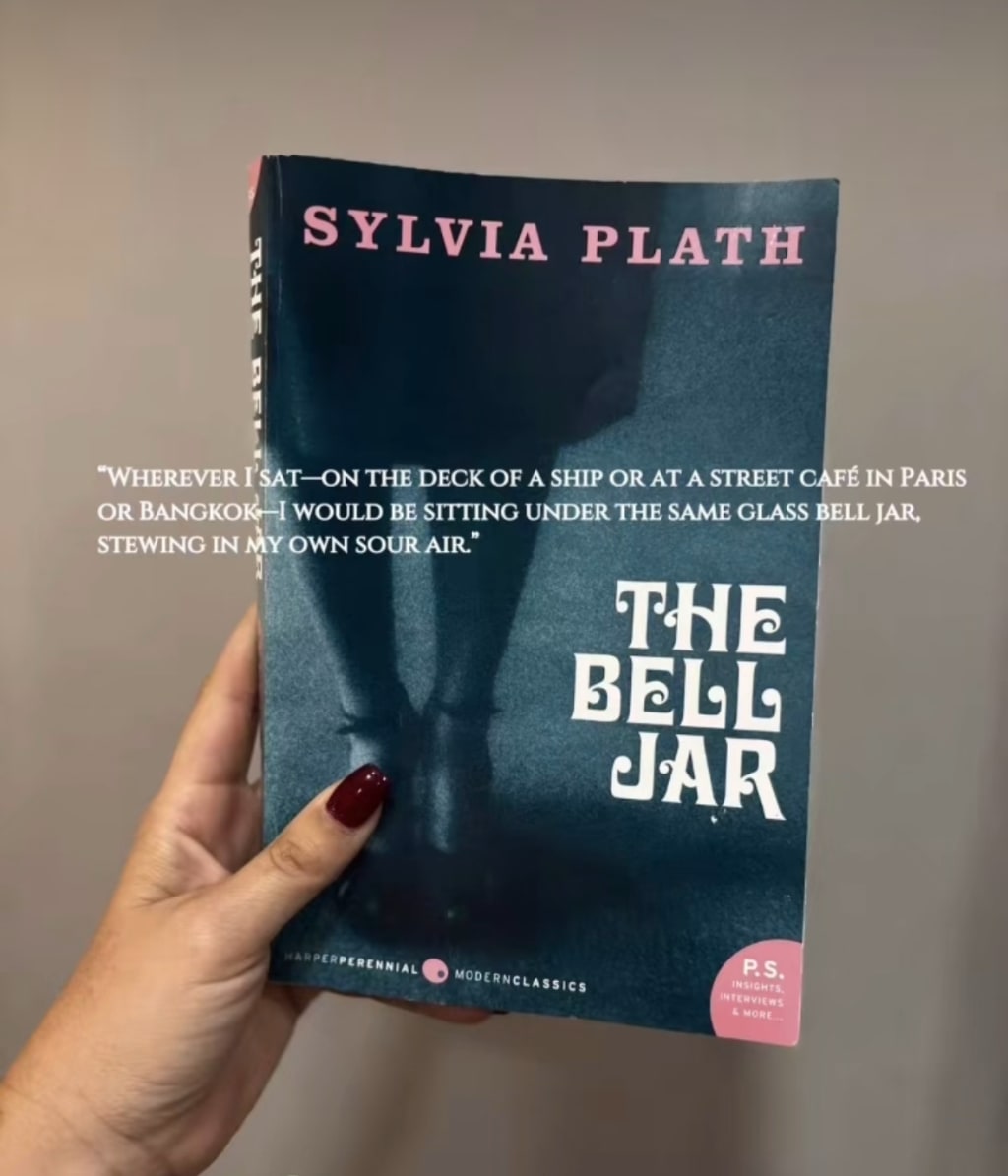
“Wherever I sat, on the deck of a ship or at a street café in Paris or Bangkok—I would be sitting under the same glass bell jar, stewing in my own sour air.”
This is one of those books where I grabbed a highlighter and couldn’t stop. Nearly every page offered a sentence that felt like a secret, something only someone who’s lived it could understand at first glance. Take this line, for example:
“I felt very still and very empty, the way the eye of a tornado must feel, moving dully along in the middle of the surrounding hullabaloo.”
Here, Esther Greenwood (Plath) describes the sensation of dissolving into time, a trauma response often known as the “freeze” state. Dissociation. Stillness disguised as survival.
To give a brief overview, The Bell Jar is a semi-autobiographical novel by poet and writer Sylvia Plath. It recounts her experiences during a summer writing fellowship in New York City. Originally published under the pseudonym Victoria Lucas, the book was Plath’s attempt to shield herself and her family from the backlash of writing about subjects still considered taboo at the time, namely, suicide, depression, and mental illness. That is, until Plath.
By 1972, the women’s movement was gaining momentum. Confessional literature was in Vogue, and The Bell Jar became a landmark in mental health discourse. In the foreword of the novel, New Yorker writer Janet Malcolm calls it “a fine evocation of what madness is actually like.”
Plath’s poetry collection Ariel is often interpreted as a series of poetic suicide notes. While her husband’s infidelity contributed to her emotional collapse, it wasn’t the root of her suffering. Plath had been battling severe mental illness long before. In The Bell Jar, she recounts electroshock therapy and her time in a psychiatric ward with vivid imagery.
Even from the very first page, Plath’s mental state shows in her writing language. Esther’s thoughts dart from one topic to another, scattered, intense, often painfully self-aware. There are shades of ADHD, depression, and extreme emotional sensitivity. But that’s what makes this novel so striking. Plath’s fearless ability to tap into her emotions and render them in language is why the book prospers.
Esther is a young, intellectual woman unafraid to say what others wouldn’t, especially in an era when admitting you were “crazy” wasn’t brave it was social suicide. And that’s why I love her. Because she was undeniably saying, “This is me. Take it or leave it.”
She had to travel deep within herself to identify—publicly—as a disaster. And that’s what makes me grieve. That’s where the mourning begins, to walk beside another woman’s thoughts and witness how deeply she internalized a negative view of herself, and worse, how she came to accept it.
“I’m broken, ugly, crazy,” she seems to believe. In Chapter Two, Esther says:
“The city hung in my window, flat as a poster, glittering and blinking, but it might just as well not have been there at all, for the good it did me.”
This line reveals so much, the novelty, that none of it touched her. There was no exhale, no relief. Only suffocation. That is the secret of the novel’s title, the bell jar. A symbol of entrapment. Of living in plain sight detached from society.
Plath became iconic without ever knowing she would make it. Isn’t that how it always goes? It seems I have to die for me to become a billionaire.
Despite her brilliance and a few notable achievements, Plath never reached the wealth or recognition she yearned for. Writing was her lifeline, but its rewards often felt cruelly distant. Just two weeks after publishing The Bell Jar in its “secret tone,” Plath sealed herself in her kitchen, placed her head in the oven, and died of carbon monoxide poisoning. She made sure the room with her children was ventilated, the windows open. She left them safely behind.
This is the true horror story of The Bell Jar, the ending you already know, the one that isn’t written in the book but lingers behind the build up leading to her tragic ending. It’s the story Esther fights throughout its pages.
Spoiler alert: the novel ends with Esther being released from the psychiatric ward. A reset. A cautious breath. But even then, she admits “I’m afraid I’m not ready to leave, I’m not healed yet.”
Knowing what we now know, that line haunts in a sinister tone. She may have walked out of the hospital, but she never fully returned.
Perhaps the most devastating metaphor in the book is that of the fig tree, an image of all the lives Esther ( Plath herself) could live, but can’t decide on fast enough to claim. Struggling with her identity of imposter syndrome
“I saw my life branching out before me like the green fig tree… From the tip of every branch, like a fat purple fig, a wonderful future beckoned and winked… I wanted each and every one of them, but choosing one meant losing all the rest… and, as I sat there, unable to decide, the figs began to wrinkle and go black, and, one by one, they plopped to the ground at my feet.”
It’s the unbearable realization, If I take too long to figure myself out, will there be anything left of me?
I rated the book a 3.75 out of 5 not because it lacked, but because I couldn’t bring myself to be like, WOW WHAT A PHENOMENAL BOOK when the story is a horror story. I would feel like I’m giving her tragedy 5 stars. Now, is the writing good? Yes. But the book was inside the head of a negative rant. And it ultimately, felt like a buzzkill, unbearable-even, because as you read, you’re rooting for her recovery, all while knowing she takes her life after publishing. But a worthy read nonetheless. This one, is not for the faint.
About the Creator
Natasha Collazo
Selected Writer in Residency, Champagne France ---2026
The Diary of an emo Latina OUT NOW
https://a.co/d/0jYT7RR
Keep reading
More stories from Natasha Collazo and writers in BookClub and other communities.
Poetry Workshop
Previously, I published my first ever exclusive story on Vocal. If you’ve subscribed to my work, then you have access to it. Thank YOU for your support. I hope to make each read worth your while. So with that, I’ll be posting insights for exclusive readers only, such as a workshop on my craft. The hows and who’s of my stories. Pretty much revealing my secrets on how I write with you. So welcome fam, and let’s get started!
By Natasha CollazoExclusive • 2 years ago
Rachel Reviews: Lakefront Wolves by Joseph Deegan
Meet Finn. He's an 18 year old kid who has potential. He's bright with great school scores and he's also an athlete, a footballer of some prowess. He has it all going for him, it would seem, and yet, he's determined to send what could be a well-planned, stable existence firmly off the rails. He drinks, he smokes, he takes drugs, he has violent tendencies and he's in danger of losing not only his mind but all that he holds dear.
By Rachel Deeming12 days ago in BookClub
Long Live The Book Club
Haruki Murakami once said, “If you only read the books that everyone else is reading, you can only think what everyone else is thinking.” He had a point, but perhaps he didn't count on the fact that many want to feel like they belong with others, and share something meaningful.
By Avocado Nunzella BSc (Psych) -- M.A.P 5 days ago in BookClub


Comments (6)
wonderful
I've been thinking and reading The Bell Jar for a while. Your review has convinced me to get on with it!
Fabulous review. This book sits up there with some of the best books I have ever read. You are right, each sentence is a wormhole of insight.
The Bell Jar is such a great book, I loved reading about your experience with it and your thoughts. ❤️ Wonderful piece mate x
“I’m afraid I’m not ready to leave, I’m not healed yet.” Gosh you're so right! Knowing that she committed suicide, this line really hits hard. Loved your review!
I must read this, but never have. My first real villanelle was the result of a discussion about Mad Girl's Love Song with a good friend of mine. thank you , another on my list