Latest Stories
Most recently published stories in BookClub.
Harmonizing Art and Science: Unveiling the Essence of AES's 'Audio Production and Critical Listening: Technical Ear Training'
The world of audio production is a harmonious blend of art and science, where the mastery of technical skills is as crucial as the creative flair that fuels musical expression. In this dynamic landscape, the Audio Engineering Society (AES) stands as a beacon, continuously pushing the boundaries of knowledge and innovation in audio engineering. One of the cornerstone events in their commitment to advancing the field is the upcoming "Audio Engineering Society Presents: Audio Production and Critical Listening: Technical Ear Training." This event serves as a unique platform where professionals and enthusiasts converge to delve into the intricacies of technical ear training, exploring the nuances that elevate audio production to new heights. As we embark on this journey, we will unravel the significance of this event, understanding how it not only fosters a deeper appreciation for sound but also equips individuals with the indispensable skills needed to navigate the complexities of the modern audio landscape. Join us as we delve into the heart of the Audio Engineering Society's mission, where the pursuit of technical excellence converges with the artistry of sound.
By JOHANNA NOVEMBER2 years ago in BookClub
Navigating the Future of IT: Key Trends and Their Impact
The IT industry, with its continuous evolution, is shaped by a multitude of factors, including technological advancements, market demands, and changing consumer preferences. As we look into the future, several key trends are emerging that are set to significantly impact the industry and how businesses operate within it.
By Magical Writes2 years ago in BookClub
Embracing Queer Identity: Navigating the Heartland
Introduction: The heartland of the United States is often depicted as a bastion of tradition and conservative values, where the concept of queerness may seem out of place or even taboo. Yet, within this seemingly homogeneous landscape, there exists a rich tapestry of queer experiences and identities waiting to be explored. In this article, we delve into the journey of discovering and embracing queerness in the Midwest, a region where pride was once perceived as belonging to others. Through personal reflections and insights, we uncover the complexities of navigating queerness in a conservative environment, the challenges faced, and the triumphs achieved. By shedding light on these experiences, we hope to foster understanding, empathy, and acceptance, and to celebrate the resilience and courage of queer individuals in the heartland.
By Layachi Bensadi2 years ago in BookClub
Born to Blush
Mary gazed in awe at the huge grey stone building at the end of a long drive lined with trees the names of which she did not know. Two massive iron gates on stone pillars topped with bronze pineapples barred the entrance. They didn’t have pineapples on the menu at the Workhouse so she didn’t know what these odd shapes represented.
By Francis Connor2 years ago in BookClub
[Analysis] Romance vs. Love Story
Being involved in numerous reading groups, I often witness to people sharing their disappointment in the “love story” they just finished. Often, the complaints centre around the fact that these stories do not adhere to the standard “romance” tropes and, thus, have not delivered what the reader was seeking when they picked the story up. Further inquiries into precisely what upset the reader typically led me to the same conclusion: very few individuals understand the difference between a love story and a romance, and those who are left disappointed in the love story they consumed are often disappointed because they were expecting a romance.
By Meg Ilsley2 years ago in BookClub
Animal
Across the globe, various species engage in a fierce battle for survival in the natural world, spanning the vast grasslands, towering peaks of the Andes, and rivers of Australia. All are entangled in deadly conflicts, with animals fighting tooth and claw for territory, food, and the right to bloodlines. From the dense forests of Africa to the remote regions of Canada, no rules apply in this animal battleground. Some creatures opt not to share space to avoid destruction, ensuring their survival. In the northern offshore waters of Australia, a formidable predator lurks - not a great white shark or killer whale, but the largest reptile on the planet, the saltwater crocodile. Protected by tough, armored scales, this apex predator fearlessly faces even the most ferocious meat-eating killers, boasting the most powerful bite force in the animal kingdom. Escaping the grasp of its three-inch long fangs is akin to surviving being crushed by a pickup truck. Among all crocodile species in the ocean, the saltwater crocodile reigns as the most aggressive. Solitude may be easier to maintain, but when it comes ashore to breed, the true killer instinct of this reptile is revealed. Guarding his prized territory like a knight in armor at his castle gate, the crocodile presents a perfect spectacle to attract the curious eye of a female. Another crocodile believes he is the lord of the castle and schemes for his own ascendancy, akin to medieval times with an aggressor at the gates. The king ventures low while the knight stands tall, with gravity aiding in delivering more force in his downward strike. The armored scales on his back act as a heavy shield, with bony plates known as osteoderms preventing even the most powerful bites in nature from penetrating. However, the vulnerable underside of his neck and limbs remain exposed, an easy target for a precise strike from his adversary. Caught in a stalemate, the knight changes tactics and initiates an underwater battle, a sudden lunge threatens to sever his foe, overwhelming the crocodile king who flees into the night of the Eastern Australian crocodile river. Not all animals seek solitude; some prefer cooperation and form alliances. When two warring factions collide, unity may be the key to survival. Though slender in build, the African wild dog is one of the most dangerous predators on the continent. With packs of up to 40 strong, they target prey twice their size and kill four out of five times they hunt, tearing down victims and feasting on them. However, if separated from the pack, there is a risk of being left behind. Inter-pack fights are rare, but if outsiders threaten local food sources, it can spark a territorial war. The invaders know they are in enemy territory, with a vanguard of three tightly knit dogs maintaining formation. One breaks ranks and charges head-on into an ambush. A family pack advances at speeds of up to 44 miles per hour, scattering the intruders and eliminating each one individually. The lone infiltrator is isolated and flees, but encounters a sudden aquatic danger. Five sets of jaws clamp down on him like prey, three dogs target the head to subdue a person with bites stronger than any other dog species. Even when flipped over, he can still bite back until a local disarms him with a strike to the throat. The crocodile's well-developed neck and muscle structure create pressure nearly double that of a human bite. This action prevents the intruder from arching his neck to bite, with 42 razor-sharp teeth encircling his throat, threatening his life. The cornered dog is in the jaws of death, but the hunting dog is relentless, focused on the task at hand, while the intruder's jaws come back to life. Once again, the terrain slows him down, and the crowd moves in to eliminate the intruder, searching for other targets. This dog has had his day, and the local scavengers won't have long to wait. Being the biggest puts you at the top, but staying there can be your undoing. It's midsummer in Yellowstone, the breeding season for America's largest land animal, the bison. This prime bull is a powerhouse, with testosterone levels doubling, fueling his aggressive behavior. This one-ton titan has a heart nearly eight times larger than an adult human's, pumping copious amounts of blood, enhancing his performance. The testosterone-fueled bison fights off rivals, making him a heavyweight contender in the animal kingdom. As the females are ready to mate and rivals gather, the bison's warning growl echoes through the season. Despite the physical toll, he takes down love rivals, maintaining his dominance. A male bison will stop at nothing to assert his position, putting his massive weight advantage to use in a downhill charge, smashing into opponents with incredible force.
By infini Yep2 years ago in BookClub
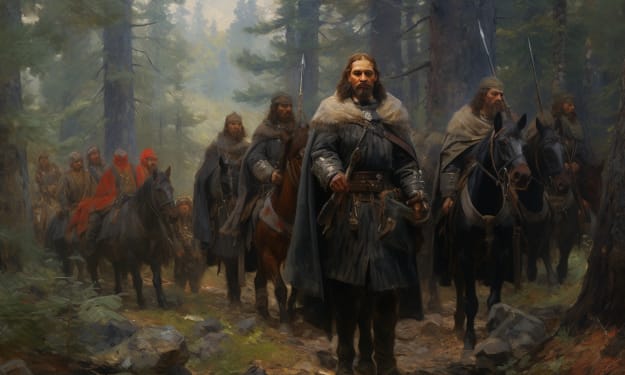
The Faces of Taras Bulba
Taras Bulba is a novella by Nikolai Gogol, set among 17th-century Cossacks on the Ukrainian steppes. The title character is an aging Cossack military commander who chafes under the rule of Polish occupation. His two sons return from their education in Kiev, as the Cossacks plot a revolt against the Poles. Like other tales from the romantic era of literature, the plot includes a forbidden love between one of Taras’s sons and the daughter of the local Polish governor. Intrigue and betrayal ensue, impacting the outcome of events, amidst a broader backdrop of military adventure.
By Randy Baker2 years ago in BookClub
Chicago Entrepreneur Debuts Graphic Novel To Inspire Hope, Promote Diversity
CHICAGO, ILLINOIS – Since launching her creative media hub, Morganacity, in Chicago, Morgan Middleton remains on a mission to create meaningful stories that inspire, enlighten, and highlight those who have been underrepresented and misrepresented in media and society across generations.
By Nikki Gaskins Campbell2 years ago in BookClub
Revelatory Realism in Ibsen’s "A Doll's House"
[Author's Note: this article is an analysis of a play by Henrik Ibsen. It can be found here: A Doll's House.] During the mid-19th Century, the literary world was loosening its embrace of Romanticism, with its idealized and emotional view of the world. A new literary movement was afoot in Europe, which came to be known as Realism. Within the field of drama, Realism involved “the direct observation of human behavior…to deal with everyday life and problems as subjects” (Trumbull 2009). Though Realism was birthed in France and later took a strong foothold in Russia, one of the primary innovators of Realism in the theater was a Norwegian playwright, Henrik Ibsen. Having shed the limitations of Romanticism, Henrik Ibsen utilized Realism in his play, A Doll’s House, to lay bare the social mores of his era that dictated the status of women. Written in 1879, A Doll’s House is one of a series of “problem plays”, so named “because of their engagement of social issues such as women’s place in society” (Kennedy and Gioia 2016).
By Randy Baker2 years ago in BookClub
The Best Dramas by the Dramatist Tennessee Williams
This article is in addition to the last article in which I talked about the best plays of Eugene O Neil but today I shall be talking about the best plays of another playwright Tennessee Williams who was also a very famous dramatist. The name might sound a little different but Tennessee was not born in Tennessee but in Mississippi on 25 February, 191. He deals with several types of themes in his novel such as the frustration of humans, sex, and violence. He was active in this field at the time of the great depression and we see the reflection of that period in his plays. He also won a Pulitzer prize in 1947 for his most celebrated drama Streetcar Named Desire. His initial plays were very successful but later he lost his muse and his plays did not remain very popular but his best plays are still the best. You can watch them and read them, when you read the plays like Streetcar Named Desire, you go through various kinds of emotions and feelings. Anyways, if you are interested in any of his plays then you can buy them at the eBay alternatives.
By Sumit Mishra2 years ago in BookClub
Little Ghost Laban. Top Story - February 2024.
I like to dig into other cultures and languages, particularly when it comes to horror, folklore, and storytelling. There's so much out there that isn't readily available in English. It's the same with your native language, whatever that might be. The world is connected now in a way it never has been, and newer technology allows me to explore it using translation tools. We take these tools for granted today, but they are recent inventions.
By J.A. Hernandez2 years ago in BookClub