
Kabbalah and the Architecture of Sacred Power
Sacred Structure, Living Magic, and the Roots of Western Esotericism

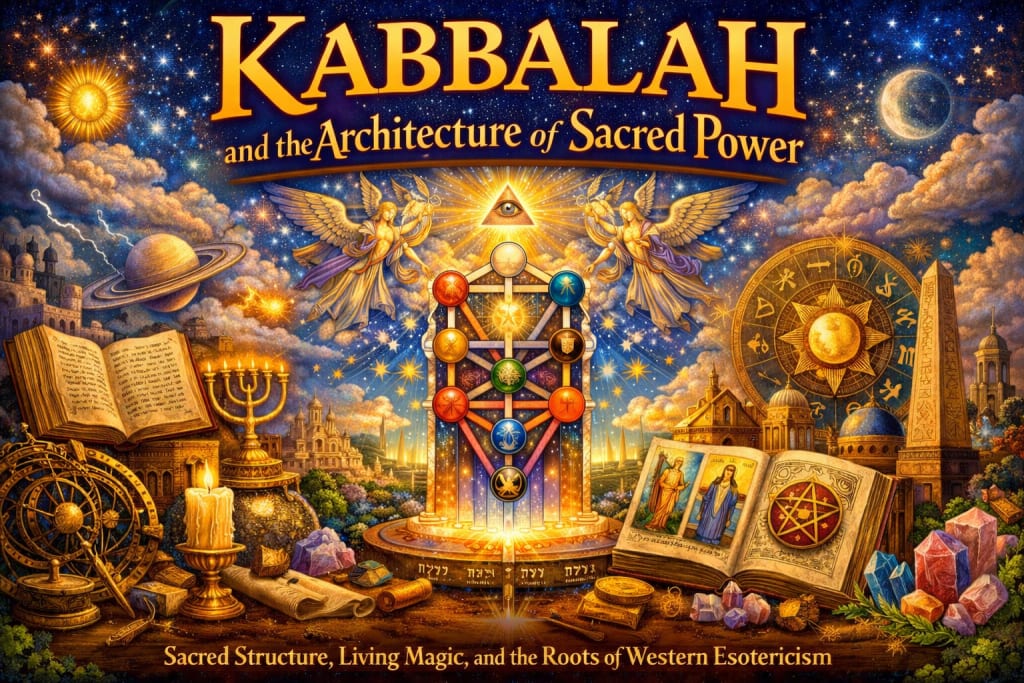
Kabbalah and the Architecture of Sacred Reality
Within the broad terrain of Western esotericism, Kabbalah stands apart for both intellectual rigor and historical endurance. Emerging from medieval Jewish theological inquiry, Kabbalah matured into a sophisticated metaphysical framework that addresses creation, consciousness, and the relationship between the infinite and the manifest world. Rather than functioning as a single scripture or closed doctrine, Kabbalah developed as an evolving body of commentaries, symbolic diagrams, meditative disciplines, and speculative theology. Central to this tradition lies a radical cosmological model in which divine reality unfolds through ordered stages of emanation, forming a structured universe that mirrors spiritual principles at every level of existence.
The conceptual core of Kabbalah rests upon the belief that creation is neither random nor opaque. Reality is understood as intelligible, layered, and responsive to ethical and intellectual alignment. Through study of sacred texts, mastery of symbolic language, and disciplined moral refinement, human awareness is believed capable of interacting with these cosmic structures. The Tree of Life, the doctrine of the sefirot, and the use of sacred language represent attempts to map the unseen mechanics of existence and to articulate how divine energy flows into material form. Such models were never intended as abstract philosophy alone, but as practical tools for contemplation, spiritual repair, and conscious participation in the unfolding of creation.
Contemporary portrayals often reduce Kabbalah to motivational clichés or commercial mysticism, stripping away historical context and philosophical depth. Authentic Kabbalistic study, by contrast, demands textual fluency, mathematical sensitivity to number symbolism, and patience with paradox and ambiguity. Medieval and early modern Kabbalists engaged in sustained debate over cosmology, divine attributes, and the limits of human knowledge, producing a tradition marked by complexity rather than easy answers. The following exploration examines the historical development of Kabbalah, its foundational cosmology, ritual and operative dimensions often mislabeled as spellwork, and the lasting influence of Kabbalistic thought on modern occult philosophy. What follows is not an initiation, but an invitation into a lineage where disciplined inquiry remains the only legitimate gateway.
Historical Foundations of Kabbalah
The term Kabbalah originates from the Hebrew root qibel, meaning “to receive,” and signifies an inherited body of esoteric knowledge transmitted through study, interpretation, and disciplined contemplation. Reception in this sense implies active engagement rather than unquestioned belief. Knowledge was preserved through close reading of sacred texts, oral instruction, and layered commentary, often restricted to those deemed intellectually and ethically prepared. From its earliest expressions, Kabbalah functioned as a method of uncovering concealed dimensions of scripture rather than a departure from established religious tradition.
The earliest foundations of Kabbalistic thought can be traced to mystical currents within late antique rabbinic literature. Texts associated with Merkavah mysticism explored visionary ascent, angelic hierarchies, and the divine throne described in prophetic scripture. These writings were less concerned with cosmology in the later systematic sense and more focused on experiential encounters with the sacred. Over time, speculative reflection on creation, divine attributes, and the structure of heavenly realms expanded these early themes. By the early medieval period, such ideas circulated quietly among learned circles in Islamic lands and Christian Europe, gradually absorbing philosophical influences from Neoplatonism and Aristotelian thought.
A decisive transformation occurred during the twelfth and thirteenth centuries in southern France and northern Spain, where Kabbalah crystallized into a recognizable mystical system. Thinkers such as Isaac the Blind and Azriel of Gerona introduced a structured metaphysical language that described divine emanation as a dynamic process rather than a static hierarchy. Creation was understood as unfolding through graded stages of divine expression, allowing transcendence and immanence to coexist without contradiction. These formulations provided a conceptual bridge between inherited Jewish theology and the philosophical environment of medieval Europe.
The most influential product of this period was the Zohar, an expansive mystical commentary on the Torah composed in a distinctive symbolic and narrative style. The text presents theology through dialogue, mythic imagery, and allegorical exegesis, transforming biblical passages into gateways for metaphysical speculation. Traditional attribution assigns authorship to the second century sage Shimon bar Yochai, yet linguistic analysis and historical evidence place composition in thirteenth century Spain, most plausibly within the intellectual circle of Moses de Leon. Regardless of authorship, the Zohar reshaped Jewish mysticism by presenting a unified vision of divine life, cosmic process, and ethical responsibility.
A further evolution unfolded during the sixteenth century in the Galilean town of Safed, where Kabbalah absorbed the weight of historical catastrophe. Following the expulsion of Jews from Spain, mystics such as Isaac Luria reformulated earlier teachings into a dramatic cosmology centered on rupture, exile, and restoration. Creation was depicted as an initial contraction of divine presence, followed by a catastrophic shattering that scattered sacred sparks throughout the material world. Spiritual practice became a disciplined labor of repair, aimed at restoring harmony within the cosmos through intention, ethical conduct, and ritual precision. This redemptive vision transformed Kabbalah from a speculative theology into a comprehensive spiritual worldview, one that would later exert profound influence on esoteric and occult traditions well beyond its original cultural boundaries.
The Infinite and the Emanated World
Kabbalistic cosmology opens with Ein Sof, the boundless source of all existence. Ein Sof is defined not by qualities but by absolute transcendence. Language fails at this level, and symbolic representation dissolves into negation. Classical Kabbalistic texts emphasize that Ein Sof cannot be addressed directly through prayer, name, or image, since any definition would impose limitation upon the infinite. Knowledge of Ein Sof arises only through its manifestations, not through conceptual description. This radical transcendence safeguards divine unity while allowing for a structured unfolding of creation.
Creation, within this framework, proceeds through emanation rather than decree. Emanation describes a gradual disclosure of divine energy, moving from indeterminate infinity toward intelligible form. This process preserves continuity between source and manifestation while avoiding the implication of separation. Divine presence does not withdraw from creation but becomes progressively differentiated, allowing multiplicity to arise without compromising unity. The resulting cosmos reflects ordered gradations of being, each level more defined than the last.
The primary architecture of this emanative process is articulated through the ten sefirot, understood as vessels or modalities through which divine energy becomes perceptible. These sefirot are not entities in isolation but relational expressions that exist only through interaction. Keter stands at the threshold between infinity and articulation, representing primordial intention or will prior to thought. Chokhmah introduces creative insight as a flash of undifferentiated wisdom, while Binah gives that insight structure, depth, and discernment. Together, these upper sefirot establish the intellectual foundation of the cosmos.
Below this triad unfold the ethical and dynamic dimensions of creation. Chesed embodies expansive generosity and unbounded flow, while Gevurah introduces limitation, discernment, and judgment. The tension between these forces finds resolution in Tiferet, which harmonizes compassion and restraint into balanced beauty. This central sefirah occupies a pivotal role in classical Kabbalistic symbolism, often associated with moral equilibrium and the integration of opposites. Netzach and Hod extend this balance into action and articulation, governing endurance, repetition, communication, and form. Yesod functions as the connective channel, gathering and transmitting the accumulated energies of the preceding sefirot toward manifestation. Malkhut completes the process by receiving and expressing divine presence within the material realm, where spiritual potential becomes lived reality.
The Tree of Life, as a diagram of the sefirot and their interconnections, serves multiple functions within Kabbalistic thought. As a metaphysical schema, it maps the structure of existence from the infinite to the tangible. As a contemplative model, it mirrors inner states of awareness and ethical disposition. As a ritual framework, it guides meditative intention, prayer, and symbolic action. Harmony among the sefirot reflects balance within the cosmos, while imbalance reverberates as disorder, fragmentation, and suffering. Restoration of alignment becomes both a cosmic and ethical task, linking inner transformation with the repair of the world itself.
Language, Number, and Creative Power
Within Kabbalistic thought, language is not a passive vehicle for meaning but a formative force embedded within creation itself. Hebrew occupies a privileged position as the medium through which divine energy becomes structured and intelligible. Letters are treated as primal forms that precede spoken speech and written text, functioning as channels through which creative power flows. Each letter embodies multiple dimensions simultaneously, including sound, shape, numerical value, and symbolic resonance. Together, these dimensions form a sacred grammar that underlies both scripture and the architecture of the cosmos.
Numerical symbolism operates as an extension of this linguistic framework. Through gematria, numerical values assigned to Hebrew letters allow words and phrases to be analyzed as quantitative expressions of qualitative meaning. When distinct terms share the same numerical total, Kabbalistic interpretation understands this correspondence as an indication of structural affinity rather than coincidence. Such equivalences invite reflection on hidden relationships between concepts, ethical qualities, and metaphysical principles. The practice requires contextual sensitivity, as numerical alignment alone never overrides scriptural meaning or theological coherence.
Additional interpretive methods deepen this engagement with sacred language. Notarikon examines words as compressed phrases, extracting meaning from initial or final letters to reveal layered significance within familiar texts. Temurah applies systematic letter substitution, allowing transformation of words into alternative expressions that expose concealed patterns of thought. These techniques were never intended as mechanical shortcuts to knowledge. Within classical tradition, disciplined study and ethical refinement remained prerequisites for meaningful interpretation. Linguistic manipulation served contemplation, not spectacle, and aimed at perceiving unity beneath the diversity of textual forms.
One of the earliest textual expressions of this worldview appears in the Sefer Yetzirah, a compact and enigmatic work that presents creation as an act of linguistic and numerical ordering. The text describes the formation of existence through combinations of the Hebrew alphabet and foundational numbers, often associated with dimensions of space, cycles of time, and structures of consciousness. Letters are depicted as building blocks through which reality is measured, weighed, and articulated. Later commentators expanded these ideas, integrating them into broader cosmological systems and meditative practices.
As Kabbalah evolved, these linguistic principles informed ritual and contemplative disciplines that sought alignment with cosmic processes. Carefully structured letter permutations, vocalizations, and visualizations were believed to refine awareness and attune consciousness to higher spiritual states. Such practices eventually became known as operative Kabbalah, distinguished from purely theoretical study by its emphasis on experiential transformation. Later observers, especially outside Jewish tradition, would label these methods as magic, often misunderstanding their ethical and theological foundations. Within Kabbalistic context, creative power attributed to language was inseparable from responsibility, discipline, and reverence for the sacred order embedded within speech itself.
Practical Kabbalah and the Nature of Spells
Practical Kabbalah designates the applied dimension of Kabbalistic knowledge, where metaphysical principles were translated into ritual action. These practices addressed concrete concerns such as healing, protection, spiritual clarity, and alignment with divine order. Classical sources consistently emphasize restraint, warning that operative work required exceptional learning, emotional discipline, and moral integrity. Improper use was believed to distort spiritual forces and endanger both practitioner and community. Rabbinic literature preserves a careful boundary between permitted contemplative practice and forbidden manipulation, a tension that shaped the development of practical methods across centuries.
Accounts surrounding the creation of a golem illustrate both the allure and the peril associated with operative Kabbalah. Medieval legends describe sages who animated lifeless matter through sacred names and letter permutations, demonstrating mastery of linguistic creation while underscoring ethical limits. These narratives function less as historical records and more as cautionary parables, reinforcing the belief that creative power mirrors divine responsibility. Mastery without humility was portrayed as spiritually destructive, regardless of technical proficiency.
Kabbalistic operative work differs fundamentally from folk magic or superstition. Ritual effectiveness rests upon precise engagement with sacred language rather than material components alone. Divine names, angelic orders, and carefully constructed letter sequences form the structural core of such practices. Each divine name corresponds to a specific mode of emanation within the sefirotic system, functioning as a key to particular channels of spiritual energy. Invocation does not compel these forces but seeks alignment with them through disciplined intention and correct symbolic form.
Protective practices frequently employed written amulets bearing angelic names associated with safeguarding, healing, or guidance. These inscriptions followed strict conventions regarding letter formation, numerical balance, and scriptural grounding. Healing rites focused on restoring equilibrium among opposing sefirotic influences, addressing spiritual imbalance believed to manifest as physical or emotional distress. Rather than confronting illness as an external enemy, such practices aimed to reestablish harmony within the underlying structure of life. Dream incubation and visionary disciplines sought instruction through symbolic experience, relying on purification, fasting, and scriptural meditation to prepare awareness for insight. Exorcistic rites addressed disruptive spiritual influences with the goal of release and restoration, avoiding domination or coercion.
The Safed tradition of the sixteenth century introduced a profound ethical reframing of practical work through Lurianic Kabbalah. Meditative disciplines known as kavvanot emphasized precise intentional focus during prayer and ritual, aligning inner awareness with cosmic processes of repair. Every action, from daily blessings to communal rites, was understood as contributing to tikkun, the restoration of fractured divine harmony. Practical Kabbalah thus evolved from a specialized operative art into a comprehensive spiritual responsibility, where ritual efficacy was inseparable from ethical conduct and collective healing.
Angelology and Cosmic Hierarchy
Kabbalistic angelology develops biblical references into an intricate cosmology of intermediary forces that mediate between the infinite source and the material world. Angels are not portrayed as autonomous personalities in the modern sense, but as structured expressions of divine function. Each angelic order channels specific qualities of emanation, translating abstract spiritual principles into active processes within creation. This framework preserves divine transcendence while explaining how ordered influence moves through the cosmos without fragmentation or chaos.
Within this hierarchy, angels are commonly associated with sefirotic attributes, elemental dynamics, and planetary rhythms inherited from earlier Jewish, Hellenistic, and Near Eastern traditions. These associations were refined through centuries of commentary, producing a symbolic grammar that linked moral qualities, cosmic cycles, and human experience. Angelic names functioned as designations of purpose rather than arbitrary titles, each name encoding a specific mode of divine activity. Figures such as Michael, Raphael, and Gabriel appear consistently as embodiments of protection, healing, and strength, reinforcing continuity between biblical narrative and mystical cosmology.
Metatron occupies a singular position within Kabbalistic literature, often described as the celestial scribe, measurer, and guardian of divine order. Texts associated with early mystical traditions portray Metatron as the angelic embodiment of structure, number, and lawful arrangement. In later Kabbalistic systems, Metatron becomes linked with the upper regions of the Tree of Life and with the principle of organized consciousness. This figure represents the interface where ineffable divinity becomes intelligible without losing transcendence, serving as a bridge between unformed potential and articulated reality.
Opposite this function stands Sandalphon, positioned at the threshold of manifestation. Sandalphon is associated with the reception and elevation of prayer, transforming human intention into spiritual movement within the higher realms. While Metatron governs descent from source to structure, Sandalphon governs ascent from action to intention. Together, these figures articulate a complete circuit of spiritual flow, uniting contemplation and embodiment within a single cosmological rhythm.
Another foundational structure within Kabbalistic angelology is the system of seventy-two divine names derived from three consecutive verses in the book of Exodus. Through precise letter extraction and arrangement, these names form a matrix of spiritual forces, each associated with specific ethical qualities and modes of awareness. Meditative engagement with these names focused on moral discipline, emotional refinement, and clarity of intention rather than material outcomes. Mastery required sustained study and adherence to ethical conduct, as misuse was believed to distort both inner and cosmic balance.
As Kabbalistic ideas migrated beyond Jewish communities, angelic hierarchies and divine name systems entered Western occult traditions. While structural elements were preserved, ethical and theological constraints were often weakened or discarded. The original context emphasized responsibility, restraint, and reverence for divine order, presenting angelology not as a catalog of supernatural beings but as a disciplined language for understanding how sacred structure permeates every level of existence.
Influence on Renaissance Occultism
During the Renaissance, Kabbalah entered European intellectual life through the efforts of Christian humanists who sought a unified philosophy capable of reconciling classical learning with biblical revelation. The revival of Greek and Hebrew studies encouraged scholars to examine Jewish mystical texts as repositories of ancient wisdom. Kabbalah was interpreted as a primordial theology that predated Christianity and encoded universal truths accessible through symbolic analysis. This approach reframed Jewish mystical concepts within a Christian metaphysical agenda, giving rise to what became known as Christian Kabbalah.
Giovanni Pico della Mirandola played a decisive role in this transmission. Trained in philosophy, languages, and theology, Pico argued that Kabbalistic doctrines provided hidden confirmation of Christian beliefs, particularly regarding divine mediation and sacred names. Hebrew letter mysticism, numerical symbolism, and angelic hierarchies were reinterpreted to support Christological readings of scripture. While this adaptation departed significantly from Jewish theological intent, it introduced Kabbalistic structures into the intellectual mainstream of Europe. Thinkers such as Johannes Reuchlin further systematized these ideas, presenting Hebrew language and symbolism as essential tools for philosophical and theological insight.
The influence of Kabbalah on Western occultism extended beyond theological reinterpretation into practical and symbolic domains. The Tree of Life was adopted as a universal map of reality, adaptable to planetary systems, psychological states, and ritual progression. Hebrew letters were incorporated into magical alphabets and sigils, valued for perceived intrinsic power rather than linguistic meaning alone. Angelic hierarchies were merged with astrological correspondences, aligning spiritual intelligences with planetary spheres and temporal cycles. Grimoires circulating in early modern Europe absorbed divine names and formulae drawn from Kabbalistic sources, often detached from their original ethical constraints and communal safeguards.
Heinrich Cornelius Agrippa of Nettesheim synthesized these converging traditions into a comprehensive esoteric philosophy that shaped ceremonial magic for centuries. Agrippa’s division of reality into elemental, celestial, and intellectual worlds parallels the layered cosmology articulated within Kabbalistic thought. Each realm operates according to distinct laws while remaining interconnected through symbolic correspondence. Sacred language, numerical harmony, and angelic mediation function as linking mechanisms across these levels. Although Agrippa drew from classical philosophy, astrology, and Christian theology, Kabbalistic influence remains evident in the emphasis on names, numbers, and structured emanation.
Subsequent ceremonial traditions inherited this framework and expanded it through ritual manuals, initiatory systems, and symbolic instruction. In many cases, original Jewish sources were obscured or uncredited, yet the underlying architecture of Kabbalistic cosmology continued to shape Western esoteric practice. The Renaissance encounter with Kabbalah thus transformed European occultism, embedding a mystical language of structure, correspondence, and ascent that remains foundational to esoteric thought today.
Kabbalah and Modern Occult Orders
The occult revival of the nineteenth and early twentieth centuries brought Kabbalistic symbolism into the center of newly formed esoteric orders. Rapid industrialization and scientific rationalism created a cultural hunger for spiritual systems that promised coherence, meaning, and experiential depth. Kabbalah offered a ready made metaphysical architecture capable of organizing ritual practice, moral development, and symbolic education within a single framework. Western occultists increasingly treated the Tree of Life as a universal diagram through which all spiritual traditions could be interpreted and harmonized.
The Hermetic Order of the Golden Dawn formalized this approach with exceptional thoroughness. Initiatory grades were explicitly aligned with the sefirotic structure, mapping spiritual progress onto ascent through the Tree of Life. Each grade integrated elemental theory, astrological symbolism, angelic hierarchies, and Hebrew letter correspondences into ritual form. Temple layouts, ceremonial implements, and initiation scripts reflected precise Kabbalistic attributions, creating an immersive symbolic environment designed to reshape perception and discipline the imagination. Although filtered through Hermetic and Christian lenses, the structural dependence on Kabbalistic cosmology remained foundational.
Aleister Crowley inherited this framework and subjected it to radical reinterpretation. Kabbalah became a symbolic language through which personal philosophy, comparative religion, and emerging psychological concepts were synthesized. Eastern mysticism, particularly yoga and tantra, was mapped onto the Tree of Life, while Freudian and Jungian ideas influenced interpretations of sefirotic dynamics as states of consciousness. Despite deliberate provocations and departures from traditional ethics, Crowley retained the Tree of Life as the primary organizing schema. Tarot symbolism, astrological correspondences, and magical formulae were consistently arranged according to sefirotic relationships, preserving the internal logic of the system even as doctrinal content shifted.
Later twentieth century developments continued to draw upon Kabbalistic structure, often in fragmented or secularized form. Ceremonial magic preserved formal rituals and hierarchical ascent, while chaos magic treated the Tree of Life as a flexible cognitive map rather than a sacred ontology. Esoteric psychology adopted sefirotic models to describe integration of conflicting drives, emotional balance, and stages of personal development. Even contemporary self development frameworks frequently echo Kabbalistic principles through language of balance, alignment, and structured progression, often without awareness of their historical origins.
Through these transformations, Kabbalah persisted not as a static doctrine but as a resilient symbolic system capable of adaptation. Modern occult orders preserved its architecture while reshaping its meaning to address changing cultural concerns. The continued relevance of Kabbalistic models within modern esotericism testifies to the enduring power of its vision of reality as an ordered, intelligible, and participatory whole.
Ethical Dimensions and Misconceptions
Ethical refinement stands at the center of authentic Kabbalistic practice. Classical sources consistently assert that intellectual insight and ritual technique possess value only when grounded in moral integrity. Knowledge divorced from ethical development was understood to amplify imbalance rather than wisdom. For this reason, traditional instruction emphasized character formation alongside textual mastery, warning that premature engagement with advanced concepts could destabilize perception and judgment. Spiritual aspiration without humility risked distortion of both inner life and communal harmony.
Kabbalistic literature repeatedly links cosmological order with ethical conduct. The sefirotic system functions not only as a map of divine emanation but also as a mirror of human character. Qualities such as compassion, restraint, discernment, and truthfulness correspond directly to specific sefirotic forces. Disharmony in behavior was believed to reverberate through spiritual channels, while ethical refinement contributed to cosmic balance. Rectification, often described as tikkun, begins with inner repair before any transformation of external conditions can occur.
Modern misconceptions frequently recast Kabbalah as a mechanism for acquiring wealth, influence, or personal control. Such interpretations stand in direct contradiction to foundational texts, which consistently subordinate material outcomes to spiritual responsibility. Mystical ascent is presented as a demanding process of self examination, ethical discipline, and sustained study. Power sought for personal gain was viewed as spiritually corrosive, undermining the very structures Kabbalah seeks to illuminate. The tradition offers no promise of shortcuts, only the gradual alignment of intention with moral clarity.
Another persistent misunderstanding portrays Kabbalah as a secret system deliberately withheld from outsiders. Historical caution surrounding instruction arose not from elitism but from concern over misuse and misinterpretation. Advanced teachings were often reserved for mature scholars with established grounding in scripture, law, and ethical practice. This restraint reflected an awareness of the psychological impact of symbolic and metaphysical exploration. Textual study itself remained accessible to dedicated learners willing to commit to sustained engagement and disciplined reflection.
Secrecy within Kabbalistic tradition thus functioned as a form of protection rather than exclusion. Safeguards aimed to preserve the integrity of the teachings and the well being of those who encountered them. When approached with patience, moral seriousness, and respect for context, Kabbalah reveals itself not as an occult commodity but as a demanding ethical philosophy woven inseparably into its mystical vision of reality.
Symbolism and Sacred Geometry
Kabbalistic symbolism operates through form as much as through concept, with the Tree of Life serving as a work of sacred geometry as well as a metaphysical schema. Spatial relationships among the sefirot are not arbitrary arrangements but intentional expressions of balance, tension, and flow. The vertical axis traces the descent of creative energy from subtle origin toward concrete manifestation, while the horizontal alignments articulate equilibrium between opposing forces. Diagonal pathways introduce movement, transition, and transformation, revealing reality as a dynamic process rather than a static hierarchy.
Triadic structures within the Tree of Life express a recurring principle of generation, differentiation, and integration. Upper triads establish conceptual and intentional foundations, while lower triads translate those principles into ethical action and embodied experience. These geometric groupings illustrate how creative tension gives rise to resolution, and how balance emerges through relationship rather than isolation. Sacred geometry in this context functions as visual theology, allowing abstract metaphysical ideas to be grasped through proportion, placement, and symmetry.
Kabbalistic correspondences extend beyond spatial form into a rich web of symbolic associations. Each sefirah resonates with specific colors, numerical values, vocal tones, divine names, and planetary movements. Such correspondences create an integrated symbolic language capable of engaging multiple dimensions of awareness simultaneously. Meditation upon these relationships allows perception to shift from linear analysis toward holistic comprehension, where meaning arises through pattern recognition rather than discursive reasoning alone.
Diagrams used within Kabbalistic study were designed for repeated contemplation rather than passive observation. Through sustained engagement, symbolic forms imprint themselves upon perception, gradually reorganizing how relationships, causality, and ethical responsibility are understood. These diagrams function as cognitive instruments, shaping inner orientation through visual rhythm and proportional harmony. Sacred geometry thus becomes an active medium of transformation rather than a decorative illustration of doctrine.
Modern psychological theory has identified comparable mapping techniques within studies of archetypal structure and symbolic cognition. While developed in entirely different historical contexts, such models reflect a shared recognition that the human psyche responds intuitively to patterned representation of inner processes. The enduring effectiveness of Kabbalistic geometry suggests an intuitive grasp of how form, meaning, and consciousness interact. Through geometry, symbolism becomes a bridge between abstract metaphysics and lived experience, allowing complex spiritual ideas to be encountered with clarity and depth.
Names, Spellings, and Shifting Meanings of Kabbalah
The term Kabbalah appears in a wide range of spellings across historical, linguistic, and cultural contexts. These variations do not indicate separate traditions but reflect transliteration choices, interpretive agendas, and the environments through which the teachings traveled. Hebrew, Greek, Latin, and modern European languages each shaped how the word entered written form, and each spelling carries subtle implications about emphasis and intention.
The Hebrew form, קַבָּלָה (Qabbalah or Kabbalah), derives from the root qibel, meaning “to receive.” This spelling emphasizes transmission, reception, and continuity. Within Jewish tradition, this form points toward an inherited body of interpretation passed through study and disciplined engagement rather than revelation claimed by individuals. The doubled consonant reflects accurate transliteration of the Hebrew letter bet with a dagesh, preserving phonetic precision valued in scholarly contexts.
The spelling Cabala emerged in medieval and Renaissance Europe through Latinized texts. Christian scholars adopted this form while integrating Kabbalistic ideas into theological and philosophical systems distinct from Jewish law and tradition. Cabala often signals Christian Kabbalah, a syncretic reinterpretation that blended Jewish mysticism with Christian theology, Neoplatonism, and Hermetic philosophy. While structurally indebted to Jewish sources, this spelling frequently marks a shift in doctrinal intent rather than linguistic accuracy.
The variant Qabalah gained prominence in nineteenth and twentieth century occult literature, particularly within ceremonial and Hermetic traditions. Use of the letter Q reflects an attempt to preserve the guttural quality of the Hebrew qof, while distinguishing esoteric practice from religious study. Occult authors often used Qabalah to denote a universalized symbolic system applicable beyond Jewish theology. This spelling became common in magical manuals, initiatory systems, and comparative metaphysical works.
Modern popular culture frequently employs simplified spellings such as Kabbala or Kabalah. These forms tend to appear in commercial, self help, or generalized spiritual contexts. Simplification often accompanies abstraction, where historical rigor and textual grounding give way to motivational or symbolic appropriation. While accessibility increases, depth and precision are often reduced, contributing to misconceptions about the tradition’s scope and demands.
Each spelling thus functions as a cultural signal. Kabbalah typically denotes Jewish mystical tradition rooted in scripture and law. Cabala points toward Renaissance Christian reinterpretation. Qabalah identifies Western esoteric and magical frameworks. Simplified modern variants reflect popularized spirituality. Understanding these distinctions clarifies not only linguistic history but also the evolving meanings attached to the tradition across time. The multiplicity of spellings reveals how Kabbalah has served as both a preserved lineage and a mutable symbolic language, shaped by the hands and intentions of those who received it.
Recommended Reading: #commissionearned
Designed for readers encountering Kabbalah for the first time, this book emphasizes experiential understanding over historical density. Concepts such as the Tree of Life, sefirotic balance, and conscious intention are presented through reflective exercises and accessible explanations. The work focuses on personal transformation rather than textual lineage, offering a modern spiritual interpretation of ancient ideas. Themes explored throughout this blog, particularly ethical balance and inner alignment, appear here in simplified form. While classical sources are not examined in depth, the book succeeds in conveying the spirit of Kabbalistic self refinement. The tone remains approachable without drifting into pure abstraction. This volume works best as an introductory orientation before engaging more demanding material.
The Essential Kabbalah: The Heart of Jewish Mysticism by Daniel C. Matt
Clear, disciplined scholarship defines this compact yet authoritative introduction to Jewish mystical thought. Central doctrines such as Ein Sof, emanation, the sefirot, and symbolic interpretation are explained with precision and historical grounding. The book draws directly from classical texts while remaining readable for non specialists. Many foundational ideas discussed throughout this blog find careful articulation here, particularly the ethical responsibilities embedded within mystical study. Attention is given to historical development without reducing Kabbalah to a linear system. The work avoids sensationalism and maintains fidelity to Jewish theological context. For readers seeking accuracy and depth, this text serves as an essential reference.
Written during a period of renewed metaphysical interest, this book reflects a universalist interpretation of Kabbalistic symbolism. The Tree of Life is treated as a map of spiritual potential and psychological development rather than a strictly theological construct. Angelic hierarchies, divine names, and sefirotic forces are framed as tools for inner empowerment. Connections to themes explored in this blog appear most strongly in discussions of balance, integration, and ethical awareness. Traditional boundaries are loosened in favor of comparative spirituality. While historical rigor is secondary, the book illustrates how Kabbalah entered modern spiritual movements. This text is useful for understanding twentieth century reinterpretations rather than classical doctrine.
Primary voices define this anthology, offering direct encounters with Kabbalistic texts across multiple historical periods. Selections range from early mystical writings to later theological reflections, allowing readers to witness doctrinal development firsthand. Editorial commentary provides context without imposing interpretive conclusions. Many of the cosmological and ethical principles discussed in this blog emerge organically from the source material. The anthology reveals internal diversity within Kabbalah rather than presenting a single unified system. Engagement with these texts demands patience and careful reading. This volume rewards sustained attention and provides invaluable depth for serious study.
An ambitious attempt to bridge ancient metaphysics and modern scientific language, this book explores Kabbalistic cosmology through systems theory and physics based analogy. Concepts such as emanation, structure, and informational flow are reframed in contemporary intellectual terms. The approach resonates with themes discussed in this blog regarding intelligible creation and ordered reality. While speculative, the work reflects a long tradition of interpreting Kabbalah through prevailing intellectual frameworks. Scientific metaphor functions as interpretive lens rather than empirical claim. Readers interested in interdisciplinary exploration may find this synthesis compelling. The book demonstrates the adaptability of Kabbalistic ideas across disciplines.
Serving as a broad overview, this guide introduces key Kabbalistic texts and concepts within a single volume. Attention is given to symbolic language, sacred geometry, and the relationship between Jewish mysticism and Western esoteric traditions. The spelling Qabalah signals engagement with occult adaptations alongside traditional sources. Topics explored throughout this blog, including sacred language, operative practice, and symbolic mapping, receive introductory explanation. Depth is traded for scope, making the book suitable as a reference rather than a definitive study. Readers gain familiarity with major texts and themes without extensive analysis. This work functions as a survey that contextualizes Kabbalah within a wider spiritual landscape.
Toward Independent Exploration
Kabbalah resists closure. Each historical period reveals additional layers of meaning shaped by language, context, and lived encounter. Texts operate as thresholds rather than conclusions, inviting sustained return rather than definitive interpretation. Diagrams such as the Tree of Life function as instruments of reflection, gaining clarity only through repeated contemplation. Progress within this tradition depends less on accumulation of facts than on patience, ethical sensitivity, and intellectual honesty. Assumptions inherited from popular culture or secondary commentary require continual reexamination.
Independent study remains the cornerstone of meaningful engagement. Summaries and interpretations provide orientation but cannot replace direct contact with foundational texts. Careful reading cultivates discernment, particularly when symbolic language resists immediate comprehension. Public libraries offer invaluable access to reliable translations, scholarly editions, and historical studies without commercial pressure or algorithmic distortion. Librarians trained in research methodology often provide guidance toward reputable sources often overlooked in digital searches.
Caution becomes especially necessary when navigating freely available online material. While some digital archives preserve rare manuscripts and academic lectures, many popular websites conflate traditions, remove historical context, or present speculative interpretations as established fact. Lack of editorial oversight frequently results in oversimplification or misrepresentation. Evaluating authorship, publication history, and scholarly grounding protects against confusion and misuse. Responsible inquiry favors depth, context, and cross comparison over speed and convenience.
Kabbalah unfolds most fully through sustained attention and ethical reflection. Study conducted with seriousness gradually reveals an integrated vision of reality shaped by responsibility, balance, and restraint. Independent exploration encourages comparison of interpretations across centuries and communities, fostering intellectual humility rather than doctrinal certainty. The path remains open to any reader willing to engage patiently, question rigorously, and allow symbols to mature through time. Sacred architecture discloses coherence only to disciplined study grounded in care, curiosity, and respect for complexity.
About the Creator
Marcus Hedare
Hello, I am Marcus Hedare, host of The Metaphysical Emporium, a YouTube channel that talks about metaphysical, occult and esoteric topics.
https://linktr.ee/metaphysicalemporium
Keep reading
More stories from Marcus Hedare and writers in BookClub and other communities.
Hearth and Cottage Witchcraft:
Where Daily Survival Became Sacred Practice Hearth and cottage witchcraft stands as a living continuation of domestic folk practice shaped by necessity, environment, and generational memory rather than a reconstructed system or modern spiritual invention. Long before institutional religion consolidated authority over belief and ritual, survival depended on knowledge held within households and passed through experience. Food preservation, illness prevention, childbirth support, and protection from environmental threat required practical skill paired with symbolic understanding. Spiritual meaning did not exist apart from daily labor. Meaning emerged through repetition, observation, and consequence.
By Marcus Hedare2 days ago in BookClub
Book Review: Atmosphere by Taylor Jenkins Reid
I flipped the book over in my hands in the centre of the small airport book shop. Although I had heard promising reviews of Atmosphere by Taylor Jenkins Reid, I hesitated. The synopsis didn’t compel me - I wasn’t much of a space girly. In high school it made me cringe when my peers would talk about the stars.
By sleepy draftsabout 14 hours ago in BookClub
The Devil's Triangle
The sails ruffled in the breeze as we cruised along. The Sea Breeze was a mid-size catamaran that sailed out of Royal Naval Dockyard in Bermuda. We had booked this trip weeks in advance and were now looking at our Captain, Spike and two boat hands. Paddy and Wilson seemed like nice guys, joking around with the passengers and telling us some stories about Bermuda that only locals would know. Their island accents sounded almost British but they were pleasant to listen to.
By Barbara Gode Wilesabout 13 hours ago in Fiction




Comments
There are no comments for this story
Be the first to respond and start the conversation.