

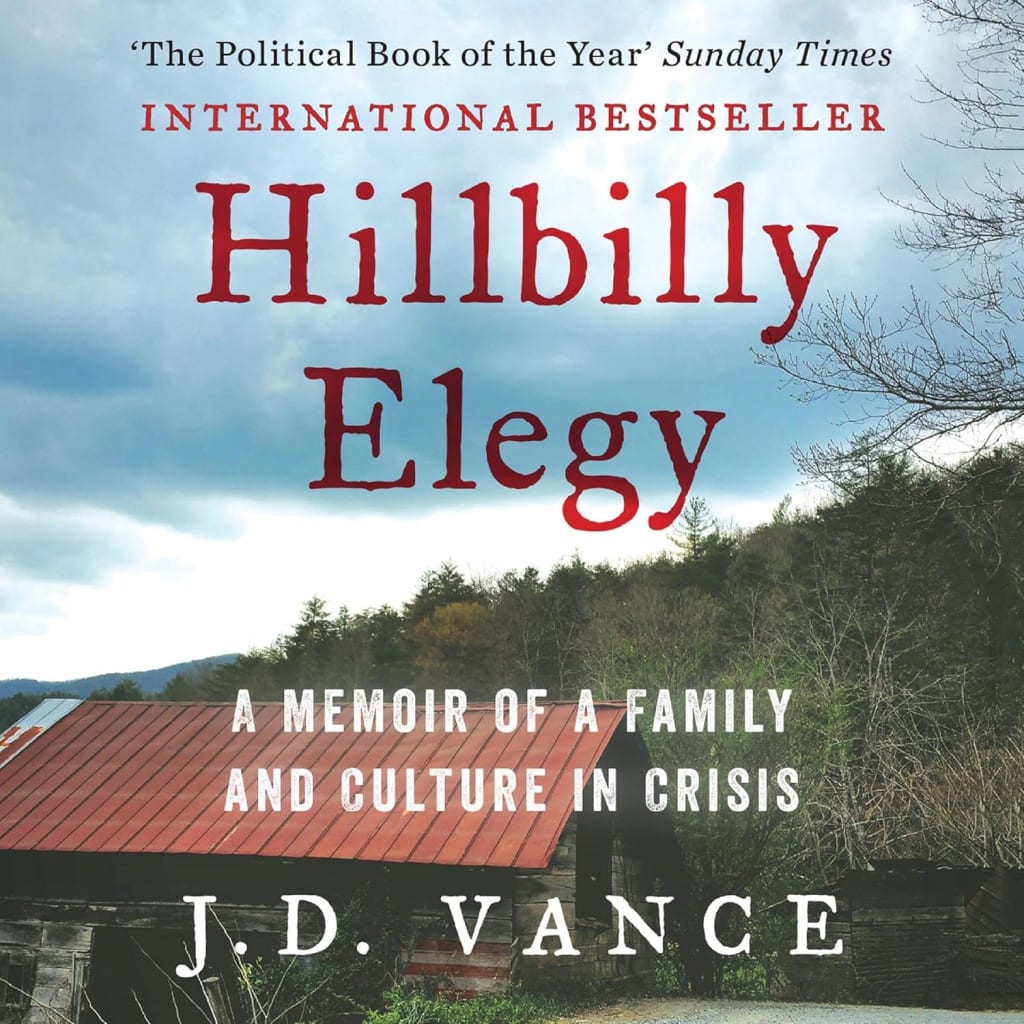
Click here to read “Hillbilly Elegy” for free with a 30-day free trial
Introduction
With J.D. Vance now confirmed as Republican nominee Donald Trump's running mate, "Hillbilly Elegy: A Memoir of a Family and Culture in Crisis" by J.D. Vance is both a compelling and deeply personal account of life in the Appalachian region of the United States, but also an insight into the author himself.
Through Vance's eyes, we get an insider's look at the struggles and triumphs of the working-class "hillbillies" and how the socio-economic and cultural factors shape their lives. Vance himself grew up eager to escape poverty, so writes with credibility on this topic with a unique perspective that is both empathetic and critical.
The Plot
The memoir begins with Vance’s early childhood in Middletown, Ohio, and Jackson, Kentucky. Vance's family moved to Ohio in search of better economic opportunities, a common trend among Appalachian families. Vance describes his family’s background, highlighting the significant influence of his grandparents, Mamaw and Papaw, who played crucial roles in his upbringing. They are portrayed as complex characters, embodying the resilience and contradictions of the hillbilly culture. Mamaw, in particular, is a standout figure—fiercely protective and loving, yet often violent and unpredictable.
Vance's mother, Bev, represents the generational challenges that many in the working class face. Her battle with addiction and her unstable relationships bring a sense of chaos and insecurity to Vance's childhood. Despite her flaws, Vance does not demonise his mother; instead, he provides a nuanced portrayal that underscores the impact of socioeconomic pressures on individual lives. This theme of understanding and empathy runs throughout the memoir, as Vance reflects on the broader societal issues that contribute to personal hardships.
Education emerges as a significant theme. Vance's journey through the public school system contains obstacles and opportunities. He candidly discusses the low expectations and lack of support that being educated in an area of poverty brings. However, he also credits several teachers and mentors who recognised his potential and encouraged him to aim higher. He eventually enlisted in the Marine Corps, a decision that Vance credits with providing structure and discipline in his life, bringing a sense of responsibility and work ethic that proved crucial in his subsequent academic and professional achievements.
Vance describes his time at Ohio State University and later at Yale Law School. He describes the culture shock he experienced upon entering these elite institutions, where he often felt out of place among his more privileged peers. Yet, these experiences also highlighted the vast disparity in opportunities available to people from different socio-economic backgrounds. Vance’s reflections on these disparities are insightful, pointing to the systemic issues that perpetuate inequality.
Click here to read “Hillbilly Elegy” for free with a 30-day free trial
Themes
One of the strengths of "Hillbilly Elegy" is Vance's ability to weave his personal story with broader social commentary. He does not shy away from criticising the destructive behaviors and attitudes he observed in his community, such as the pervasive sense of victimhood and the tendency to blame external forces for personal failures. At the same time, he acknowledges the systemic problems, including the decline of manufacturing jobs, the opioid crisis, and the lack of access to quality education and healthcare, which contribute to the cycle of poverty.
Vance's conservative perspective on these issues has sparked considerable debate. While some readers appreciate his emphasis on personal responsibility and the need for cultural change, others criticise him for overlooking the structural factors that limit opportunities for the working class. Regardless of where you stand on these issues, it is clear that Vance's insights stem from a place of lived experience and genuine concern for his community.
The memoir is also notable for its exploration of identity and belonging. Vance grapples with his dual identity as a hillbilly and as someone who has achieved success in mainstream America. This tension is evident in his reflections on the concept of the "American Dream." Vance argues that the dream is still attainable, but it requires hard work, perseverance, and a supportive network—qualities that are often undermined by the very cultural and social forces he critiques.
"Hillbilly Elegy" also touches on the theme of trauma and its long-lasting effects. Vance's accounts of domestic violence, addiction, and instability highlight the psychological toll these experiences can take on children. He discusses his own struggles with anger and trust issues, providing a candid look at how past traumas can shape one’s behavior and relationships. This aspect of the memoir adds depth to Vance's story, showing that success does not erase the scars of a troubled past.
Click here to read “Hillbilly Elegy” for free with a 30-day free trial
Writing Style
In terms of writing style, Vance's prose is straightforward, which suits the raw and honest way he tells his story. He writes with a clear sense of purpose, aiming to shed light on the realities of a segment of American society that is often misunderstood or overlooked. The memoir is both accessible and engaging, making it a compelling read for a wide audience.
However, some critics argue that Vance's narrative oversimplifies complex issues. By focusing on his personal success story, he may inadvertently suggest that individual effort alone is sufficient to overcome systemic challenges. This perspective, they argue, risks reinforcing the myth of meritocracy and ignoring the broader context of structural inequality. While Vance acknowledges the role of luck and external support in his journey, these acknowledgments sometimes feel overshadowed by his emphasis on personal responsibility.
The book's reception has been mixed, reflecting the polarizing nature of its subject matter. Some readers and critics have praised Vance for bringing attention to the struggles of the white working class, a demographic that has been the focus of much political and social debate. Others have taken issue with his perceived blaming of the victims and his political views. Regardless of these differing opinions, "Hillbilly Elegy" has undeniably sparked important conversations about class, culture, and the American Dream.
My Verdict
"Hillbilly Elegy" is a powerful memoir that offers a poignant and personal look at the struggles of the working class in Appalachia. Vance's story is one of resilience and transformation, but it is also a critique of the cultural and systemic forces that perpetuate poverty and despair. The book's strength lies in its honest portrayal of these issues, even if its solutions may be contested. Whether you agree with Vance's conclusions or not, his memoir provides a valuable contribution to the debte surrounding inequality and opportunity in America and an insight into someone who is now a permanent fixture in American politics.
Click here to read “Hillbilly Elegy” for free with a 30-day free trial
About the Creator
Malcolm Clarke
Malcolm is an avid book reader who enjoys writing reviews.
Reader insights
Outstanding
Excellent work. Looking forward to reading more!
Top insights
Compelling and original writing
Creative use of language & vocab
Easy to read and follow
Well-structured & engaging content
Excellent storytelling
Original narrative & well developed characters
Expert insights and opinions
Arguments were carefully researched and presented
Masterful proofreading
Zero grammar & spelling mistakes
On-point and relevant
Writing reflected the title & theme
Keep reading
More stories from Malcolm Clarke and writers in BookClub and other communities.
The Beach Cafe Review
Introduction The Beach Café by Lucy Diamond is a heartwarming, engaging, and inspirational novel that follows the journey of Evie Flynn, a 32-year-old woman who transforms her life after inheriting a beach café from her late aunt Jo. This story is one of self-discovery set against the backdrop of a charming seaside town.
By Malcolm Clarke2 years ago in BookClub
My New Book is Finally Here
My poetry collection Beautiful and Brutal Things is done. It's actually done and finally published over 270 pages. Over a year of my life went into this book. More than a year, really. Long days at my computer, sometimes seven days a week because I couldn't stop even when I probably should have. Then two months of editing that felt harder than the writing itself. But it's finished, and I'm still standing, and the book is real.
By Tim Carmichael9 days ago in BookClub
A Year In: Trump’s Second-Term Economy Shows Growth Without Jobs
Donald Trump One year into Donald Trump’s second presidency, the U.S. economy looks both familiar and different. Growth has continued, consumers are still spending, and inflation has cooled modestly. But beneath the headline numbers, cracks are visible — particularly in the labor market.
By Organic Products 3 days ago in BookClub




Comments