
A Year In: Trump’s Second-Term Economy Shows Growth Without Jobs
A Job Market Losing Momentum


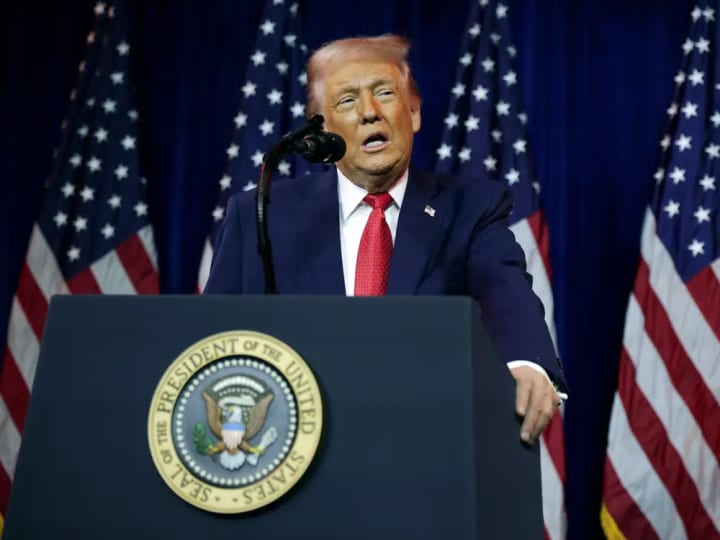
One year into Donald Trump’s second presidency, the U.S. economy looks both familiar and different. Growth has continued, consumers are still spending, and inflation has cooled modestly. But beneath the headline numbers, cracks are visible — particularly in the labor market.
Trump took office for a second term in January 2025 with sweeping plans to reshape trade, immigration, and the federal workforce. Those policies moved quickly, and economists say the speed and scale of change have played a major role in defining the economy during his first year back in the White House.
“The uncertainty was everywhere,” said Elizabeth Renter, a senior economist at NerdWallet. “Consumers, job seekers, and businesses were all trying to interpret policy changes in real time, often without clear data to guide decisions.”
A Job Market Losing Momentum
The most striking economic signal from 2025 was weak job growth. The U.S. added just 584,000 jobs over the year — the slowest pace outside of a recession since 2003. Hiring cooled across multiple sectors as businesses pulled back amid tariff increases, immigration changes, and lingering fears of a downturn.

Jason Draho, head of asset allocation Americas at UBS Global Wealth Management, said policy uncertainty alone was enough to make employers cautious.
“Even if a company isn’t directly hit by tariffs, the fear of broader economic drag makes firms reluctant to invest and hire,” Draho explained.
Economists warn that such a slow pace of hiring cannot persist indefinitely. Renter noted that confidence in income is closely tied to spending habits — and prolonged job-market weakness could eventually cause households to tighten their budgets.
Growth Without Hiring
Despite sluggish employment gains, the broader economy has continued to grow. After contracting in the first quarter of 2025, real GDP rebounded in the second and third quarters as companies accelerated activity ahead of new tariffs.

Gregory Daco, chief economist at EY, described the moment as a “jobless expansion” a rare combination of solid output growth with minimal hiring.
“The U.S. economy has shown remarkable resilience,” Daco said, pointing to forces reshaping the labor market, including an aging population, reduced net migration, and advances in automation and artificial intelligence.
Businesses, he added, are increasingly selective about hiring because they simply don’t need as many workers as they once did.
Federal Workforce Shrinks Sharply
One area where jobs clearly disappeared was the federal government. Federal employment fell 9% year over year by December, following administration-led initiatives aimed at reducing workforce size. Buyouts and reductions-in-force, coordinated by the Department of Government Efficiency, led to a particularly steep decline in October, when deferred resignations officially took effect.

For workers caught in the cuts, the impact has been personal. Cameron Hilaker, a former emergency manager at the U.S. Agency for International Development, lost his job last spring and has yet to find new employment.
“We were fully unprepared for this,” Hilaker said. “I stayed home with our newborn because we couldn’t afford childcare without my government paycheck. Budgets are tight.”
Manufacturing Still Struggles
Manufacturing employment fell 0.5% from a year earlier, continuing a trend that predates Trump’s return to office. While the administration has promoted tariffs as a way to bring manufacturing back to the U.S., economists say rebuilding domestic production is expensive, slow, and far from guaranteed.

“Tariffs may have done more harm than good for manufacturers that depend on imported inputs,” Renter said.
The White House disputes that narrative. Spokesperson Kush Desai pointed to rising industrial production and record capital goods shipments as evidence of future manufacturing strength. “President Trump has delivered accelerating GDP growth and strong investment fundamentals,” Desai said.
What Comes Next
With one year complete, economists expect the pace of economic change to slow. Draho said the most consequential policies — tariffs, tax cuts, and federal restructuring — are largely already in place. Recent proposals, such as a credit card interest-rate cap and adjustments to mortgage-backed securities purchases, are unlikely to significantly alter the macroeconomic picture.

Still, the defining question remains whether consumer spending — the backbone of recent growth — can hold up if job creation fails to rebound.
“One year down, three more to go,” Draho noted. “And the labor market will ultimately determine how durable this expansion really is.”
Hey Family & Friends,
I hope you’re all doing great. I’m reaching out because I’ve been putting my heart into writing short stories on Vocal, and it’s become a powerful creative outlet for me. Every read, share, and subscription truly helps me grow.
If you could subscribe, read, and share my stories, it would mean everything to me. Your support helps my work reach more people and keeps me motivated to keep creating.
🔥 And I want to do something for you, too:
If you ever want a personal story — for inspiration, your children, a special moment, or just something creative from your imagination — I’d love to write it for you.
Thank you for supporting my journey. I appreciate every one of you.
With love,
Leavie Scott
About the Creator
Organic Products
I was born and raised in Chicago but lived all over the Midwest. I am health, safety, and Environmental personnel at the shipyard. Please subscribe to my page and support me and share my stories to the world. Thank you for your time!
Keep reading
More stories from Organic Products and writers in BookClub and other communities.
TYLER ROBINSON
JOHN BROWN V. HITLER High Legal Threshold Not Met In a world often divided by prejudice and misunderstanding, the meeting of two seemingly opposing figures, Tyler and Charlie, became a pivotal moment in their lives. Tyler, known for his compassionate heart, found himself in a position that challenged his beliefs and values. Charlie, who had lived a life filled with controversy and conflict, represented a past that many wished to forget. Yet, in this extraordinary encounter, Tyler saw an opportunity for redemption and forgiveness that could transcend their differences.
By Organic Products 7 days ago in BookClub
My New Book is Finally Here
My poetry collection Beautiful and Brutal Things is done. It's actually done and finally published over 270 pages. Over a year of my life went into this book. More than a year, really. Long days at my computer, sometimes seven days a week because I couldn't stop even when I probably should have. Then two months of editing that felt harder than the writing itself. But it's finished, and I'm still standing, and the book is real.
By Tim Carmichael7 days ago in BookClub
8 Short Books You Need To Read In 2026
In a world where our attention is constantly pulled in a million directions, finding time to read can feel impossible. Yet, short books offer a unique solution: they deliver profound insights, unforgettable stories, and transformative lessons—all without demanding weeks of commitment. Short books are perfect for busy professionals, students, or anyone who wants to enrich their mind efficiently.
By Diana Meresc4 days ago in BookClub




Comments
There are no comments for this story
Be the first to respond and start the conversation.