
Grief Behind Bars: Mandela’s Silent Struggle
Unseen Battles: Mandela’s Family Tragedies in Prison

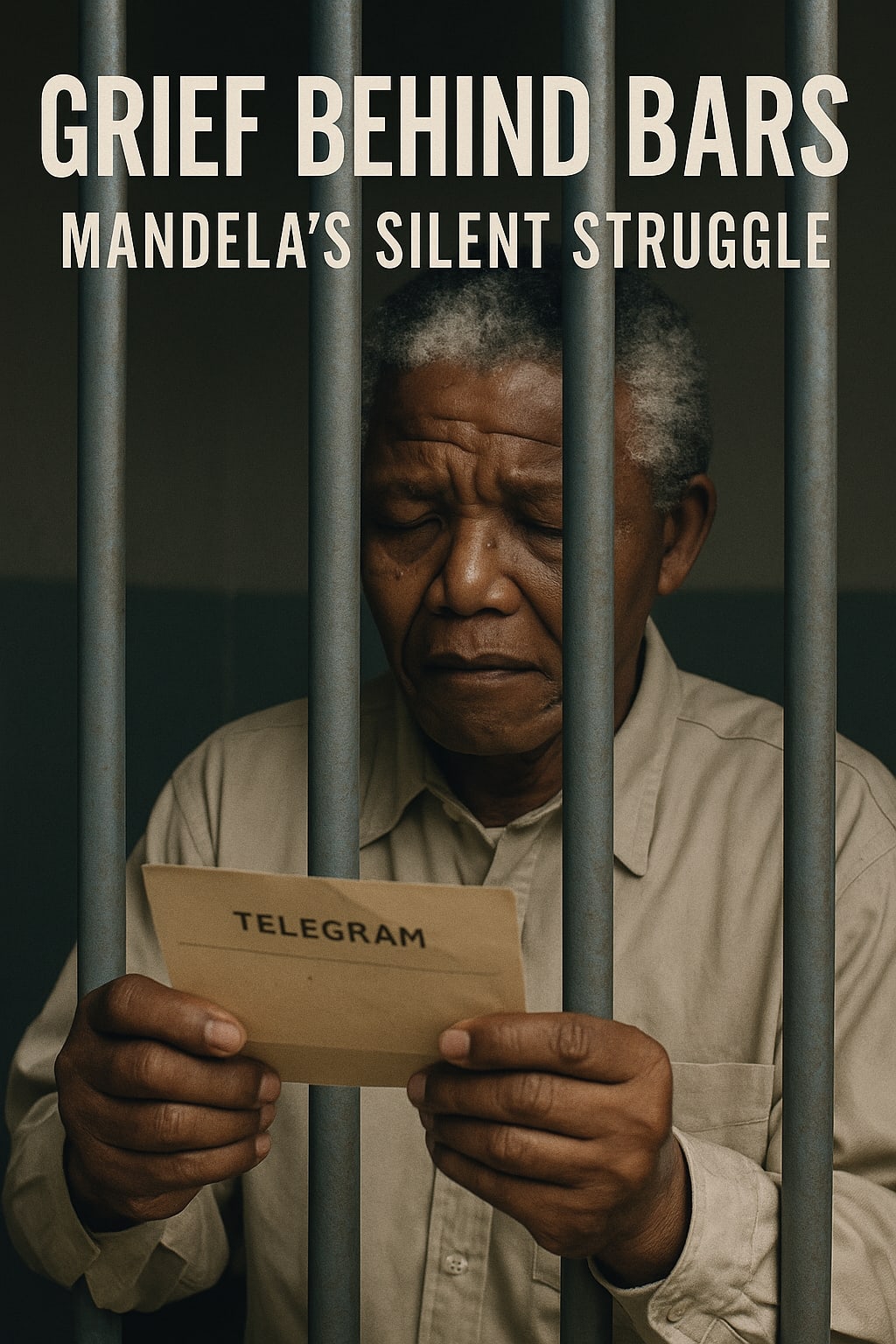
Nelson Mandela, the global symbol of peace and resistance against injustice, faced not only political hardships but also deep personal tragedies during his long imprisonment on Robben Island. While the world admired him for his strength and commitment, few knew the emotional storms he silently endured behind those prison walls.
One day, while serving his life sentence, Mandela received a telegram from the prison authorities. As he opened and read it, his hands trembled and his heart sank. It was a message informing him that his beloved mother had passed away from a heart attack. For any son, this would be a devastating moment—but for Mandela, the pain was even more unbearable. He was the only son, the eldest child, and deeply attached to his mother, who had always supported him during the early struggles of his life.
Shaken and grieving, Mandela made a formal request to the prison commander, asking for permission to attend his mother’s funeral. He explained that as the eldest son and her only child, it was his duty—both culturally and emotionally—to be present at the burial, to say his final goodbye, and to fulfill his responsibility as a son. But the authorities denied his request.
The prison officer, while speaking with Mandela, said something that added to the pain. He told him, “We trust you, Mandela. But we don’t trust your people. We fear they might kidnap you during the funeral.” Mandela was devastated—not only was he losing the opportunity to mourn his mother properly, but he was also being denied the basic right to grieve with his family because of political fear.
Mandela was heartbroken, but he had no choice. He mourned in silence, within the cold walls of his prison cell. There was no funeral, no final hug, no goodbye—only isolation and pain.
A few months passed, and Mandela received yet another telegram. This time, it was from his second son. As he read the message, his heart broke once again. The telegram said that Mandela’s eldest son had died in a tragic road accident. The young man, full of potential and hope, was gone. It was a double blow for Mandela. First his mother, now his son. Both had passed while he was confined to a tiny prison cell, unable to fulfill his basic roles as a son and a father.
Mandela wrote later that after reading the telegram, he silently went back to his prison cell and lay on his bed. He was numb, overcome with grief. He didn’t know how long he lay there—minutes, hours—it all seemed like a blur. The emotional weight was too heavy to carry. As a father, the guilt of not being there for his son was overwhelming. His heart ached not only from sorrow but also from helplessness.
He again made a request to the prison officials, this time to attend the funeral of his son. He explained that as a father, it was his duty to be there, to see his son one last time, and to support his family in their darkest hour. But once again, the authorities denied his plea. They feared it would cause political unrest or pose a security risk. Mandela was only permitted to send a short telegram message in response. No final look, no chance to place a flower, no hug for his grieving family—only a few words on paper.
These moments reveal the deep emotional suffering Mandela experienced during his imprisonment—pain that never made the headlines. Despite all this, he never allowed hatred or bitterness to control him. He endured these personal losses silently, with dignity, and continued his lifelong struggle for justice and equality—not just for his family, but for all people in South Africa.
Nelson Mandela was more than just a political leader; he was a man who sacrificed everything—even the chance to mourn with his loved ones—for the greater good. His struggle wasn’t only in the courtroom or the battlefield of politics; it was also within his heart, behind the iron bars of Robben Island.
About the Creator
Dr Ali
PhD student and part-time dreamer. I write short stories inspired by culture, emotion, and everyday life. Exploring fiction that connects hearts across borders.
Rachel Reviews: Lakefront Wolves by Joseph Deegan
Meet Finn. He's an 18 year old kid who has potential. He's bright with great school scores and he's also an athlete, a footballer of some prowess. He has it all going for him, it would seem, and yet, he's determined to send what could be a well-planned, stable existence firmly off the rails. He drinks, he smokes, he takes drugs, he has violent tendencies and he's in danger of losing not only his mind but all that he holds dear.
By Rachel Deeming13 days ago in BookClub
Peter J. Carroll
The Emergence of Chaos Magic and the Influence of Peter J. Carroll The closing decades of the twentieth century witnessed a notable transformation within Western occult thought. Ceremonial traditions rooted in nineteenth century esoteric orders continued to influence magical practice, yet growing dissatisfaction with rigid doctrine encouraged new approaches. Within experimental occult circles in Britain and Europe, discussion increasingly focused on results, psychology, and personal experience rather than inherited authority. From that environment emerged chaos magic, a current that challenged long established assumptions about ritual, belief, and the nature of magical practice.
By Marcus Hedare6 days ago in BookClub



Comments
There are no comments for this story
Be the first to respond and start the conversation.