
Good Habits, Bad Habits vs Atomic Habits: A Deep Comparison of Two Powerful Books on Behavior Change
Good Habits, Bad Habits vs Atomic Habits

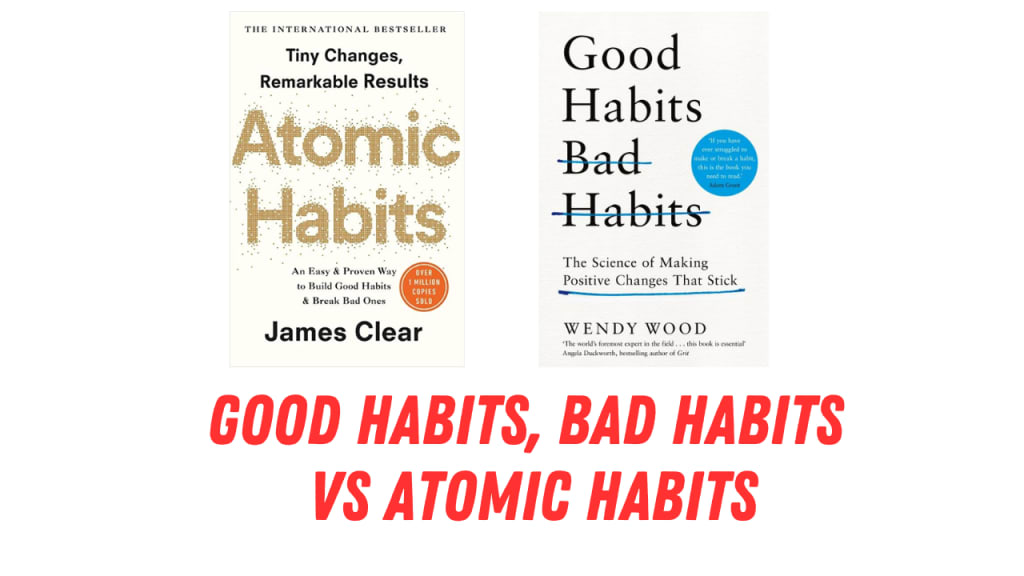
If you’ve ever searched for books to help build better habits or break bad ones, you’ve probably come across two bestselling titles: Atomic Habits by James Clear and Good Habits, Bad Habits by Wendy Wood. Both are widely praised for their insights into habit formation, but they differ in their approach, research depth, writing style, and practical application.
In this article, we’ll compare Atomic Habits vs Good Habits, Bad Habits to help you decide which book is better suited for your goals, or whether reading both is the best way to master your habits once and for all.
Overview of Atomic Habits by James Clear
Published in 2018, Atomic Habits quickly became a global phenomenon. James Clear is not a scientist by training, but he excels at translating behavioral science into simple, actionable advice.
Key Takeaways from Atomic Habits:
- Focus on tiny changes that lead to remarkable results.
- Use the Four Laws of Behavior Change:
- Make it obvious
- Make it attractive
- Make it easy
- Make it satisfying
- Build systems, not goals. Your habits shape your identity.
- Track habits and create positive feedback loops.
Clear’s style is very approachable, filled with stories, examples, and highly practical tips. It's a favorite among readers who want clear steps to follow without getting lost in theory.
Overview of Good Habits, Bad Habits by Wendy Wood
Wendy Wood is a leading researcher in psychology and behavioral science. In Good Habits, Bad Habits (2019), she presents decades of scientific research in an accessible way, revealing what really drives our habits and how much of our behavior is unconscious.
Key Takeaways from Good Habits, Bad Habits:
- 43% of our daily behavior is habitual, not deliberate.
- Habits form through repetition in stable contexts, often without awareness.
- Motivation and willpower are overrated; context and environment are more powerful.
- To change behavior, focus on changing your environment, not just your mindset.
Wood combines research with case studies and real-world examples. The book is deeper in science than Atomic Habits, making it ideal for readers who want to understand why habits form and how the brain actually works.
Atomic Habits vs Good Habits, Bad Habits: Key Differences
1. Scientific Depth vs Practical Simplicity
If you want science-backed explanations, Good Habits, Bad Habits offers a more research-heavy exploration of habit psychology. It discusses neurological pathways, experiments, and cognitive theories.
On the other hand, Atomic Habits simplifies the science into digestible frameworks, perfect for those who prefer step-by-step strategies without diving too deep into technical detail.
2. Author Background
Wendy Wood is an academic psychologist with over 30 years of research experience.
James Clear is a writer and public speaker who synthesizes existing research into practical advice.
Both are experts in their own right, but their backgrounds influence how they present information. Wood leans toward evidence; Clear leans toward implementation.
3. Writing Style
Atomic Habits is more conversational and motivational, often appealing to a general audience, productivity enthusiasts, and entrepreneurs.
Good Habits, Bad Habits is analytical and structured, attracting readers who enjoy scientific reasoning and critical thinking.
4. Focus on Identity
James Clear introduces a powerful idea: “Habits are how you embody your identity.” He emphasizes becoming the type of person who acts out the habits you want.
Wendy Wood doesn’t dive as much into identity. Instead, she focuses on how repetition and environmental cues shape automatic behaviors, often bypassing conscious identity.
5. Role of Environment
Both books emphasize the power of environment, but Wood makes it central to her argument. She argues that context trumps willpower and that lasting change requires designing surroundings that make the right behavior easier.
Clear also talks about environmental design, but it's woven into a broader framework with identity, goals, and habit tracking.
Which Book is Better for Building Good Habits?

It depends on your needs:
- If you're looking for a practical guide with clear steps, Atomic Habits is probably the best choice. It’s perfect for creating new habits, sticking to them, and understanding the psychology behind daily routines in a digestible way.
- If you’re interested in the science of habit formation, including unconscious behavior, cognitive biases, and how habits form without awareness, Good Habits, Bad Habits will give you a deeper understanding.
Many readers actually recommend reading both books together. Start with Atomic Habits to build a strong framework, then move to Good Habits, Bad Habits for a deeper scientific understanding.
Atomic Habits and Good Habits, Bad Habits in Everyday Life

Let’s compare how each book approaches a few common situations:
Habit: Going to the Gym
- Atomic Habits: Make the gym obvious (leave gym shoes by the door), attractive (listen to your favorite playlist while working out), easy (start with just 5 minutes), and satisfying (track your workouts with a habit tracker).
- Good Habits, Bad Habits: Focus on context. Go to the gym at the same time and place every day. Make it part of your commute home or morning routine so that it becomes automatic.
Habit: Reducing Screen Time
- Atomic Habits: Use habit inversion. Make screen time unattractive or hard (turn off notifications, move your phone to another room). Reward yourself for time spent offline.
- Good Habits, Bad Habits: Remove cues (don’t bring your phone to bed), reduce friction for better habits (keep a book next to your bed instead), and accept that motivation alone won’t help—you must change your environment.
Habit: Eating Healthier
- Atomic Habits: Make healthy eating easy (prep meals in advance), obvious (keep fruit on the counter), and satisfying (reward yourself for eating well).
- Good Habits, Bad Habits: Repetition in the same context is key. Always eat healthy at lunch or dinner, and make those environments consistent to strengthen the habit loop.
Final Thoughts: Which Book Should You Read First?
If you’re just starting your journey to self-improvement and want a quick, practical system, begin with Atomic Habits. It gives you an excellent roadmap for making lasting change and offers tools you can use immediately.
If you’ve already read Atomic Habits or want to dive into the science behind behavior change, Good Habits, Bad Habits is a brilliant follow-up that offers deeper insights.
Both books complement each other beautifully. One helps you build habits effectively; the other helps you understand why they work.
Whether you're trying to become more productive, eat better, exercise regularly, or just live more intentionally, reading both books could be a life-changing decision.
About the Creator
pestosol
Hi.
I am Hmimda 30 years old From Algeria. I am a blogger. I like to share articles about decoration and designs
My New Book is Finally Here
My poetry collection Beautiful and Brutal Things is done. It's actually done and finally published over 270 pages. Over a year of my life went into this book. More than a year, really. Long days at my computer, sometimes seven days a week because I couldn't stop even when I probably should have. Then two months of editing that felt harder than the writing itself. But it's finished, and I'm still standing, and the book is real.
By Tim Carmichaela day ago in BookClub
7 Classic Books Everyone Should Read In 2026
In an age of endless content and shrinking attention spans, classic books remain steadfast anchors of wisdom, beauty, and truth. They have endured not because they are old, but because they are timeless. These works speak to the deepest parts of the human experience—love and loss, power and morality, freedom and fate. When we read classics, we are not escaping the present; we are understanding it more clearly.
By Diana Meresc7 days ago in BookClub




Comments
There are no comments for this story
Be the first to respond and start the conversation.